Singapore Industrial Analytics Market Size & Growth Rate (2026-2032)
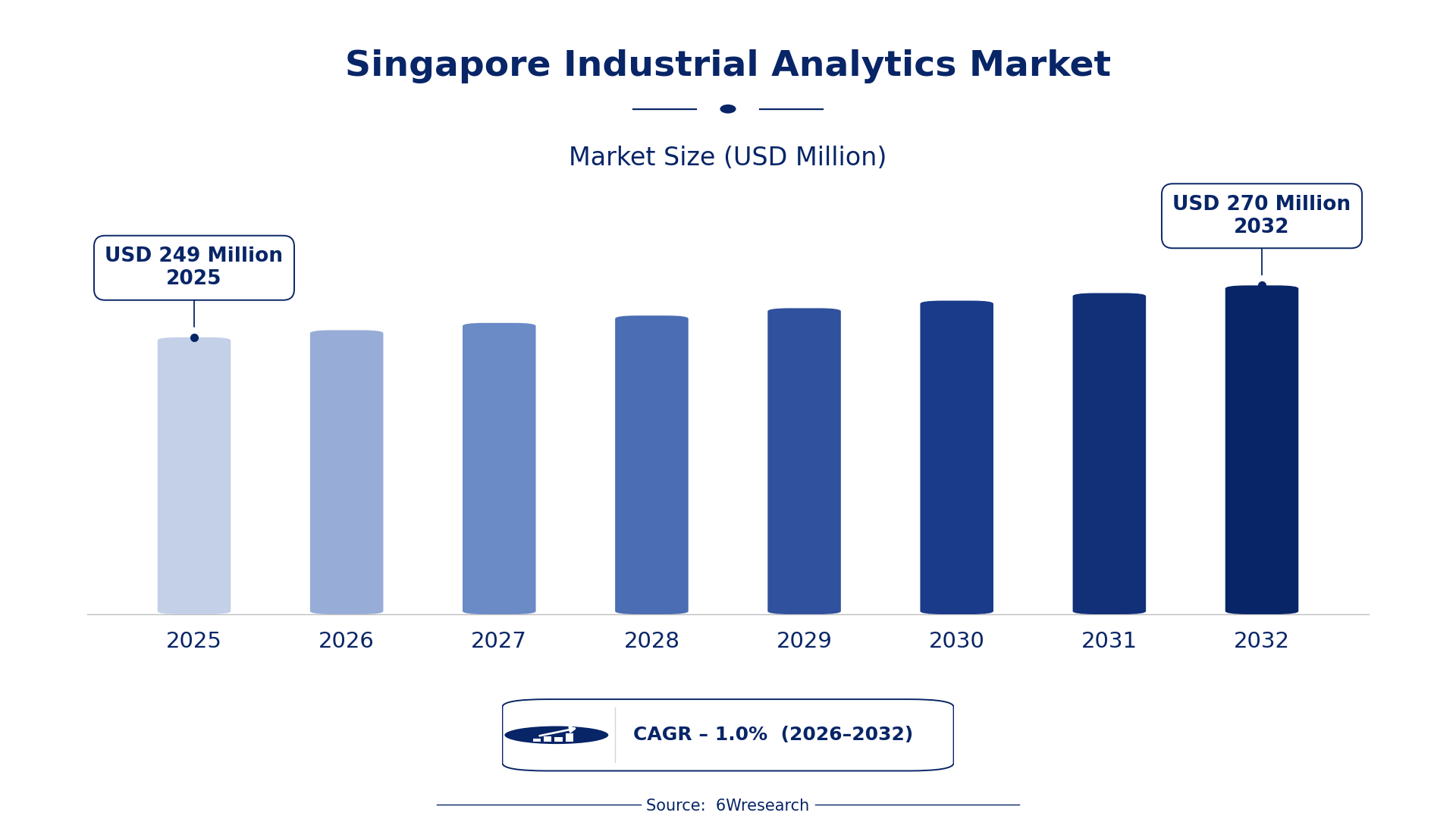
The Singapore Industrial Analytics Market was estimated at USD 249 Million in 2025 and is projected to reach USD 270 Million by 2032, growing at a CAGR of 1.0% from 2026 to 2032.
Singapore Industrial Analytics Market Synopsis
The Singapore Industrial Analytics Market is currently witnessing a surge in demand as organizations increasingly recognize the value of data-driven insights. Companies are implementing advanced analytics to enhance operational efficiency, optimize production processes, and improve maintenance strategies across various sectors.
As industries in Singapore adapt to the digital age, the focus on industrial analytics is intensifying. Businesses are not just looking to collect data; they want actionable insights that can drive real-time decision-making and foster innovation. This shift is essential for maintaining competitiveness in a rapidly evolving market.
Singapore Industrial Analytics Market Year-wise Growth Rate and Key Drivers
This graph illustrates the annual growth rates of the Singapore Industrial Analytics Market from 2021 to 2032, highlighting a steady upward trajectory and projected expansion over the forecast period.
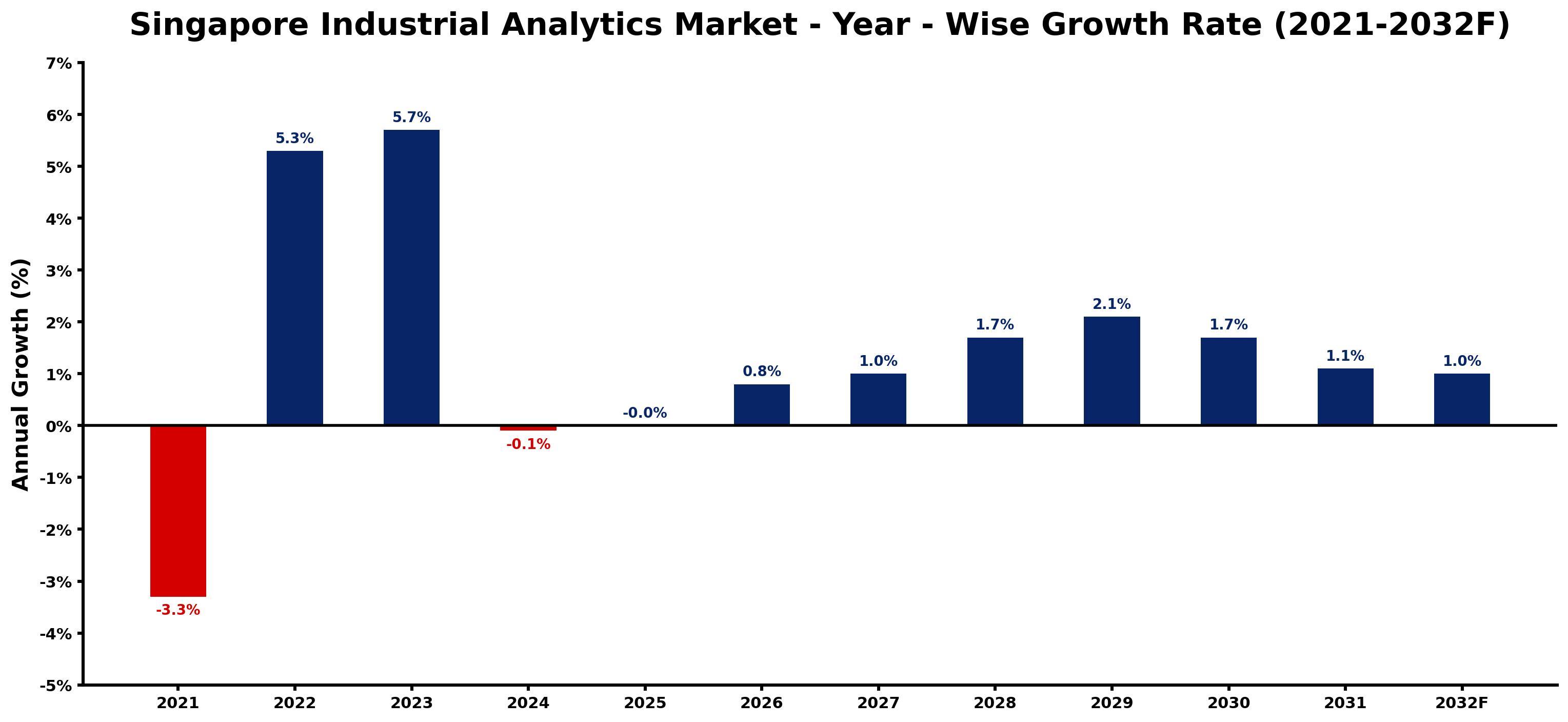
The table below presents the year‑wise growth rates along with the key drivers influencing the market
| Year | Growth Rate | Major Drivers |
| 2021 | -3.3% | COVID-19 restrictions hindered industrial IoT adoption efforts. |
| 2022 | 5.3% | Government's Smart Industry Readiness Index initiative launched. |
| 2023 | 5.7% | Increased adoption of AI for manufacturing efficiency. |
| 2024 | -0.1% | Government focus shifted to cybersecurity over analytics investments. |
| 2025 | -0.0% | Expansion of manufacturing activities |
| 2026 | 0.8% | Growing focus on Industry 4.0 integration strategies. |
| 2027 | 1.0% | Local startups innovating in data analytics solutions. |
| 2028 | 1.7% | Enhanced collaboration between universities and industrial sectors. |
| 2029 | 2.1% | Manufacturers leveraging IoT for operational insights. |
| 2030 | 1.7% | Regulatory incentives for technology-driven industrial upgrades. |
| 2031 | 1.1% | Rising need for sustainable manufacturing practices. |
| 2032 | 1.0% | Support for digital transformation from Enterprise Singapore. |
Note: Market size estimations and growth projections presented in this report are based on 6Wresearch's proprietary forecasting methodology, utilizing the latest available industry data, government publications, and primary research inputs.
Singapore Industrial Analytics Market Key Takeaways
Below are some of the specific key takeaways from the market, including:
- Industrial analytics solutions are critical for enhancing productivity and minimizing operational downtime.
- There is a strong demand for predictive maintenance tools that can foresee equipment failures before they occur.
- Integration of IoT technologies is revolutionizing data collection and analysis capabilities in industrial settings.
- Companies are increasingly investing in employee training to effectively utilize analytics tools.
- Government initiatives are actively promoting the adoption of digital technologies in the industrial sector.
Evaluation of Restraints in Singapore Industrial Analytics Market
While the Singapore Industrial Analytics Market shows promise, several restraints hinder its full potential. A primary concern is the challenge of integrating analytics solutions across diverse industrial environments. Many businesses struggle with data silos, where critical information is trapped within departmental boundaries, limiting comprehensive analysis.
Additionally, there is a pressing need for real-time analytics to drive immediate operational decisions. The complexity of managing various data sources can overwhelm organizations, leading to delays in insight generation and implementation. Ensuring data security and compliance with regulatory standards is another significant hurdle that businesses must navigate.
Singapore Industrial Analytics Market Trends
Several key trends are shaping the Singapore Industrial Analytics Market. The integration of artificial intelligence and machine learning is becoming mainstream, enabling more accurate predictions and deeper insights into operational processes. Additionally, the demand for cloud-based analytics solutions is rising, as they offer scalability and flexibility to businesses.
on top of that, the emphasis on sustainability is influencing analytics strategies. Companies are increasingly looking to analytics to minimize waste and optimize resource utilization, aligning with global sustainability goals. As a result, analytics tools that support these initiatives are gaining traction in the market.
Singapore Industrial Analytics Market Opportunities
The Singapore Industrial Analytics Market presents numerous opportunities for growth and investment. Businesses that can provide specialized analytics solutions tailored to specific industries, such as manufacturing, logistics, and energy, are well-positioned to capitalize on this demand. on top of that, as industries continue to embrace digital transformation, partnerships between technology providers and manufacturers can facilitate the development of innovative analytics solutions.
The ongoing push for smart factories and Industry 4.0 initiatives is another significant opportunity. Companies that can align their analytics offerings with these trends will likely see substantial growth. on top of that, as more organizations recognize the importance of data literacy, educational initiatives focusing on analytics skills will create a more informed workforce, driving further market expansion.
Government Initiatives in the Singapore Industrial Analytics Market
The Singapore government is actively shaping the Industrial Analytics Market through various initiatives. Recently completed, the Smart Industry Readiness Index aims to guide companies in their digital transformation journey, highlighting the importance of industrial analytics in achieving operational excellence.
Currently underway, the Industry Transformation Maps focus on specific sectors, encouraging businesses to adopt advanced analytics and automation. The initiative provides funding and resources for companies to implement these technologies effectively.
- Looking ahead, the government plans to launch additional grants and funding programs in the second half of 2026 to support small and medium-sized enterprises (SMEs) in adopting industrial analytics solutions.
- There are also discussions about establishing a national data strategy to enhance data sharing and integration across various industries, promoting a more collaborative environment.
Future Insights of the Singapore Industrial Analytics Market
From 2026 to 2032, the Singapore Industrial Analytics Market is expected to evolve significantly. Companies will increasingly focus on data democratization, ensuring that insights are accessible across all organizational levels. This shift will enhance decision-making capabilities and drive operational improvements.
on top of that, as technology continues to advance, the adoption of edge computing will become more prevalent. This will enable real-time data processing and analytics closer to the source of data generation, further enhancing responsiveness in industrial operations. As these trends unfold, businesses that adapt and innovate will thrive in the competitive market.
Singapore Industrial Analytics Market Latest Developments
In the past 12 months, the Singapore Industrial Analytics Market has seen notable developments. A leading technology vendor launched a new analytics platform designed specifically for manufacturing processes, with implementation completed by late 2025. This platform leverages AI to provide predictive insights and optimize production lines.
Ongoing initiatives include a major regional operator's collaboration with academic institutions to develop advanced analytics training programs for employees, aimed at enhancing workforce capabilities in industrial settings. This program began in mid-2025 and remains underway.
Looking ahead, an upcoming project is expected to kick off in the second half of 2026, focusing on integrating IoT devices with analytics platforms to streamline data collection and enhance operational efficiency across various industries.
Singapore Industrial Analytics Market - Key Attractiveness of the Report
- 10 Years of Market Numbers
- Historical Data Starting from 2022 to 2025
- Base Year: 2025
- Forecast Data until 2032
- Key Performance Indicators Impacting the Market
- Major Upcoming Developments and Projects
Key Highlights of the Report:
- Singapore Industrial Analytics Market Outlook
- Market Size of Singapore Industrial Analytics Market, 2025
- Forecast of Singapore Industrial Analytics Market, 2032
- Historical Data and Forecast of Singapore Industrial Analytics Revenues & Volume for the Period 2022-2032F
- Singapore Industrial Analytics Market Trend Evolution
- Singapore Industrial Analytics Market Drivers and Challenges
- Singapore Industrial Analytics Price Trends
- Singapore Industrial Analytics Porter's Five Forces
- Singapore Industrial Analytics Industry Life Cycle
- Historical Data and Forecast of Singapore Industrial Analytics Market Revenues & Volume By Component for the Period 2022-2032F
- Historical Data and Forecast of Singapore Industrial Analytics Market Revenues & Volume By Software for the Period 2022-2032F
- Historical Data and Forecast of Singapore Industrial Analytics Market Revenues & Volume By Service for the Period 2022-2032F
- Historical Data and Forecast of Singapore Industrial Analytics Market Revenues & Volume By Software for the Period 2022-2032F
- Historical Data and Forecast of Singapore Industrial Analytics Market Revenues & Volume By Operational analytics for the Period 2022-2032F
- Historical Data and Forecast of Singapore Industrial Analytics Market Revenues & Volume By Risk analytics for the Period 2022-2032F
- Historical Data and Forecast of Singapore Industrial Analytics Market Revenues & Volume By Financial analytics for the Period 2022-2032F
- Historical Data and Forecast of Singapore Industrial Analytics Market Revenues & Volume By Marketing analytics for the Period 2022-2032F
- Historical Data and Forecast of Singapore Industrial Analytics Market Revenues & Volume By Customer analytics for the Period 2022-2032F
- Historical Data and Forecast of Singapore Industrial Analytics Market Revenues & Volume By Workforce analytics for the Period 2022-2032F
- Historical Data and Forecast of Singapore Industrial Analytics Market Revenues & Volume By Service for the Period 2022-2032F
- Historical Data and Forecast of Singapore Industrial Analytics Market Revenues & Volume By Managed services for the Period 2022-2032F
- Historical Data and Forecast of Singapore Industrial Analytics Market Revenues & Volume By Professional services for the Period 2022-2032F
- Historical Data and Forecast of Singapore Industrial Analytics Market Revenues & Volume By Analytics Type for the Period 2022-2032F
- Historical Data and Forecast of Singapore Industrial Analytics Market Revenues & Volume By Descriptive for the Period 2022-2032F
- Historical Data and Forecast of Singapore Industrial Analytics Market Revenues & Volume By Diagnostic for the Period 2022-2032F
- Historical Data and Forecast of Singapore Industrial Analytics Market Revenues & Volume By Predictive for the Period 2022-2032F
- Historical Data and Forecast of Singapore Industrial Analytics Market Revenues & Volume By Prescriptive for the Period 2022-2032F
- Historical Data and Forecast of Singapore Industrial Analytics Market Revenues & Volume By Organization size for the Period 2022-2032F
- Historical Data and Forecast of Singapore Industrial Analytics Market Revenues & Volume By Large enterprises for the Period 2022-2032F
- Historical Data and Forecast of Singapore Industrial Analytics Market Revenues & Volume By Small and medium-sized enterprises for the Period 2022-2032F
- Singapore Industrial Analytics Import Export Trade Statistics
- Market Opportunity Assessment By Component
- Market Opportunity Assessment By Software
- Market Opportunity Assessment By Service
- Market Opportunity Assessment By Analytics Type
- Market Opportunity Assessment By Organization size
- Singapore Industrial Analytics Top Companies Market Share
- Singapore Industrial Analytics Competitive Benchmarking By Technical and Operational Parameters
- Singapore Industrial Analytics Company Profiles
- Singapore Industrial Analytics Key Strategic Recommendations






































