Singapore Industrial Furnace Market Size, Share & Growth Rate
The Singapore Industrial Furnace Market was estimated at USD 191 Million in 2025 and is projected to reach USD 209 Million by 2032, growing at a CAGR of 1.3% from 2026 to 2032. This growth trajectory is primarily fueled by the increasing demand for efficient and precise heating processes across the country's key manufacturing sectors. As Singapore solidifies its position as a regional manufacturing hub, the push for sustainable practices and innovative technologies continues to enhance furnace solutions, driving market expansion.
Singapore Industrial Furnace Market Year-wise Growth Rate and Key Drivers
This graph highlights how the Singapore Industrial Furnace Market has steadily grown over the years, supported by major growth factors.
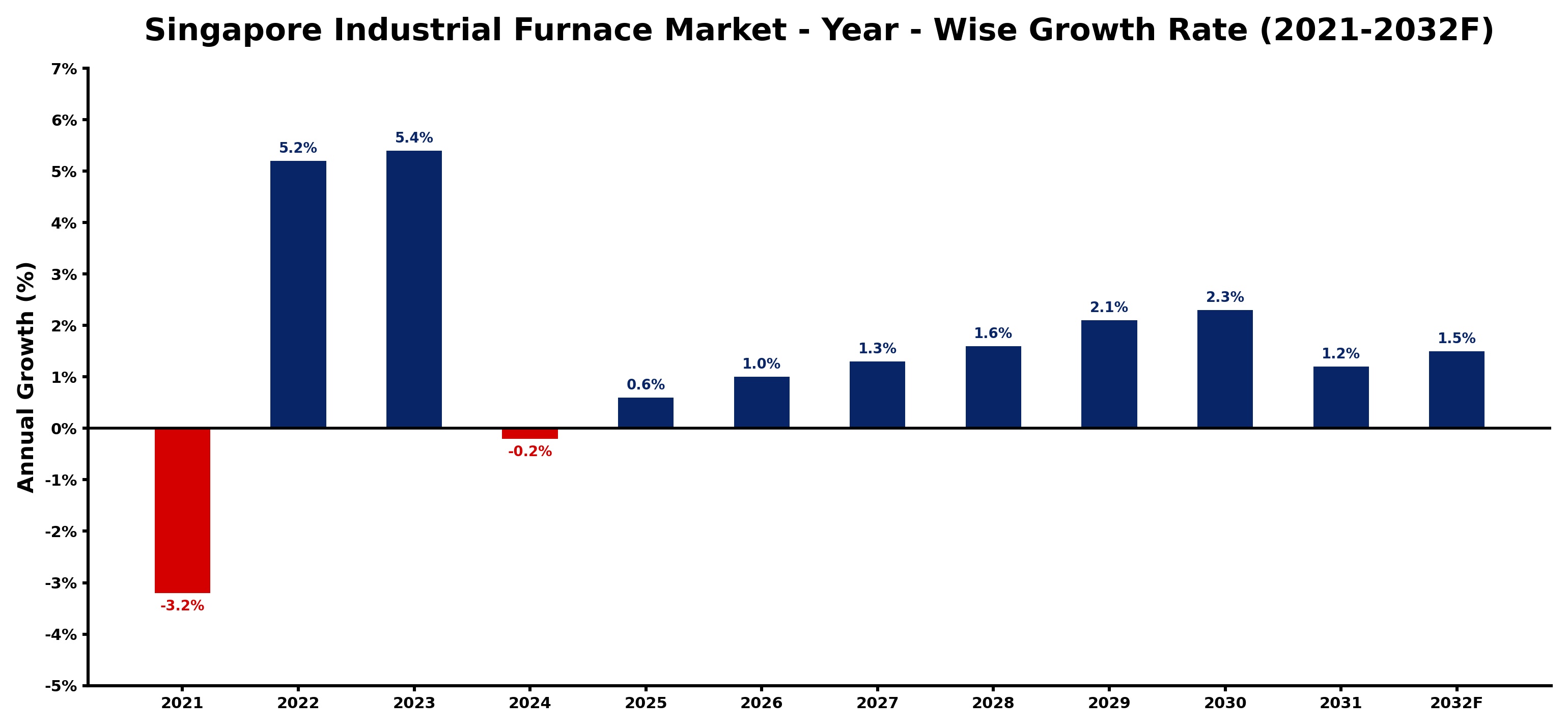
The table below presents the year‑wise growth rates along with the key drivers influencing the market
| Year | Growth Rate | Major Drivers |
| 2021 | -3.2% | Manufacturing investments declined due to rising operational costs and inflation |
| 2022 | 5.2% | Adoption of energy efficient furnaces boosted steel manufacturing capabilities |
| 2023 | 5.4% | New manufacturing facilities enhance demand for industrial furnace upgrades |
| 2024 | -0.2% | Higher energy costs curtailed industrial furnace operation investments |
| 2025 | 0.6% | Accelerated demand for heat treatment processes boosts furnace utilization |
| 2026 | 1.0% | Furnace technology upgrades drive local steel manufacturing capacity expansion |
| 2027 | 1.3% | Foundry upgrades improved precision casting processes for aerospace components |
| 2028 | 1.6% | Higher energy efficiency standards drive furnace modernization projects across industries |
| 2029 | 2.1% | Export driven semiconductor manufacturing boosts demand for advanced furnace systems |
| 2030 | 2.3% | Technology integration boosts energy efficiency in furnace operations |
| 2031 | 1.2% | Infrastructure projects boost demand for industrial furnace technologies |
| 2032 | 1.5% | Increased semiconductor fabrication investments drive furnace production demand |
Note - Market size estimations and growth projections presented in this report are based on 6Wresearch's advanced forecasting approach, validated with industry datasets as of June 2026.
Singapore Industrial Furnace Market Synopsis
The Singapore industrial furnace market has witnessed recent momentum, driven by robust manufacturing activity, particularly in aerospace and automotive sectors. However, the market is poised for further evolution, with sustainability and energy efficiency emerging as pivotal factors shaping future demand. This shift reflects Singapore's commitment to green technologies and stringent environmental standards, prompting investments in advanced furnace systems.
Despite the upward trend, the landscape is marked by challenges such as compliance with regulatory requirements and competition from global players. Companies are actively seeking innovative solutions that not only meet production needs but also align with sustainability goals. As these dynamics play out, the Singapore industrial furnace market is set to transition towards a more energy-efficient and technologically advanced future.
Singapore Industrial Furnace Market Key Takeaways
- The market is benefiting from increased investment in energy-efficient furnace technologies.
- Sustainability initiatives are driving the adoption of cleaner industrial furnace solutions.
- Manufacturing sectors, especially aerospace and automotive, are key growth drivers.
- Technological advancements in electric and induction furnaces are enhancing operational efficiencies.
- Compliance with environmental regulations poses both a challenge and a catalyst for innovation.
Evaluation of Restraints in Singapore Industrial Furnace Market
Several factors limit the growth potential of the Singapore industrial furnace market. The stringent environmental regulations necessitate costly upgrades and compliance strategies, which can strain budgets for many manufacturers. Moreover, economic fluctuations can significantly impact demand across industries reliant on industrial furnaces, such as metallurgy and manufacturing. Compounding these challenges is the competition from international manufacturers, which forces local companies to navigate pricing pressures while maintaining quality and innovation. The industry's shift towards automation and the adoption of Industry 4.0 technologies demands substantial investment in research and development, adding another layer of complexity to the market landscape.
Singapore Industrial Furnace Market Trends
Current trends in the Singapore industrial furnace market highlight a strong shift towards automation and smart technologies. Manufacturers are increasingly integrating Industry 4.0 capabilities, which enhance furnace monitoring and optimization through data analytics. Additionally, the rising adoption of electric and induction furnaces is transforming traditional heating processes, offering improved energy efficiency and reduced carbon footprints. Furthermore, there is a growing emphasis on modular and flexible furnace designs that can adapt to varying production needs, reflecting the market's responsiveness to changing industrial demands.
Singapore Industrial Furnace Market Opportunities
The market presents substantial growth and investment opportunities, particularly in the realm of green technology. Companies focusing on developing eco-friendly furnace solutions stand to benefit from government incentives and an increasingly aware consumer base. Additionally, the push for higher efficiency standards opens avenues for innovation in product offerings. Collaborations with research institutions to advance material science and furnace technologies may also yield significant returns. With continued expansion in sectors such as electronics, there is ample room for specialized furnace solutions tailored to specific manufacturing requirements.
Government Initiatives in the Singapore Industrial Furnace Market
The Singapore government is actively fostering a conducive environment for the industrial furnace market through various policies aimed at promoting sustainability and innovation. Initiatives include funding for research and development projects, public spending on clean energy technologies, and incentives for industries adopting energy-efficient practices. Additionally, the government emphasizes adherence to strict environmental regulations, encouraging manufacturers to invest in greener furnace technologies. These efforts align with Singapore's broader goals of reducing carbon emissions and enhancing its reputation as a global manufacturing leader.
Future Insights of the Singapore Industrial Furnace Market
Looking ahead to 2026-2032, the Singapore industrial furnace market is expected to embrace significant transformations driven by technological advancements and a heightened focus on sustainability. As industries prioritize energy efficiency, the demand for innovative furnace solutions will continue to rise. Furthermore, the integration of smart technologies will likely reshape operational paradigms, enabling manufacturers to achieve greater precision and control in their heating processes. With the continued support of government initiatives and a thriving manufacturing landscape, the market is well-positioned for steady growth in the coming years.
Singapore Industrial Furnace Market Latest Developments (May 2025 - June 2026)
Recent industry developments indicate a growing emphasis on technological innovation within the Singapore industrial furnace market. Companies have increasingly focused on enhancing energy efficiency through the adoption of advanced materials and smart technologies. Additionally, there has been a noticeable uptick in collaborations between industry players and research institutions aimed at developing cutting-edge solutions tailored to meet evolving production demands. This trend highlights a proactive approach to addressing sustainability challenges while also positioning firms to leverage competitive advantages in the market.
Singapore Industrial Furnace Market - Key Attractiveness of the Report
- 10 Years of Market Numbers
- Historical Data Starting from 2022 to 2025
- Base Year: 2025
- Forecast Data until 2032
- Key Performance Indicators Impacting the Market
- Major Upcoming Developments and Projects
Key Highlights of the Report:
- Singapore Industrial Furnace Market Outlook
- Market Size of Singapore Industrial Furnace Market, 2025
- Forecast of Singapore Industrial Furnace Market, 2032
- Historical Data and Forecast of Singapore Industrial Furnace Revenues & Volume for the Period 2022-2032F
- Singapore Industrial Furnace Market Trend Evolution
- Singapore Industrial Furnace Market Drivers and Challenges
- Singapore Industrial Furnace Price Trends
- Singapore Industrial Furnace Porter's Five Forces
- Singapore Industrial Furnace Industry Life Cycle
- Historical Data and Forecast of Singapore Industrial Furnace Market Revenues & Volume By Furnace Type for the Period 2022-2032F
- Historical Data and Forecast of Singapore Industrial Furnace Market Revenues & Volume By Gas/fuel Operated Industrial Furnace for the Period 2022-2032F
- Historical Data and Forecast of Singapore Industrial Furnace Market Revenues & Volume By Electrically Operated Industrial Furnace for the Period 2022-2032F
- Historical Data and Forecast of Singapore Industrial Furnace Market Revenues & Volume By Arrangement for the Period 2022-2032F
- Historical Data and Forecast of Singapore Industrial Furnace Market Revenues & Volume By Tube or Clamshell Type for the Period 2022-2032F
- Historical Data and Forecast of Singapore Industrial Furnace Market Revenues & Volume By Box Type for the Period 2022-2032F
- Historical Data and Forecast of Singapore Industrial Furnace Market Revenues & Volume By Bottom Loading & Car Bottom Furnace for the Period 2022-2032F
- Historical Data and Forecast of Singapore Industrial Furnace Market Revenues & Volume By Top Loading Furnace for the Period 2022-2032F
- Historical Data and Forecast of Singapore Industrial Furnace Market Revenues & Volume By Others for the Period 2022-2032F
- Historical Data and Forecast of Singapore Industrial Furnace Market Revenues & Volume By End-User for the Period 2022-2032F
- Historical Data and Forecast of Singapore Industrial Furnace Market Revenues & Volume By Metals & Mining for the Period 2022-2032F
- Historical Data and Forecast of Singapore Industrial Furnace Market Revenues & Volume By Transportation for the Period 2022-2032F
- Historical Data and Forecast of Singapore Industrial Furnace Market Revenues & Volume By Oil & Gas for the Period 2022-2032F
- Historical Data and Forecast of Singapore Industrial Furnace Market Revenues & Volume By Chemicals for the Period 2022-2032F
- Historical Data and Forecast of Singapore Industrial Furnace Market Revenues & Volume By Others for the Period 2022-2032F
- Singapore Industrial Furnace Import Export Trade Statistics
- Market Opportunity Assessment By Furnace Type
- Market Opportunity Assessment By Arrangement
- Market Opportunity Assessment By End-User
- Singapore Industrial Furnace Top Companies Market Share
- Singapore Industrial Furnace Competitive Benchmarking By Technical and Operational Parameters
- Singapore Industrial Furnace Company Profiles
- Singapore Industrial Furnace Key Strategic Recommendations






































