Singapore Industrial Mixers and Blenders Market Summary
The singapore industrial mixers and blenders market was estimated at USD 84 Million in 2025 and is projected to reach USD 91 Million by 2032, growing at a CAGR of 1.1% from 2026 to 2032.
Singapore Industrial Mixers and Blenders Market Year-wise Growth Rate and Key Drivers
This graph highlights how the Singapore Industrial Mixers and Blenders Market has steadily grown over the past five years, supported by major growth factors.
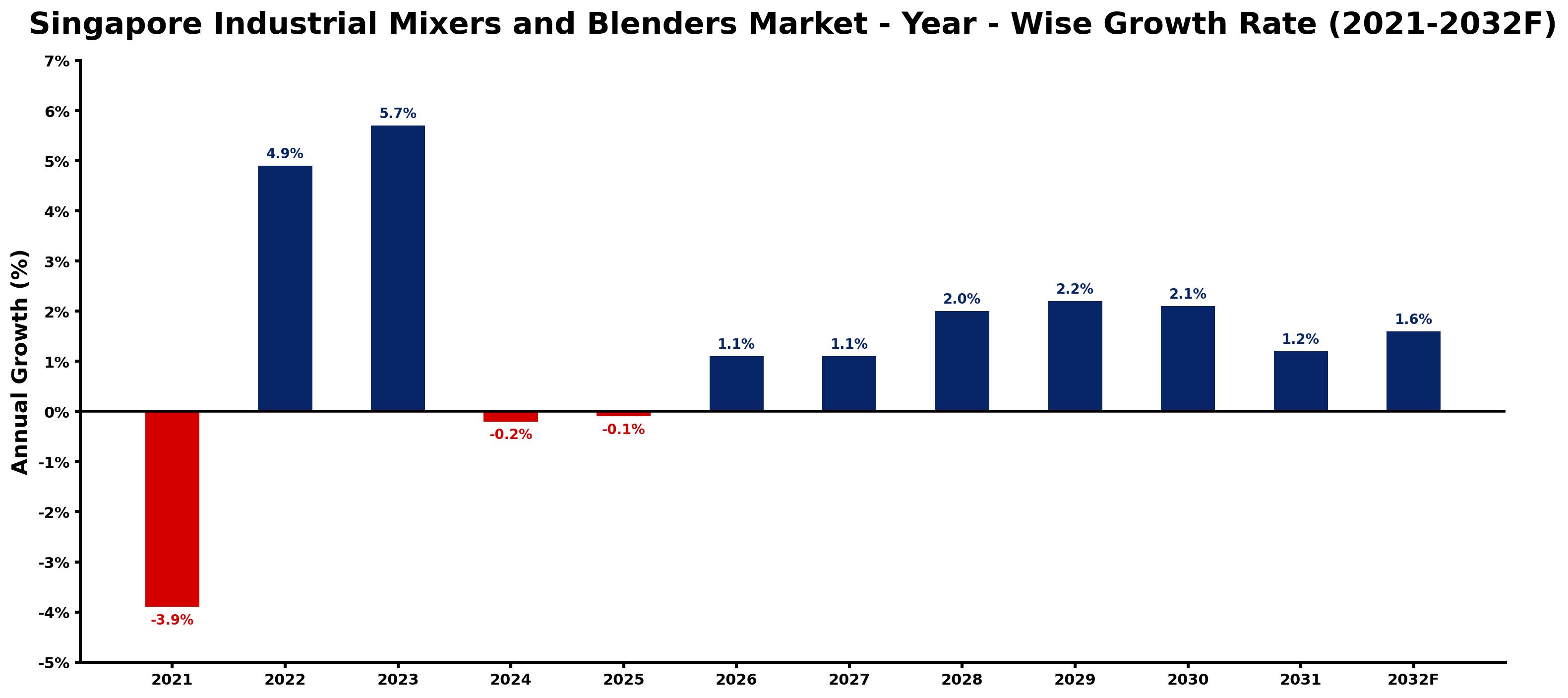
The table below presents the year wise growth rates along with the key drivers influencing the market
| Year | Growth Rate | Major Drivers |
| 2021 | -3.9% | Lingering supply chain disruptions hindered manufacturing capabilities, leading to decreased output and customer delays. |
| 2022 | 4.9% | Local companies began investing in advanced blending technology for competitive differentiation. |
| 2023 | 5.7% | The food and beverage sector expanded, increasing reliance on specialized mixing equipment. |
| 2024 | -0.2% | Heightened competition from international manufacturers led to price wars, significantly eroding profit margins in the sector. |
| 2025 | -0.1% | Increased automation in manufacturing processes diminished the necessity for traditional mixers and blenders. |
| 2026 | 1.1% | Increased labor costs led to automation, boosting demand for sophisticated blending systems. |
| 2027 | 1.1% | Investments in R&D flourished, pushing boundaries of mixer design and application versatility. |
| 2028 | 2.0% | Global supply chain adjustments necessitated flexible mixing solutions for diverse product lines. |
| 2029 | 2.2% | A focus on product quality raised standards for industrial mixers and blenders significantly. |
| 2030 | 2.1% | Emerging industries, like plant-based foods, expanded usage of specialized blending technologies. |
| 2031 | 1.2% | Digital transformation initiatives highlighted the importance of smart mixers for efficiency. |
| 2032 | 1.6% | Market consolidation among suppliers introduced innovative products and improved customer services. |
Note - Market size estimations and growth projections presented in this report are based on 6Wresearch's advanced forecasting approach, validated with industry datasets as of June 2026.
Singapore Industrial Mixers and Blenders Market Synopsis
The Singapore Industrial Mixers and Blenders Market is projected to reach 1.1% and witness significant growth during the forecast period (2026-2032). This growth trajectory is primarily fueled by the rising demand for processed food products, particularly within the hospitality sector, and the ongoing trend of automation across various industries. As businesses look to enhance operational efficiency, the adoption of advanced mixing and blending technologies is expected to surge, driven by government initiatives advocating for technological advancement.
Singapore Industrial Mixers and Blenders Market Growth Drivers
Several key factors are contributing to the expansion of the Singapore Industrial Mixers and Blenders Market. These include:
- Increasing Demand for Processed Foods: The hospitality sector's growing appetite for convenience foods—such as sauces and pastes—has spurred an uptick in the demand for industrial mixers and blenders. As consumer preferences shift toward ready-to-eat meal options, food manufacturers are compelled to integrate advanced mixing solutions into their processes.
- Rising Popularity of Private Labeling: The trend of private labeling among retailers has led to a greater emphasis on product variety and quality. This development translates into increased usage of industrial mixers and blenders to create customized products that cater to consumers' specific needs.
- Enhanced Automation Across Various Sectors: Enterprises increasingly favor automated mixing solutions for improved accuracy and efficiency. Automated systems not only streamline operations but also significantly reduce labor costs while enhancing product consistency, which is vital in maintaining customer satisfaction.
- Technological Advancements: The integration of smart technologies in industrial mixers and blenders enables manufacturers to monitor and control processes more effectively. Innovations such as IoT connectivity are facilitating real-time data analysis, allowing for optimized production and quality assurance.
- Government Support for Advanced Technology Adoption: The Singaporean government is actively promoting the adoption of advanced manufacturing technologies through various initiatives and funding programs, which is anticipated to enhance the market appeal of industrial mixers and blenders.
Singapore Industrial Mixers and Blenders Market Challenges and Restraints
While the market exhibits strong growth potential, several challenges could impede its progress:
- High Equipment Costs: The sophisticated features of industrial mixers and blenders often come with elevated price tags, making them a substantial investment for businesses. This pricing dilemma can deter smaller companies from upgrading their mixing and blending capabilities.
- Competition from Low-Cost Alternatives: Smaller competitors may offer less advanced mixing solutions at a lower price, which may appeal to budget-conscious businesses. This could result in price wars that challenge established players striving to maintain their market position.
- Dependence on Raw Material Availability: The performance and efficiency of industrial mixers and blenders are contingent on the availability and quality of raw materials. Supply chain disruptions could impact production timelines and overall market stability.
- Adapting to Rapid Technological Changes: As the industry evolves, companies will need to continuously adapt to new technologies and trends. This could necessitate additional investments and training, which may not be feasible for all businesses.
- COVID-19 Aftermath Challenges: The lingering effects of the pandemic are still being felt in various sectors, which could hamper recovery and growth. Companies may remain cautious in their spending and investment strategies until market conditions stabilize.
Singapore Industrial Mixers and Blenders Market Government Investment and Initiatives
The Singapore government plays a pivotal role in shaping the industrial mixers and blenders market through various initiatives aimed at fostering growth and innovation. Investment in research and development is prioritized to support the advancement of sophisticated mixing technologies. Additionally, programs designed to enhance workforce skills in automation and technology are underway, ensuring that the labor pool is equipped to meet the needs of a modernized industrial landscape. Public spending on infrastructure improvements is expected to facilitate smoother logistics and distribution, further bolstering market growth. Policies that encourage partnerships between academia and industry are also being implemented, fostering innovation through collaborative research efforts and knowledge sharing. Such government actions are critical in positioning Singapore as a leader in advanced manufacturing technologies.
Singapore Industrial Mixers and Blenders Market Latest Developments (May 2025 - June 2026)
Recent developments in the Singapore Industrial Mixers and Blenders Market highlight the sector's resilience and adaptability. Companies have focused on optimizing production processes and enhancing technological integration. The introduction of automated systems is gaining momentum, with many manufacturers investing in IoT-enabled machinery to improve operational efficiency. Furthermore, a noticeable shift towards sustainability has emerged, with players exploring eco-friendly materials and processes in response to growing environmental concerns. Additionally, industry players are increasingly collaborating to enhance technological advancements, particularly in smart manufacturing solutions, ensuring they stay competitive in a rapidly evolving market landscape.
Singapore Industrial Mixers and Blenders Market - Key Attractiveness of the Report
- 10 Years of Market Numbers
- Historical Data Starting from 2022 to 2025
- Base Year: 2025
- Forecast Data until 2032
- Key Performance Indicators Impacting the Market
- Major Upcoming Developments and Projects
Key Highlights of the Report:
- Singapore Industrial Mixers and Blenders Market Outlook
- Market Size of Singapore Industrial Mixers and Blenders Market, 2025
- Forecast of Singapore Industrial Mixers and Blenders Market, 2032F
- Historical Data and Forecast of Singapore Industrial Mixers and Blenders Revenues & Volume for the Period 2022-2032F
- Singapore Industrial Mixers and Blenders Market Trend Evolution
- Singapore Industrial Mixers and Blenders Market Drivers and Challenges
- Singapore Industrial Mixers and Blenders Price Trends
- Singapore Industrial Mixers and Blenders Porter's Five Forces
- Singapore Industrial Mixers and Blenders Industry Life Cycle
- Historical Data and Forecast of Singapore Industrial Mixers and Blenders Market Revenues & Volume By Product Type for the Period 2022-2032F
- Historical Data and Forecast of Singapore Industrial Mixers and Blenders Market Revenues & Volume By Ribbon Blenders for the Period 2022-2032F
- Historical Data and Forecast of Singapore Industrial Mixers and Blenders Market Revenues & Volume By High Shear Mixers for the Period 2022-2032F
- Historical Data and Forecast of Singapore Industrial Mixers and Blenders Market Revenues & Volume By Shaft Mixers for the Period 2022-2032F
- Historical Data and Forecast of Singapore Industrial Mixers and Blenders Market Revenues & Volume By Planetary Mixers for the Period 2022-2032F
- Historical Data and Forecast of Singapore Industrial Mixers and Blenders Market Revenues & Volume By Conical Screw Mixers for the Period 2022-2032F
- Historical Data and Forecast of Singapore Industrial Mixers and Blenders Market Revenues & Volume By Double Cone Blenders for the Period 2022-2032F
- Historical Data and Forecast of Singapore Industrial Mixers and Blenders Market Revenues & Volume By End-users for the Period 2022-2032F
- Historical Data and Forecast of Singapore Industrial Mixers and Blenders Market Revenues & Volume By Chemical for the Period 2022-2032F
- Historical Data and Forecast of Singapore Industrial Mixers and Blenders Market Revenues & Volume By F&B for the Period 2022-2032F
- Historical Data and Forecast of Singapore Industrial Mixers and Blenders Market Revenues & Volume By W&WW for the Period 2022-2032F
- Historical Data and Forecast of Singapore Industrial Mixers and Blenders Market Revenues & Volume By Others? for the Period 2022-2032F
- Singapore Industrial Mixers and Blenders Import Export Trade Statistics
- Market Opportunity Assessment By Product Type
- Market Opportunity Assessment By End-users
- Singapore Industrial Mixers and Blenders Top Companies Market Share
- Singapore Industrial Mixers and Blenders Competitive Benchmarking By Technical and Operational Parameters
- Singapore Industrial Mixers and Blenders Company Profiles
- Singapore Industrial Mixers and Blenders Key Strategic Recommendations






































