Singapore Inorganic Acids Market Size, Share & Growth Rate
The Singapore Inorganic Acids Market was estimated at USD 389 Million in 2025 and is projected to reach USD 519 Million by 2032, growing at a CAGR of 4.2% from 2026 to 2032. This anticipated growth trajectory is largely propelled by the extensive demand for inorganic acids across diverse sectors such as chemicals, pharmaceuticals, and electronics. The ongoing advancements in acid production technologies further augment market prospects, enabling manufacturers to enhance the quality and purity of their products, thereby meeting the stringent standards set by various industries.
Singapore Inorganic Acids Market Year-wise Growth Rate and Key Drivers
This graph highlights how the Singapore Inorganic Acids Market has steadily grown over the years, supported by major growth factors.
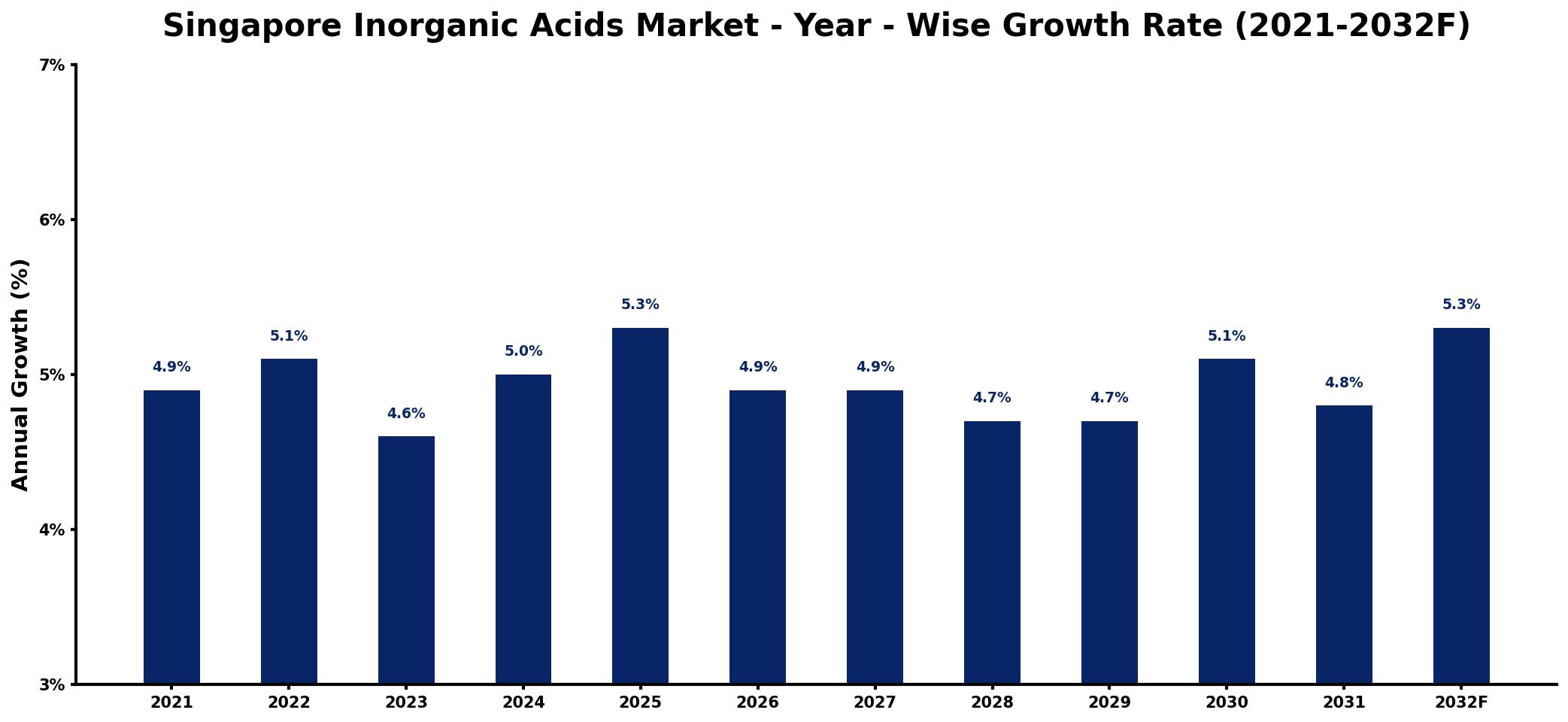
The table below presents the year‑wise growth rates along with the key drivers influencing the market
| Year | Growth Rate | Major Drivers |
| 2021 | 4.9% | Rising demand from construction sector |
| 2022 | 5.1% | Increased investments in manufacturing |
| 2023 | 4.6% | Growth in water treatment industry |
| 2024 | 5.0% | Expansion of chemical production facilities |
| 2025 | 5.3% | Surge in agricultural applications |
| 2026 | 4.9% | Rising need for industrial cleaning |
| 2027 | 4.9% | Increased focus on environmental regulations |
| 2028 | 4.7% | increased overall sector activity |
| 2029 | 4.7% | rising export shipment volumes |
| 2030 | 5.1% | rising procurement volume requirements |
| 2031 | 4.8% | Increased production in food processing |
| 2032 | 5.3% | growing automotive sector requirements |
Note: Market size estimations and growth projections presented in this report are based on 6Wresearch's proprietary forecasting methodology, utilizing the latest available industry data, government publications, and primary research inputs.
Singapore Inorganic Acids Market Synopsis
The dominant force currently shaping the Singapore Inorganic Acids Market is the increasing utilization of these acids in chemical processes as intermediates. Industries ranging from electronics to pharmaceuticals are increasingly reliant on high-purity inorganic acids, which are integral for applications such as pH control and drug formulation.
Additionally, technological advancements in production methods are fostering greater efficiency and sustainability in the manufacturing of inorganic acids. This progress not only enhances the availability of high-quality acids but also aligns with the industrys focus on reducing environmental impact, further driving market growth.
Singapore Inorganic Acids Market Key Takeaways
- The market is experiencing steady growth driven by robust demand across several key industries.
- Increased production of high-purity inorganic acids is pivotal to meeting stringent quality standards.
- The COVID-19 pandemic highlighted the essential role of inorganic acids in the pharmaceutical and hygiene sectors.
- Advancements in production technology are improving efficiency and sustainability.
- Price volatility of raw materials presents ongoing challenges for market players.
Evaluation of Restraints in Singapore Inorganic Acids Market
The Singapore Inorganic Acids Market is confronted with several restraints that can impede growth. Fluctuations in raw material prices pose a significant risk, often leading to unpredictable cost structures for manufacturers. In a fiercely competitive environment, companies are challenged to maintain profitability while managing these price dynamics. Moreover, stringent environmental regulations necessitate considerable investment in compliance measures, which can strain smaller entities within the market and limit their operational capacities.
Singapore Inorganic Acids Market Trends
A notable trend within the Singapore Inorganic Acids Market is the increasing focus on sustainable production practices. Companies are investing in greener technologies to reduce environmental footprints, aligning with global sustainability goals. Additionally, the demand for specialty inorganic acids tailored for specific applications, particularly in the electronics and pharmaceutical industries, is on the rise. This trend is expected to drive innovation and diversification of product offerings, enhancing competitiveness in the market.
Singapore Inorganic Acids Market Opportunities
The Singapore Inorganic Acids Market presents numerous growth opportunities for stakeholders. With the pharmaceutical sector expected to expand, there is a rising demand for inorganic acids used in drug synthesis and formulation. Furthermore, as industries continue to prioritize efficiency and quality, investments in advanced production technologies will create avenues for enhanced market presence. The emphasis on high-purity acids also opens doors for innovation, particularly in niche applications that require precise specifications.
Government Initiatives in the Singapore Inorganic Acids Market
The Singaporean government has implemented various initiatives aimed at bolstering the chemical industry, which includes inorganic acids production. Policies encouraging research and development in green chemistry and sustainable manufacturing are fostering innovation within the sector. Moreover, public investments in infrastructure and incentives for adopting environmentally friendly practices are creating a conducive environment for growth and competitiveness in the market.
Future Insights of the Singapore Inorganic Acids Market
Looking forward to the 2026-2032 period, the Singapore Inorganic Acids Market is set to undergo significant transformation. The anticipated growth in key end-use sectors, combined with increasing awareness regarding sustainability, will likely shape production and consumption patterns. Furthermore, continuous advancements in acid production processes will enhance product offerings, catering to the evolving needs of industries. As the market adapts to emerging trends, stakeholders are expected to capitalize on opportunities that align with both regulatory standards and consumer demands.
Singapore Inorganic Acids Market Latest Developments (2025 - 2026)
Recent developments in the Singapore Inorganic Acids Market reflect a proactive approach towards innovation and sustainability. Key manufacturers are implementing new technologies aimed at improving production efficiency while reducing environmental impact. This shift not only meets current industry demands but also positions companies favorably for future growth. Collaborations between industry players and research institutions are also gaining momentum, fostering advancements in product formulations and applications.
Singapore Inorganic Acids Market - Key Attractiveness of the Report
- 10 Years of Market Numbers
- Historical Data Starting from 2022 to 2025
- Base Year: 2025
- Forecast Data until 2032
- Key Performance Indicators Impacting the Market
- Major Upcoming Developments and Projects
Key Highlights of the Report:
- Singapore Inorganic Acids Market Outlook
- Market Size of Singapore Inorganic Acids Market, 2025
- Forecast of Singapore Inorganic Acids Market, 2032
- Historical Data and Forecast of Singapore Inorganic Acids Revenues & Volume for the Period 2022-2032F
- Singapore Inorganic Acids Market Trend Evolution
- Singapore Inorganic Acids Market Drivers and Challenges
- Singapore Inorganic Acids Price Trends
- Singapore Inorganic Acids Porter's Five Forces
- Singapore Inorganic Acids Industry Life Cycle
- Historical Data and Forecast of Singapore Inorganic Acids Market Revenues & Volume By Type for the Period 2022-2032F
- Historical Data and Forecast of Singapore Inorganic Acids Market Revenues & Volume By Hydrochloric Acid for the Period 2022-2032F
- Historical Data and Forecast of Singapore Inorganic Acids Market Revenues & Volume By Sulfuric Acid for the Period 2022-2032F
- Historical Data and Forecast of Singapore Inorganic Acids Market Revenues & Volume By Nitric Acid for the Period 2022-2032F
- Historical Data and Forecast of Singapore Inorganic Acids Market Revenues & Volume By Phosphoric Acid for the Period 2022-2032F
- Historical Data and Forecast of Singapore Inorganic Acids Market Revenues & Volume By Boric Acid for the Period 2022-2032F
- Historical Data and Forecast of Singapore Inorganic Acids Market Revenues & Volume By Hydrofluoric Acid for the Period 2022-2032F
- Historical Data and Forecast of Singapore Inorganic Acids Market Revenues & Volume By Others for the Period 2022-2032F
- Historical Data and Forecast of Singapore Inorganic Acids Market Revenues & Volume By Application for the Period 2022-2032F
- Historical Data and Forecast of Singapore Inorganic Acids Market Revenues & Volume By Agrochemicals & Fertilizers for the Period 2022-2032F
- Historical Data and Forecast of Singapore Inorganic Acids Market Revenues & Volume By Pigments & Dyes for the Period 2022-2032F
- Historical Data and Forecast of Singapore Inorganic Acids Market Revenues & Volume By Pharmaceutical for the Period 2022-2032F
- Historical Data and Forecast of Singapore Inorganic Acids Market Revenues & Volume By Explosives for the Period 2022-2032F
- Historical Data and Forecast of Singapore Inorganic Acids Market Revenues & Volume By Others for the Period 2022-2032F
- Singapore Inorganic Acids Import Export Trade Statistics
- Market Opportunity Assessment By Type
- Market Opportunity Assessment By Application
- Singapore Inorganic Acids Top Companies Market Share
- Singapore Inorganic Acids Competitive Benchmarking By Technical and Operational Parameters
- Singapore Inorganic Acids Company Profiles
- Singapore Inorganic Acids Key Strategic Recommendations






































