Singapore IoT Security Market Size & Growth Rate (2026-2032)
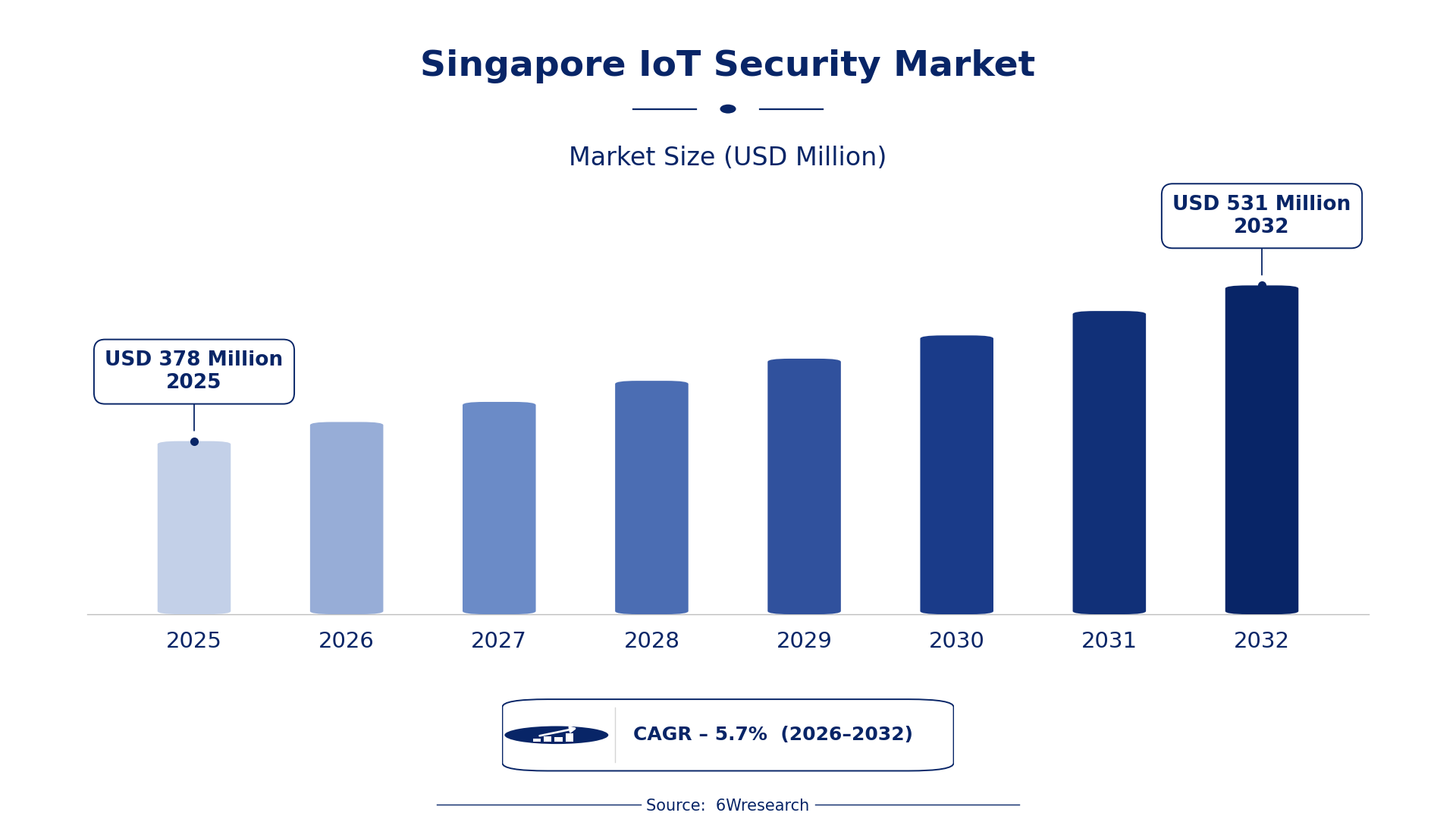
The Singapore IoT Security Market was estimated at USD 378 Million in 2025 and is projected to reach USD 531 Million by 2032, growing at a CAGR of 5.7% from 2026 to 2032.
Singapore IoT Security Market Synopsis
The escalating adoption of IoT devices across various sectors is the primary force driving the Singapore IoT Security Market. As organizations integrate more interconnected systems into their operations, the urgency to safeguard these digital assets from cyber threats has reached unprecedented levels.
Singapore's strong governmental commitment to cybersecurity, paired with its burgeoning smart city initiatives, has set the stage for a flourishing IoT security ecosystem. As cyber threats become increasingly sophisticated, businesses are compelled to invest in advanced security solutions to protect sensitive data and maintain operational integrity.
Singapore IoT Security Market Year-wise Growth Rate and Key Drivers
This graph illustrates the annual growth rates of the Singapore IoT Security Market from 2021 to 2032, highlighting a steady upward trajectory and projected expansion over the forecast period.
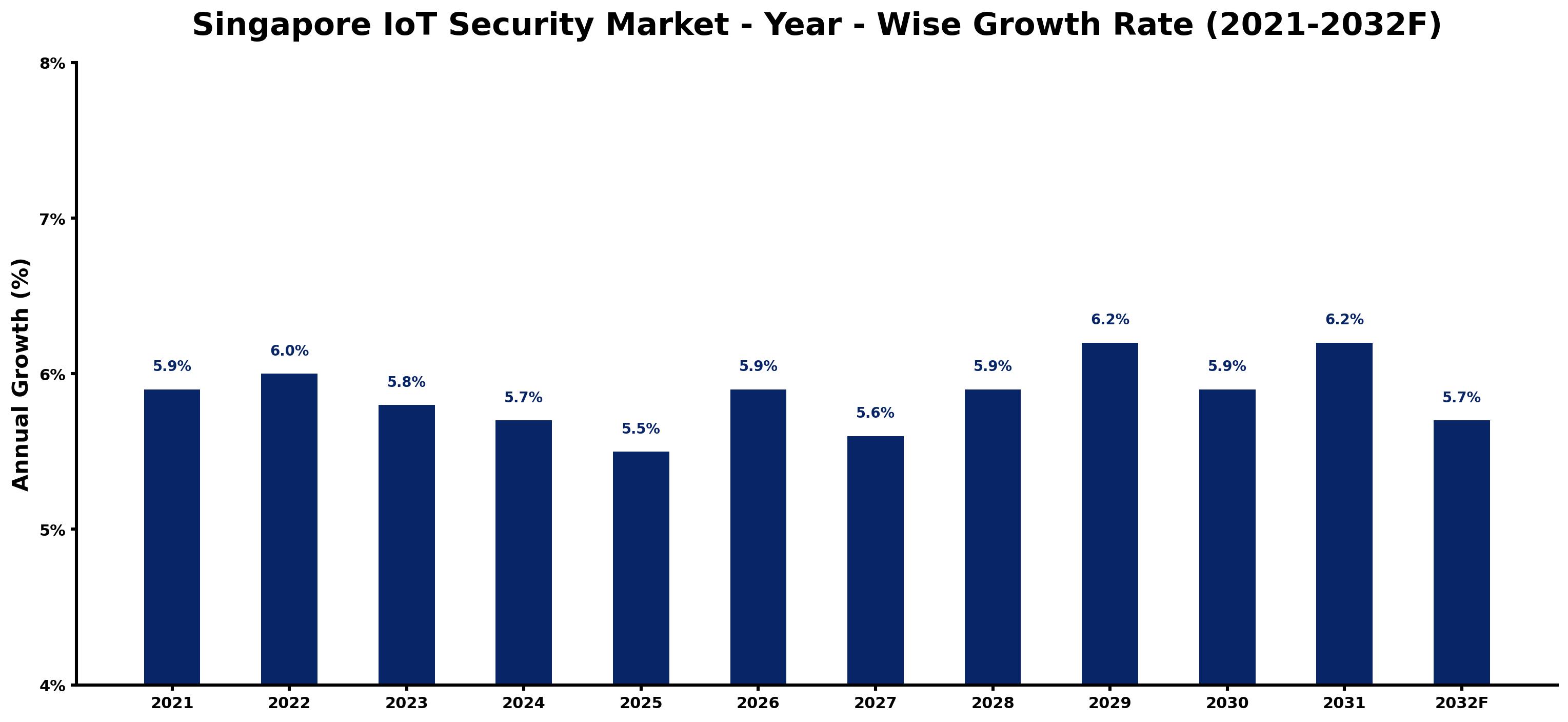
The table below presents the year‑wise growth rates along with the key drivers influencing the market
| Year | Growth Rate | Major Drivers |
| 2021 | 5.9% | Cybersecurity Agency of Singapore strengthens national security frameworks |
| 2022 | 6.0% | Increased IoT device deployment among smart city initiatives |
| 2023 | 5.8% | Government mandates cybersecurity audits for IoT systems |
| 2024 | 5.7% | Rising concerns over data breaches in connected devices |
| 2025 | 5.5% | Local regulations enhance standards for IoT cybersecurity |
| 2026 | 5.9% | Growing number of IoT start-ups boosts innovative security solutions |
| 2027 | 5.6% | Increased public sector investment in digital infrastructure security |
| 2028 | 5.9% | Collaboration with private sector to improve IoT safety |
| 2029 | 6.2% | Local universities launch IoT security research partnerships |
| 2030 | 5.9% | Adoption of IoT in logistics drives security demand |
| 2031 | 6.2% | Smart homes in urban areas fuel demand for IoT security |
| 2032 | 5.7% | Community outreach programs promote IoT security awareness |
Note: Market size estimations and growth projections presented in this report are based on 6Wresearch's proprietary forecasting methodology, utilizing the latest available industry data, government publications, and primary research inputs.
Singapore IoT Security Market Key Takeaways
Below are some of the specific key takeaways from the market, including:
- Increased investment in IoT security solutions by both public and private sectors.
- Heightened awareness of cybersecurity risks, particularly post-COVID-19.
- Demand for industry-specific IoT security solutions is on the rise.
- Integration of AI and machine learning technologies to enhance security measures.
- Growing emphasis on regulatory compliance driving market growth.
Evaluation of Restraints in Singapore IoT Security Market
The Singapore IoT Security Market faces a host of challenges primarily stemming from the diversity and volume of IoT devices that require protection. Cybersecurity solutions must evolve continuously to counteract an expanding range of threats, from data breaches to sophisticated device hijacking. Additionally, the necessity for solutions tailored to specific industries complicates the development and implementation processes, often leading to increased costs and longer deployment times.
Singapore IoT Security Market Trends
A surge in the adoption of AI-driven security solutions is a notable trend in the market. Organizations are leveraging machine learning algorithms to enhance threat detection and response times. on top of that, the shift towards zero-trust security models is gaining traction, as businesses recognize the importance of treating every device and user as potentially compromised.
The integration of IoT with 5G technology is also reshaping the security paradigm. With faster data transmission rates, the need for real-time security measures becomes critical, prompting providers to innovate more robust security frameworks.
Singapore IoT Security Market Opportunities
As the demand for IoT security solutions expands, opportunities for investment are emerging in several areas. Companies specializing in AI and machine learning can capitalize on the growing need for automated security measures. Additionally, the government’s push for smart city initiatives creates avenues for tailored security solutions in urban infrastructure. Collaboration between public and private sectors is also likely to yield innovative security frameworks, paving the way for sustainable growth in this market.
Government Initiatives in the Singapore IoT Security Market
The Singaporean government has been proactive in shaping the IoT security market through various initiatives. Its strategic focus on enhancing cybersecurity measures is crucial for fostering a secure digital environment, particularly as IoT devices proliferate across critical sectors. The regulatory framework emphasizes robust security protocols, which are essential for maintaining public trust and safeguarding sensitive data.
- A national cybersecurity strategy launched in late 2023 aimed at enhancing the security of IoT networks.
- Ongoing collaboration between government agencies and private sector firms to develop standardized security protocols for IoT devices.
- A public-private initiative is currently underway to promote cybersecurity awareness and training for IoT professionals.
- Plans for a comprehensive review of IoT security regulations are set for 2026, with the aim of adapting to emerging threats.
- Investment in research and development for IoT security technologies is part of the government’s 2024 budget allocation.
Future Insights of the Singapore IoT Security Market
Looking ahead to 2026-2032, the Singapore IoT Security Market is expected to witness significant transformations driven by technological advancements and evolving threat landscapes. As organizations increasingly prioritize cybersecurity, the emphasis will be on developing more integrated, adaptive security solutions that can respond to real-time threats. The convergence of IoT with emerging technologies will further reshape the security landscape, leading to enhanced solutions tailored to specific industry needs.
Singapore IoT Security Market Latest Developments
In the past year, the Singapore IoT Security Market has seen a flurry of activities aimed at bolstering the security of interconnected systems. Organizations are increasingly recognizing the need to address vulnerabilities in their IoT ecosystems, leading to a wave of innovative solutions and partnerships. The heightened focus on cybersecurity has catalyzed a proactive approach among businesses and government entities alike.
- A major technology vendor announced the launch of an AI-powered IoT security platform in Q1 2024, designed to enhance threat detection capabilities.
- A collaborative initiative between public agencies and cybersecurity firms is currently underway to create industry-specific security standards, aimed at enhancing compliance and safety.
- In mid-2024, a pilot program for testing smart city infrastructure security measures is expected to commence, focusing on urban IoT applications.
- A regional operator revealed plans for an extensive rollout of IoT security solutions by late 2025, targeting critical infrastructure sectors.
- An upcoming cybersecurity conference scheduled for early 2025 will focus on IoT security challenges, bringing together industry leaders to discuss best practices.
Singapore IoT Security Market - Key Attractiveness of the Report
- 10 Years of Market Numbers
- Historical Data Starting from 2022 to 2025
- Base Year: 2025
- Forecast Data until 2032
- Key Performance Indicators Impacting the Market
- Major Upcoming Developments and Projects
Key Highlights of the Report:
- Singapore IoT Security Market Outlook
- Market Size of Singapore IoT Security Market, 2025
- Forecast of Singapore IoT Security Market, 2032
- Historical Data and Forecast of Singapore IoT Security Revenues & Volume for the Period 2022-2032F
- Singapore IoT Security Market Trend Evolution
- Singapore IoT Security Market Drivers and Challenges
- Singapore IoT Security Price Trends
- Singapore IoT Security Porter's Five Forces
- Singapore IoT Security Industry Life Cycle
- Historical Data and Forecast of Singapore IoT Security Market Revenues & Volume By Type for the Period 2022-2032F
- Historical Data and Forecast of Singapore IoT Security Market Revenues & Volume By Network Security for the Period 2022-2032F
- Historical Data and Forecast of Singapore IoT Security Market Revenues & Volume By Endpoint Security for the Period 2022-2032F
- Historical Data and Forecast of Singapore IoT Security Market Revenues & Volume By Application Security for the Period 2022-2032F
- Historical Data and Forecast of Singapore IoT Security Market Revenues & Volume By Cloud Security for the Period 2022-2032F
- Historical Data and Forecast of Singapore IoT Security Market Revenues & Volume By Other Security Types for the Period 2022-2032F
- Historical Data and Forecast of Singapore IoT Security Market Revenues & Volume By Deployment Mode for the Period 2022-2032F
- Historical Data and Forecast of Singapore IoT Security Market Revenues & Volume By Small and Medium Enterprises for the Period 2022-2032F
- Historical Data and Forecast of Singapore IoT Security Market Revenues & Volume By Large Enterprises for the Period 2022-2032F
- Historical Data and Forecast of Singapore IoT Security Market Revenues & Volume By Component for the Period 2022-2032F
- Historical Data and Forecast of Singapore IoT Security Market Revenues & Volume By Solutions for the Period 2022-2032F
- Historical Data and Forecast of Singapore IoT Security Market Revenues & Volume By Services for the Period 2022-2032F
- Historical Data and Forecast of Singapore IoT Security Market Revenues & Volume By Solution for the Period 2022-2032F
- Historical Data and Forecast of Singapore IoT Security Market Revenues & Volume By Identity and Access Management for the Period 2022-2032F
- Historical Data and Forecast of Singapore IoT Security Market Revenues & Volume By Data Encryption and Tokenization for the Period 2022-2032F
- Historical Data and Forecast of Singapore IoT Security Market Revenues & Volume By Intrusion Detection System/Intrusion Prevention System for the Period 2022-2032F
- Historical Data and Forecast of Singapore IoT Security Market Revenues & Volume By Device Authentication and Management for the Period 2022-2032F
- Historical Data and Forecast of Singapore IoT Security Market Revenues & Volume By Secure Communications for the Period 2022-2032F
- Historical Data and Forecast of Singapore IoT Security Market Revenues & Volume By PKI Lifecycle Management for the Period 2022-2032F
- Historical Data and Forecast of Singapore IoT Security Market Revenues & Volume By Distributed Denial of Service Protection for the Period 2022-2032F
- Historical Data and Forecast of Singapore IoT Security Market Revenues & Volume By Security Analytics for the Period 2022-2032F
- Historical Data and Forecast of Singapore IoT Security Market Revenues & Volume By Application Area for the Period 2022-2032F
- Historical Data and Forecast of Singapore IoT Security Market Revenues & Volume By Smart Manufacturing for the Period 2022-2032F
- Historical Data and Forecast of Singapore IoT Security Market Revenues & Volume By Smart Energy and Utilities for the Period 2022-2032F
- Historical Data and Forecast of Singapore IoT Security Market Revenues & Volume By Connected Logistics for the Period 2022-2032F
- Historical Data and Forecast of Singapore IoT Security Market Revenues & Volume By Smart Home and Consumer Electronics for the Period 2022-2032F
- Historical Data and Forecast of Singapore IoT Security Market Revenues & Volume By Connected Healthcare for the Period 2022-2032F
- Historical Data and Forecast of Singapore IoT Security Market Revenues & Volume By Smart Government and Defense for the Period 2022-2032F
- Historical Data and Forecast of Singapore IoT Security Market Revenues & Volume By Smart Retail for the Period 2022-2032F
- Historical Data and Forecast of Singapore IoT Security Market Revenues & Volume By Other Application Areas for the Period 2022-2032F
- Historical Data and Forecast of Singapore IoT Security Market Revenues & Volume By Organization Size for the Period 2022-2032F
- Historical Data and Forecast of Singapore IoT Security Market Revenues & Volume By Small and Medium-sized Enterprises for the Period 2022-2032F
- Historical Data and Forecast of Singapore IoT Security Market Revenues & Volume By Large Enterprises for the Period 2022-2032F
- Historical Data and Forecast of Singapore IoT Security Market Revenues & Volume By Service for the Period 2022-2032F
- Historical Data and Forecast of Singapore IoT Security Market Revenues & Volume By Professional Services for the Period 2022-2032F
- Historical Data and Forecast of Singapore IoT Security Market Revenues & Volume By Managed Services for the Period 2022-2032F
- Singapore IoT Security Import Export Trade Statistics
- Market Opportunity Assessment By Type
- Market Opportunity Assessment By Deployment Mode
- Market Opportunity Assessment By Component
- Market Opportunity Assessment By Solution
- Market Opportunity Assessment By Application Area
- Market Opportunity Assessment By Organization Size
- Market Opportunity Assessment By Service
- Singapore IoT Security Top Companies Market Share
- Singapore IoT Security Competitive Benchmarking By Technical and Operational Parameters
- Singapore IoT Security Company Profiles
- Singapore IoT Security Key Strategic Recommendations






































