Singapore IT Operations Analytics Market Size & Growth Rate (2026-2032)
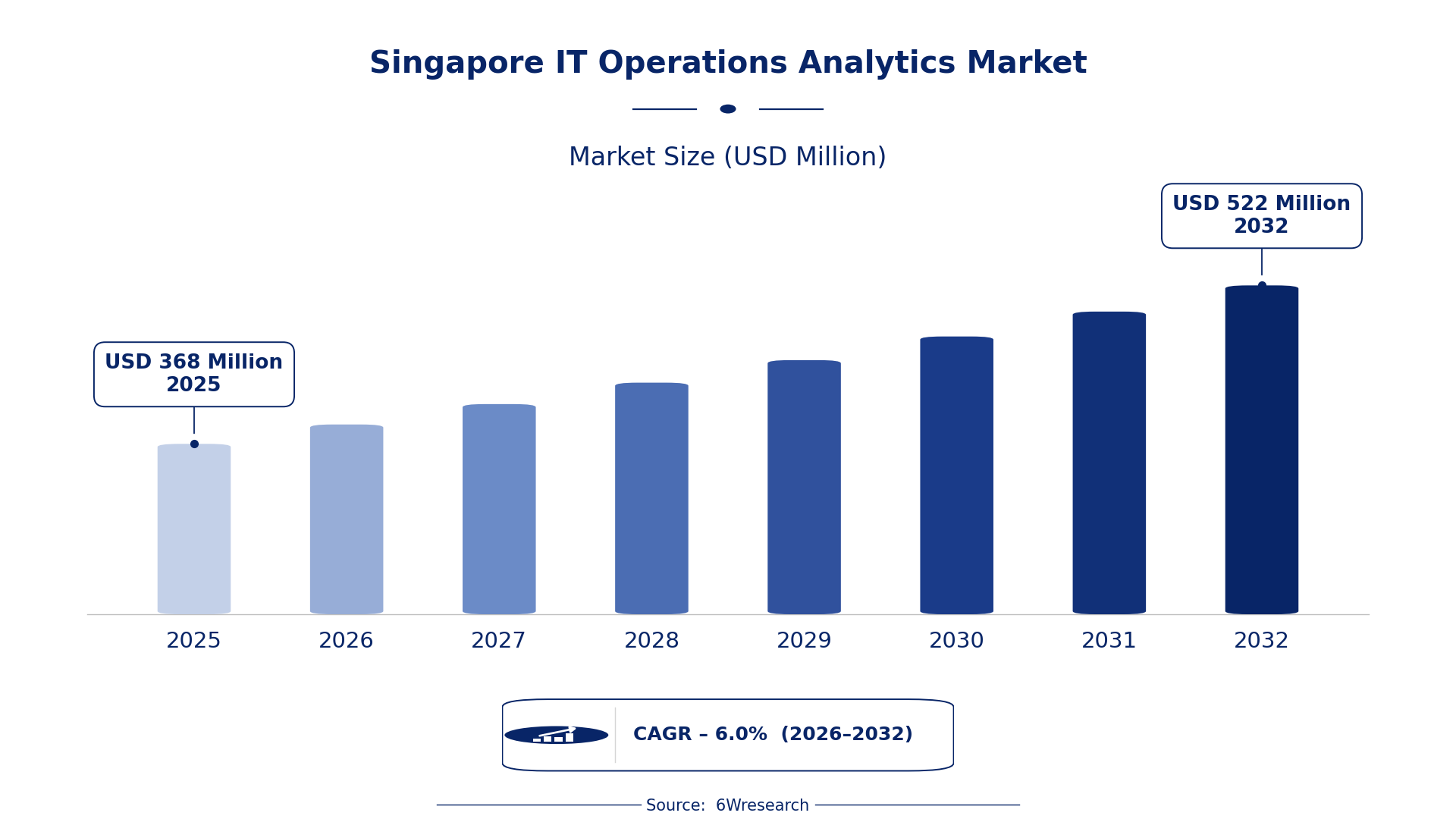
The Singapore IT Operations Analytics Market was estimated at USD 368 Million in 2025 and is projected to reach USD 522 Million by 2032, growing at a CAGR of 6.0% from 2026 to 2032.
Singapore IT Operations Analytics Market Synopsis
In Singapore, the IT Operations Analytics market has become an essential component for organizations aiming to optimize their IT infrastructure. As businesses increasingly rely on complex digital systems, the need for robust analytics solutions that monitor and analyze IT performance has surged.
With the growing emphasis on digital transformation, companies in Singapore are investing heavily in IT Operations Analytics. This trend is driven by the need to enhance system reliability, prevent downtime, and ensure seamless service delivery. As the digital landscape continues to evolve, the importance of these analytics tools cannot be overstated.
Singapore IT Operations Analytics Market Year-wise Growth Rate and Key Drivers
This graph illustrates the annual growth rates of the Singapore IT Operations Analytics Market from 2021 to 2032, highlighting a steady upward trajectory and projected expansion over the forecast period.
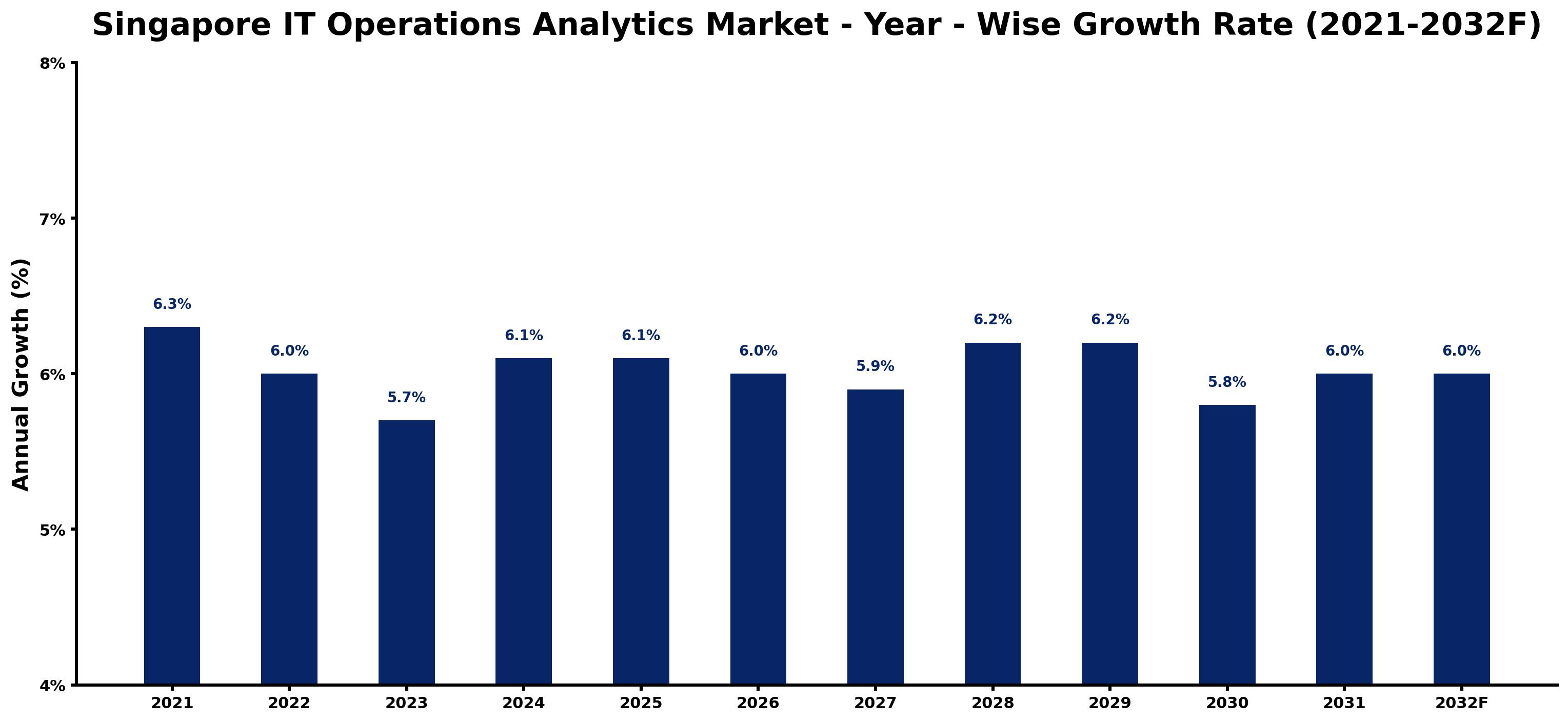
The table below presents the year‑wise growth rates along with the key drivers influencing the market
| Year | Growth Rate | Major Drivers |
| 2021 | 6.3% | Government's AI Strategy promotes analytics in IT operations. |
| 2022 | 6.0% | Increased cloud adoption by local tech startups boosts demand. |
| 2023 | 5.7% | Cybersecurity regulations drive investment in IT analytics solutions. |
| 2024 | 6.1% | Digital Transformation Framework supports data-driven decision making. |
| 2025 | 6.1% | Talent shortage in IT analytics drives competitive salaries. |
| 2026 | 6.0% | Adoption of IoT technologies increases operational data generation. |
| 2027 | 5.9% | Growth in e-commerce leads to advanced analytics requirements. |
| 2028 | 6.2% | Green IT initiatives enhance operational efficiency through analytics. |
| 2029 | 6.2% | Focus on smart nation initiatives increases IT investment. |
| 2030 | 5.8% | Resilience in logistics sector boosts need for operational insights. |
| 2031 | 6.0% | Regional data protection laws enhance compliance analytics demand. |
| 2032 | 6.0% | Rising investment in fintech drives analytics for operational improvement. |
Note: Market size estimations and growth projections presented in this report are based on 6Wresearch's proprietary forecasting methodology, utilizing the latest available industry data, government publications, and primary research inputs.
Singapore IT Operations Analytics Market Key Takeaways
Below are some of the specific key takeaways from the market, including:
- The market is experiencing a significant uptick due to increasing IT infrastructure complexity.
- Real-time insights provided by analytics solutions are critical for proactive issue resolution.
- The COVID-19 pandemic accelerated the demand for efficient IT operations management.
- Integration challenges across multiple platforms remain a key hurdle for organizations.
- Data security and threat detection capabilities are becoming integral to analytics tools.
Evaluation of Restraints in Singapore IT Operations Analytics Market
The Singapore IT Operations Analytics market faces significant constraints, primarily linked to data volume management. Organizations grapple with the vast amounts of data generated by modern IT environments, making real-time analysis challenging. This situation is compounded by the need for integration across disparate IT systems, which often leads to fragmented visibility. on top of that, the urgency to address security threats complicates the operational landscape, demanding more sophisticated and agile analytics solutions.
Singapore IT Operations Analytics Market Trends
Several trends are currently shaping the Singapore IT Operations Analytics market. There is a noticeable shift towards cloud-based solutions, driven by the need for scalability and flexibility. Organizations are increasingly adopting AI and machine learning capabilities within their analytics tools, enabling them to predict system failures before they occur. Additionally, there is a growing focus on user experience, with analytics solutions designed to deliver intuitive dashboards and actionable insights.
Singapore IT Operations Analytics Market Opportunities
The market presents a wealth of growth opportunities, particularly for companies willing to innovate. As businesses seek to enhance their IT performance, there is strong demand for advanced analytics capabilities that can provide deeper insights into operational health. Additionally, the ongoing digital transformation initiatives across various sectors in Singapore create fertile ground for new entrants and established players alike to offer tailored solutions.
Government Initiatives in the Singapore IT Operations Analytics Market
Government policies play a significant role in shaping the Singapore IT Operations Analytics market. The Singaporean government is focused on fostering a conducive environment for digital innovation, prioritizing initiatives that enhance IT infrastructure and analytics capabilities. These initiatives are essential for promoting transparency and operational efficiency in both public and private sectors.
- A national digital infrastructure upgrade programme launched recently aims to enhance IT operations across various industries.
- Currently underway is a government-led initiative focused on increasing cybersecurity measures within IT operations analytics tools.
- A regulatory framework established in 2025 mandates the integration of analytics solutions in public sector IT operations.
- Upcoming plans include a public-private partnership expected to promote the development of advanced IT analytics solutions by 2027.
Future Insights of the Singapore IT Operations Analytics Market
Looking ahead to 2026-2032, the Singapore IT Operations Analytics market is set for substantial growth. As digital transformation efforts deepen across various sectors, organizations will increasingly prioritize analytics to enhance operational efficiency. The integration of AI and machine learning technologies into analytics solutions will likely redefine how companies approach IT management, resulting in smarter, data-driven decision-making processes.
Singapore IT Operations Analytics Market Latest Developments
In the past year, the Singapore IT Operations Analytics market has seen a flurry of activity, with companies striving to stay ahead in a competitive environment. This period has been characterized by significant technological advancements and collaborations aimed at enhancing operational efficiency.
- A major technology vendor launched an updated IT operations analytics platform in Q3 2025, incorporating advanced machine learning algorithms.
- In early 2025, a regional operator completed the rollout of a comprehensive analytics solution designed to optimize IT resource management.
- Currently, a leading analytics firm is in the process of developing a new product aimed at enhancing real-time monitoring capabilities.
- A planned initiative expected to begin in late 2026 focuses on integrating IoT data into IT operations analytics for smarter insights.
Singapore IT Operations Analytics Market - Key Attractiveness of the Report
- 10 Years of Market Numbers
- Historical Data Starting from 2022 to 2025
- Base Year: 2025
- Forecast Data until 2032
- Key Performance Indicators Impacting the Market
- Major Upcoming Developments and Projects
Key Highlights of the Report:
- Singapore IT Operations Analytics Market Outlook
- Market Size of Singapore IT Operations Analytics Market, 2025
- Forecast of Singapore IT Operations Analytics Market, 2032
- Historical Data and Forecast of Singapore IT Operations Analytics Revenues & Volume for the Period 2022-2032F
- Singapore IT Operations Analytics Market Trend Evolution
- Singapore IT Operations Analytics Market Drivers and Challenges
- Singapore IT Operations Analytics Price Trends
- Singapore IT Operations Analytics Porter's Five Forces
- Singapore IT Operations Analytics Industry Life Cycle
- Historical Data and Forecast of Singapore IT Operations Analytics Market Revenues & Volume By Component for the Period 2022-2032F
- Historical Data and Forecast of Singapore IT Operations Analytics Market Revenues & Volume By Solutions for the Period 2022-2032F
- Historical Data and Forecast of Singapore IT Operations Analytics Market Revenues & Volume By Services for the Period 2022-2032F
- Historical Data and Forecast of Singapore IT Operations Analytics Market Revenues & Volume By Service for the Period 2022-2032F
- Historical Data and Forecast of Singapore IT Operations Analytics Market Revenues & Volume By Professional Services for the Period 2022-2032F
- Historical Data and Forecast of Singapore IT Operations Analytics Market Revenues & Volume By Managed Services for the Period 2022-2032F
- Historical Data and Forecast of Singapore IT Operations Analytics Market Revenues & Volume By Solution for the Period 2022-2032F
- Historical Data and Forecast of Singapore IT Operations Analytics Market Revenues & Volume By Log Management for the Period 2022-2032F
- Historical Data and Forecast of Singapore IT Operations Analytics Market Revenues & Volume By Application Performance Management (APM) for the Period 2022-2032F
- Historical Data and Forecast of Singapore IT Operations Analytics Market Revenues & Volume By Network and Security Management for the Period 2022-2032F
- Historical Data and Forecast of Singapore IT Operations Analytics Market Revenues & Volume By Root Cause Analysis for the Period 2022-2032F
- Historical Data and Forecast of Singapore IT Operations Analytics Market Revenues & Volume By Anomaly Detection for the Period 2022-2032F
- Historical Data and Forecast of Singapore IT Operations Analytics Market Revenues & Volume By Others for the Period 2022-2032F
- Historical Data and Forecast of Singapore IT Operations Analytics Market Revenues & Volume By Deployment Mode for the Period 2022-2032F
- Historical Data and Forecast of Singapore IT Operations Analytics Market Revenues & Volume By Cloud for the Period 2022-2032F
- Historical Data and Forecast of Singapore IT Operations Analytics Market Revenues & Volume By On-premises for the Period 2022-2032F
- Historical Data and Forecast of Singapore IT Operations Analytics Market Revenues & Volume By End User for the Period 2022-2032F
- Historical Data and Forecast of Singapore IT Operations Analytics Market Revenues & Volume By BFSI for the Period 2022-2032F
- Historical Data and Forecast of Singapore IT Operations Analytics Market Revenues & Volume By Retail and Consumer Goods for the Period 2022-2032F
- Historical Data and Forecast of Singapore IT Operations Analytics Market Revenues & Volume By Telecom for the Period 2022-2032F
- Historical Data and Forecast of Singapore IT Operations Analytics Market Revenues & Volume By Manufacturing for the Period 2022-2032F
- Historical Data and Forecast of Singapore IT Operations Analytics Market Revenues & Volume By Energy and Utilities for the Period 2022-2032F
- Historical Data and Forecast of Singapore IT Operations Analytics Market Revenues & Volume By Healthcare and Life Sciences for the Period 2022-2032F
- Historical Data and Forecast of Singapore IT Operations Analytics Market Revenues & Volume By Government and Defense for the Period 2022-2032F
- Historical Data and Forecast of Singapore IT Operations Analytics Market Revenues & Volume By Transportation and Logistics for the Period 2022-2032F
- Historical Data and Forecast of Singapore IT Operations Analytics Market Revenues & Volume By Organization Size for the Period 2022-2032F
- Historical Data and Forecast of Singapore IT Operations Analytics Market Revenues & Volume By SMEs for the Period 2022-2032F
- Historical Data and Forecast of Singapore IT Operations Analytics Market Revenues & Volume By Large Enterprises for the Period 2022-2032F
- Singapore IT Operations Analytics Import Export Trade Statistics
- Market Opportunity Assessment By Component
- Market Opportunity Assessment By Service
- Market Opportunity Assessment By Solution
- Market Opportunity Assessment By Deployment Mode
- Market Opportunity Assessment By End User
- Market Opportunity Assessment By Organization Size
- Singapore IT Operations Analytics Top Companies Market Share
- Singapore IT Operations Analytics Competitive Benchmarking By Technical and Operational Parameters
- Singapore IT Operations Analytics Company Profiles
- Singapore IT Operations Analytics Key Strategic Recommendations






































