Singapore Knitted Fabric Market: Import Trend Analysis
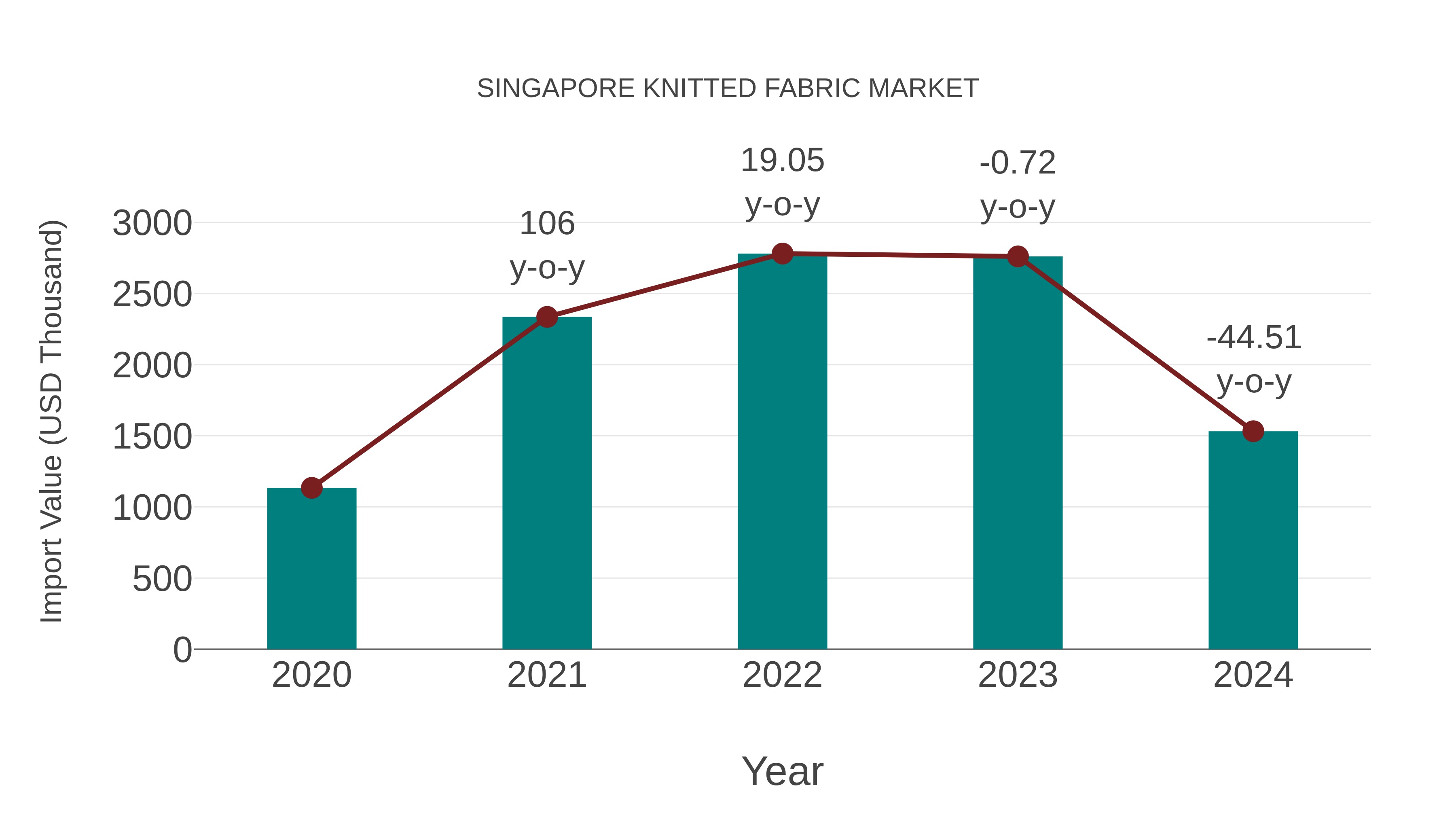
In 2024, Singapore`s knitted fabric market witnessed a -44.51% decline in imports compared to 2023. However, the compound annual growth rate (CAGR) from 2020 to 2024 stood at a positive 7.81%. This significant import momentum shift can be attributed to evolving demand patterns or potential changes in trade policies impacting market stability.
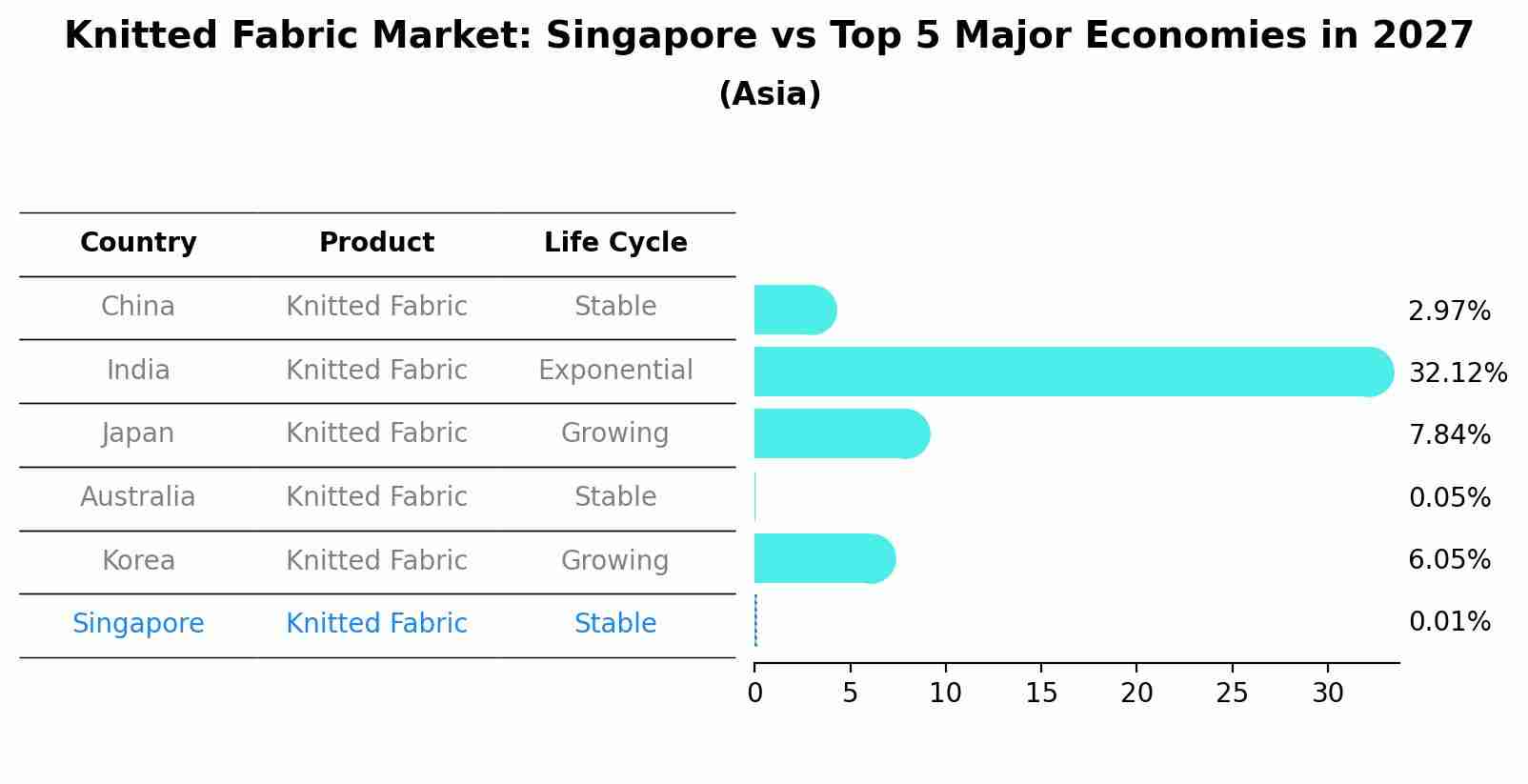
Knitted Fabric Market: Singapore vs Top 5 Major Economies in 2027 (Asia)
In the Asia region, the Knitted Fabric market in Singapore is projected to expand at a stable growth rate of 0.01% by 2027. The largest economy is China, followed by India, Japan, Australia and South Korea.
Singapore Knitted Fabric Market Synopsis
The Singapore knitted fabric market is expected to register a CAGR of 5.5% during the forecast period from 2020 to 2026. The region has been witnessing an increase in demand for knitted fabrics, owing to their superior durable properties and varied designs available. In addition, rising consumer preferences for lightweight and breathable fabrics have further augmented market growth. Furthermore, increasing production of sportswear apparel with high-performance fabrics is also anticipated to drive the knitted fabric market in this region over the coming years.
Market Drivers
Increasing demand for strETChable and comfortable fabric options across garment manufacturing industries are driving the growth of Singapore knitted fabric market Growing disposable income among consumers coupled with changing lifestyle trends have led to increased product innovation activities in order meet consumer demands Increasing use of ecofriendly materials such as organic cotton and bamboo fibers have significantly contributed towards increasing adoption rates of these textiles among sustainable fashion brands.
Market challenges
Price fluctuations due to unpredictable raw material prices may hinder investments from foreign players into this industry.High cost involved in procuring quality yarns as well as large amounts required for producing large batches are likely act as key restraint on revenue generation opportunities.
Key players
KG Denim India Ltd., Tian Yuan Garment Co., Ltd, Far Eastern New Century Corporation (FENC), PT Garmindo Tekstil Maju Abadi Indonesia, JCT Limited are the major players.
Covid-19 Impact
The outbreak of Covid 19 had a negative impact on the global economy which directly affected many sectors including textile & apparel industry across all countries, leading manufacturers like KG Denim India Ltd., Tian Yuan Garment Co., Ltd ETC, witnessed decline in revenues due to closure or slowdown operations due to pandemic situation disruption caused by Covid 19 crisis worldwide.Despite these factors however, there has been some recovery experienced post second quarter following relaxation measures taken up by governments after first wave lockdown.This resurgence is attributed mainly towards rise ecommerce platforms, bringing convenience shopping option at doorsteps customers which helped boost sales within sector.
Key Highlights of the Report:
- Singapore Knitted Fabric Market Outlook
- Market Size of Singapore Knitted Fabric Market, 2023
- Forecast of Singapore Knitted Fabric Market, 2030
- Historical Data and Forecast of Singapore Knitted Fabric Revenues & Volume for the Period 2020-2030
- Singapore Knitted Fabric Market Trend Evolution
- Singapore Knitted Fabric Market Drivers and Challenges
- Singapore Knitted Fabric Price Trends
- Singapore Knitted Fabric Porter's Five Forces
- Singapore Knitted Fabric Industry Life Cycle
- Historical Data and Forecast of Singapore Knitted Fabric Market Revenues & Volume By Construction Type for the Period 2020-2030
- Historical Data and Forecast of Singapore Knitted Fabric Market Revenues & Volume By Weft for the Period 2020-2030
- Historical Data and Forecast of Singapore Knitted Fabric Market Revenues & Volume By Wrap for the Period 2020-2030
- Historical Data and Forecast of Singapore Knitted Fabric Market Revenues & Volume By Fabrics Type for the Period 2020-2030
- Historical Data and Forecast of Singapore Knitted Fabric Market Revenues & Volume By Flat/Jersey for the Period 2020-2030
- Historical Data and Forecast of Singapore Knitted Fabric Market Revenues & Volume By Purl for the Period 2020-2030
- Historical Data and Forecast of Singapore Knitted Fabric Market Revenues & Volume By Rib Stitch for the Period 2020-2030
- Historical Data and Forecast of Singapore Knitted Fabric Market Revenues & Volume By Interlock for the Period 2020-2030
- Singapore Knitted Fabric Import Export Trade Statistics
- Market Opportunity Assessment By Construction Type
- Market Opportunity Assessment By Fabrics Type
- Singapore Knitted Fabric Top Companies Market Share
- Singapore Knitted Fabric Competitive Benchmarking By Technical and Operational Parameters
- Singapore Knitted Fabric Company Profiles
- Singapore Knitted Fabric Key Strategic Recommendations






































