Singapore Kosher Food Market Size, Share & Growth Rate
The Singapore Kosher Food Market was estimated at USD 273 Million in 2025 and is projected to reach USD 371 Million by 2032, growing at a CAGR of 4.5% from 2026 to 2032. This growth trajectory is underpinned by a multicultural society that increasingly values certified food options. The demand from both the local Jewish community and consumers preferring high-quality, clean food products positions the market for steady expansion in the coming years.
Singapore Kosher Food Market Year-wise Growth Rate and Key Drivers
This graph highlights how the Singapore Kosher Food Market has steadily grown over the years, supported by major growth factors.
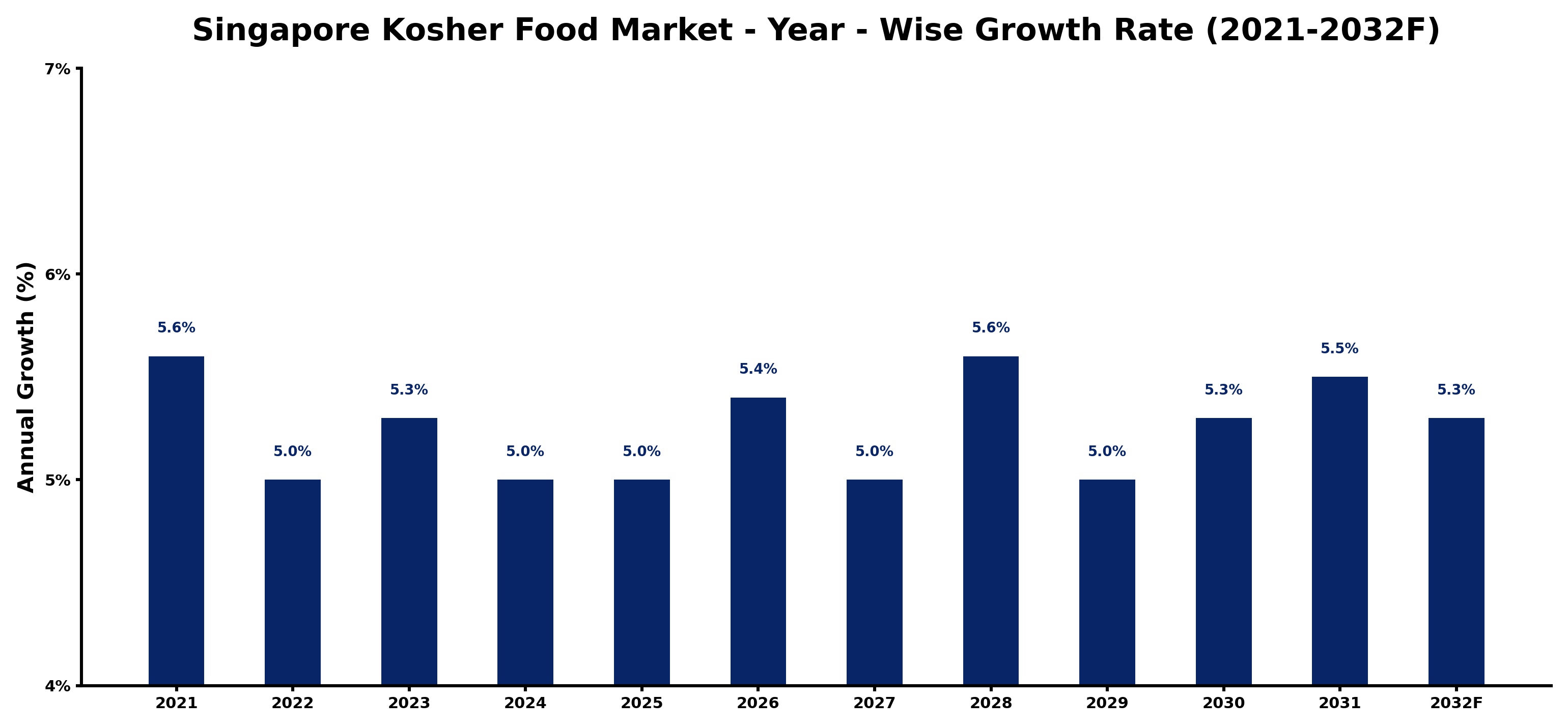
The table below presents the year‑wise growth rates along with the key drivers influencing the market
| Year | Growth Rate | Major Drivers |
| 2021 | 5.6% | Regional halal certification improvements enhance Singapore's kosher food production |
| 2022 | 5.0% | New kosher facility openings boost local food production capabilities |
| 2023 | 5.3% | Export driven consumer interest boosted local kosher food processing capabilities |
| 2024 | 5.0% | Blockchain technology integration optimizes kosher supply chain transparency |
| 2025 | 5.0% | Improved facility compliance boosted kosher meat processing output capacity |
| 2026 | 5.4% | Kosher food production technology upgrades enhance processing efficiency and output |
| 2027 | 5.0% | Increased kosher certification demand boosts local food processing capacity |
| 2028 | 5.6% | Kosher certification advancements boost local food manufacturing capabilities |
| 2029 | 5.0% | Increased kosher food processing capacity supports local supply chain efficiency |
| 2030 | 5.3% | Automated processing systems streamline production of kosher certified food items |
| 2031 | 5.5% | New processing technologies boosted efficiency in kosher food production |
| 2032 | 5.3% | Local suppliers increased capacity to meet rising kosher food demand |
Note - Market size estimations and growth projections presented in this report are based on 6Wresearch's advanced forecasting approach, validated with industry datasets as of June 2026.
Singapore Kosher Food Market Synopsis
Singapore's kosher food sector is gaining traction as more consumers recognize the quality and safety associated with certified kosher products. The growing interest is not limited to the Jewish population; many health-conscious individuals are also gravitating towards these offerings. As Singapore continues to be a hub for international tourism, kosher food is becoming an appealing option for visitors, further bolstering market demand.
In addition, the local market's unique blend of cultures creates an opportunity for kosher food producers to innovate and diversify their product lines. As awareness regarding dietary restrictions and religious observances increases, businesses that successfully align their offerings with these trends are likely to achieve significant market penetration.
Singapore Kosher Food Market Key Takeaways
- The market is expanding due to a growing diverse population and increasing demand for certified food products.
- Awareness of dietary preferences is crucial for market growth, providing opportunities for innovation.
- Health-conscious consumers are increasingly drawn to kosher-certified products for their perceived quality.
- Market stability during the COVID-19 pandemic reflects the consistent demand for kosher food.
- Streamlined certification processes could enhance accessibility and reduce production costs for businesses.
Evaluation of Restraints in Singapore Kosher Food Market
Despite its growth potential, the Singapore kosher food market faces inherent constraints. The niche nature of the market primarily serves a specific cultural and religious demographic, limiting broad scalability. Additionally, the stringent kosher certification requirements impose significant costs and operational challenges on producers, necessitating specialized facilities and oversight. As consumer tastes continue to evolve rapidly, staying ahead of market trends can also pose a constant challenge for businesses aiming to capture this demographic.
Singapore Kosher Food Market Trends
One notable trend is the increasing crossover between kosher and halal markets, as consumers from diverse backgrounds seek food that meets their specific dietary needs. Moreover, there is a rising interest in plant-based and organic kosher products, reflecting broader health and wellness trends. Retailers are also leveraging e-commerce platforms to reach consumers who prefer online shopping, thus expanding the availability of kosher-certified items beyond traditional brick-and-mortar stores. This convergence of dietary needs and technological advancements is reshaping the landscape of the kosher food market in Singapore.
Singapore Kosher Food Market Opportunities
The Singapore kosher food market presents multiple avenues for growth. Expansion into new retail channels, such as online platforms, can reach a broader audience. Additionally, developing partnerships with restaurants and hotels that cater to international visitors offers significant potential. There's also an opportunity to increase the product range by incorporating fusion cuisines that blend kosher principles with local flavors, thus appealing to a wider consumer base and enhancing brand differentiation.
Government Initiatives in the Singapore Kosher Food Market
The Singaporean government is actively promoting a multicultural society that embraces various dietary needs, including kosher food. Policies aimed at supporting food safety and quality certification create a favorable environment for kosher food businesses. Additionally, initiatives encouraging tourism contribute to increased demand for diverse culinary options, including kosher, further supporting the growth of the kosher food market within Singapore.
Future Insights of the Singapore Kosher Food Market
Looking towards 2026-2032, the Singapore kosher food market is poised for significant evolution. Enhanced consumer awareness surrounding dietary options, combined with a continued influx of global tourists, will likely propel demand. As producers adapt to changing consumer preferences and innovative marketing strategies, the sector is expected to gain momentum. Businesses that can effectively navigate the complexities of kosher certification and leverage emerging food trends will be well-positioned to capitalize on the growing market.
Singapore Kosher Food Market Latest Developments (May 2025 - June 2026)
In recent months, the Singapore kosher food market has seen a notable increase in new product launches, focusing on plant-based and health-oriented offerings. Retailers are beginning to explore partnerships with local chefs to create signature dishes that highlight kosher cuisine while appealing to the broader culinary landscape. Additionally, e-commerce platforms are ramping up their offerings of kosher products, making it easier for consumers to access a variety of certified items. These developments illustrate a responsive market adapting to consumer needs and trends.
Singapore Kosher Food Market - Key Attractiveness of the Report
- 10 Years of Market Numbers
- Historical Data Starting from 2022 to 2025
- Base Year: 2025
- Forecast Data until 2032
- Key Performance Indicators Impacting the Market
- Major Upcoming Developments and Projects
Key Highlights of the Report:
- Singapore Kosher Food Market Outlook
- Market Size of Singapore Kosher Food Market, 2025
- Forecast of Singapore Kosher Food Market, 2032
- Historical Data and Forecast of Singapore Kosher Food Revenues & Volume for the Period 2022-2032F
- Singapore Kosher Food Market Trend Evolution
- Singapore Kosher Food Market Drivers and Challenges
- Singapore Kosher Food Price Trends
- Singapore Kosher Food Porter's Five Forces
- Singapore Kosher Food Industry Life Cycle
- Historical Data and Forecast of Singapore Kosher Food Market Revenues & Volume By Type for the Period 2022-2032F
- Historical Data and Forecast of Singapore Kosher Food Market Revenues & Volume By Meat for the Period 2022-2032F
- Historical Data and Forecast of Singapore Kosher Food Market Revenues & Volume By Dairy for the Period 2022-2032F
- Historical Data and Forecast of Singapore Kosher Food Market Revenues & Volume By Pareve for the Period 2022-2032F
- Historical Data and Forecast of Singapore Kosher Food Market Revenues & Volume By Application for the Period 2022-2032F
- Historical Data and Forecast of Singapore Kosher Food Market Revenues & Volume By Seafood for the Period 2022-2032F
- Historical Data and Forecast of Singapore Kosher Food Market Revenues & Volume By Processed Meat and Poultry for the Period 2022-2032F
- Historical Data and Forecast of Singapore Kosher Food Market Revenues & Volume By Beverages for the Period 2022-2032F
- Historical Data and Forecast of Singapore Kosher Food Market Revenues & Volume By Staples for the Period 2022-2032F
- Historical Data and Forecast of Singapore Kosher Food Market Revenues & Volume By Snacks & Savoury for the Period 2022-2032F
- Historical Data and Forecast of Singapore Kosher Food Market Revenues & Volume By Bakery and Confectionery for the Period 2022-2032F
- Historical Data and Forecast of Singapore Kosher Food Market Revenues & Volume By Others for the Period 2022-2032F
- Historical Data and Forecast of Singapore Kosher Food Market Revenues & Volume By Distribution Channel for the Period 2022-2032F
- Historical Data and Forecast of Singapore Kosher Food Market Revenues & Volume By Supermarkets and Hypermarkets for the Period 2022-2032F
- Historical Data and Forecast of Singapore Kosher Food Market Revenues & Volume By Grocery Stores for the Period 2022-2032F
- Historical Data and Forecast of Singapore Kosher Food Market Revenues & Volume By Online Stores for the Period 2022-2032F
- Singapore Kosher Food Import Export Trade Statistics
- Market Opportunity Assessment By Type
- Market Opportunity Assessment By Application
- Market Opportunity Assessment By Distribution Channel
- Singapore Kosher Food Top Companies Market Share
- Singapore Kosher Food Competitive Benchmarking By Technical and Operational Parameters
- Singapore Kosher Food Company Profiles
- Singapore Kosher Food Key Strategic Recommendations






































