Singapore lawn & garden equipment Market Size, Share & Growth Rate
The Singapore lawn & garden equipment Market was estimated at USD 438 Million in 2025 and is projected to reach USD 592 Million by 2032, growing at a CAGR of 4.4% from 2026 to 2032. This growth trajectory is primarily driven by the escalating interest in home gardening and urban landscaping, as residents seek to enhance their limited outdoor spaces. Furthermore, supportive government initiatives promoting sustainability and green living are fostering a favorable environment for market expansion.
Singapore lawn & garden equipment Market Growth Rate Analysis (2021-2032)
The Singapore lawn and garden equipment market has demonstrated stable growth, with annual increases fluctuating between 4.9% and 5.5% from 2021 to 2032. In 2021, growth peaked at 5.5%, fueled by rising consumer demand for outdoor living spaces and increased urban gardening initiatives. This momentum slightly waned in 2022 and 2023, with growth rates of 5.2% and 4.9%, respectively, partially due to external economic pressures and supply chain disruptions. However, a rebound is anticipated in 2024, reaching 5.0% as investments in smart gardening technologies and sustainable practices gain traction. The market is expected to stabilize around 5.1% to 5.3% in the following years, reflecting a continued shift towards eco-friendly products and digitalization in gardening solutions.
Singapore lawn & garden equipment Market Year-wise Growth Rate and Key Drivers
This graph highlights how the Singapore lawn & garden equipment Market has steadily grown over the past five years, supported by major growth factors.
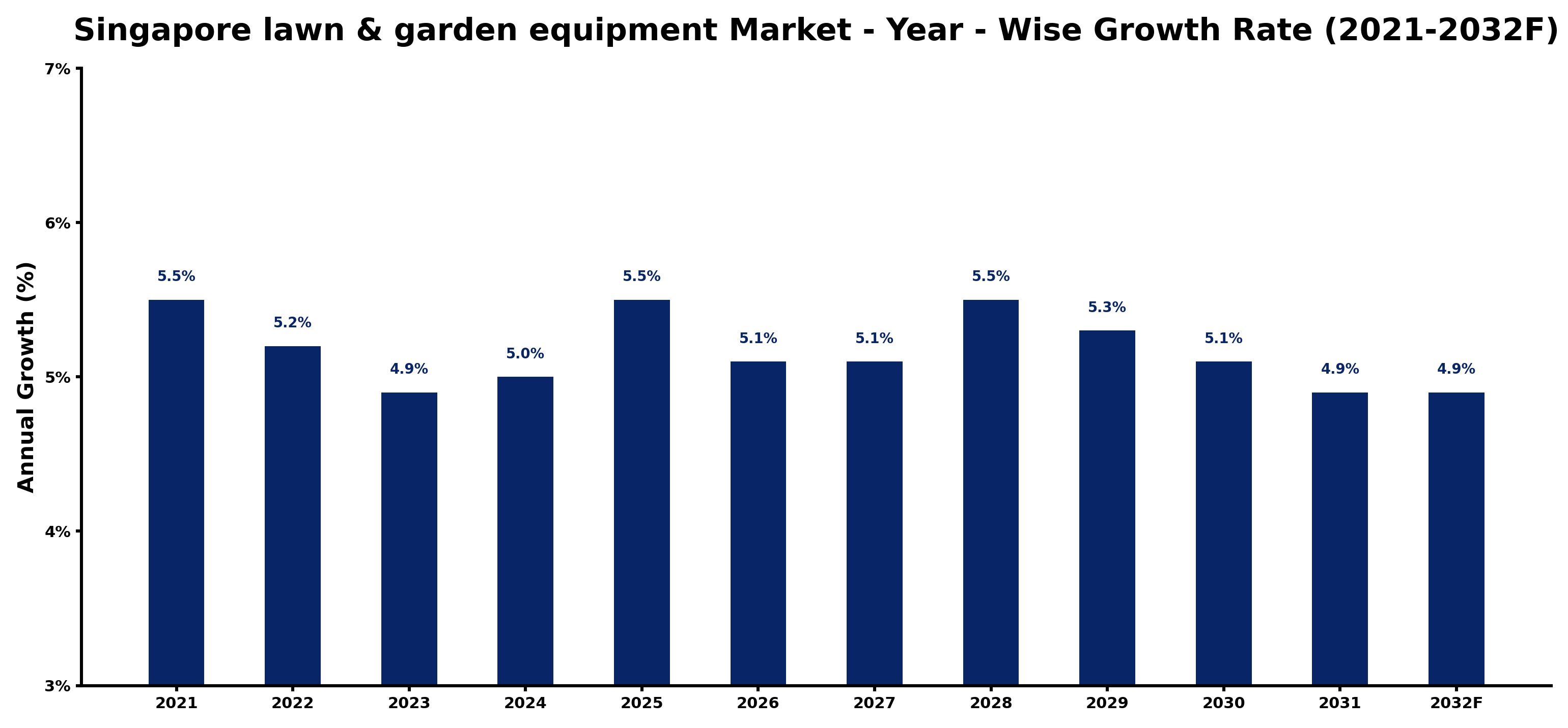
The table below presents the year‑wise growth rates along with the key drivers influencing the market
| Year | Growth Rate | Major Drivers |
| 2021 | 5.5% | Increased urban gardening popularity |
| 2022 | 5.2% | Sustainable gardening practices gained traction |
| 2023 | 4.9% | Smart gardening technology adoption rose |
| 2024 | 5.0% | Home improvement projects surged demand |
| 2025 | 5.5% | Eco-friendly products attracted consumers |
| 2026 | 5.1% | Lawn care services expanded offerings |
| 2027 | 5.1% | Community gardening initiatives flourished |
| 2028 | 5.5% | DIY gardening trends gained momentum |
| 2029 | 5.3% | Online retail channels grew significantly |
| 2030 | 5.1% | Garden landscaping services increased demand |
| 2031 | 4.9% | Seasonal gardening events attracted participation |
| 2032 | 4.9% | Homeownership rates supported gardening growth |
Note - Market size estimations and growth projections presented in this report are based on 6Wresearch's advanced forecasting approach, validated with industry datasets as of June 2026.
Singapore lawn & garden equipment Market Synopsis
The strongest force currently shaping the Singapore lawn & garden equipment market is the burgeoning interest in landscaping and outdoor aesthetics among urban dwellers. As more individuals take up gardening as a hobby, there is a marked increase in demand for specialized equipment to maintain and beautify these spaces.
Additionally, Singapore's unique urban environment, characterized by compact living spaces and a focus on greenery, drives innovation in lawn and garden equipment. This sector is witnessing a rise in compact, efficient solutions that cater to the needs of urban gardeners, ensuring that every inch of available space is utilized effectively.
Singapore lawn & garden equipment Market Key Takeaways
- The market is witnessing a sustained increase in interest towards home gardening, particularly in urban settings.
- Compact and efficient equipment is becoming a necessity due to Singapore's limited outdoor spaces.
- Government initiatives aimed at promoting sustainability and greenery bolster market growth.
- Consumer education on the use and maintenance of gardening equipment is critical for market maturation.
- Post-COVID-19 trends indicate a lasting interest in outdoor activities and gardening as leisure pursuits.
Evaluation of Restraints in Singapore lawn & garden equipment Market
While the Singapore lawn & garden equipment market is poised for growth, several restraints are noteworthy. One of the primary challenges lies in the need for compact tools that cater to the constraints of urban living. Additionally, sustainability concerns regarding emissions and noise pollution pose a barrier. Educating consumers on the appropriate use and maintenance of garden equipment remains an ongoing challenge, potentially hindering adoption rates.
Singapore lawn & garden equipment Market Trends
Current trends in the Singapore lawn & garden equipment market indicate a shift towards environmentally friendly products, including battery-operated tools that reduce emissions and noise. Moreover, smart gardening solutions that integrate technology for enhanced efficiency are gaining traction. These innovations resonate well with the tech-savvy urban population seeking to streamline their gardening efforts while minimizing their environmental footprint.
Singapore lawn & garden equipment Market Opportunities
Significant opportunities exist within the Singapore lawn & garden equipment market for companies willing to invest in R&D for compact and sustainable solutions. The rising trend of vertical gardening presents a novel avenue for equipment innovation. Additionally, partnerships with local communities and educational institutions can enhance consumer awareness and drive the adoption of gardening practices, further fueling market growth.
Government Initiatives in the Singapore lawn & garden equipment Market
The Singapore government actively promotes initiatives aimed at increasing greenery and sustainability within urban environments. Programs that encourage rooftop gardens, community gardens, and public landscaping projects are paving the way for heightened interest in gardening and lawn care. Such policies not only foster a greener city but also provide a conducive environment for the growth of the lawn & garden equipment market.
Future Insights of the Singapore lawn & garden equipment Market
Looking ahead to 2026-2032, the Singapore lawn & garden equipment market is expected to evolve significantly, driven by ongoing urbanization and sustainability trends. As consumers increasingly seek to personalize their living spaces, the demand for innovative, efficient, and eco-friendly gardening solutions will continue to rise. This period is likely to witness the integration of advanced technologies, such as IoT and smart devices, further enhancing the gardening experience for urban dwellers.
Singapore lawn & garden equipment Market Latest Developments (May 2025 - June 2026)
In recent months, the industry has seen a surge in new product launches focused on sustainable gardening practices. Companies are increasingly emphasizing the development of quieter and more energy-efficient tools to address noise pollution concerns. There is also a notable uptick in collaborations with tech firms to create smart gardening solutions, reflecting the merging of technology and traditional gardening practices.
Singapore lawn & garden equipment Market - Key Attractiveness of the Report
- 10 Years of Market Numbers
- Historical Data Starting from 2022 to 2025
- Base Year: 2025
- Forecast Data until 2032
- Key Performance Indicators Impacting the Market
- Major Upcoming Developments and Projects
Key Highlights of the Report:
- Singapore lawn & garden equipment Market Outlook
- Market Size of Singapore lawn & garden equipment Market, 2025
- Forecast of Singapore lawn & garden equipment Market, 2032F
- Historical Data and Forecast of Singapore lawn & garden equipment Revenues & Volume for the Period 2022-2032F
- Singapore lawn & garden equipment Market Trend Evolution
- Singapore lawn & garden equipment Market Drivers and Challenges
- Singapore lawn & garden equipment Price Trends
- Singapore lawn & garden equipment Porter's Five Forces
- Singapore lawn & garden equipment Industry Life Cycle
- Historical Data and Forecast of Singapore lawn & garden equipment Market Revenues & Volume By Power for the Period 2022-2032F
- Historical Data and Forecast of Singapore lawn & garden equipment Market Revenues & Volume By Manual for the Period 2022-2032F
- Historical Data and Forecast of Singapore lawn & garden equipment Market Revenues & Volume By Electric-powered for the Period 2022-2032F
- Historical Data and Forecast of Singapore lawn & garden equipment Market Revenues & Volume By Gas-powered for the Period 2022-2032F
- Historical Data and Forecast of Singapore lawn & garden equipment Market Revenues & Volume By Others for the Period 2022-2032F
- Historical Data and Forecast of Singapore lawn & garden equipment Market Revenues & Volume By End-use for the Period 2022-2032F
- Historical Data and Forecast of Singapore lawn & garden equipment Market Revenues & Volume By Residential for the Period 2022-2032F
- Historical Data and Forecast of Singapore lawn & garden equipment Market Revenues & Volume By Golf Courses for the Period 2022-2032F
- Historical Data and Forecast of Singapore lawn & garden equipment Market Revenues & Volume By Playgrounds for the Period 2022-2032F
- Historical Data and Forecast of Singapore lawn & garden equipment Market Revenues & Volume By Operation for the Period 2022-2032F
- Historical Data and Forecast of Singapore lawn & garden equipment Market Revenues & Volume By Walk-behind for the Period 2022-2032F
- Historical Data and Forecast of Singapore lawn & garden equipment Market Revenues & Volume By Riders for the Period 2022-2032F
- Historical Data and Forecast of Singapore lawn & garden equipment Market Revenues & Volume By Others for the Period 2022-2032F
- Historical Data and Forecast of Singapore lawn & garden equipment Market Revenues & Volume By Product for the Period 2022-2032F
- Historical Data and Forecast of Singapore lawn & garden equipment Market Revenues & Volume By Blowers for the Period 2022-2032F
- Historical Data and Forecast of Singapore lawn & garden equipment Market Revenues & Volume By Chain Saws for the Period 2022-2032F
- Historical Data and Forecast of Singapore lawn & garden equipment Market Revenues & Volume By Cutters & Shredders for the Period 2022-2032F
- Historical Data and Forecast of Singapore lawn & garden equipment Market Revenues & Volume By Tractors for the Period 2022-2032F
- Historical Data and Forecast of Singapore lawn & garden equipment Market Revenues & Volume By Lawn Mowers for the Period 2022-2032F
- Historical Data and Forecast of Singapore lawn & garden equipment Market Revenues & Volume By Sprinkler & Hoses for the Period 2022-2032F
- Historical Data and Forecast of Singapore lawn & garden equipment Market Revenues & Volume By Others for the Period 2022-2032F
- Singapore lawn & garden equipment Import Export Trade Statistics
- Market Opportunity Assessment By Power
- Market Opportunity Assessment By End-use
- Market Opportunity Assessment By Operation
- Market Opportunity Assessment By Product
- Singapore lawn & garden equipment Top Companies Market Share
- Singapore lawn & garden equipment Competitive Benchmarking By Technical and Operational Parameters
- Singapore lawn & garden equipment Company Profiles
- Singapore lawn & garden equipment Key Strategic Recommendations






































