Singapore LED Traffic Signs and Signals Market Size, Share & Growth Rate
The Singapore LED Traffic Signs and Signals Market was estimated at USD 219 Million in 2025 and is projected to reach USD 294 Million by 2032, growing at a CAGR of 4.3% from 2026 to 2032. This growth trajectory is primarily driven by the government's concerted efforts to enhance road safety and streamline traffic management through innovative technologies. Increasing urbanization and a push towards sustainable infrastructure will further fuel the demand for energy-efficient signaling solutions.
Singapore LED Traffic Signs and Signals Market Year-wise Growth Rate and Key Drivers
This graph highlights how the Singapore LED Traffic Signs and Signals Market has steadily grown over the years, supported by major growth factors.
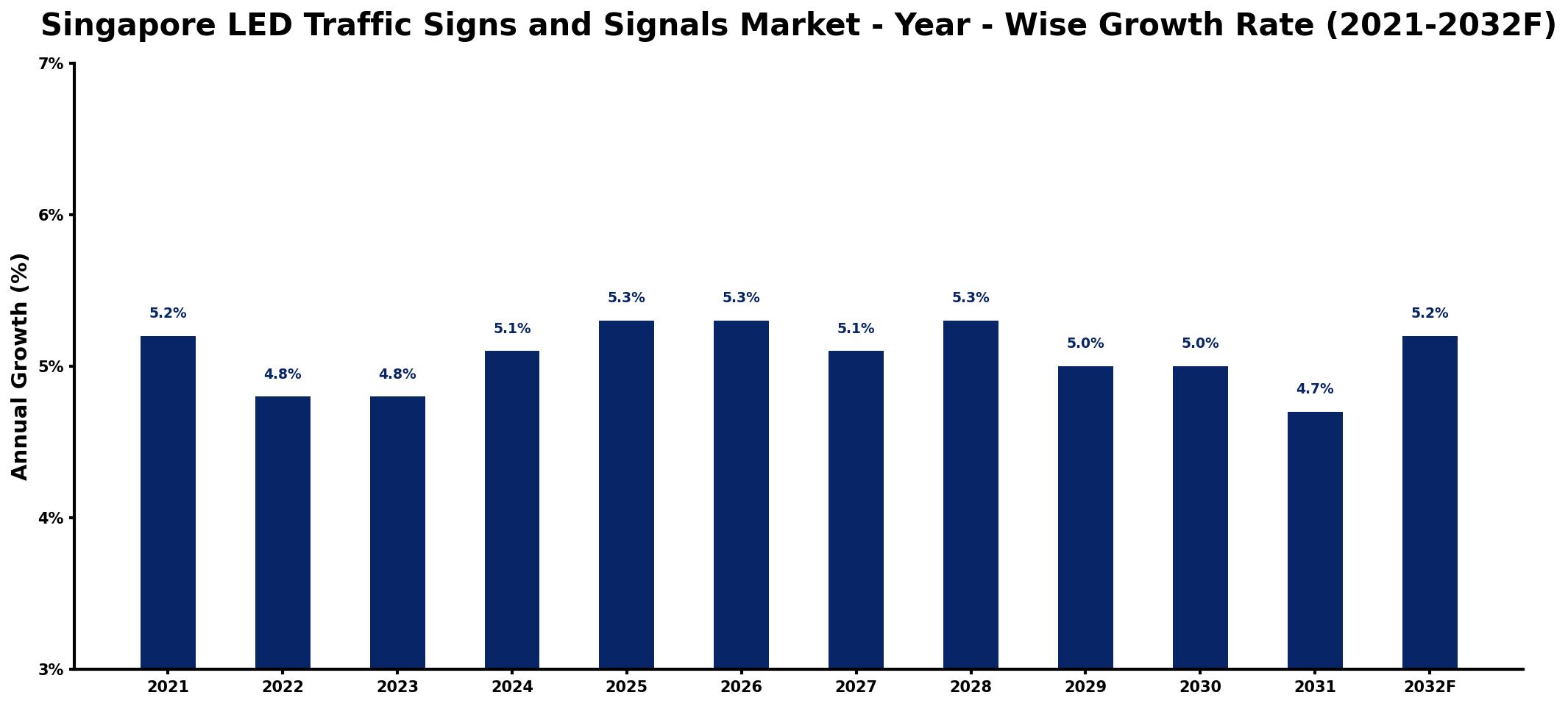
The table below presents the year‑wise growth rates along with the key drivers influencing the market
| Year | Growth Rate | Major Drivers |
| 2021 | 5.2% | Rising urbanization and infrastructure development |
| 2022 | 4.8% | Increased focus on road safety |
| 2023 | 4.8% | Growing demand for smart cities |
| 2024 | 5.1% | Technological advancements in lighting |
| 2025 | 5.3% | Government investments in modernization |
| 2026 | 5.3% | Expansion of renewable energy initiatives |
| 2027 | 5.1% | improved processing technologies adoption |
| 2028 | 5.3% | Surge in environmental awareness campaigns |
| 2029 | 5.0% | Growing public-private partnerships emerging |
| 2030 | 5.0% | Increased urban mobility solutions demand |
| 2031 | 4.7% | Emerging trends in sustainability practices |
| 2032 | 5.2% | Rising investments in infrastructure projects |
Note: Market size estimations and growth projections presented in this report are based on 6Wresearch's proprietary forecasting methodology, utilizing the latest available industry data, government publications, and primary research inputs.
Singapore LED Traffic Signs and Signals Market Synopsis
The strongest force shaping the Singapore LED Traffic Signs and Signals Market is the government's commitment to modernizing traffic infrastructure. This initiative is critical for reducing congestion and accidents while promoting sustainable urban living. Coupled with the integration of smart traffic management systems, the demand for LED solutions is set to rise significantly.
Moreover, the remarkable benefits offered by LED technology, including longer lifespan, superior visibility, and reduced energy consumption, make it a favorable choice for traffic management applications. The market is also witnessing an increasing focus on safety, which aligns well with the growing adoption of advanced LED signaling solutions.
Singapore LED Traffic Signs and Signals Market Key Takeaways
- The market is expected to grow from USD 219 Million in 2025 to USD 294 Million by 2032.
- Enhanced visibility and energy efficiency of LED technology are key growth drivers.
- Government initiatives are focused on traffic infrastructure modernization and safety improvements.
- Smart city initiatives are integrating LED solutions for improved traffic management.
- Regulatory compliance remains a significant consideration for manufacturers in the sector.
Evaluation of Restraints in Singapore LED Traffic Signs and Signals Market
While the potential for growth in the Singapore LED Traffic Signs and Signals Market is significant, there are real constraints to consider. Regulatory compliance can be a burdensome process for manufacturers, as meeting stringent government standards entails substantial costs. Additionally, the maintenance and replacement expenses associated with LED systems pose challenges for public agencies, especially given the finite lifespan of LED technologies, which can be adversely affected by environmental factors.
Singapore LED Traffic Signs and Signals Market Trends
Current trends indicate a rapid shift towards smart traffic management systems that leverage LED technology to optimize traffic flow. The integration of data analytics and real-time monitoring is becoming increasingly common, allowing for adaptive signaling based on traffic conditions. Furthermore, advancements in LED technology are focusing on improving durability and resilience, catering to the unique environmental challenges faced in urban settings.
Singapore LED Traffic Signs and Signals Market Opportunities
There are ample opportunities for investment in the Singapore LED Traffic Signs and Signals Market, particularly in the realm of infrastructure upgrades. As the government focuses on expanding smart city initiatives, stakeholders can capitalize on the demand for enhanced traffic management solutions. Additionally, collaboration opportunities between public and private sectors are likely to emerge, fostering innovation and streamlining project execution.
Government Initiatives in the Singapore LED Traffic Signs and Signals Market
The Singapore government is actively promoting public spending on traffic management systems, emphasizing the adoption of sustainable practices. Various programs aimed at modernizing traffic infrastructure include investments in LED-based signaling solutions, which are aligned with the broader goal of smart city development. These initiatives not only aim to improve road safety but also contribute to the reduction of energy consumption and carbon emissions.
Future Insights of the Singapore LED Traffic Signs and Signals Market
Looking ahead to the period from 2026 to 2032, the Singapore LED Traffic Signs and Signals Market is poised for significant advancements. With increasing urbanization, the demand for efficient and reliable traffic management solutions will continue to rise. The focus will be on integrating cutting-edge technologies that enhance traffic flow and safety, positioning LED solutions as a cornerstone of future urban infrastructure.
Singapore LED Traffic Signs and Signals Market Latest Developments (2025 - 2026)
Recent developments in the Singapore LED Traffic Signs and Signals Market have underscored the transition towards more energy-efficient traffic management solutions. Ongoing projects are emphasizing the installation of smart signaling systems that utilize data analytics to optimize traffic flows. Furthermore, public agencies are increasingly prioritizing contracts with companies that offer comprehensive maintenance plans to ensure the longevity and reliability of LED installations.
Singapore LED Traffic Signs and Signals Market - Key Attractiveness of the Report
- 10 Years of Market Numbers
- Historical Data Starting from 2022 to 2025
- Base Year: 2025
- Forecast Data until 2032
- Key Performance Indicators Impacting the Market
- Major Upcoming Developments and Projects
Key Highlights of the Report:
- Singapore LED Traffic Signs and Signals Market Outlook
- Market Size of Singapore LED Traffic Signs and Signals Market, 2025
- Forecast of Singapore LED Traffic Signs and Signals Market, 2032
- Historical Data and Forecast of Singapore LED Traffic Signs and Signals Revenues & Volume for the Period 2022-2032F
- Singapore LED Traffic Signs and Signals Market Trend Evolution
- Singapore LED Traffic Signs and Signals Market Drivers and Challenges
- Singapore LED Traffic Signs and Signals Price Trends
- Singapore LED Traffic Signs and Signals Porter's Five Forces
- Singapore LED Traffic Signs and Signals Industry Life Cycle
- Historical Data and Forecast of Singapore LED Traffic Signs and Signals Market Revenues & Volume By Product for the Period 2022-2032F
- Historical Data and Forecast of Singapore LED Traffic Signs and Signals Market Revenues & Volume By LED Traffic Signals for the Period 2022-2032F
- Historical Data and Forecast of Singapore LED Traffic Signs and Signals Market Revenues & Volume By LED Traffic Signs for the Period 2022-2032F
- Singapore LED Traffic Signs and Signals Import Export Trade Statistics
- Market Opportunity Assessment By Product
- Singapore LED Traffic Signs and Signals Top Companies Market Share
- Singapore LED Traffic Signs and Signals Competitive Benchmarking By Technical and Operational Parameters
- Singapore LED Traffic Signs and Signals Company Profiles
- Singapore LED Traffic Signs and Signals Key Strategic Recommendations






































