Singapore Letterpress Printing Machinery Market Size, Share & Growth Rate
The Singapore Letterpress Printing Machinery Market was estimated at USD 1018 Million in 2025 and is projected to reach USD 1473 Million by 2032, growing at a CAGR of 5.4% from 2026 to 2032. This growth trajectory is fueled by the sustained interest in artisanal printing techniques, particularly within niche markets such as premium stationery and bespoke packaging. As businesses increasingly seek unique ways to stand out in a competitive landscape, the distinct craftsmanship associated with letterpress printing continues to attract a dedicated clientele.
Singapore Letterpress Printing Machinery Market Year-wise Growth Rate and Key Drivers
This graph highlights how the Singapore Letterpress Printing Machinery Market has steadily grown over the years, supported by major growth factors.
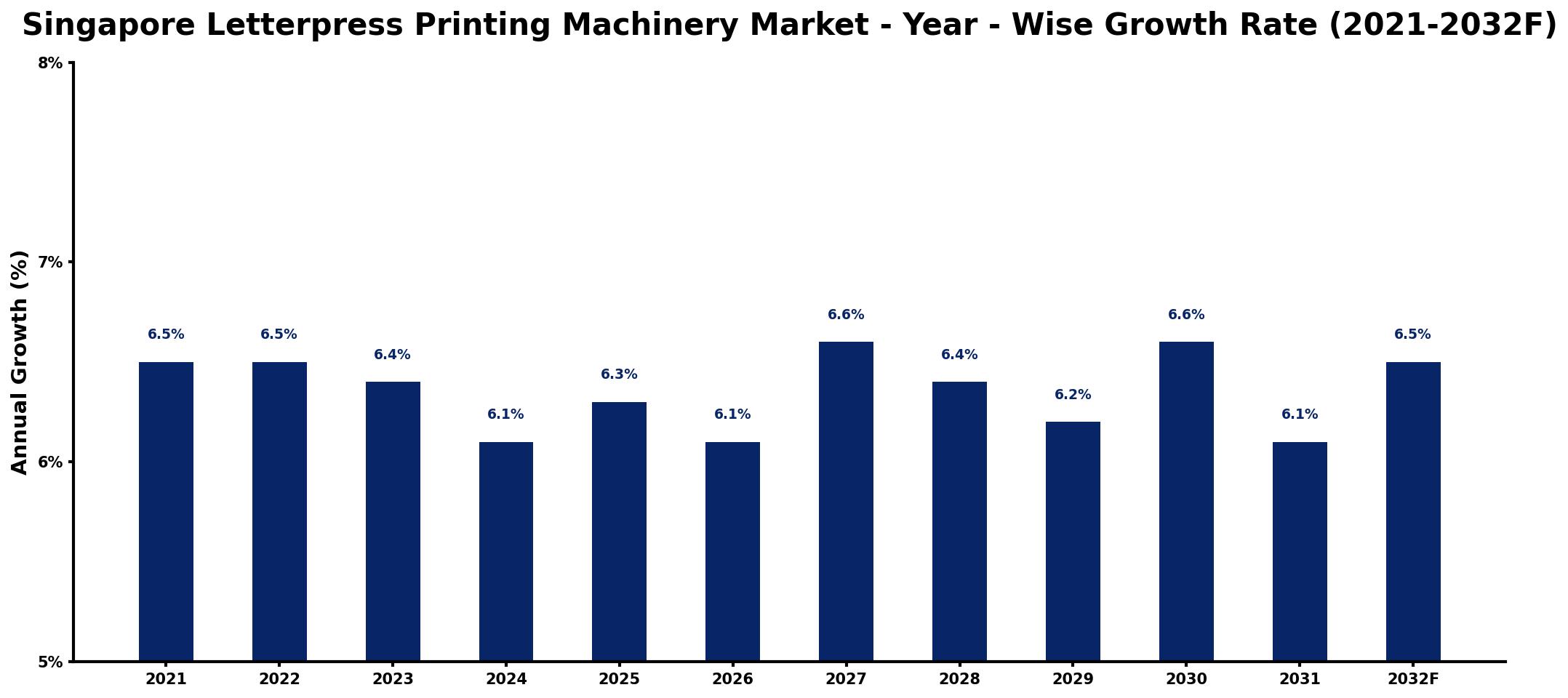
The table below presents the year‑wise growth rates along with the key drivers influencing the market
| Year | Growth Rate | Major Drivers |
| 2021 | 6.5% | rising demand for custom designs |
| 2022 | 6.5% | growth in small business sector |
| 2023 | 6.4% | increased interest in sustainability |
| 2024 | 6.1% | expansion of artisanal markets |
| 2025 | 6.3% | boost in creative industries investment |
| 2026 | 6.1% | growing popularity of niche products |
| 2027 | 6.6% | surge in local craftsmanship appreciation |
| 2028 | 6.4% | enhanced focus on eco-friendly materials |
| 2029 | 6.2% | development of online retail platforms |
| 2030 | 6.6% | increase in personalized gifting trends |
| 2031 | 6.1% | emergence of new design technologies |
| 2032 | 6.5% | rising consumer interest in heritage |
Note: Market size estimations and growth projections presented in this report are based on 6Wresearch's proprietary forecasting methodology, utilizing the latest available industry data, government publications, and primary research inputs.
Singapore Letterpress Printing Machinery Market Synopsis
In Singapore, the letterpress printing machinery market showcases a unique blend of traditional artistry and modern technological advancements. Despite the prevalence of digital alternatives, there remains a steadfast demand for the tactile quality and aesthetic appeal that letterpress provides, particularly for specialty items such as wedding invitations and artisanal packaging.
This market's resilience can be attributed to the growing emphasis on customization and premium quality among consumers. As creative industries flourish, there is a rising appreciation for meticulously crafted printed materials that enhance brand storytelling and evoke emotional connections.
Singapore Letterpress Printing Machinery Market Key Takeaways
- The market is thriving due to a shift towards high-quality, customized printing solutions.
- Artisan printing remains significant for sectors such as packaging, events, and personal stationery.
- The demand for letterpress printing is supported by a cultural appreciation for craftsmanship and detail.
- Companies are adapting by focusing on niche markets that value premium quality over volume.
- As digital printing continues to dominate, letterpress finds its strength in unique, artistic applications.
Evaluation of Restraints in Singapore Letterpress Printing Machinery Market
The Singapore letterpress printing machinery market faces notable restraints as it grapples with the realities of digitalization. While digital printing offers efficiency and cost-effectiveness, the traditional letterpress industry must counteract the declining number of skilled operators. This scarcity poses challenges to maintaining machinery and providing the level of craftsmanship that clients expect. Additionally, fluctuating raw material costs and competition from more agile digital services can hinder growth, prompting companies to innovate and specialize further in their offerings.
Singapore Letterpress Printing Machinery Market Trends
Key trends in the Singapore letterpress printing machinery market include a resurgence of interest in artisanal methods and a heightened focus on sustainability. As businesses adopt eco-friendly practices, theres a push for using sustainable materials in letterpress printing. Additionally, collaborations between printers and local artists are becoming more common, leading to a new wave of creative projects that highlight the unique capabilities of letterpress machinery. This trend not only diversifies offerings but also strengthens community ties and promotes local talent.
Singapore Letterpress Printing Machinery Market Opportunities
Emerging opportunities in the Singapore letterpress printing machinery market are vast, particularly within specialized segments like luxury packaging and limited edition art prints. Businesses can capitalize on the growing trend of personalization, catering to clients looking for distinctive printed materials that reflect their brand identity. Moreover, the rising interest in DIY craft and handmade products opens avenues for manufacturers to develop more accessible and user-friendly letterpress machinery for hobbyists and small businesses.
Government Initiatives in the Singapore Letterpress Printing Machinery Market
The Singapore government has been proactive in fostering the creative industries, which indirectly supports the letterpress printing sector. Through initiatives that promote innovation in arts and crafts, as well as grants aimed at sustainable business practices, the government encourages investments in traditional crafts like letterpress printing. These policies aim to preserve cultural heritage while also driving economic growth, reflecting a commitment to maintaining a diverse printing landscape in the country.
Future Insights of the Singapore Letterpress Printing Machinery Market
Looking ahead to 2026-2032, the Singapore letterpress printing machinery market is poised for a transformative phase. As more businesses recognize the value of unique, quality-driven print solutions, the market is likely to witness innovative machinery that merges traditional techniques with modern technology. Automation in certain aspects of the printing process may enhance efficiency without compromising the handcrafted touch. Ultimately, the future will be defined by a balance between maintaining artisanal quality and adapting to the evolving demands of the market.
Singapore Letterpress Printing Machinery Market Latest Developments (2025 - 2026)
Recent developments in the Singapore letterpress printing machinery market indicate a shift towards the integration of smart technologies. Companies are increasingly exploring automation features that allow for greater precision and efficiency while retaining the artisanal elements of letterpress printing. Additionally, there have been movements towards collaborative projects among local artists and printmakers, highlighting the ongoing relevance of letterpress techniques in contemporary creative expression.
Singapore Letterpress Printing Machinery Market - Key Attractiveness of the Report
- 10 Years of Market Numbers
- Historical Data Starting from 2022 to 2025
- Base Year: 2025
- Forecast Data until 2032
- Key Performance Indicators Impacting the Market
- Major Upcoming Developments and Projects
Key Highlights of the Report:
- Singapore Letterpress Printing Machinery Market Outlook
- Market Size of Singapore Letterpress Printing Machinery Market, 2025
- Forecast of Singapore Letterpress Printing Machinery Market, 2032
- Historical Data and Forecast of Singapore Letterpress Printing Machinery Revenues & Volume for the Period 2022-2032F
- Singapore Letterpress Printing Machinery Market Trend Evolution
- Singapore Letterpress Printing Machinery Market Drivers and Challenges
- Singapore Letterpress Printing Machinery Price Trends
- Singapore Letterpress Printing Machinery Porter's Five Forces
- Singapore Letterpress Printing Machinery Industry Life Cycle
- Historical Data and Forecast of Singapore Letterpress Printing Machinery Market Revenues & Volume By Type for the Period 2022-2032F
- Historical Data and Forecast of Singapore Letterpress Printing Machinery Market Revenues & Volume By Rotary Letterpress Machine for the Period 2022-2032F
- Historical Data and Forecast of Singapore Letterpress Printing Machinery Market Revenues & Volume By Other for the Period 2022-2032F
- Historical Data and Forecast of Singapore Letterpress Printing Machinery Market Revenues & Volume By Application for the Period 2022-2032F
- Historical Data and Forecast of Singapore Letterpress Printing Machinery Market Revenues & Volume By Securities for the Period 2022-2032F
- Historical Data and Forecast of Singapore Letterpress Printing Machinery Market Revenues & Volume By Invitation Card for the Period 2022-2032F
- Historical Data and Forecast of Singapore Letterpress Printing Machinery Market Revenues & Volume By Other for the Period 2022-2032F
- Singapore Letterpress Printing Machinery Import Export Trade Statistics
- Market Opportunity Assessment By Type
- Market Opportunity Assessment By Application
- Singapore Letterpress Printing Machinery Top Companies Market Share
- Singapore Letterpress Printing Machinery Competitive Benchmarking By Technical and Operational Parameters
- Singapore Letterpress Printing Machinery Company Profiles
- Singapore Letterpress Printing Machinery Key Strategic Recommendations






































