Singapore Lithographic Printing for Packaging Market Summary
The singapore lithographic printing for packaging market was estimated at USD 329 Million in 2025 and is projected to reach USD 441 Million by 2032, growing at a CAGR of 4.7% from 2026 to 2032.
Singapore Lithographic Printing for Packaging Market Year-wise Growth Rate and Key Drivers
This graph highlights how the Singapore Lithographic Printing for Packaging Market has steadily grown over the past five years, supported by major growth factors.
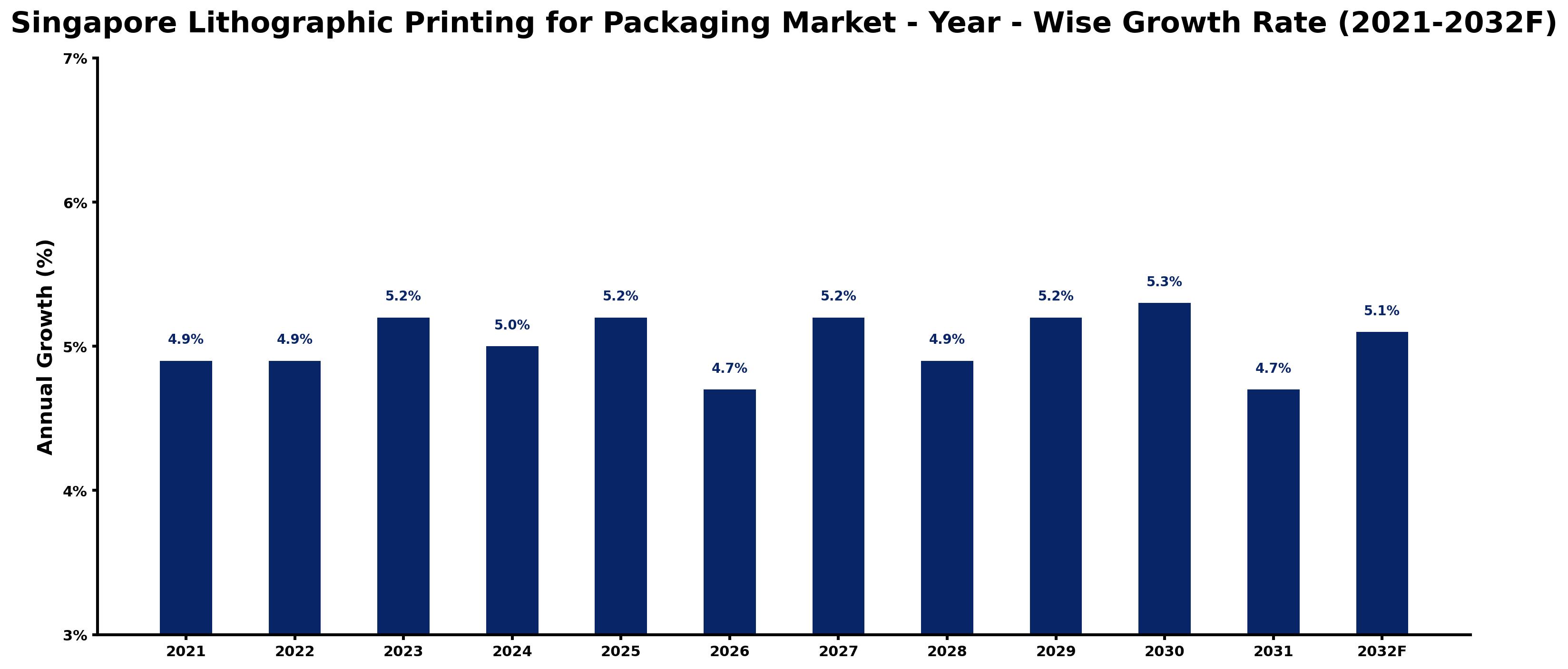
The table below presents the year wise growth rates along with the key drivers influencing the market
| Year | Growth Rate | Major Drivers |
| 2021 | 4.9% | Emerging e-commerce trends have catalyzed packaging innovation within the lithographic printing sector. |
| 2022 | 4.9% | Sustainability commitments from brands are reshaping packaging design and material choices. |
| 2023 | 5.2% | Increased personalization demands have led to bespoke printing solutions gaining traction. |
| 2024 | 5.0% | Technological investments in digital printing processes are enhancing operational efficiencies for printers. |
| 2025 | 5.2% | Supply chain resilience initiatives are pushing local sourcing for packaging materials. |
| 2026 | 4.7% | Consumer awareness around eco-friendly packaging is influencing purchasing decisions significantly. |
| 2027 | 5.2% | Emergence of smart packaging is driving new applications in the lithographic printing landscape. |
| 2028 | 4.9% | Collaborations between brands and printers are fostering innovative packaging solutions with unique designs. |
| 2029 | 5.2% | Post-pandemic economic recovery is renewing focus on brand differentiation through packaging. |
| 2030 | 5.3% | Investment in automation technologies is streamlining production and reducing turnaround times. |
| 2031 | 4.7% | Market entry of startups is introducing fresh perspectives on sustainable packaging strategies. |
| 2032 | 5.1% | Advancements in materials science are expanding possibilities for lithographic printing applications. |
Note - Market size estimations and growth projections presented in this report are based on 6Wresearch's advanced forecasting approach, validated with industry datasets as of June 2026.
Singapore Lithographic Printing for Packaging Market Synopsis
The Singapore Lithographic Printing for Packaging Market is projected to reach 4.7% and witness significant growth during the forecast period (2026-2032). Lithographic printing, also known as offset printing, has become a preferred method for commercial printing, especially in producing large volumes of high-quality prints at a cost-effective rate. This printing technique transfers images from plates to rubber blankets and subsequently to various paper stocks, making it versatile for multiple applications, including packaging, which is a key growth area.
Singapore Lithographic Printing for Packaging Market Growth Drivers
The growth of the Singapore lithographic printing for packaging market is influenced by several robust factors:
- The rising demand for sustainable packaging solutions has pushed manufacturers to adopt lithographic printing, which allows for high-quality output while being environmentally friendly.
- The post-COVID-19 era has led to a surge in e-commerce, resulting in heightened demand for printed packaging materials that appeal to online shoppers.
- Technological advancements in lithographic printing processes such as automated finishing solutions have significantly reduced production times without compromising quality.
- The introduction of new flexible packaging materials has opened avenues for increasing product differentiation, compelling manufacturers to enhance their packaging through attractive labelling.
- Increased industrial activities across Southeast Asia, particularly within the food & beverage sector, have contributed positively to the overall market outlook.
Singapore Lithographic Printing for Packaging Market Challenges and Restraints
While the Singapore lithographic printing for packaging market presents promising opportunities, several challenges are hindering its growth:
- The market is facing intense competition among local and international players, resulting in price wars that can undermine profitability.
- Raw material price volatility poses a significant risk, as fluctuations can impact the overall production costs and operational margins.
- The industry is experiencing a shortage of skilled labor, particularly during peak seasons, which can affect production timelines and quality.
- Compliance with regional regulations surrounding the use of hazardous chemicals in production processes can complicate operational efficiencies.
- The transition towards digital and flexo printing technologies may pose a long-term threat to traditional lithographic printing methods.
Singapore Lithographic Printing for Packaging Market Government Investment and Initiatives
The Singapore government plays a crucial role in bolstering the lithographic printing for packaging market through various investment strategies and initiatives. Policies aimed at promoting sustainable practices have created a conducive environment for growth. Public spending on developing advanced technologies within the sector, along with incentives for eco-friendly production methods, underscores the government's focus on encouraging innovation. Additionally, various development plans emphasizing the importance of the packaging industry have been rolled out, aiming to enhance manufacturing efficiencies and reduce environmental footprints. These efforts not only strengthen local market competitiveness but also integrate Singapore into the larger framework of the Asia-Pacific manufacturing landscape.
Singapore Lithographic Printing for Packaging Market Latest Developments (May 2025 - June 2026)
In the period between May 2025 and June 2026, the Singapore lithographic printing for packaging market observed several noteworthy developments. Companies within the sector began adopting advanced technologies to streamline operations and improve print quality, particularly in response to demands from the e-commerce sector. There was a noticeable trend towards incorporating more sustainable practices, highlighting a shift in consumer preferences towards eco-friendly packaging solutions. Furthermore, various collaborations emerged among local businesses to innovate packaging designs and implement automated solutions for enhanced efficiency. Regulatory frameworks governing the use of chemicals in printing processes were also observed to evolve, creating a more defined guideline for businesses operating in this space.
Singapore Lithographic Printing for Packaging Market - Key Attractiveness of the Report
- 10 Years of Market Numbers
- Historical Data Starting from 2022 to 2025
- Base Year: 2025
- Forecast Data until 2032
- Key Performance Indicators Impacting the Market
- Major Upcoming Developments and Projects
Key Highlights of the Report:
- Singapore Lithographic Printing for Packaging Market Outlook
- Market Size of Singapore Lithographic Printing for Packaging Market, 2025
- Forecast of Singapore Lithographic Printing for Packaging Market, 2032F
- Historical Data and Forecast of Singapore Lithographic Printing for Packaging Revenues & Volume for the Period 2022-2032F
- Singapore Lithographic Printing for Packaging Market Trend Evolution
- Singapore Lithographic Printing for Packaging Market Drivers and Challenges
- Singapore Lithographic Printing for Packaging Price Trends
- Singapore Lithographic Printing for Packaging Porter's Five Forces
- Singapore Lithographic Printing for Packaging Industry Life Cycle
- Historical Data and Forecast of Singapore Lithographic Printing for Packaging Market Revenues & Volume By Printing Ink Types for the Period 2022-2032F
- Historical Data and Forecast of Singapore Lithographic Printing for Packaging Market Revenues & Volume By U.V based for the Period 2022-2032F
- Historical Data and Forecast of Singapore Lithographic Printing for Packaging Market Revenues & Volume By Aqueous for the Period 2022-2032F
- Historical Data and Forecast of Singapore Lithographic Printing for Packaging Market Revenues & Volume By Strikethrough for the Period 2022-2032F
- Historical Data and Forecast of Singapore Lithographic Printing for Packaging Market Revenues & Volume By Material for the Period 2022-2032F
- Historical Data and Forecast of Singapore Lithographic Printing for Packaging Market Revenues & Volume By Paper & Paperboard for the Period 2022-2032F
- Historical Data and Forecast of Singapore Lithographic Printing for Packaging Market Revenues & Volume By Plastic for the Period 2022-2032F
- Historical Data and Forecast of Singapore Lithographic Printing for Packaging Market Revenues & Volume By Application for the Period 2022-2032F
- Historical Data and Forecast of Singapore Lithographic Printing for Packaging Market Revenues & Volume By Food & Beverages for the Period 2022-2032F
- Historical Data and Forecast of Singapore Lithographic Printing for Packaging Market Revenues & Volume By Cosmetics & Toiletries for the Period 2022-2032F
- Historical Data and Forecast of Singapore Lithographic Printing for Packaging Market Revenues & Volume By Healthcare for the Period 2022-2032F
- Historical Data and Forecast of Singapore Lithographic Printing for Packaging Market Revenues & Volume By Other? for the Period 2022-2032F
- Singapore Lithographic Printing for Packaging Import Export Trade Statistics
- Market Opportunity Assessment By Printing Ink Types
- Market Opportunity Assessment By Material
- Market Opportunity Assessment By Application
- Singapore Lithographic Printing for Packaging Top Companies Market Share
- Singapore Lithographic Printing for Packaging Competitive Benchmarking By Technical and Operational Parameters
- Singapore Lithographic Printing for Packaging Company Profiles
- Singapore Lithographic Printing for Packaging Key Strategic Recommendations






































