Singapore Livestock Market Size, Share & Growth Rate
The Singapore Livestock Market was estimated at USD 308 Million in 2025 and is projected to reach USD 416 Million by 2032, growing at a CAGR of 4.4% from 2026 to 2032. This growth trajectory is bolstered by increasing consumer demand for high-quality, locally sourced meat products and a shift towards sustainable farming practices. As culinary preferences evolve and dietary habits change, the market is poised to adapt to these dynamics, presenting opportunities for innovative livestock farming and meat processing solutions.
Singapore Livestock Market Year-wise Growth Rate and Key Drivers
This graph highlights how the Singapore Livestock Market has steadily grown over the years, supported by major growth factors.
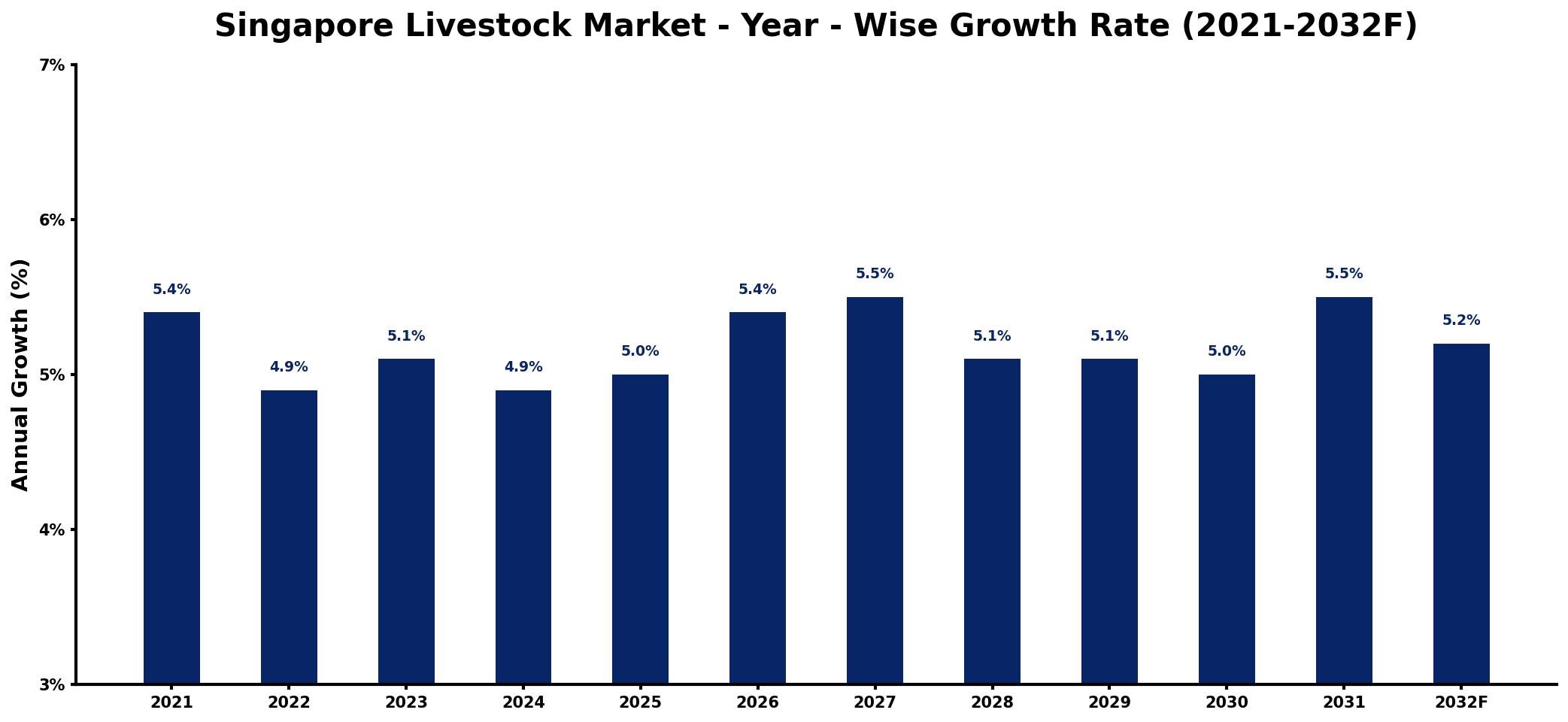
The table below presents the year‑wise growth rates along with the key drivers influencing the market
| Year | Growth Rate | Major Drivers |
| 2021 | 5.4% | Rising consumer protein demand |
| 2022 | 4.9% | Increased investment in infrastructure |
| 2023 | 5.1% | Growing export opportunities abroad |
| 2024 | 4.9% | Higher domestic consumption rates |
| 2025 | 5.0% | Expansion of organic farming practices |
| 2026 | 5.4% | Technological advancements in breeding |
| 2027 | 5.5% | Emergence of sustainable practices |
| 2028 | 5.1% | Strengthening supply chain networks |
| 2029 | 5.1% | Diversification of product offerings |
| 2030 | 5.0% | Enhanced distribution channels established |
| 2031 | 5.5% | Collaborations with international partners |
| 2032 | 5.2% | Focus on nutritional product innovation |
Note: Market size estimations and growth projections presented in this report are based on 6Wresearch's proprietary forecasting methodology, utilizing the latest available industry data, government publications, and primary research inputs.
Singapore Livestock Market Synopsis
The Singapore livestock market is characterized by a growing preference for premium meat products, reflecting the increasing sophistication of local consumers. As urbanization intensifies and lifestyles evolve, the demand for ethically sourced and high-quality meat continues to drive market development.
Sustainable farming practices and animal welfare are becoming pivotal in the market, with consumers increasingly prioritizing transparency in sourcing. This growing awareness is reshaping the landscape, compelling producers to align with stringent food safety standards while addressing ethical concerns surrounding livestock farming.
Singapore Livestock Market Key Takeaways
- The market is projected to grow steadily, influenced by changing consumer preferences and increased demand for local produce.
- Innovations in livestock farming techniques are emerging, focusing on sustainability and animal welfare.
- Challenges in supply chain management and disease prevention are critical areas requiring attention.
- COVID-19 highlighted the significance of resilient livestock production, fostering growth strategies for the future.
- Government initiatives will play a crucial role in shaping industry standards and practices.
Evaluation of Restraints in Singapore Livestock Market
Despite its promising outlook, the Singapore livestock market faces significant restraints that can impede growth. Chief among these is the complexity of supply chain management, which can lead to disruptions in product availability and quality. Furthermore, the industry's reliance on sustainable practices requires ongoing investment in technology and training, which can be challenging for smaller producers. Ethical treatment of animals and adherence to strict food safety regulations are also critical, as lapses in these areas could damage consumer trust and negatively impact market expansion.
Singapore Livestock Market Trends
Key trends shaping the Singapore livestock market include a marked shift towards organic and hormone-free meat products as health consciousness rises among consumers. Advances in animal husbandry technologies, such as precision farming and automated feeding systems, are streamlining production processes and enhancing sustainability. Additionally, the integration of traceability systems is gaining traction, allowing consumers to verify the origins of their meat, thus aligning with their preferences for ethical sourcing.
Singapore Livestock Market Opportunities
There are substantial growth and investment opportunities within the Singapore livestock market, particularly in sectors focused on innovation and sustainability. The adoption of advanced breeding techniques and sustainable farming practices can yield better quality meat products while addressing consumer demands. Additionally, partnerships between local producers and technology firms may lead to breakthroughs in food safety and logistics management, enabling the industry to enhance productivity and supply chain efficiency.
Government Initiatives in the Singapore Livestock Market
The Singapore government has been proactive in supporting the livestock market through policies aimed at enhancing food security and promoting sustainable practices. Initiatives include funding for research in animal husbandry technologies, incentives for producers adopting sustainable farming methods, and programs that encourage the ethical treatment of animals. By fostering collaboration among stakeholders, the government seeks to elevate industry standards and ensure a resilient food supply chain.
Future Insights of the Singapore Livestock Market
Looking ahead to 2026-2032, the Singapore livestock market is expected to evolve significantly, driven by a blend of technological advancements and changing consumer preferences. The emphasis on sustainability will likely intensify, with producers increasingly adopting environmentally friendly practices. Moreover, as consumer awareness surrounding health and ethical sourcing continues to grow, the demand for premium and locally sourced meat products is poised to surge, positioning the industry for dynamic growth in the years to come.
Singapore Livestock Market Latest Developments (2025 - 2026)
Recent developments in the Singapore livestock market indicate a growing focus on integrating technology into traditional farming practices. As part of efforts to enhance food security, more producers are investing in digital platforms for supply chain management. Additionally, there has been a noticeable increase in collaborations between local farms and research institutions aimed at improving livestock health and productivity, further underscoring the market's commitment to innovation and sustainability.
Singapore Livestock Market - Key Attractiveness of the Report
- 10 Years of Market Numbers
- Historical Data Starting from 2022 to 2025
- Base Year: 2025
- Forecast Data until 2032
- Key Performance Indicators Impacting the Market
- Major Upcoming Developments and Projects
Key Highlights of the Report:
- Singapore Livestock Market Outlook
- Market Size of Singapore Livestock Market, 2025
- Forecast of Singapore Livestock Market, 2032
- Historical Data and Forecast of Singapore Livestock Revenues & Volume for the Period 2022-2032F
- Singapore Livestock Market Trend Evolution
- Singapore Livestock Market Drivers and Challenges
- Singapore Livestock Price Trends
- Singapore Livestock Porter's Five Forces
- Singapore Livestock Industry Life Cycle
- Historical Data and Forecast of Singapore Livestock Market Revenues & Volume By Animal Type for the Period 2022-2032F
- Historical Data and Forecast of Singapore Livestock Market Revenues & Volume By Ruminants for the Period 2022-2032F
- Historical Data and Forecast of Singapore Livestock Market Revenues & Volume By Poultry for the Period 2022-2032F
- Historical Data and Forecast of Singapore Livestock Market Revenues & Volume By Swine for the Period 2022-2032F
- Historical Data and Forecast of Singapore Livestock Market Revenues & Volume By Aquaculture for the Period 2022-2032F
- Singapore Livestock Import Export Trade Statistics
- Market Opportunity Assessment By Animal Type
- Singapore Livestock Top Companies Market Share
- Singapore Livestock Competitive Benchmarking By Technical and Operational Parameters
- Singapore Livestock Company Profiles
- Singapore Livestock Key Strategic Recommendations






































