Singapore Log Management Market Size & Growth Rate (2026-2032)
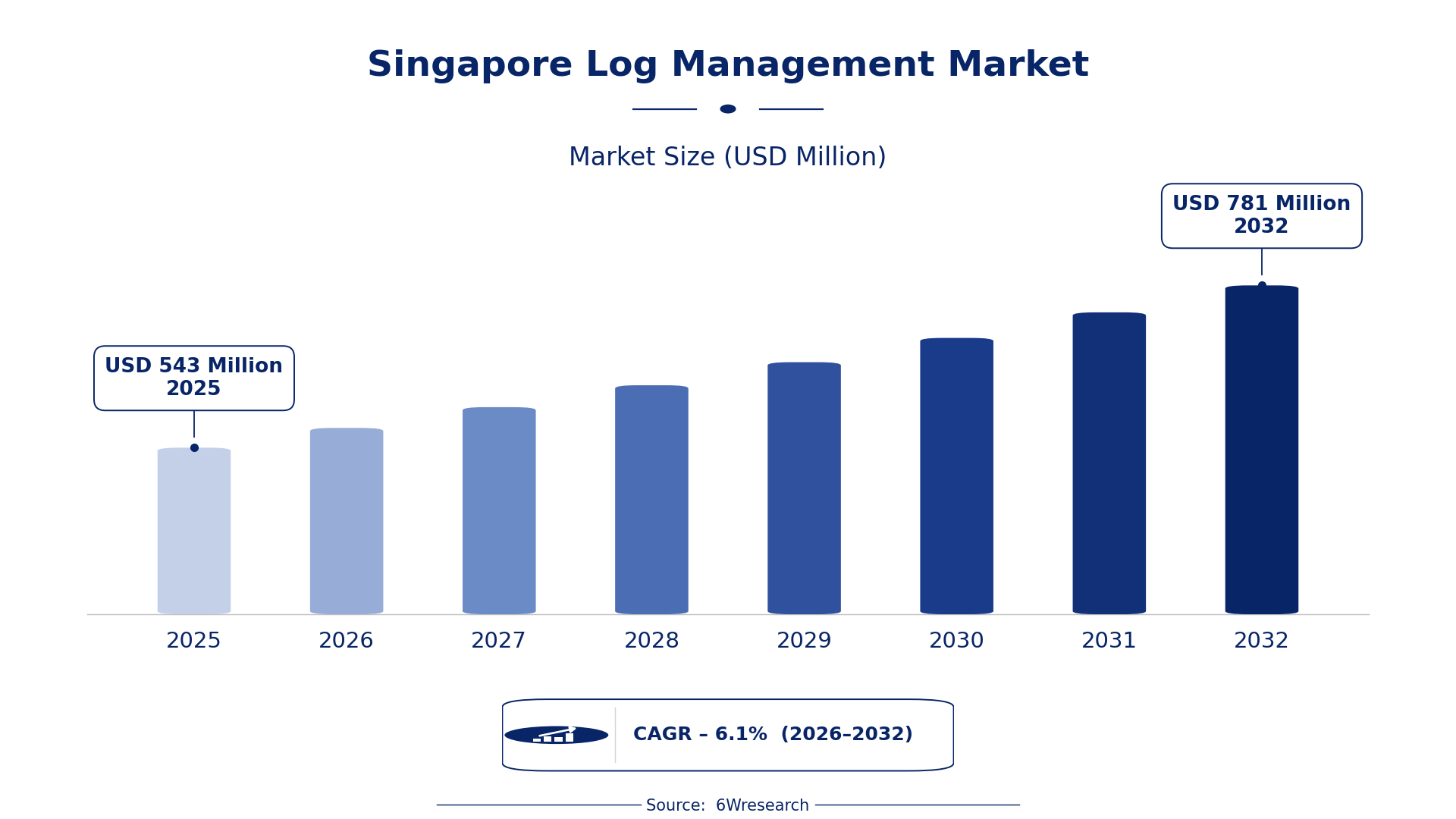
The Singapore Log Management Market was estimated at USD 543 Million in 2025 and is projected to reach USD 781 Million by 2032, growing at a CAGR of 6.1% from 2026 to 2032.
Singapore Log Management Market Synopsis
The Singapore Log Management market is rapidly evolving as organizations face increasing pressure to enhance their security protocols and comply with regulatory demands. Companies are recognizing the critical role of log management solutions in safeguarding sensitive data and maintaining operational efficiency. This heightened awareness is propelling growth and innovation within the sector.
As businesses become more digital, the volume of log data generated continues to surge, making effective log management indispensable. Enterprises are now focusing on real-time analytics and advanced monitoring capabilities to not only address security concerns but also leverage data for operational insights. This presents both challenges and opportunities in the market.
Singapore Log Management Market Year-wise Growth Rate and Key Drivers
This graph illustrates the annual growth rates of the Singapore Log Management Market from 2021 to 2032, highlighting a steady upward trajectory and projected expansion over the forecast period.
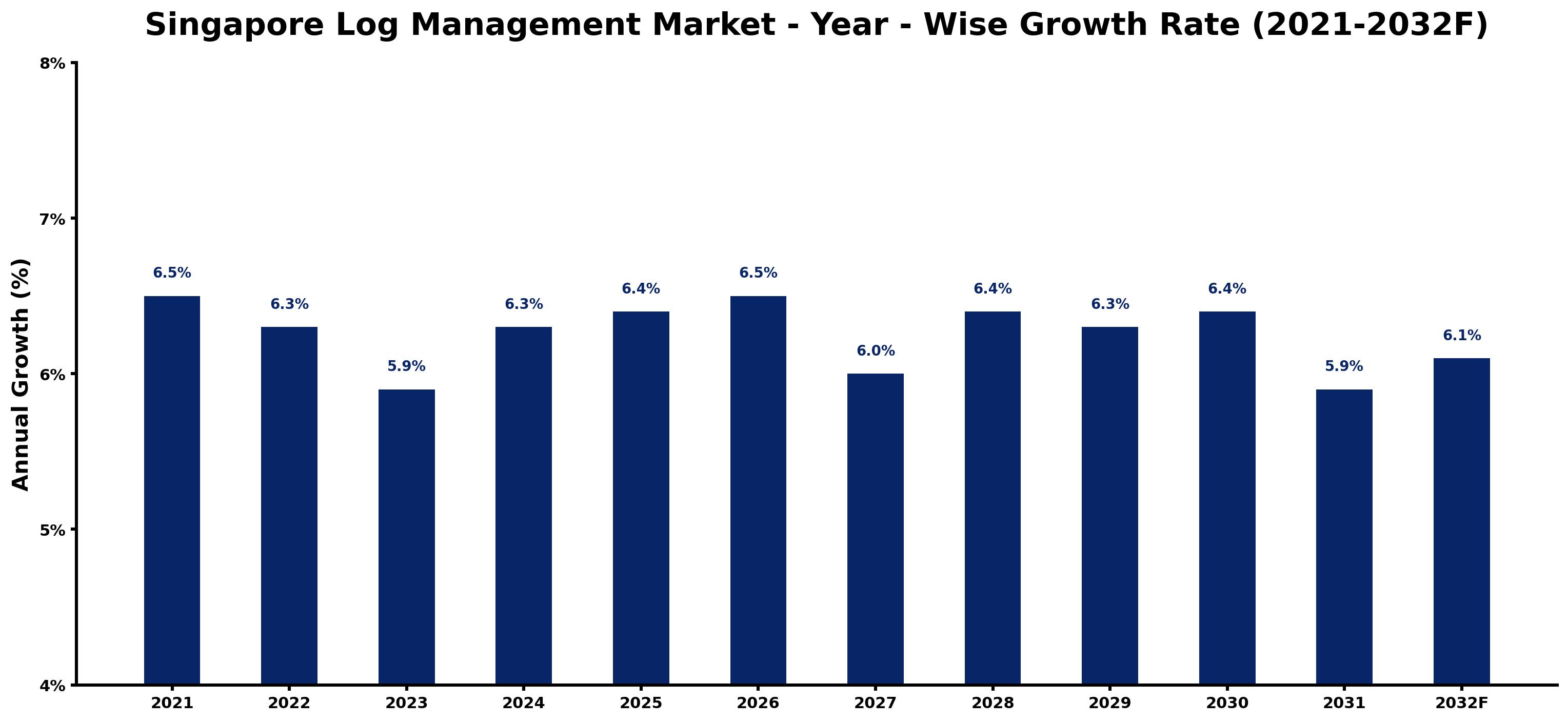
The table below presents the year‑wise growth rates along with the key drivers influencing the market
| Year | Growth Rate | Major Drivers |
| 2021 | 6.5% | Cybersecurity Agency of Singapore enhances data protection frameworks. |
| 2022 | 6.3% | Rise in data privacy regulations boosts log management needs. |
| 2023 | 5.9% | Increased cyberattacks drive demand for security monitoring solutions. |
| 2024 | 6.3% | Launch of Smart Nation initiative emphasizes digital security. |
| 2025 | 6.4% | Cloud adoption increases necessity for log analysis tools. |
| 2026 | 6.5% | Regulatory focus on transparency fuels log retention requirements. |
| 2027 | 6.0% | Telecommunications sector growth necessitates advanced log management. |
| 2028 | 6.4% | Expanded e-commerce activities highlight need for security insights. |
| 2029 | 6.3% | Financial sector's digital transformation increases log tracking demands. |
| 2030 | 6.4% | Government push for AI adoption drives analytics log usage. |
| 2031 | 5.9% | Growing public sector digitization emphasizes log management software. |
| 2032 | 6.1% | Increased scrutiny on data handling practices prompts log audits. |
Note: Market size estimations and growth projections presented in this report are based on 6Wresearch's proprietary forecasting methodology, utilizing the latest available industry data, government publications, and primary research inputs.
Singapore Log Management Market Key Takeaways
Below are some of the specific key takeaways from the market, including:
- The increasing complexity of IT environments is driving demand for comprehensive log management solutions.
- Organizations are investing in automation to efficiently handle vast amounts of log data.
- The rise in cyber threats has amplified the need for proactive monitoring and incident response capabilities.
- Compliance requirements are influencing the adoption of sophisticated log management tools.
- The market is witnessing significant interest from sectors like finance, healthcare, and government, which require stringent data protection measures.
Evaluation of Restraints in Singapore Log Management Market
One of the major restraints in the Singapore Log Management market is the resource-intensive nature of advanced analytics and real-time monitoring. Many organizations struggle to efficiently collect and analyze the growing volumes of log data from disparate sources. This challenge is compounded by the need for skilled personnel capable of interpreting complex log data, which can limit the effective implementation of log management solutions. Additionally, ensuring the security of log data itself remains a pressing concern, as it is often targeted by malicious actors aiming to erase their digital footprints.
Singapore Log Management Market Trends
Key trends shaping the Singapore Log Management market include the integration of artificial intelligence and machine learning for predictive analytics. Companies are increasingly seeking tools that not only aggregate and analyze log data but also provide actionable insights that can prevent security breaches before they occur. Another trend is the shift towards cloud-based log management solutions, driven by the need for scalability and cost-effectiveness in managing log data.
Singapore Log Management Market Opportunities
Growth opportunities lie in the expansion of service offerings that combine log management with cybersecurity solutions. As organizations prioritize holistic security frameworks, the demand for integrated solutions that address both log management and threat detection is on the rise. on top of that, as regulatory pressures increase, particularly in sectors such as finance and healthcare, companies will continue to invest in log management solutions that ensure compliance while enhancing operational efficiency.
Government Initiatives in the Singapore Log Management Market
The Singapore government is actively shaping the log management market through various policy frameworks and initiatives aimed at enhancing data security and compliance standards. The emphasis on digital transformation and cybersecurity is driving organizations to adopt advanced log management solutions. Recent regulations and initiatives reflect a concerted effort to bolster the IT infrastructure and promote best practices in log management.
- A regulatory framework introduced in 2025 mandating comprehensive log retention policies for organizations handling sensitive data.
- A national cybersecurity strategy launched recently that focuses on improving incident response capabilities through better log management practices.
- An ongoing initiative aimed at funding technology upgrades for public sector agencies to enhance their log management systems.
- A planned public-private partnership expected to develop training programs for professionals in the field of log management and cybersecurity.
Future Insights of the Singapore Log Management Market
Looking ahead to 2026-2032, the Singapore Log Management market is expected to experience steady growth fueled by the increasing complexity of IT infrastructures and the ongoing threat of cyberattacks. Companies will continue to invest in sophisticated solutions that not only meet compliance standards but also provide insights to enhance decision-making. The emphasis on automation and AI-driven analytics will likely redefine log management practices, pushing organizations towards more proactive security postures.
Singapore Log Management Market Latest Developments
In the last year, the Singapore Log Management market has seen a flurry of activity, with companies ramping up efforts to innovate and adapt to the evolving cybersecurity landscape. There has been a noticeable increase in partnerships and collaborations aimed at enhancing log management capabilities across various sectors.
- A leading technology vendor launched a new cloud-based log management solution in Q3 2023, designed to streamline log data processing and improve analytics capabilities.
- An initiative that began in early 2023 focused on integrating AI tools into existing log management systems, enabling more efficient anomaly detection.
- A major cybersecurity firm announced plans for a comprehensive training program for IT professionals, set to roll out by mid-2024, to address the skills gap in log management.
- Currently underway is a partnership between local universities and industry leaders to develop advanced log management curricula aimed at enhancing workforce readiness.
Singapore Log Management Market - Key Attractiveness of the Report
- 10 Years of Market Numbers
- Historical Data Starting from 2022 to 2025
- Base Year: 2025
- Forecast Data until 2032
- Key Performance Indicators Impacting the Market
- Major Upcoming Developments and Projects
Key Highlights of the Report:
- Singapore Log Management Market Outlook
- Market Size of Singapore Log Management Market, 2025
- Forecast of Singapore Log Management Market, 2032
- Historical Data and Forecast of Singapore Log Management Revenues & Volume for the Period 2022-2032F
- Singapore Log Management Market Trend Evolution
- Singapore Log Management Market Drivers and Challenges
- Singapore Log Management Price Trends
- Singapore Log Management Porter's Five Forces
- Singapore Log Management Industry Life Cycle
- Historical Data and Forecast of Singapore Log Management Market Revenues & Volume By Component for the Period 2022-2032F
- Historical Data and Forecast of Singapore Log Management Market Revenues & Volume By Solution for the Period 2022-2032F
- Historical Data and Forecast of Singapore Log Management Market Revenues & Volume By Services for the Period 2022-2032F
- Historical Data and Forecast of Singapore Log Management Market Revenues & Volume By Organization Size for the Period 2022-2032F
- Historical Data and Forecast of Singapore Log Management Market Revenues & Volume By Large Enterprises for the Period 2022-2032F
- Historical Data and Forecast of Singapore Log Management Market Revenues & Volume By SMEs for the Period 2022-2032F
- Historical Data and Forecast of Singapore Log Management Market Revenues & Volume By Deployment Mode for the Period 2022-2032F
- Historical Data and Forecast of Singapore Log Management Market Revenues & Volume By Cloud for the Period 2022-2032F
- Historical Data and Forecast of Singapore Log Management Market Revenues & Volume By On-premises for the Period 2022-2032F
- Historical Data and Forecast of Singapore Log Management Market Revenues & Volume By Vertical for the Period 2022-2032F
- Historical Data and Forecast of Singapore Log Management Market Revenues & Volume By IT and ITeS for the Period 2022-2032F
- Historical Data and Forecast of Singapore Log Management Market Revenues & Volume By BFSI for the Period 2022-2032F
- Historical Data and Forecast of Singapore Log Management Market Revenues & Volume By Healthcare for the Period 2022-2032F
- Historical Data and Forecast of Singapore Log Management Market Revenues & Volume By Telecom, and Education for the Period 2022-2032F
- Singapore Log Management Import Export Trade Statistics
- Market Opportunity Assessment By Component
- Market Opportunity Assessment By Organization Size
- Market Opportunity Assessment By Deployment Mode
- Market Opportunity Assessment By Vertical
- Singapore Log Management Top Companies Market Share
- Singapore Log Management Competitive Benchmarking By Technical and Operational Parameters
- Singapore Log Management Company Profiles
- Singapore Log Management Key Strategic Recommendations






































