Singapore Logic Semiconductor Market Size, Share & Growth Rate
The Singapore Logic Semiconductor Market was estimated at USD 431 Million in 2025 and is projected to reach USD 598 Million by 2032, growing at a CAGR of 4.8% from 2026 to 2032. This growth trajectory is significantly influenced by the robust demand for high-performance electronics, particularly in smartphones and IoT devices, where power efficiency and processing capabilities are paramount. Additionally, Singapore's strategic initiatives and its position as a global electronics hub further accelerate advancements within the semiconductor sector.
Singapore Logic Semiconductor Market Year-wise Growth Rate and Key Drivers
This graph highlights how the Singapore Logic Semiconductor Market has steadily grown over the years, supported by major growth factors.
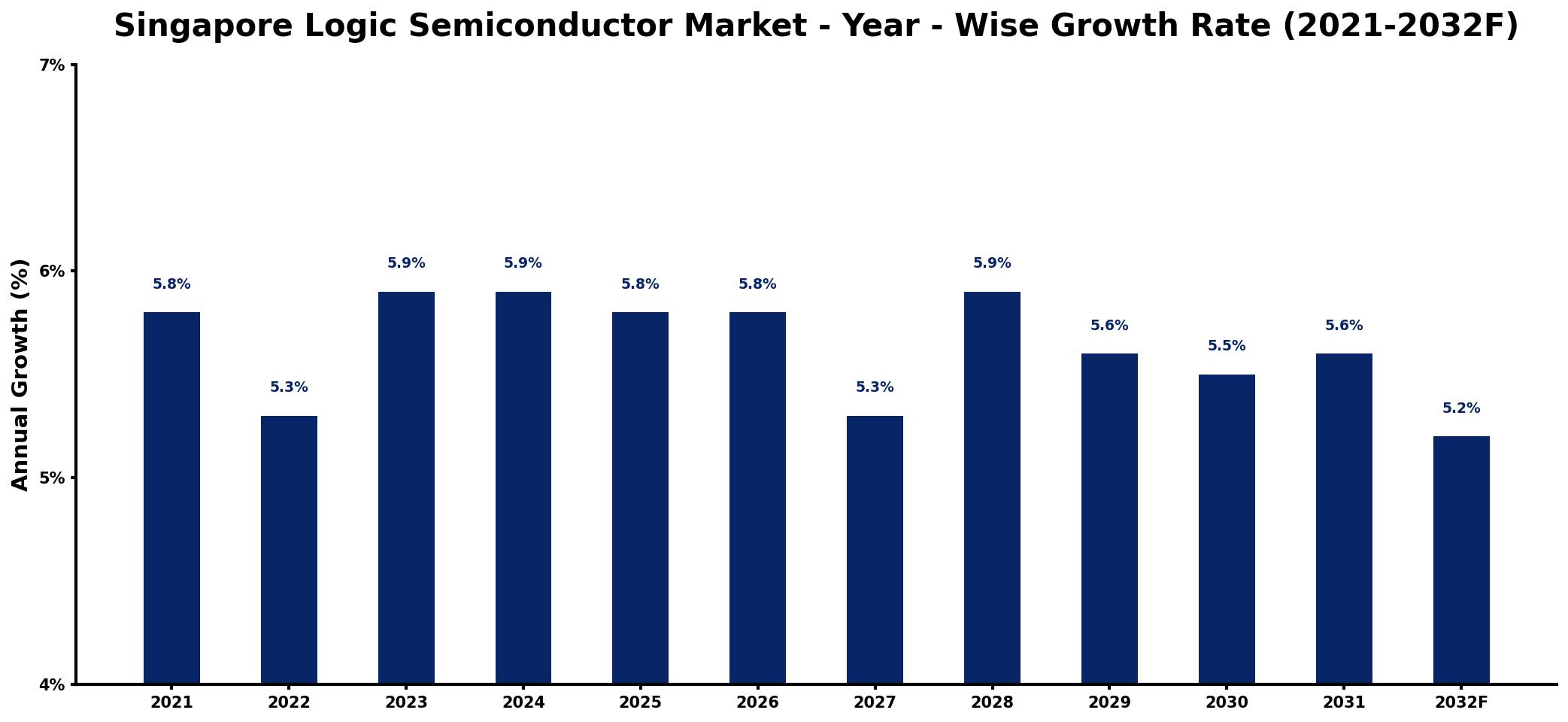
The table below presents the year‑wise growth rates along with the key drivers influencing the market
| Year | Growth Rate | Major Drivers |
| 2021 | 5.8% | Increased demand for consumer electronics |
| 2022 | 5.3% | Growth in automotive technology investments |
| 2023 | 5.9% | Expansion of 5G network infrastructure |
| 2024 | 5.9% | Rising applications in IoT devices |
| 2025 | 5.8% | Surge in renewable energy solutions |
| 2026 | 5.8% | Advancements in artificial intelligence applications |
| 2027 | 5.3% | stronger distribution network expansion |
| 2028 | 5.9% | improved raw material availability |
| 2029 | 5.6% | Increase in wearable health devices |
| 2030 | 5.5% | expanding industrial usage applications |
| 2031 | 5.6% | enhanced product quality standards |
| 2032 | 5.2% | rising procurement volume requirements |
Note: Market size estimations and growth projections presented in this report are based on 6Wresearch's proprietary forecasting methodology, utilizing the latest available industry data, government publications, and primary research inputs.
Singapore Logic Semiconductor Market Synopsis
The Singapore logic semiconductor market plays a vital role in powering the devices that form the backbone of modern technology. Advanced logic ICs are crucial in applications ranging from consumer electronics to automotive systems, reflecting a diverse spectrum of demand in the market. As companies continuously innovate to meet consumer expectations, the integration of cutting-edge technologies remains a focus, underlining the competitive nature of this market.
Singapore boasts a robust semiconductor ecosystem that includes a well-established infrastructure and strong research capabilities. This positioning fosters collaboration among various stakeholders, driving R&D and facilitating a faster time-to-market for new products. With government backing and industry expertise, the Singapore logic semiconductor market is set for substantial growth amidst the global technology landscape.
Singapore Logic Semiconductor Market Key Takeaways
- The market is driven by rising demand for advanced electronics and IoT devices.
- Singapores strategic initiatives enhance its role as a semiconductor manufacturing hub.
- Technological innovation is critical to navigating short product life cycles.
- The government's support mechanisms bolster industry growth and R&D efforts.
- Skilled workforce availability remains pivotal for sustained competitive advantage.
Evaluation of Restraints in Singapore Logic Semiconductor Market
While the Singapore logic semiconductor market shows promise, several restraints could hinder its growth trajectory. Rapid technological advancements lead to frequent product obsolescence, necessitating constant innovation that demands significant capital investment. Additionally, the challenge of securing a skilled workforce remains pressing, as talent in semiconductor design and manufacturing is in high demand but short supply. Navigating complex intellectual property laws and export regulations also presents ongoing hurdles that stakeholders must adeptly manage to maintain market competitiveness.
Singapore Logic Semiconductor Market Trends
Current trends indicate a strong push towards miniaturization and enhanced power efficiency in logic semiconductor designs. As manufacturers prioritize the integration of advanced materials, the market is witnessing a shift toward more sophisticated fabrication techniques. Furthermore, the rise of AI and machine learning technologies is prompting innovations that allow for more intelligent processing capabilities in devices, thereby expanding the application scope of logic semiconductors. In addition, sustainability considerations are increasingly shaping design and manufacturing processes, urging companies to adopt environmentally friendly practices.
Singapore Logic Semiconductor Market Opportunities
Significant growth opportunities lie within the burgeoning sectors of automotive electronics and smart devices, driven by increasing consumer demands for connectivity and automation. The integration of logic semiconductors in smart cities, autonomous vehicles, and IoT frameworks presents a fertile ground for investment and innovation. Additionally, collaborations between academia and industry can accelerate R&D efforts, leading to the development of next-generation technologies. Companies that can effectively leverage these trends will find themselves well-positioned to capture a significant share of the market.
Government Initiatives in the Singapore Logic Semiconductor Market
The Singapore government actively supports the semiconductor industry through various initiatives aimed at bolstering research and development. Policies focused on providing tax incentives and funding for innovation projects are in place to stimulate growth. Additionally, investments in infrastructure, such as state-of-the-art fabrication facilities, enhance Singapore's attractiveness as a destination for semiconductor manufacturing. The government's commitment to fostering a vibrant ecosystem ensures that the industry remains competitive on the global stage.
Future Insights of the Singapore Logic Semiconductor Market
Looking ahead to 2026-2032, the Singapore logic semiconductor market is poised for continued expansion driven by technological advancements and a growing demand for smarter electronic devices. The ongoing focus on sustainability, miniaturization, and energy efficiency will likely influence new product developments. Moreover, as the global landscape evolves with increased reliance on digital solutions, Singapore's strategic initiatives and robust research capabilities will play a critical role in maintaining its competitive edge in the international semiconductor market.
Singapore Logic Semiconductor Market Latest Developments (2025 - 2026)
Recent developments in the Singapore logic semiconductor market highlight a dynamic shift towards advanced manufacturing processes and smart technology integration. Notably, collaborations between industry leaders and research institutions are emerging, aimed at pushing the boundaries of semiconductor innovation. Furthermore, new projects focused on increasing production capabilities have been announced, signaling an optimistic outlook for the sector amid evolving global demand patterns.
Singapore Logic Semiconductor Market - Key Attractiveness of the Report
- 10 Years of Market Numbers
- Historical Data Starting from 2022 to 2025
- Base Year: 2025
- Forecast Data until 2032
- Key Performance Indicators Impacting the Market
- Major Upcoming Developments and Projects
Key Highlights of the Report:
- Singapore Logic Semiconductor Market Outlook
- Market Size of Singapore Logic Semiconductor Market, 2025
- Forecast of Singapore Logic Semiconductor Market, 2032
- Historical Data and Forecast of Singapore Logic Semiconductor Revenues & Volume for the Period 2022-2032F
- Singapore Logic Semiconductor Market Trend Evolution
- Singapore Logic Semiconductor Market Drivers and Challenges
- Singapore Logic Semiconductor Price Trends
- Singapore Logic Semiconductor Porter's Five Forces
- Singapore Logic Semiconductor Industry Life Cycle
- Historical Data and Forecast of Singapore Logic Semiconductor Market Revenues & Volume By Type for the Period 2022-2032F
- Historical Data and Forecast of Singapore Logic Semiconductor Market Revenues & Volume By Special Purpose Logic for the Period 2022-2032F
- Historical Data and Forecast of Singapore Logic Semiconductor Market Revenues & Volume By Programmable Logic Devices for the Period 2022-2032F
- Historical Data and Forecast of Singapore Logic Semiconductor Market Revenues & Volume By Display Drivers for the Period 2022-2032F
- Historical Data and Forecast of Singapore Logic Semiconductor Market Revenues & Volume By Application Specific Integrated Circuit for the Period 2022-2032F
- Historical Data and Forecast of Singapore Logic Semiconductor Market Revenues & Volume By General Purpose Logic for the Period 2022-2032F
- Historical Data and Forecast of Singapore Logic Semiconductor Market Revenues & Volume By Product Type for the Period 2022-2032F
- Historical Data and Forecast of Singapore Logic Semiconductor Market Revenues & Volume By Programmable Logic ICs for the Period 2022-2032F
- Historical Data and Forecast of Singapore Logic Semiconductor Market Revenues & Volume By Ultra-Low Power Programmable Logic ICs for the Period 2022-2032F
- Historical Data and Forecast of Singapore Logic Semiconductor Market Revenues & Volume By Mixed Signal Programmable Logic ICs for the Period 2022-2032F
- Historical Data and Forecast of Singapore Logic Semiconductor Market Revenues & Volume By High End Programmable Logic ICs for the Period 2022-2032F
- Historical Data and Forecast of Singapore Logic Semiconductor Market Revenues & Volume By Programmable Logic Device for the Period 2022-2032F
- Historical Data and Forecast of Singapore Logic Semiconductor Market Revenues & Volume By Others for the Period 2022-2032F
- Historical Data and Forecast of Singapore Logic Semiconductor Market Revenues & Volume By Industry Vertical for the Period 2022-2032F
- Historical Data and Forecast of Singapore Logic Semiconductor Market Revenues & Volume By Healthcare for the Period 2022-2032F
- Historical Data and Forecast of Singapore Logic Semiconductor Market Revenues & Volume By Communication for the Period 2022-2032F
- Historical Data and Forecast of Singapore Logic Semiconductor Market Revenues & Volume By Aerospace and Defense for the Period 2022-2032F
- Historical Data and Forecast of Singapore Logic Semiconductor Market Revenues & Volume By Automotive for the Period 2022-2032F
- Historical Data and Forecast of Singapore Logic Semiconductor Market Revenues & Volume By Consumer Electronics for the Period 2022-2032F
- Historical Data and Forecast of Singapore Logic Semiconductor Market Revenues & Volume By Telecommunication and Networking for the Period 2022-2032F
- Historical Data and Forecast of Singapore Logic Semiconductor Market Revenues & Volume By Industrial for the Period 2022-2032F
- Historical Data and Forecast of Singapore Logic Semiconductor Market Revenues & Volume By Others for the Period 2022-2032F
- Singapore Logic Semiconductor Import Export Trade Statistics
- Market Opportunity Assessment By Type
- Market Opportunity Assessment By Product Type
- Market Opportunity Assessment By Industry Vertical
- Singapore Logic Semiconductor Top Companies Market Share
- Singapore Logic Semiconductor Competitive Benchmarking By Technical and Operational Parameters
- Singapore Logic Semiconductor Company Profiles
- Singapore Logic Semiconductor Key Strategic Recommendations






































