Singapore Lubrication System Market Summary
The singapore lubrication system market was estimated at USD 155 Million in 2025 and is projected to reach USD 213 Million by 2032, growing at a CAGR of 5.2% from 2026 to 2032.
Singapore Lubrication System Market Year-wise Growth Rate and Key Drivers
This graph highlights how the Singapore Lubrication System Market has steadily grown over the past five years, supported by major growth factors.
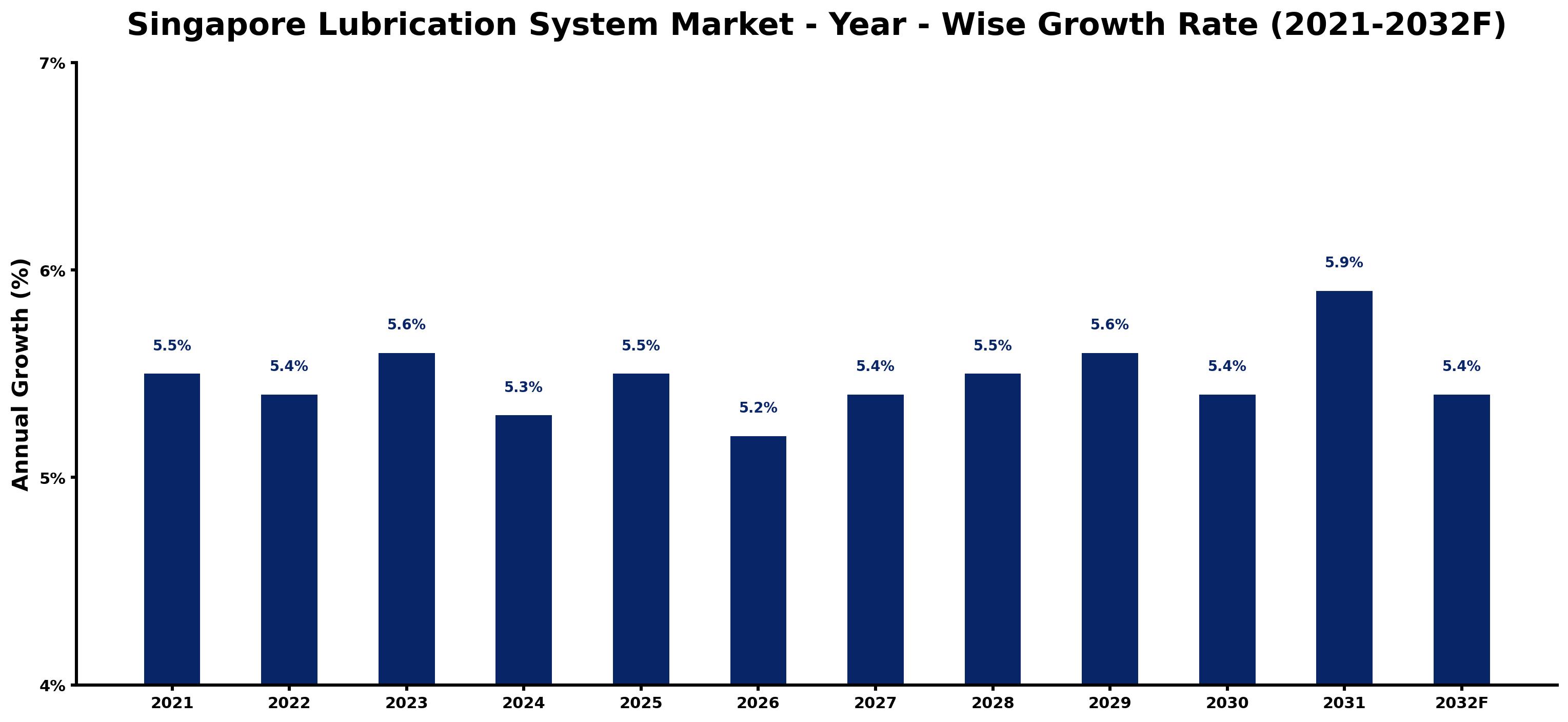
The table below presents the year wise growth rates along with the key drivers influencing the market
| Year | Growth Rate | Major Drivers |
| 2021 | 5.5% | Post-lockdown manufacturing recovery sparked interest in efficient lubrication solutions. |
| 2022 | 5.4% | Increased industrial automation in Singapore led to heightened lubrication system integration. |
| 2023 | 5.6% | Companies emphasized sustainability, focusing on eco-friendly lubrication technologies and practices. |
| 2024 | 5.3% | A surge in electric vehicle production required specialized lubrication for new technologies. |
| 2025 | 5.5% | Expanding semiconductor manufacturing necessitated precision lubrication for high-tech machinery. |
| 2026 | 5.2% | Regional competition urged local firms to adopt advanced lubrication management systems. |
| 2027 | 5.4% | Emerging industries, like robotics, created unique lubrication challenges and opportunities. |
| 2028 | 5.5% | Investment in green energy technologies increased the demand for specialized lubrication solutions. |
| 2029 | 5.6% | Digital transformation initiatives prompted manufacturers to implement predictive maintenance lubrication systems. |
| 2030 | 5.4% | International collaborations in aerospace and defense highlighted niche lubrication system requirements. |
| 2031 | 5.9% | Market players prioritized smart lubrication systems to enhance operational efficiency and safety. |
| 2032 | 5.4% | Expansion of sustainable urban mobility projects drove demand for advanced lubrication technologies. |
Note - Market size estimations and growth projections presented in this report are based on 6Wresearch's advanced forecasting approach, validated with industry datasets as of June 2026.
Singapore Lubrication System Market Synopsis
The Singapore Lubrication System Market is projected to reach 5.2% and witness significant growth during the forecast period (2026-2032). This growth is primarily driven by the rising demand for automobiles and industrial equipment. The increasing application of lubricants across various sectors, including automotive and industrial machinery, is further facilitating the expansion of the lubrication system market in Singapore. Moreover, advancements in tribology technologies alongside stringent government regulations aimed at reducing vehicular emissions are expected to enhance the market's growth prospects over the coming years.
Singapore Lubrication System Market Growth Drivers
The drivers influencing the Singapore Lubrication System Market are multifaceted and primarily stem from the following factors:
- The growing demand for automobiles necessitates efficient lubrication systems that not only enhance vehicle performance but also contribute to lower emissions. This rising automobile count increases the need for advanced lubrication technologies.
- Technological advancements in tribology enable the development of superior lubrication solutions. These innovations yield higher load-bearing capacities and reduce friction, leading to improved operational efficiency.
- Increased investments in industrial machinery and equipment also fuel demand for lubrication systems, as manufacturers seek to optimize the lifespan and performance of their assets.
- The trend of sustainable practices is pushing manufacturers to adopt environmentally-friendly lubricants, which helps in meeting regulatory standards and reducing ecological footprints.
- The introduction of synthetic oils has revolutionized lubrication technology, offering enhanced protection against wear and tear, which is critical for modern engines operating under challenging conditions.
Singapore Lubrication System Market Challenges and Restraints
Despite the positive outlook, the Singapore Lubrication System Market faces several challenges that may hinder growth:
- The high cost associated with the installation and maintenance of lubrication systems can be a significant barrier for many companies, affecting their operational budgets and investments.
- A lack of expert knowledge among operators regarding the proper use and maintenance of lubrication systems can lead to increased operational costs, resulting in frequent repairs or replacements.
- Fluctuations in raw material prices may impact the manufacturing costs of lubricating products, thus affecting overall market stability.
- A limited awareness about the benefits of advanced lubrication technologies among smaller players can impede market penetration and adoption of innovative solutions.
- Recent disruptions in supply chains due to global events may pose challenges in meeting market demands, affecting the availability of lubrication systems and components.
Singapore Lubrication System Market Government Investment and Initiatives
The government of Singapore has instituted several initiatives and policies to support the development of the lubrication system market. Investments in technology development and infrastructure enhancements aim to create a more efficient industrial ecosystem. Public spending on research and development in tribology technologies is being prioritized, fostering innovation. Furthermore, various incentives are offered to encourage manufacturers to adopt sustainable practices, including the use of environmentally-friendly lubricants. Collaborative efforts with private sectors aim to accelerate advancements in lubrication technologies, thereby boosting the overall market landscape.
Singapore Lubrication System Market Latest Developments (May 2025 - June 2026)
The period from May 2025 to June 2026 has seen significant developments within the Singapore Lubrication System Market. There has been a notable increase in research initiatives focusing on the enhancement of lubrication formulations, emphasizing the need for higher performance under extreme conditions. The government has also intensified regulatory frameworks aimed at reducing emissions, further pushing industries towards adopting advanced lubricants. Additionally, trade exhibitions and conferences have facilitated knowledge sharing on the latest technologies in lubrication systems, fostering increased collaboration among stakeholders. The market has also experienced a renewed focus on sustainability, with more players exploring environmentally-friendly options in lubricant production.
Singapore Lubrication System Market - Key Attractiveness of the Report
- 10 Years of Market Numbers
- Historical Data Starting from 2022 to 2025
- Base Year: 2025
- Forecast Data until 2032
- Key Performance Indicators Impacting the Market
- Major Upcoming Developments and Projects
Key Highlights of the Report:
- Singapore Lubrication System Market Outlook
- Market Size of Singapore Lubrication System Market, 2025
- Forecast of Singapore Lubrication System Market, 2032F
- Historical Data and Forecast of Singapore Lubrication System Revenues & Volume for the Period 2022-2032F
- Singapore Lubrication System Market Trend Evolution
- Singapore Lubrication System Market Drivers and Challenges
- Singapore Lubrication System Price Trends
- Singapore Lubrication System Porter's Five Forces
- Singapore Lubrication System Industry Life Cycle
- Historical Data and Forecast of Singapore Lubrication System Market Revenues & Volume By Line Type for the Period 2022-2032F
- Historical Data and Forecast of Singapore Lubrication System Market Revenues & Volume By Manual Lubrication Systems for the Period 2022-2032F
- Historical Data and Forecast of Singapore Lubrication System Market Revenues & Volume By Automatic Lubrication Systems for the Period 2022-2032F
- Historical Data and Forecast of Singapore Lubrication System Market Revenues & Volume By Product Type for the Period 2022-2032F
- Historical Data and Forecast of Singapore Lubrication System Market Revenues & Volume By Single-Product Lubrication Systems for the Period 2022-2032F
- Historical Data and Forecast of Singapore Lubrication System Market Revenues & Volume By Dual-Product Lubrication Systems for the Period 2022-2032F
- Historical Data and Forecast of Singapore Lubrication System Market Revenues & Volume By Multi-Product Lubrication Systems for the Period 2022-2032F
- Historical Data and Forecast of Singapore Lubrication System Market Revenues & Volume By Series Progressive for the Period 2022-2032F
- Historical Data and Forecast of Singapore Lubrication System Market Revenues & Volume By Circulating Oil for the Period 2022-2032F
- Historical Data and Forecast of Singapore Lubrication System Market Revenues & Volume By Oil & Air for the Period 2022-2032F
- Historical Data and Forecast of Singapore Lubrication System Market Revenues & Volume By Application for the Period 2022-2032F
- Historical Data and Forecast of Singapore Lubrication System Market Revenues & Volume By Cement Plants for the Period 2022-2032F
- Historical Data and Forecast of Singapore Lubrication System Market Revenues & Volume By Steel Industry for the Period 2022-2032F
- Historical Data and Forecast of Singapore Lubrication System Market Revenues & Volume By Mining & Mineral Processing for the Period 2022-2032F
- Historical Data and Forecast of Singapore Lubrication System Market Revenues & Volume By Paper & Printing for the Period 2022-2032F
- Historical Data and Forecast of Singapore Lubrication System Market Revenues & Volume By Automotive for the Period 2022-2032F
- Historical Data and Forecast of Singapore Lubrication System Market Revenues & Volume By Industrial Machine & Machine Tools for the Period 2022-2032F
- Historical Data and Forecast of Singapore Lubrication System Market Revenues & Volume By Construction Machines Machines for the Period 2022-2032F
- Singapore Lubrication System Import Export Trade Statistics
- Market Opportunity Assessment By Line Type
- Market Opportunity Assessment By Product Type
- Market Opportunity Assessment By Application
- Singapore Lubrication System Top Companies Market Share
- Singapore Lubrication System Competitive Benchmarking By Technical and Operational Parameters
- Singapore Lubrication System Company Profiles
- Singapore Lubrication System Key Strategic Recommendations






































