Singapore Magnesium Metal Market Size, Share & Growth Rate
The Singapore Magnesium Metal Market was estimated at USD 325 Million in 2025 and is projected to reach USD 431 Million by 2032, growing at a CAGR of 4.1% from 2026 to 2032. This positive trajectory is largely fueled by the growing demand from the automotive and aerospace industries, where magnesium's lightweight and high-strength properties are increasingly sought after. Additionally, the push for sustainable manufacturing and fuel efficiency is driving industries to favor magnesium alloys over heavier alternatives.
Singapore Magnesium Metal Market Year-wise Growth Rate and Key Drivers
This graph highlights how the Singapore Magnesium Metal Market has steadily grown over the years, supported by major growth factors.
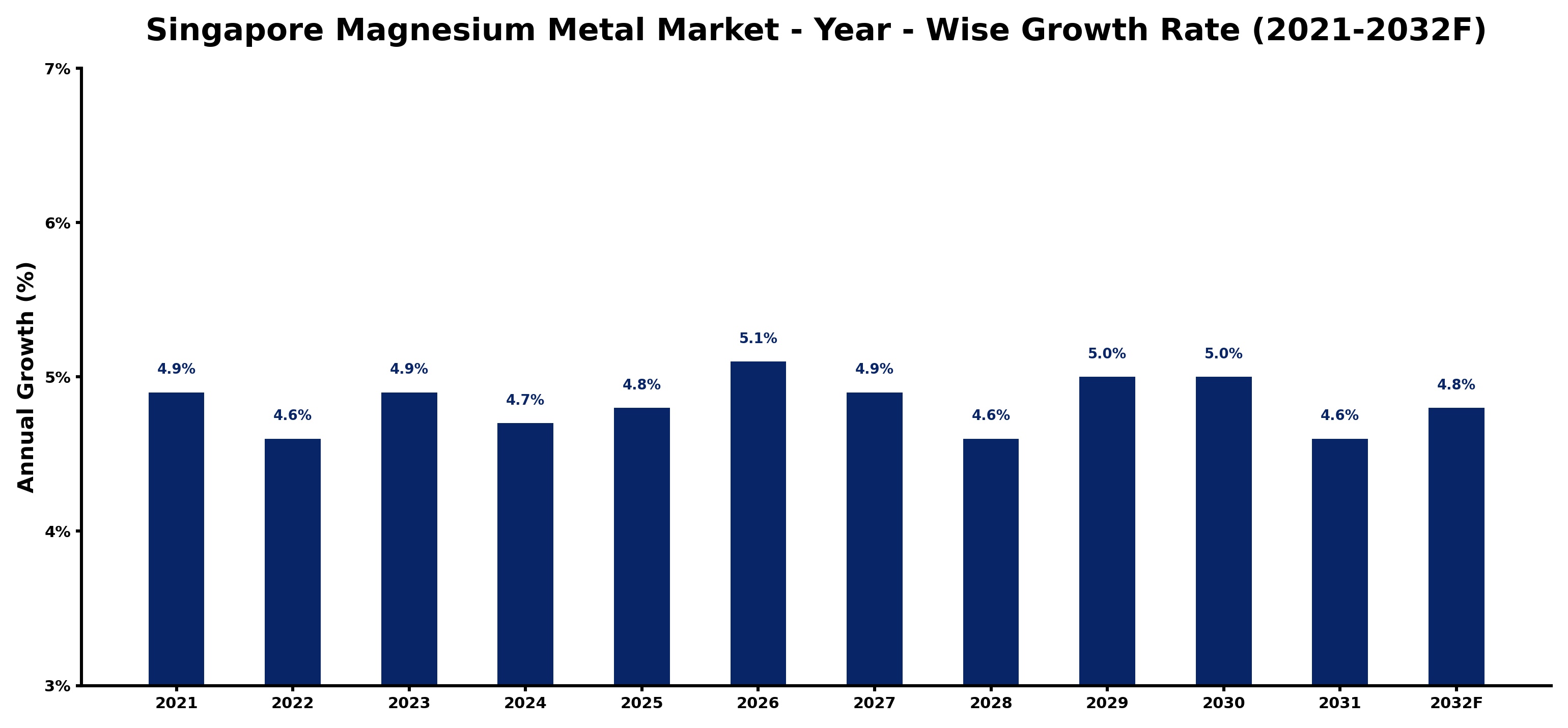
The table below presents the year‑wise growth rates along with the key drivers influencing the market
| Year | Growth Rate | Major Drivers |
| 2021 | 4.9% | Automotive sector demand increased |
| 2022 | 4.6% | Aerospace applications expanded significantly |
| 2023 | 4.9% | Construction projects drove consumption |
| 2024 | 4.7% | Electronics manufacturing growth accelerated |
| 2025 | 4.8% | Renewable energy initiatives boosted usage |
| 2026 | 5.1% | Medical applications gained traction |
| 2027 | 4.9% | Transportation sector growth enhanced demand |
| 2028 | 4.6% | Defense industry requirements surged upward |
| 2029 | 5.0% | Consumer electronics innovation expanded |
| 2030 | 5.0% | Lightweight materials adoption increased |
| 2031 | 4.6% | Research and development investments rose |
| 2032 | 4.8% | Sustainability trends influenced market growth |
Note - Market size estimations and growth projections presented in this report are based on 6Wresearch's advanced forecasting approach, validated with industry datasets as of June 2026.
Singapore Magnesium Metal Market Synopsis
The Singapore magnesium metal market is showing promising signs of growth, attributed to the heightened utilization of magnesium in automotive, aerospace, and electronics sectors. With Singapore's robust manufacturing capabilities, the market is well-positioned to meet the rising demand for lightweight materials that contribute to enhanced fuel efficiency.
In recent years, the emphasis on environmental sustainability has significantly influenced production and consumption patterns. As companies strive to develop more eco-friendly practices, the adoption of magnesium alloys is expected to gain traction, aligning with global initiatives aimed at reducing carbon footprints.
Singapore Magnesium Metal Market Key Takeaways
- Market growth is primarily driven by the automotive and aerospace industries' demand for lightweight materials.
- Magnesium's unique properties make it a favored choice for enhancing fuel efficiency in vehicles and aircraft.
- Regulatory pressures surrounding environmental impact may shape production practices in the future.
- Technological advancements in magnesium alloys are anticipated to unlock new application areas, particularly in electronics.
- Investment in advanced manufacturing technologies in Singapore is a crucial element for market growth.
Evaluation of Restraints in Singapore Magnesium Metal Market
Despite its growth potential, the Singapore magnesium metal market faces significant restraints. Fluctuations in raw material prices can create volatility, affecting production costs and, consequently, market pricing. Additionally, the emergence of alternative materials poses a competitive threat, challenging magnesium's traditional stronghold in various applications. Environmental regulations related to production processes are also becoming stricter, which could impose additional operational challenges for manufacturers aiming to comply while remaining cost-effective.
Singapore Magnesium Metal Market Trends
Current trends highlight a move towards the integration of advanced manufacturing technologies in the production of magnesium metal. Innovations aimed at improving the properties and applications of magnesium alloys are becoming prevalent. Moreover, there is a notable increase in collaborations between stakeholders to enhance the research and development landscape, thereby driving improvements in product offerings. Sustainability initiatives are also shaping consumer preferences, as industries increasingly seek eco-friendly materials.
Singapore Magnesium Metal Market Opportunities
Opportunities abound in the Singapore magnesium metal market, particularly through investments in R&D for new alloy formulations that improve performance characteristics. Emerging markets in the Asia-Pacific region present avenues for expansion, as demand for magnesium alloys rises in tandem with economic growth. Furthermore, advancements in recycling technologies and circular economy practices can potentially lower costs and reduce environmental impact, creating competitive advantages for innovative companies.
Government Initiatives in the Singapore Magnesium Metal Market
The Singapore government has implemented several initiatives aimed at fostering sustainable industrial practices. Public funding and support for research projects related to lightweight materials and advanced manufacturing technologies are key elements in promoting the magnesium metal sector. Additionally, regulatory frameworks are evolving to encourage environmentally responsible production processes, which can aid the magnesium industry in achieving compliance while enhancing its market position.
Future Insights of the Singapore Magnesium Metal Market
Looking ahead to 2026-2032, the Singapore magnesium metal market is poised for sustainable growth driven by a combination of technological innovation and increasing demand from key industries. As manufacturers embrace magnesium's advantages for weight reduction and fuel efficiency, the industry will likely see an uptick in research initiatives aimed at unlocking further potential applications. Additionally, the global emphasis on sustainability will continue to shape market dynamics, encouraging stakeholders to explore eco-friendly practices and enhance the overall attractiveness of magnesium as a material of choice.
Singapore Magnesium Metal Market Latest Developments (May 2025 - June 2026)
Recent developments in the Singapore magnesium metal market indicate a surge in collaborative efforts among industry stakeholders. Strategic partnerships aimed at enhancing research capabilities have been established, focusing on advanced alloys and improved manufacturing techniques. There has also been a noticeable increase in government initiatives aimed at supporting sustainable practices in magnesium production, aligning with global environmental commitments. These developments signify a vibrant industry landscape poised for continued advancement.
Singapore Magnesium Metal Market - Key Attractiveness of the Report
- 10 Years of Market Numbers
- Historical Data Starting from 2022 to 2025
- Base Year: 2025
- Forecast Data until 2032
- Key Performance Indicators Impacting the Market
- Major Upcoming Developments and Projects
Key Highlights of the Report:
- Singapore Magnesium Metal Market Outlook
- Market Size of Singapore Magnesium Metal Market, 2025
- Forecast of Singapore Magnesium Metal Market, 2032
- Historical Data and Forecast of Singapore Magnesium Metal Revenues & Volume for the Period 2022-2032F
- Singapore Magnesium Metal Market Trend Evolution
- Singapore Magnesium Metal Market Drivers and Challenges
- Singapore Magnesium Metal Price Trends
- Singapore Magnesium Metal Porter's Five Forces
- Singapore Magnesium Metal Industry Life Cycle
- Historical Data and Forecast of Singapore Magnesium Metal Market Revenues & Volume By Application for the Period 2022-2032F
- Historical Data and Forecast of Singapore Magnesium Metal Market Revenues & Volume By Die Casting for the Period 2022-2032F
- Historical Data and Forecast of Singapore Magnesium Metal Market Revenues & Volume By Aluminum Alloys for the Period 2022-2032F
- Historical Data and Forecast of Singapore Magnesium Metal Market Revenues & Volume By Titanium Reduction for the Period 2022-2032F
- Historical Data and Forecast of Singapore Magnesium Metal Market Revenues & Volume By Iron & Steel Making for the Period 2022-2032F
- Historical Data and Forecast of Singapore Magnesium Metal Market Revenues & Volume By Others for the Period 2022-2032F
- Historical Data and Forecast of Singapore Magnesium Metal Market Revenues & Volume By End-user Industry for the Period 2022-2032F
- Historical Data and Forecast of Singapore Magnesium Metal Market Revenues & Volume By Automotive for the Period 2022-2032F
- Historical Data and Forecast of Singapore Magnesium Metal Market Revenues & Volume By Aerospace for the Period 2022-2032F
- Historical Data and Forecast of Singapore Magnesium Metal Market Revenues & Volume By Electronics for the Period 2022-2032F
- Historical Data and Forecast of Singapore Magnesium Metal Market Revenues & Volume By Sports for the Period 2022-2032F
- Historical Data and Forecast of Singapore Magnesium Metal Market Revenues & Volume By Medical for the Period 2022-2032F
- Historical Data and Forecast of Singapore Magnesium Metal Market Revenues & Volume By Others for the Period 2022-2032F
- Singapore Magnesium Metal Import Export Trade Statistics
- Market Opportunity Assessment By Application
- Market Opportunity Assessment By End-user Industry
- Singapore Magnesium Metal Top Companies Market Share
- Singapore Magnesium Metal Competitive Benchmarking By Technical and Operational Parameters
- Singapore Magnesium Metal Company Profiles
- Singapore Magnesium Metal Key Strategic Recommendations






































