Singapore Meat Packaging Market Summary
The singapore meat packaging market was estimated at USD 244 Million in 2025 and is projected to reach USD 326 Million by 2032, growing at a CAGR of 5.0% from 2026 to 2032.
Singapore Meat Packaging Market Year-wise Growth Rate and Key Drivers
This graph highlights how the Singapore Meat Packaging Market has steadily grown over the past five years, supported by major growth factors.
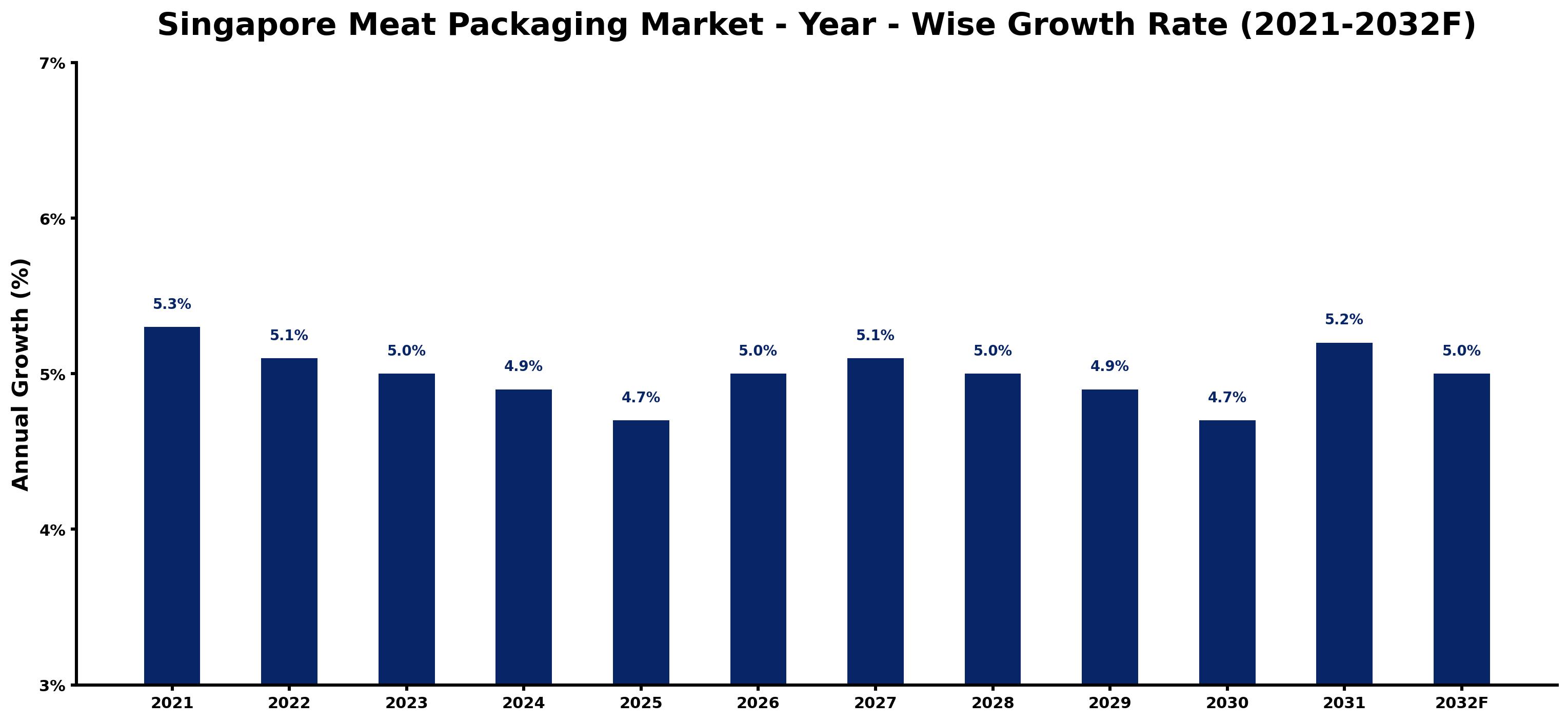
The table below presents the year wise growth rates along with the key drivers influencing the market
| Year | Growth Rate | Major Drivers |
| 2021 | 5.3% | COVID-19 influenced consumers' focus on food safety and packaging integrity. |
| 2022 | 5.1% | Sustainability considerations now impact packaging materials and design strategies significantly. |
| 2023 | 5.0% | Local sourcing trends push meatpackers to adopt more transparent supply chain practices. |
| 2024 | 4.9% | Innovative packaging solutions offer extended shelf life and improved product freshness. |
| 2025 | 4.7% | Health consciousness among consumers boosts demand for high-quality, preservative-free meats. |
| 2026 | 5.0% | E-commerce growth fuels investments in user-friendly and eco-friendly packaging formats. |
| 2027 | 5.1% | Technological integration enhances operational efficiency in meat packaging processes significantly. |
| 2028 | 5.0% | Demand for customized packaging solutions becomes essential for competitive differentiation. |
| 2029 | 4.9% | Emerging veganism trends necessitate innovative packaging adaptations for plant-based alternatives. |
| 2030 | 4.7% | Collaboration between local producers and packagers strengthens community-focused market strategies. |
| 2031 | 5.2% | Integration of smart packaging technology provides real-time monitoring and consumer engagement. |
| 2032 | 5.0% | Global supply chain disruptions prompt refinements in local production and packaging strategies. |
Note - Market size estimations and growth projections presented in this report are based on 6Wresearch's advanced forecasting approach, validated with industry datasets as of June 2026.
Singapore Meat Packaging Market Synopsis
The Singapore Meat Packaging Market is projected to reach 5.0% and witness significant growth during the forecast period (2026-2032). This growth trajectory is largely fueled by evolving consumer preferences toward packaged processed foods, which align with the increasing demand for convenience and hygiene in food consumption.
Singapore Meat Packaging Market Growth Drivers
Several critical factors are driving the expansion of the Singapore Meat Packaging Market. Firstly, the surge in demand for processed meat products reflects a shift in consumer behavior toward ready-to-eat and easily accessible food options. As lifestyles become busier, consumers favor products that offer both convenience and affordability, prompting local producers to enhance their packaging solutions accordingly.
- The increasing health awareness among consumers regarding food safety has significantly influenced purchasing decisions, thereby elevating the importance of innovative and hygienic packaging designs.
- Additionally, advancements in packaging technology have enabled the use of cost-effective materials, which appeal to manufacturers striving to maintain competitive pricing while ensuring product quality.
- Government initiatives aimed at bolstering the food processing industry through investment and support for local enterprises have also positively impacted the market.
- Rising competition from foreign investments in the Singaporean meat market is further propelling growth, introducing novel products and packaging options that align with consumer expectations.
- Overall, the interrelation between consumer demands and technological innovations presents a robust growth opportunity for the meat packaging sector in Singapore.
Singapore Meat Packaging Market Trends and Opportunities
The Singapore Meat Packaging Market is experiencing a shift characterized by the adoption of sustainable and environmentally friendly packaging solutions. As consumers become increasingly conscious of their environmental impact, the industry's focus is turning towards biodegradable materials and recyclable packaging designs. This represents not only a response to consumer demand but also a strategic alignment with global sustainability trends.
- The integration of smart packaging technologies, such as QR codes and freshness indicators, is becoming prevalent, enhancing customer engagement and ensuring product freshness.
- There is also a growing trend towards personalized packaging, which caters to individual consumer preferences, thus driving brand loyalty and repeat purchases.
- The meat packaging market is poised to benefit from cross-industry collaborations that aim to innovate packaging materials and designs to improve shelf-life while ensuring food safety.
- Additionally, the expansion of e-commerce channels for meat products necessitates advanced packaging solutions that ensure product integrity during transit, presenting further opportunities for packaging innovation.
- Ultimately, the convergence of technology, consumer preferences, and sustainability will shape future developments within the Singapore Meat Packaging Market.
Singapore Meat Packaging Market Challenges and Restraints
Despite the promising growth outlook, the Singapore Meat Packaging Market faces several challenges that could hinder its development. A primary concern is the high cost associated with modern packaging technologies, which can be a significant barrier for small-scale producers who may struggle to invest in advanced solutions.
- Moreover, the lack of skilled labor in the packaging industry poses a challenge, as it limits the capacity of businesses to effectively implement innovative packaging practices.
- Additionally, compliance with stringent food safety regulations necessitates continuous investment in packaging technology and materials, which can strain financial resources for smaller players.
- The fluctuating prices of raw materials can further impact production costs and profitability, creating an unpredictable environment for packaging manufacturers.
- Lastly, external factors such as global supply chain disruptions can adversely affect the availability of packaging materials, posing a threat to market stability.
Singapore Meat Packaging Market Government Investment and Initiatives
The Singaporean government has identified the meat packaging sector as a critical component of its food security strategy. As such, various initiatives have been introduced to stimulate growth and innovation within this industry. Investments are being channeled into research and development to encourage the adoption of advanced packaging technologies that enhance safety and sustainability.
- Policies promoting public-private partnerships aim to foster collaboration between government agencies and the private sector to improve overall efficiency in meat processing and packaging.
- Grants and funding programs are available to support local entrepreneurs in deploying advanced packaging solutions, thereby enhancing competitiveness in the market.
- Regulatory frameworks are being updated to ensure that safety standards for meat packaging are maintained, providing a conducive environment for industry growth.
- The government is also encouraging sustainability initiatives through incentives for companies adopting eco-friendly packaging materials.
- Overall, the proactive stance of the Singaporean government is creating a favorable landscape for the meat packaging market's growth.
Singapore Meat Packaging Market Latest Developments (May 2025 - June 2026)
Recent developments in the Singapore Meat Packaging Market indicate a growing emphasis on technology integration. Companies are increasingly investing in automation and smart packaging solutions to enhance operational efficiency and product freshness. Additionally, collaborations between technology firms and packaging manufacturers are emerging, focusing on innovating packing methods that meet both consumer demands and regulatory standards.
- The trend toward sustainability is expected to continue, with increased focus on reducing plastic usage and enhancing the recyclability of packaging materials.
- Research initiatives aimed at developing biodegradable alternatives to conventional meat packaging are gaining traction, reflecting a shift towards eco-conscious product offerings.
- Consumer feedback mechanisms are being established by various producers to ensure that new packaging solutions align with market expectations, thereby enhancing customer satisfaction.
- Trade shows and industry events are playing a crucial role in showcasing advancements in packaging technology, fostering an environment of collaboration and innovation in the sector.
- As a result, the Singapore Meat Packaging Market is poised for transformative changes that could redefine its operational landscape.
Singapore Meat Packaging Market - Key Attractiveness of the Report
- 10 Years of Market Numbers
- Historical Data Starting from 2022 to 2025
- Base Year: 2025
- Forecast Data until 2032
- Key Performance Indicators Impacting the Market
- Major Upcoming Developments and Projects
Key Highlights of the Report:
- Singapore Meat Packaging Market Outlook
- Market Size of Singapore Meat Packaging Market, 2025
- Forecast of Singapore Meat Packaging Market, 2032F
- Historical Data and Forecast of Singapore Meat Packaging Revenues & Volume for the Period 2022-2032F
- Singapore Meat Packaging Market Trend Evolution
- Singapore Meat Packaging Market Drivers and Challenges
- Singapore Meat Packaging Price Trends
- Singapore Meat Packaging Porter's Five Forces
- Singapore Meat Packaging Industry Life Cycle
- Historical Data and Forecast of Singapore Meat Packaging Market Revenues & Volume By Material Type for the Period 2022-2032F
- Historical Data and Forecast of Singapore Meat Packaging Market Revenues & Volume By Plastic for the Period 2022-2032F
- Historical Data and Forecast of Singapore Meat Packaging Market Revenues & Volume By Rigid? for the Period 2022-2032F
- Historical Data and Forecast of Singapore Meat Packaging Market Revenues & Volume By Metal for the Period 2022-2032F
- Historical Data and Forecast of Singapore Meat Packaging Market Revenues & Volume By Meat Type for the Period 2022-2032F
- Historical Data and Forecast of Singapore Meat Packaging Market Revenues & Volume By Fresh and Frozen for the Period 2022-2032F
- Historical Data and Forecast of Singapore Meat Packaging Market Revenues & Volume By Processed for the Period 2022-2032F
- Historical Data and Forecast of Singapore Meat Packaging Market Revenues & Volume By Ready to Eat for the Period 2022-2032F
- Singapore Meat Packaging Import Export Trade Statistics
- Market Opportunity Assessment By Material Type
- Market Opportunity Assessment By Meat Type
- Singapore Meat Packaging Top Companies Market Share
- Singapore Meat Packaging Competitive Benchmarking By Technical and Operational Parameters
- Singapore Meat Packaging Company Profiles
- Singapore Meat Packaging Key Strategic Recommendations






































