Singapore Metal Shredder Machine Market Size, Share & Growth Rate
The Singapore Metal Shredder Machine Market was estimated at USD 237 Million in 2025 and is projected to reach USD 318 Million by 2032, growing at a CAGR of 4.3% from 2026 to 2032. This growth trajectory is driven by a robust push towards recycling initiatives and stringent waste management regulations in Singapore. As industries increasingly focus on sustainability, the efficiency and effectiveness of metal shredder machines play a critical role in addressing metal waste.
Singapore Metal Shredder Machine Market Year-wise Growth Rate and Key Drivers
This graph highlights how the Singapore Metal Shredder Machine Market has steadily grown over the years, supported by major growth factors.
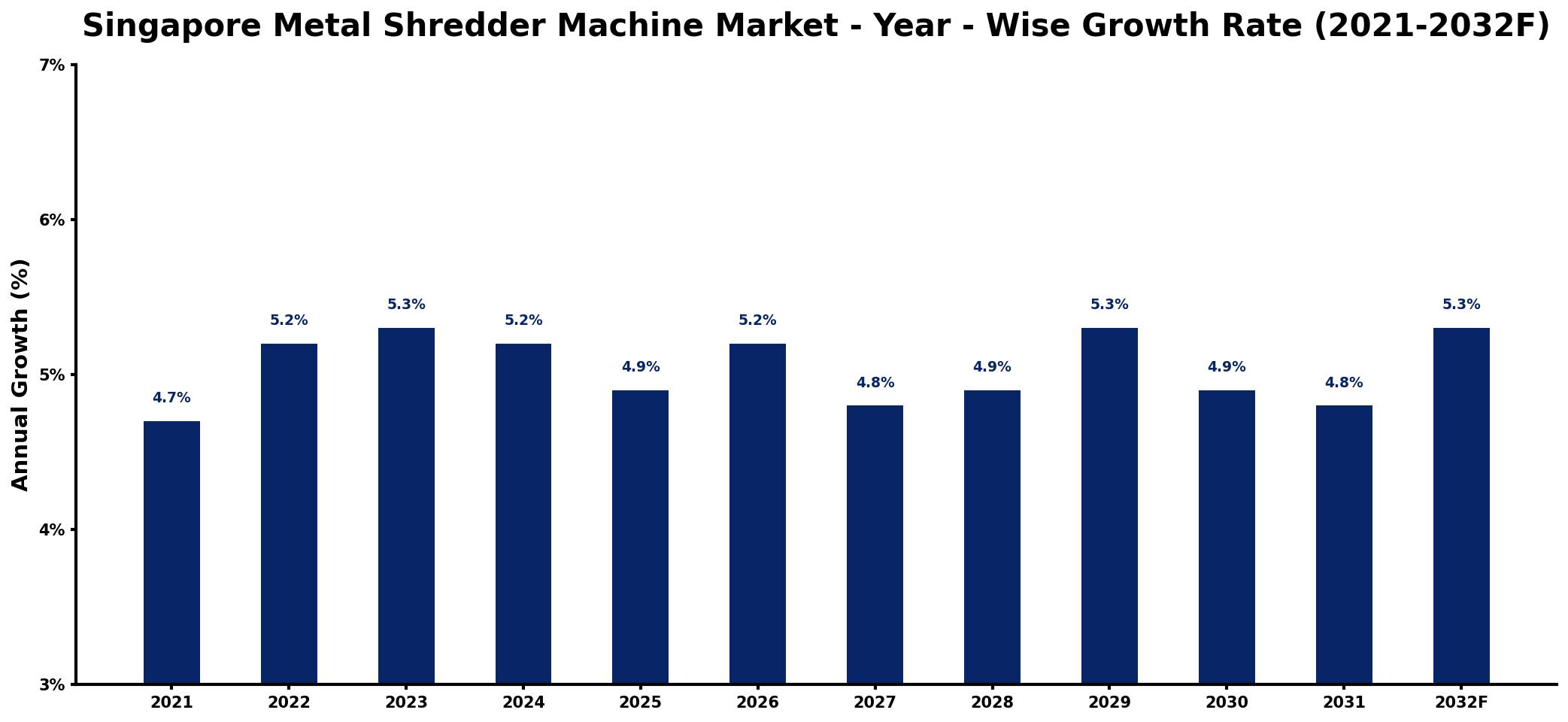
The table below presents the year‑wise growth rates along with the key drivers influencing the market
| Year | Growth Rate | Major Drivers |
| 2021 | 4.7% | Rising recycling industry investments |
| 2022 | 5.2% | Increased environmental regulations implemented |
| 2023 | 5.3% | Growing demand for sustainable practices |
| 2024 | 5.2% | Expansion of construction waste management |
| 2025 | 4.9% | Emerging technologies in waste processing |
| 2026 | 5.2% | Higher consumer awareness on recycling |
| 2027 | 4.8% | Enhanced industrial waste management solutions |
| 2028 | 4.9% | Strengthened partnerships in recycling sector |
| 2029 | 5.3% | Demand surge in urban development |
| 2030 | 4.9% | Focus on circular economy initiatives |
| 2031 | 4.8% | Government incentives for recycling programs |
| 2032 | 5.3% | Investments in renewable resource recovery |
Note: Market size estimations and growth projections presented in this report are based on 6Wresearch's proprietary forecasting methodology, utilizing the latest available industry data, government publications, and primary research inputs.
Singapore Metal Shredder Machine Market Synopsis
The metal shredder machine market in Singapore is currently witnessing dynamic changes fueled by an escalating demand for advanced recycling solutions. Industries are prioritizing resource conservation, and metal shredders are crucial for transforming scrap into reusable material, bolstering both economic and environmental benefits.
The increasing regulatory framework surrounding waste management is significantly influencing market dynamics. As firms strive to comply with these regulations, the need for efficient shredding machinery becomes more pronounced, driving investments in innovative and high-capacity solutions that promise enhanced performance and sustainability.
Singapore Metal Shredder Machine Market Key Takeaways
- The market is propelled by the need for sustainable recycling practices amid rising environmental regulations.
- Technological advancements are enhancing shredder efficiency and automation, attracting more investment.
- Scrap metal production from manufacturing processes provides a continuous feedstock for shredders.
- Competition within the recycling sector is fostering innovation, driving companies to upgrade their machinery.
- Post-pandemic recovery in the waste management sector is contributing to renewed growth in demand.
Evaluation of Restraints in Singapore Metal Shredder Machine Market
While the Singapore Metal Shredder Machine Market presents considerable opportunities, it grapples with challenges that could impede its growth. Stringent recycling regulations necessitate ongoing adaptations in shredding technologies to effectively differentiate and process various metal types. This requires significant investment in research and development, which can be a financial strain, particularly for smaller enterprises. Additionally, the rapid evolution of sensor and automation technologies demands constant innovation, making it difficult for firms to maintain competitive edges amid the rising costs of technology integration and skilled labor.
Singapore Metal Shredder Machine Market Trends
Emerging trends are shaping the landscape of the metal shredder machine market in Singapore. One notable trend is the integration of smart technology into shredding equipment, enabling real-time monitoring and data analytics to optimize performance. Furthermore, there is a growing preference for energy-efficient models that reduce operational costs and environmental impact, aligning with the country's sustainability objectives. Additionally, manufacturers are increasingly adopting modular designs that enhance flexibility and adaptability in various recycling processes.
Singapore Metal Shredder Machine Market Opportunities
Significant growth opportunities lie within the Singapore Metal Shredder Machine Market. As industries seek to embrace circular economy principles, there is an increasing demand for shredders that not only process metal waste but also integrate seamlessly into broader recycling workflows. Innovations focused on producing lighter, more durable machines that require less maintenance can also attract investments. Furthermore, partnerships between manufacturers and recycling firms can facilitate the development of customized shredding solutions tailored to specific industry needs, expanding market reach.
Government Initiatives in the Singapore Metal Shredder Machine Market
The Singaporean government has implemented various initiatives aimed at enhancing recycling rates and waste management efficiency. Policies promoting environmental sustainability are driving investments into advanced waste processing technologies, including metal shredders. Additionally, public spending on waste infrastructure improvements and incentives for companies that adopt eco-friendly practices are encouraging the growth of the metal shredding sector. These initiatives reflect the governments commitment to fostering a sustainable economy.
Future Insights of the Singapore Metal Shredder Machine Market
Looking ahead, the Singapore Metal Shredder Machine Market is poised for significant advancements. Between 2026 and 2032, we expect to see an increasing adoption of AI and automation in shredding processes, elevating operational efficiency. The rise of eco-conscious consumerism will further pressurize industries to adopt sustainable practices, propelling demand for cutting-edge shredding solutions. With continuous innovations in technology and a supportive regulatory environment, the market is likely to grow as manufacturers seek to align with global sustainability goals.
Singapore Metal Shredder Machine Market Latest Developments (2025 - 2026)
Recent developments in the Singapore metal shredder machine market indicate a strong focus on enhancing product efficiency and sustainability. Companies are increasingly investing in research to develop machines that incorporate smarter technologies, aimed at reducing energy consumption and improving operational longevity. Additionally, there has been a noticeable trend towards collaborations between manufacturers and research institutions to drive innovations and address regulatory challenges, ensuring a competitive edge in the evolving market landscape.
Singapore Metal Shredder Machine Market - Key Attractiveness of the Report
- 10 Years of Market Numbers
- Historical Data Starting from 2022 to 2025
- Base Year: 2025
- Forecast Data until 2032
- Key Performance Indicators Impacting the Market
- Major Upcoming Developments and Projects
Key Highlights of the Report:
- Singapore Metal Shredder Machine Market Outlook
- Market Size of Singapore Metal Shredder Machine Market, 2025
- Forecast of Singapore Metal Shredder Machine Market, 2032
- Historical Data and Forecast of Singapore Metal Shredder Machine Revenues & Volume for the Period 2022-2032F
- Singapore Metal Shredder Machine Market Trend Evolution
- Singapore Metal Shredder Machine Market Drivers and Challenges
- Singapore Metal Shredder Machine Price Trends
- Singapore Metal Shredder Machine Porter's Five Forces
- Singapore Metal Shredder Machine Industry Life Cycle
- Historical Data and Forecast of Singapore Metal Shredder Machine Market Revenues & Volume By Type for the Period 2022-2032F
- Historical Data and Forecast of Singapore Metal Shredder Machine Market Revenues & Volume By Mechanical Shredder Machine for the Period 2022-2032F
- Historical Data and Forecast of Singapore Metal Shredder Machine Market Revenues & Volume By Shock Wave Shredder Machine for the Period 2022-2032F
- Historical Data and Forecast of Singapore Metal Shredder Machine Market Revenues & Volume By Application for the Period 2022-2032F
- Historical Data and Forecast of Singapore Metal Shredder Machine Market Revenues & Volume By Iron and Steel for the Period 2022-2032F
- Historical Data and Forecast of Singapore Metal Shredder Machine Market Revenues & Volume By Aluminum and Copper for the Period 2022-2032F
- Historical Data and Forecast of Singapore Metal Shredder Machine Market Revenues & Volume By Non-Ferrous Metals for the Period 2022-2032F
- Singapore Metal Shredder Machine Import Export Trade Statistics
- Market Opportunity Assessment By Type
- Market Opportunity Assessment By Application
- Singapore Metal Shredder Machine Top Companies Market Share
- Singapore Metal Shredder Machine Competitive Benchmarking By Technical and Operational Parameters
- Singapore Metal Shredder Machine Company Profiles
- Singapore Metal Shredder Machine Key Strategic Recommendations






































