Singapore Military Radar Market Size, Share & Growth Rate
The Singapore Military Radar Market was estimated at USD 358 Million in 2025 and is projected to reach USD 521 Million by 2032, growing at a CAGR of 5.5% from 2026 to 2032. This growth trajectory is significantly influenced by Singapore's commitment to defense modernization and the pressing need for advanced radar systems to bolster national security. The region's geopolitical landscape further necessitates sophisticated surveillance and early warning capabilities, enhancing the demand for reliable radar solutions.
Singapore Military Radar Market Year-wise Growth Rate and Key Drivers
This graph highlights how the Singapore Military Radar Market has steadily grown over the years, supported by major growth factors.
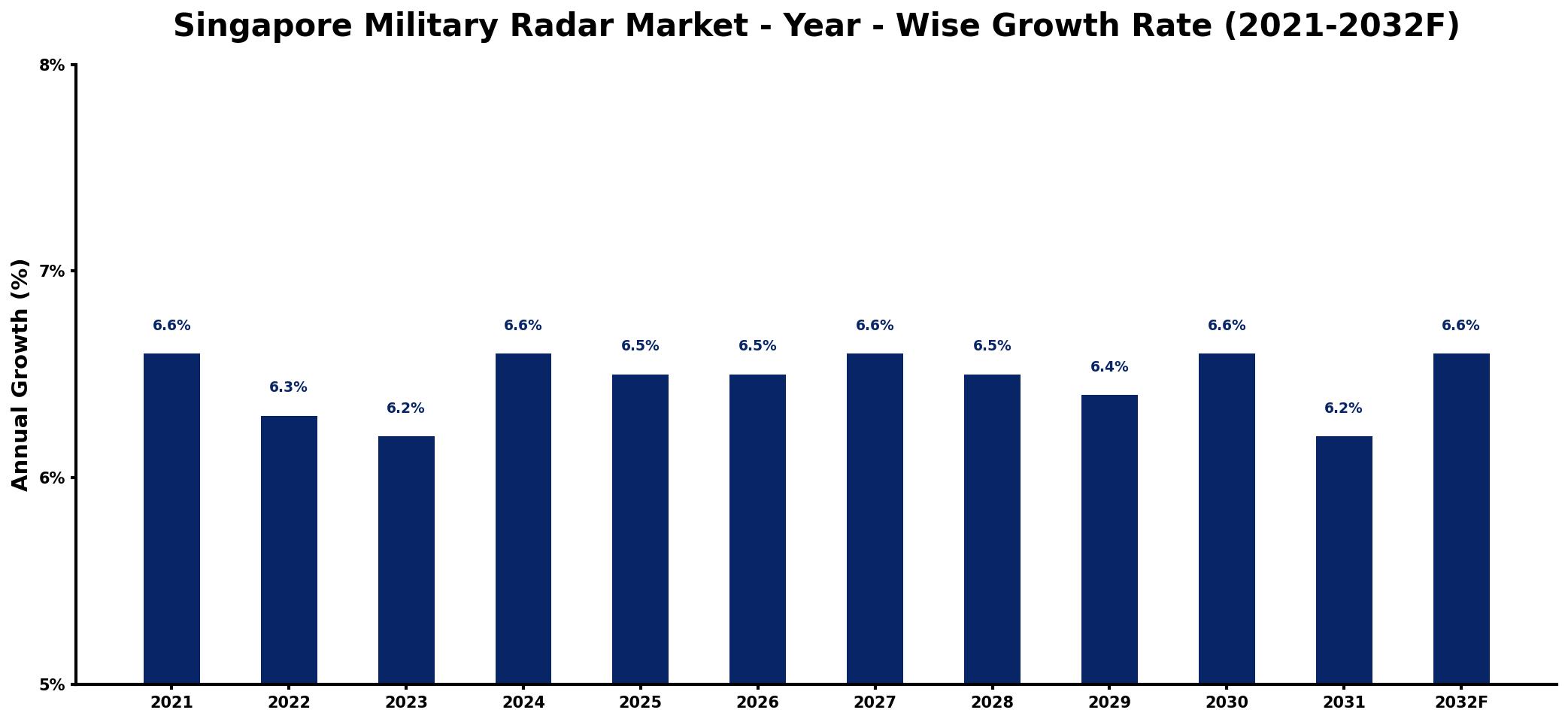
The table below presents the year‑wise growth rates along with the key drivers influencing the market
| Year | Growth Rate | Major Drivers |
| 2021 | 6.6% | Increased defense spending initiatives |
| 2022 | 6.3% | Expansion of advanced technology sectors |
| 2023 | 6.2% | Growing demand for surveillance systems |
| 2024 | 6.6% | Investment in national security infrastructure |
| 2025 | 6.5% | Rise in geopolitical tensions globally |
| 2026 | 6.5% | Emerging market opportunities identified |
| 2027 | 6.6% | Strengthening international defense partnerships |
| 2028 | 6.5% | Focus on modernization of assets |
| 2029 | 6.4% | Enhanced research and development funding |
| 2030 | 6.6% | Integration of AI in operations |
| 2031 | 6.2% | Growing emphasis on cybersecurity measures |
| 2032 | 6.6% | Increased collaboration with private sector |
Note: Market size estimations and growth projections presented in this report are based on 6Wresearch's proprietary forecasting methodology, utilizing the latest available industry data, government publications, and primary research inputs.
Singapore Military Radar Market Synopsis
As a strategic node in Southeast Asia, Singapore places a high priority on its defense capabilities, particularly concerning maritime and airspace surveillance. The increasing complexity of regional threats amplifies the demand for cutting-edge radar systems equipped with advanced features such as target tracking accuracy and resistance to electronic warfare.
This market is characterized by a strong focus on research and development aimed at enhancing radar performance and reducing energy consumption. As technological advancements continue to reshape military operations, Singapore is investing in next-generation radar systems that leverage artificial intelligence and machine learning for improved situational awareness and operational efficiency.
Singapore Military Radar Market Key Takeaways
- The market is driven by Singapore's strategic location and increasing defense investments.
- Advanced radar systems are critical for airspace monitoring and early threat detection.
- Research and development efforts are enhancing radar capabilities and energy efficiency.
- Geopolitical tensions in the region are fostering a heightened emphasis on surveillance technology.
- Cybersecurity concerns are paramount as reliance on radar systems grows.
Evaluation of Restraints in Singapore Military Radar Market
The Singapore Military Radar Market faces a range of constraints that could hinder its growth. A significant concern is the need for robust cybersecurity measures to protect radar systems from potential cyber threats. As advanced radar technologies become more integrated into defense operations, ensuring their resilience against cyberattacks is essential. Additionally, adapting radar systems to effectively counter emerging technologies, including stealth and hypersonic threats, presents a continuous challenge. Budgetary constraints further complicate matters, as the government seeks to balance defense spending with other critical national priorities.
Singapore Military Radar Market Trends
A notable trend in the Singapore Military Radar Market is the increasing incorporation of AI and machine learning technologies, which enhance data analysis and operational efficiency. This evolution enables military personnel to respond more quickly to threats and improve situational awareness. Another emerging trend is the focus on energy-efficient radar systems, which not only reduce operational costs but also align with global sustainability goals. Furthermore, there is a growing emphasis on interoperability among various defense systems, allowing for coordinated operations and enhanced effectiveness in joint military efforts.
Singapore Military Radar Market Opportunities
Investment opportunities in the Singapore Military Radar Market are robust, particularly in the realm of developing next-generation radar technologies that utilize cutting-edge advancements. The need for upgraded systems for airspace and maritime surveillance creates openings for firms specializing in high-performance radar solutions. Additionally, partnerships between public and private sectors can drive innovation, enabling the development of cost-effective solutions that meet the evolving demands of the defense sector. With the ongoing modernization initiatives, market players are well-positioned to capitalize on this growth potential.
Government Initiatives in the Singapore Military Radar Market
The Singapore government continues to bolster its defense capabilities through various initiatives, focusing on enhancing military technology and operational readiness. Public spending on defense modernization is a priority, with allocations aimed at acquiring advanced radar systems and other critical technologies. Furthermore, government programs that encourage research and development in defense technologies are pivotal for fostering innovation and ensuring that Singapore remains at the forefront of military capabilities.
Future Insights of the Singapore Military Radar Market
Looking ahead to 2026-2032, the Singapore Military Radar Market is expected to evolve significantly as defense strategies adapt to new technological realities and emerging threats. The emphasis on integrating AI and machine learning into radar operations will likely reshape operational protocols, leading to more effective threat detection and response. Moreover, as geopolitical dynamics shift, the need for enhanced surveillance capabilities will remain a top priority, ensuring sustained investments in military radar technologies. Consequently, the market is poised for robust growth, driven by an unwavering commitment to national security and defense modernization.
Singapore Military Radar Market Latest Developments (2025 - 2026)
In recent months, the Singapore Military Radar Market has seen a flurry of activity focused on advancing radar capabilities and enhancing interoperability among military systems. Initiatives have been launched to foster collaboration between public agencies and private sector entities, aimed at driving innovation in radar technology. Additionally, significant strides have been made in integrating AI into radar systems, enhancing their operational capabilities and situational awareness. These developments reflect Singapore's commitment to staying ahead in military technology amidst a rapidly evolving threat landscape.
Singapore Military Radar Market - Key Attractiveness of the Report
- 10 Years of Market Numbers
- Historical Data Starting from 2022 to 2025
- Base Year: 2025
- Forecast Data until 2032
- Key Performance Indicators Impacting the Market
- Major Upcoming Developments and Projects
Key Highlights of the Report:
- Singapore Military Radar Market Outlook
- Market Size of Singapore Military Radar Market, 2025
- Forecast of Singapore Military Radar Market, 2032
- Historical Data and Forecast of Singapore Military Radar Revenues & Volume for the Period 2022-2032F
- Singapore Military Radar Market Trend Evolution
- Singapore Military Radar Market Drivers and Challenges
- Singapore Military Radar Price Trends
- Singapore Military Radar Porter's Five Forces
- Singapore Military Radar Industry Life Cycle
- Historical Data and Forecast of Singapore Military Radar Market Revenues & Volume By Platform for the Period 2022-2032F
- Historical Data and Forecast of Singapore Military Radar Market Revenues & Volume By Airborne Radar for the Period 2022-2032F
- Historical Data and Forecast of Singapore Military Radar Market Revenues & Volume By Land Radar for the Period 2022-2032F
- Historical Data and Forecast of Singapore Military Radar Market Revenues & Volume By Naval Radar for the Period 2022-2032F
- Historical Data and Forecast of Singapore Military Radar Market Revenues & Volume By Range for the Period 2022-2032F
- Historical Data and Forecast of Singapore Military Radar Market Revenues & Volume By Long for the Period 2022-2032F
- Historical Data and Forecast of Singapore Military Radar Market Revenues & Volume By Medium for the Period 2022-2032F
- Historical Data and Forecast of Singapore Military Radar Market Revenues & Volume By Short for the Period 2022-2032F
- Historical Data and Forecast of Singapore Military Radar Market Revenues & Volume By Very Short for the Period 2022-2032F
- Historical Data and Forecast of Singapore Military Radar Market Revenues & Volume By Application for the Period 2022-2032F
- Historical Data and Forecast of Singapore Military Radar Market Revenues & Volume By Weapon Guidance for the Period 2022-2032F
- Historical Data and Forecast of Singapore Military Radar Market Revenues & Volume By Airspace Monitoring & Traffic Management for the Period 2022-2032F
- Historical Data and Forecast of Singapore Military Radar Market Revenues & Volume By Airborne Mapping for the Period 2022-2032F
- Historical Data and Forecast of Singapore Military Radar Market Revenues & Volume By Ground Surveillance & Intruder Detection for the Period 2022-2032F
- Historical Data and Forecast of Singapore Military Radar Market Revenues & Volume By Navigation for the Period 2022-2032F
- Historical Data and Forecast of Singapore Military Radar Market Revenues & Volume By Others for the Period 2022-2032F
- Historical Data and Forecast of Singapore Military Radar Market Revenues & Volume By Frequency for the Period 2022-2032F
- Historical Data and Forecast of Singapore Military Radar Market Revenues & Volume By C-Band for the Period 2022-2032F
- Historical Data and Forecast of Singapore Military Radar Market Revenues & Volume By S-Band for the Period 2022-2032F
- Historical Data and Forecast of Singapore Military Radar Market Revenues & Volume By X-Band for the Period 2022-2032F
- Historical Data and Forecast of Singapore Military Radar Market Revenues & Volume By L-Band for the Period 2022-2032F
- Historical Data and Forecast of Singapore Military Radar Market Revenues & Volume By UHF/VHF for the Period 2022-2032F
- Historical Data and Forecast of Singapore Military Radar Market Revenues & Volume By Ku/K/Ka-Band for the Period 2022-2032F
- Historical Data and Forecast of Singapore Military Radar Market Revenues & Volume By Component for the Period 2022-2032F
- Historical Data and Forecast of Singapore Military Radar Market Revenues & Volume By Transmitter for the Period 2022-2032F
- Historical Data and Forecast of Singapore Military Radar Market Revenues & Volume By Antenna for the Period 2022-2032F
- Historical Data and Forecast of Singapore Military Radar Market Revenues & Volume By Receiver for the Period 2022-2032F
- Historical Data and Forecast of Singapore Military Radar Market Revenues & Volume By Duplexer for the Period 2022-2032F
- Historical Data and Forecast of Singapore Military Radar Market Revenues & Volume By Others for the Period 2022-2032F
- Singapore Military Radar Import Export Trade Statistics
- Market Opportunity Assessment By Platform
- Market Opportunity Assessment By Range
- Market Opportunity Assessment By Application
- Market Opportunity Assessment By Frequency
- Market Opportunity Assessment By Component
- Singapore Military Radar Top Companies Market Share
- Singapore Military Radar Competitive Benchmarking By Technical and Operational Parameters
- Singapore Military Radar Company Profiles
- Singapore Military Radar Key Strategic Recommendations






































