Singapore Motorcycle Saddle Market Size, Share & Growth Rate
The Singapore Motorcycle Saddle Market was estimated at USD 396 Million in 2025 and is projected to reach USD 537 Million by 2032, growing at a CAGR of 4.4% from 2026 to 2032. This growth trajectory is primarily driven by the increasing urbanization and a rising preference for motorcycles as an efficient mode of transportation within the bustling city-state. Furthermore, the trend towards customization and ergonomic enhancements in saddle design reflects evolving consumer demands, suggesting sustained market vitality.
Singapore Motorcycle Saddle Market Year-wise Growth Rate and Key Drivers
This graph highlights how the Singapore Motorcycle Saddle Market has steadily grown over the years, supported by major growth factors.
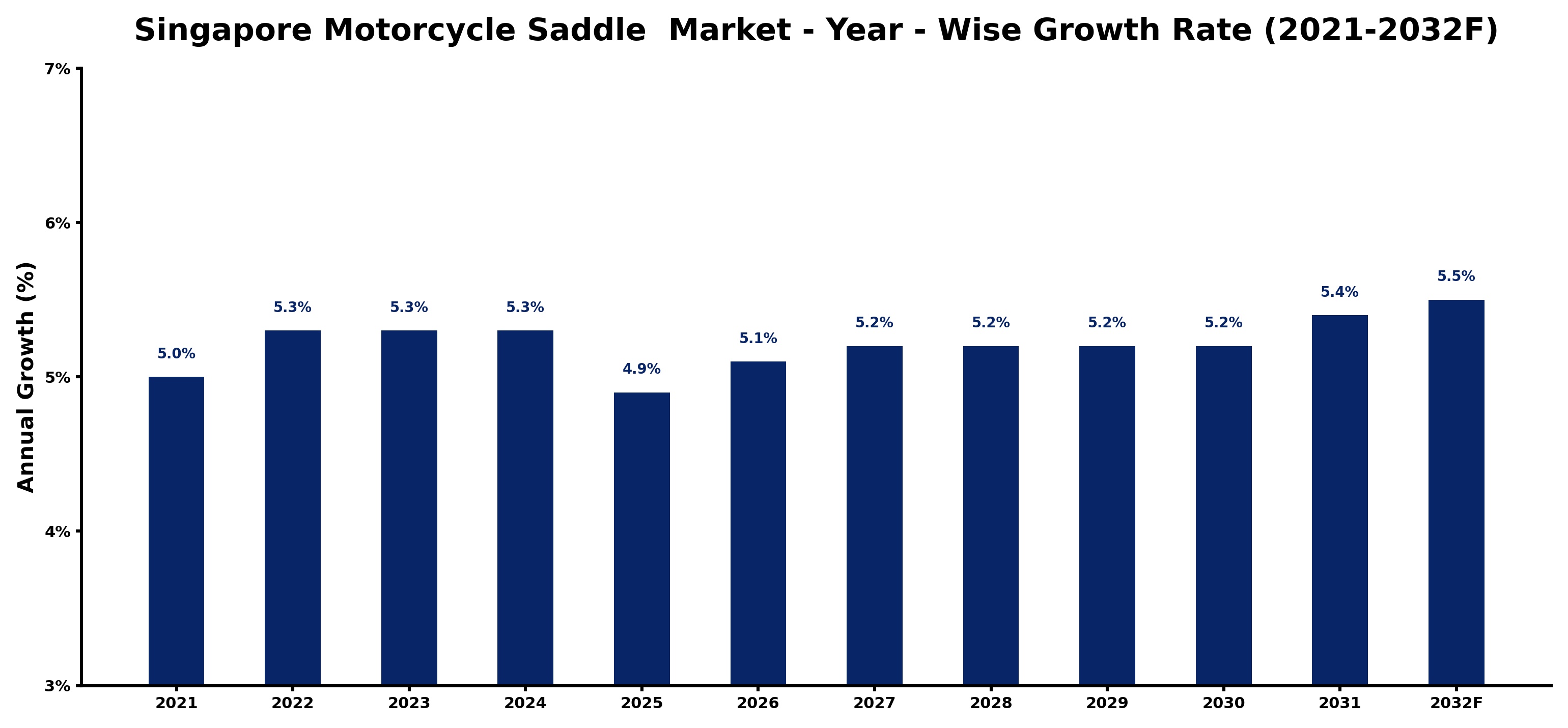
The table below presents the year‑wise growth rates along with the key drivers influencing the market
| Year | Growth Rate | Major Drivers |
| 2021 | 5.0% | Investment in local manufacturing enhanced motorcycle saddle production capacity |
| 2022 | 5.3% | Local assembly facilities boosted motorcycle saddle production capacity significantly |
| 2023 | 5.3% | Local manufacturing investments boost motorcycle saddle production capacity |
| 2024 | 5.3% | Revamped logistics networks improved motorcycle saddle supply chain efficiency |
| 2025 | 4.9% | Advanced manufacturing technologies boost precision motorcycle saddle production efficiency |
| 2026 | 5.1% | Domestic smart manufacturing adoption boosted motorcycle saddle production efficiency |
| 2027 | 5.2% | Saddle manufacturers adopt lean processes to boost production efficiency |
| 2028 | 5.2% | Increased local assembly operations boost motorcycle saddle production efficiency |
| 2029 | 5.2% | Strengthened domestic assembly capabilities boosted motorcycle saddle production efficiency |
| 2030 | 5.2% | Local motorcycle manufacturers invest in smart production technologies |
| 2031 | 5.4% | Digital fabrication technology optimizes custom motorcycle saddle production efficiency |
| 2032 | 5.5% | Manufacturers invest in advanced materials to enhance saddle durability |
Note - Market size estimations and growth projections presented in this report are based on 6Wresearch’s advanced forecasting approach, validated with industry datasets as of June 2026.
Singapore Motorcycle Saddle Market Synopsis
In Singapore, the motorcycle saddle market is witnessing a notable shift, with an increasing emphasis on ergonomic designs that prioritize rider comfort. As a critical component of motorcycles, saddles are being tailored to accommodate diverse riding styles, showcasing a range of materials and aesthetic options to meet consumer preferences.
Moreover, sustainability has emerged as a pivotal theme in the Singapore Motorcycle Saddle Market, as manufacturers are exploring eco-friendly materials and production processes. This commitment to environmentally conscious practices resonates with a growing demographic of environmentally aware consumers.
Singapore Motorcycle Saddle Market Key Takeaways
- The market is evolving with a focus on ergonomic and customizable saddle designs, catering to diverse rider preferences.
- There is a notable trend towards sustainability, with manufacturers increasingly utilizing eco-friendly materials.
- The urban landscape of Singapore supports the ongoing demand for efficient two-wheeled transportation solutions.
- Post-COVID recovery is leading to renewed interest in personal mobility options, including motorcycles.
- Competition from international suppliers is influencing local manufacturers to innovate and enhance their product offerings.
Evaluation of Restraints in Singapore Motorcycle Saddle Market
Despite the favorable outlook, the Singapore Motorcycle Saddle Market faces certain restraints. A key limitation is the niche nature of the market, which can restrict production scalability and complicate efforts to achieve economies of scale. Additionally, the stringent quality and safety regulations governing saddle manufacturing necessitate consistent compliance, translating into resource-heavy operations. The persistent need for customization, alongside fluctuating consumer preferences, further challenges manufacturers, compelling them to continuously adapt and innovate to stay competitive.
Singapore Motorcycle Saddle Market Trends
Current trends indicate a robust demand for motorcycle saddles that balance comfort with style, as riders increasingly prioritize both aspects in their purchasing decisions. Furthermore, the integration of technology into saddle design, such as temperature control materials and improved cushioning systems, is becoming more prevalent. The customization trend is also shaping the market, with an increasing number of riders opting for personalized saddle options that reflect their individual style and riding habits.
Singapore Motorcycle Saddle Market Opportunities
The Singapore Motorcycle Saddle Market presents numerous opportunities for growth and investment. The ongoing shift towards electric motorcycles opens new avenues for manufacturers to innovate in saddle design that accommodates the unique ergonomics of these vehicles. Additionally, as the government continues to promote sustainable transportation solutions, there is an opportunity for companies that prioritize eco-friendly materials and practices to differentiate themselves in the marketplace.
Government Initiatives in the Singapore Motorcycle Saddle Market
Government initiatives in Singapore are playing a significant role in shaping the motorcycle industry, including the saddle market. Policies aimed at promoting sustainable transportation options are encouraging manufacturers to adopt greener practices. Furthermore, public spending on infrastructure improvements enhances the safety and convenience of motorcycle use, thereby driving demand for enhanced saddle designs and comfort features.
Future Insights of the Singapore Motorcycle Saddle Market
Looking ahead to 2026-2032, the Singapore Motorcycle Saddle Market is set to witness substantial advancements driven by technological innovation and design evolution. The anticipated growth in electric motorcycle adoption will necessitate a reevaluation of saddle design, prompting manufacturers to focus on enhanced comfort and functionality. As the demand for personalization continues to rise, companies that can quickly adapt to changing consumer preferences will likely lead the market. Overall, the intersection of sustainability, technology, and rider comfort will define the future landscape of this dynamic market.
Singapore Motorcycle Saddle Market Latest Developments (May 2025 - June 2026)
Recent developments within the Singapore Motorcycle Saddle Market indicate an increasing focus on enhancing product offerings through innovative materials and design features. Manufacturers are embracing digital transformation, exploring e-commerce platforms for greater reach. As the pandemic influences consumer behavior, there is a noticeable shift towards online sales channels, allowing manufacturers to connect directly with customers while catering to evolving preferences for comfort and aesthetics.
Singapore Motorcycle Saddle Market - Key Attractiveness of the Report
- 10 Years of Market Numbers
- Historical Data Starting from 2022 to 2025
- Base Year: 2025
- Forecast Data until 2032
- Key Performance Indicators Impacting the Market
- Major Upcoming Developments and Projects
Key Highlights of the Report:
- Singapore Motorcycle Saddle Market Outlook
- Market Size of Singapore Motorcycle Saddle Market, 2025
- Forecast of Singapore Motorcycle Saddle Market, 2032
- Historical Data and Forecast of Singapore Motorcycle Saddle Revenues & Volume for the Period 2022-2032F
- Singapore Motorcycle Saddle Market Trend Evolution
- Singapore Motorcycle Saddle Market Drivers and Challenges
- Singapore Motorcycle Saddle Price Trends
- Singapore Motorcycle Saddle Porter's Five Forces
- Singapore Motorcycle Saddle Industry Life Cycle
- Historical Data and Forecast of Singapore Motorcycle Saddle Market Revenues & Volume By Type for the Period 2022-2032F
- Historical Data and Forecast of Singapore Motorcycle Saddle Market Revenues & Volume By Foam Seat for the Period 2022-2032F
- Historical Data and Forecast of Singapore Motorcycle Saddle Market Revenues & Volume By Gel Seat for the Period 2022-2032F
- Historical Data and Forecast of Singapore Motorcycle Saddle Market Revenues & Volume By Application for the Period 2022-2032F
- Historical Data and Forecast of Singapore Motorcycle Saddle Market Revenues & Volume By OEM for the Period 2022-2032F
- Historical Data and Forecast of Singapore Motorcycle Saddle Market Revenues & Volume By Aftermarket for the Period 2022-2032F
- Singapore Motorcycle Saddle Import Export Trade Statistics
- Market Opportunity Assessment By Type
- Market Opportunity Assessment By Application
- Singapore Motorcycle Saddle Top Companies Market Share
- Singapore Motorcycle Saddle Competitive Benchmarking By Technical and Operational Parameters
- Singapore Motorcycle Saddle Company Profiles
- Singapore Motorcycle Saddle Key Strategic Recommendations






































