Singapore Music Recording Market Size, Share & Growth Rate
The Singapore Music Recording Market was estimated at USD 183 Million in 2025 and is projected to reach USD 199 Million by 2032, growing at a CAGR of 1.2% from 2026 to 2032. This growth trajectory is driven by the vibrant emergence of local artists who are increasingly leveraging digital platforms for distribution and engagement. Additionally, the favorable government initiatives supporting the arts sector have further solidified the foundation for sustained growth.
Singapore Music Recording Market Year-wise Growth Rate and Key Drivers
This graph highlights how the Singapore Music Recording Market has steadily grown over the years, supported by major growth factors.
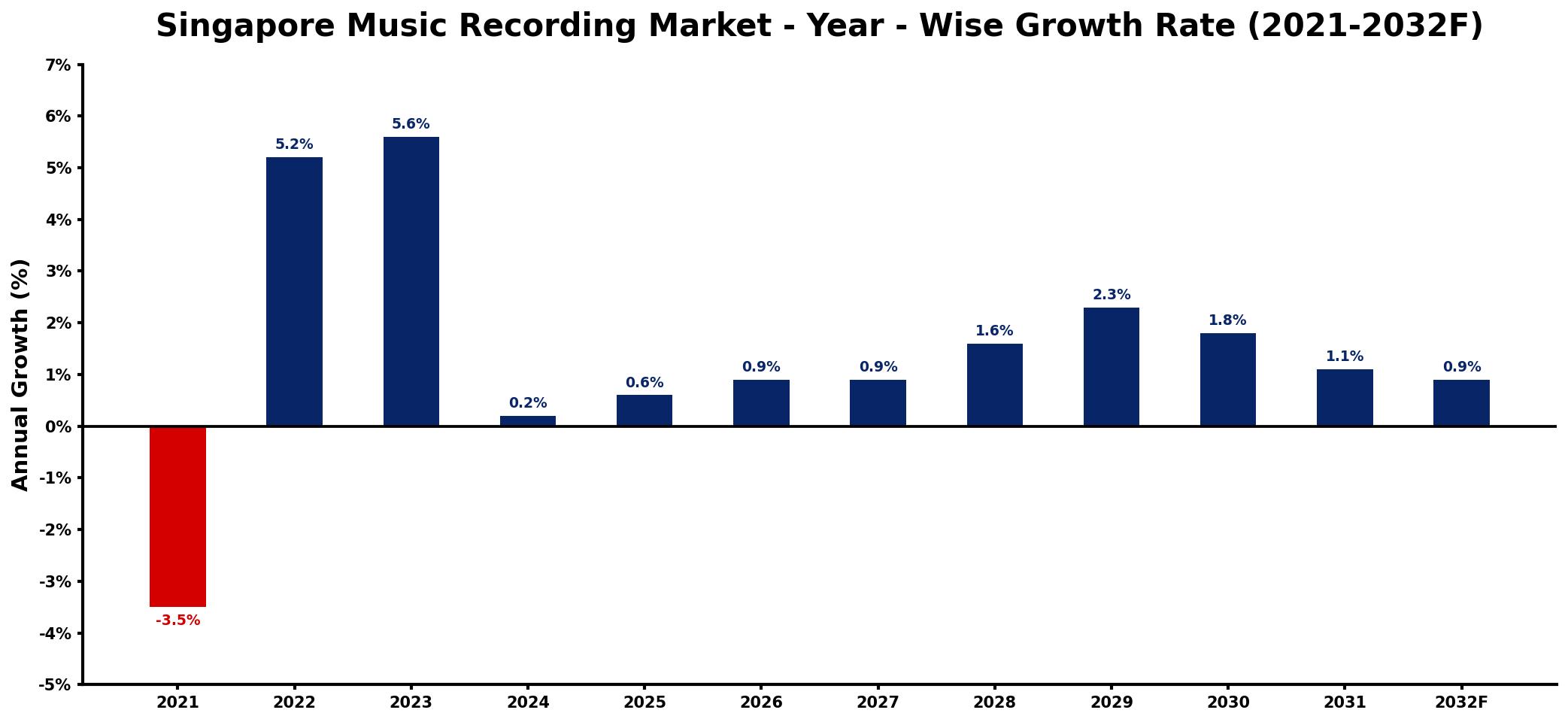
The table below presents the year‑wise growth rates along with the key drivers influencing the market
| Year | Growth Rate | Major Drivers |
| 2021 | -3.5% | decreased consumer spending on entertainment |
| 2022 | 5.2% | increased investment in local talent |
| 2023 | 5.6% | growing popularity of digital platforms |
| 2024 | 0.2% | expansion of live performance venues |
| 2025 | 0.6% | rise in consumer disposable income |
| 2026 | 0.9% | emergence of new genres |
| 2027 | 0.9% | increased collaborations with brands |
| 2028 | 1.6% | growth in streaming subscriptions |
| 2029 | 2.3% | enhanced marketing strategies adopted |
| 2030 | 1.8% | development of innovative technologies |
| 2031 | 1.1% | increased focus on international markets |
| 2032 | 0.9% | growing interest in local culture |
Note: Market size estimations and growth projections presented in this report are based on 6Wresearch's proprietary forecasting methodology, utilizing the latest available industry data, government publications, and primary research inputs.
Singapore Music Recording Market Synopsis
The Singapore music recording market is currently thriving, propelled by technological advancements that enable independent artists to create and share their music more effectively. The integration of digital distribution channels has reshaped the landscape, allowing for a rich diversity of genres and talents to flourish within the local music scene.
Consumer preferences are evolving, with audiences increasingly favoring digital consumption through streaming platforms and virtual events. This shift has spurred a wave of innovation, as artists and producers adapt to new formats, such as immersive experiences and live streaming concerts, enhancing their connection with listeners.
Singapore Music Recording Market Key Takeaways
- The market is benefiting from an influx of local talent and international interest in Asian music genres.
- Technological advancements, including the use of AI in production, are broadening creative possibilities.
- Government support plays a critical role in fostering a vibrant music ecosystem.
- Digital transformation, accelerated by the pandemic, is reshaping consumption and revenue models.
- Opportunities for revenue diversification exist through live performances, merchandise sales, and online content distribution.
Evaluation of Restraints in Singapore Music Recording Market
Despite its growth, the Singapore music recording market encounters significant restraints that could hinder its full potential. Digital piracy remains a persistent issue, threatening the financial stability of artists and recording studios. The transition from physical to digital formats has also disrupted traditional revenue streams, compelling industry players to rethink their business models. As more consumers gravitate toward streaming services, the challenge lies in ensuring fair compensation for artists while adapting to a landscape where digital access dominates. Thus, the industry must continue to innovate and identify alternative revenue opportunities to combat these barriers.
Singapore Music Recording Market Trends
Several key trends are currently shaping the Singapore music recording market. The rise of virtual concerts and live streaming has become a primary engagement method, particularly in the wake of COVID-19. Additionally, the increasing incorporation of technology, such as virtual reality and AI, is enhancing music production processes and audience interactions. There is also a noticeable shift towards collaborative projects, where artists come together across genres and borders, creating unique sounds and experiences that resonate with a global audience. Overall, the convergence of music and technology is driving exciting changes in this market.
Singapore Music Recording Market Opportunities
Opportunities abound in the Singapore music recording market as artists and producers look to capitalize on the digital landscape. The growth of streaming platforms offers local musicians a chance to reach international audiences without the constraints of traditional distribution. Additionally, the demand for unique and immersive live experiences is leading to innovations in event production. Collaborations between local talents and international artists create fresh musical perspectives, expanding market reach. Furthermore, with government support, there is a robust framework encouraging investment in music-related projects, bolstering the industry's growth potential.
Government Initiatives in the Singapore Music Recording Market
The Singaporean government plays an integral role in nurturing the local music scene through various initiatives aimed at supporting the arts and creative industries. Financial grants, funding programs, and partnerships with private entities promote the growth of musical talent and infrastructure. Government-sponsored events and festivals offer artists platforms to showcase their work, while policies encouraging the integration of technology in arts foster innovation within the music sector. Such initiatives are crucial for establishing a sustainable ecosystem that supports both emerging and established talents.
Future Insights of the Singapore Music Recording Market
Looking ahead to 2026-2032, the Singapore music recording market is poised for steady growth. As digital consumption continues to dominate, artists will increasingly leverage emerging technologies to enhance their creative offerings and audience engagement. The shift toward more personalized and immersive experiences will become a focal point, with live streaming and virtual reality expected to play pivotal roles in how music is consumed. With ongoing government support and a thriving ecosystem of local talent, the market is set to evolve into a dynamic space where innovation and creativity flourish.
Singapore Music Recording Market Latest Developments (2025 - 2026)
Recent developments in the Singapore music recording market indicate a strong shift towards digital engagement as artists experiment with new formats and platforms. The rise of virtual reality experiences in music concerts has garnered attention, while digital collaborations across regional and international lines are on the rise. Furthermore, initiatives aimed at enhancing copyright protection for artists are being discussed, reflecting the industry's ongoing adaptation to challenges posed by digital piracy and streaming services. This evolving landscape is a testament to the resilience and creativity of the Singapore music scene.
Singapore Music Recording Market - Key Attractiveness of the Report
- 10 Years of Market Numbers
- Historical Data Starting from 2022 to 2025
- Base Year: 2025
- Forecast Data until 2032
- Key Performance Indicators Impacting the Market
- Major Upcoming Developments and Projects
Key Highlights of the Report:
- Singapore Music Recording Market Outlook
- Market Size of Singapore Music Recording Market, 2025
- Forecast of Singapore Music Recording Market, 2032
- Historical Data and Forecast of Singapore Music Recording Revenues & Volume for the Period 2022-2032F
- Singapore Music Recording Market Trend Evolution
- Singapore Music Recording Market Drivers and Challenges
- Singapore Music Recording Price Trends
- Singapore Music Recording Porter's Five Forces
- Singapore Music Recording Industry Life Cycle
- Historical Data and Forecast of Singapore Music Recording Market Revenues & Volume By Type for the Period 2022-2032F
- Historical Data and Forecast of Singapore Music Recording Market Revenues & Volume By Record Production for the Period 2022-2032F
- Historical Data and Forecast of Singapore Music Recording Market Revenues & Volume By Music Publishers for the Period 2022-2032F
- Historical Data and Forecast of Singapore Music Recording Market Revenues & Volume By Record Distribution for the Period 2022-2032F
- Historical Data and Forecast of Singapore Music Recording Market Revenues & Volume By Sound Recording Studios for the Period 2022-2032F
- Historical Data and Forecast of Singapore Music Recording Market Revenues & Volume By Application for the Period 2022-2032F
- Historical Data and Forecast of Singapore Music Recording Market Revenues & Volume By Mechanical for the Period 2022-2032F
- Historical Data and Forecast of Singapore Music Recording Market Revenues & Volume By Performance for the Period 2022-2032F
- Historical Data and Forecast of Singapore Music Recording Market Revenues & Volume By Synchronization for the Period 2022-2032F
- Historical Data and Forecast of Singapore Music Recording Market Revenues & Volume By Digital for the Period 2022-2032F
- Historical Data and Forecast of Singapore Music Recording Market Revenues & Volume By Others for the Period 2022-2032F
- Historical Data and Forecast of Singapore Music Recording Market Revenues & Volume By End-User for the Period 2022-2032F
- Historical Data and Forecast of Singapore Music Recording Market Revenues & Volume By Individual for the Period 2022-2032F
- Historical Data and Forecast of Singapore Music Recording Market Revenues & Volume By Commercial for the Period 2022-2032F
- Historical Data and Forecast of Singapore Music Recording Market Revenues & Volume By Genre for the Period 2022-2032F
- Historical Data and Forecast of Singapore Music Recording Market Revenues & Volume By Rock for the Period 2022-2032F
- Historical Data and Forecast of Singapore Music Recording Market Revenues & Volume By Hip Hop for the Period 2022-2032F
- Historical Data and Forecast of Singapore Music Recording Market Revenues & Volume By Pop for the Period 2022-2032F
- Historical Data and Forecast of Singapore Music Recording Market Revenues & Volume By Jazz for the Period 2022-2032F
- Historical Data and Forecast of Singapore Music Recording Market Revenues & Volume By Others for the Period 2022-2032F
- Singapore Music Recording Import Export Trade Statistics
- Market Opportunity Assessment By Type
- Market Opportunity Assessment By Application
- Market Opportunity Assessment By End-User
- Market Opportunity Assessment By Genre
- Singapore Music Recording Top Companies Market Share
- Singapore Music Recording Competitive Benchmarking By Technical and Operational Parameters
- Singapore Music Recording Company Profiles
- Singapore Music Recording Key Strategic Recommendations






































