Singapore Music Toys Market Size, Share & Growth Rate
The Singapore Music Toys Market was estimated at USD 198 Million in 2025 and is projected to reach USD 217 Million by 2032, growing at a CAGR of 1.3% from 2026 to 2032. This growth trajectory is being fueled by an increasing awareness of the importance of early childhood education, prompting parents to seek out toys that blend fun with developmental benefits. Additionally, Singapore's vibrant cultural landscape is cultivating a growing interest in music and the arts among young families, leading to a rising demand for innovative music toys.
Singapore Music Toys Market Year-wise Growth Rate and Key Drivers
This graph highlights how the Singapore Music Toys Market has steadily grown over the years, supported by major growth factors.
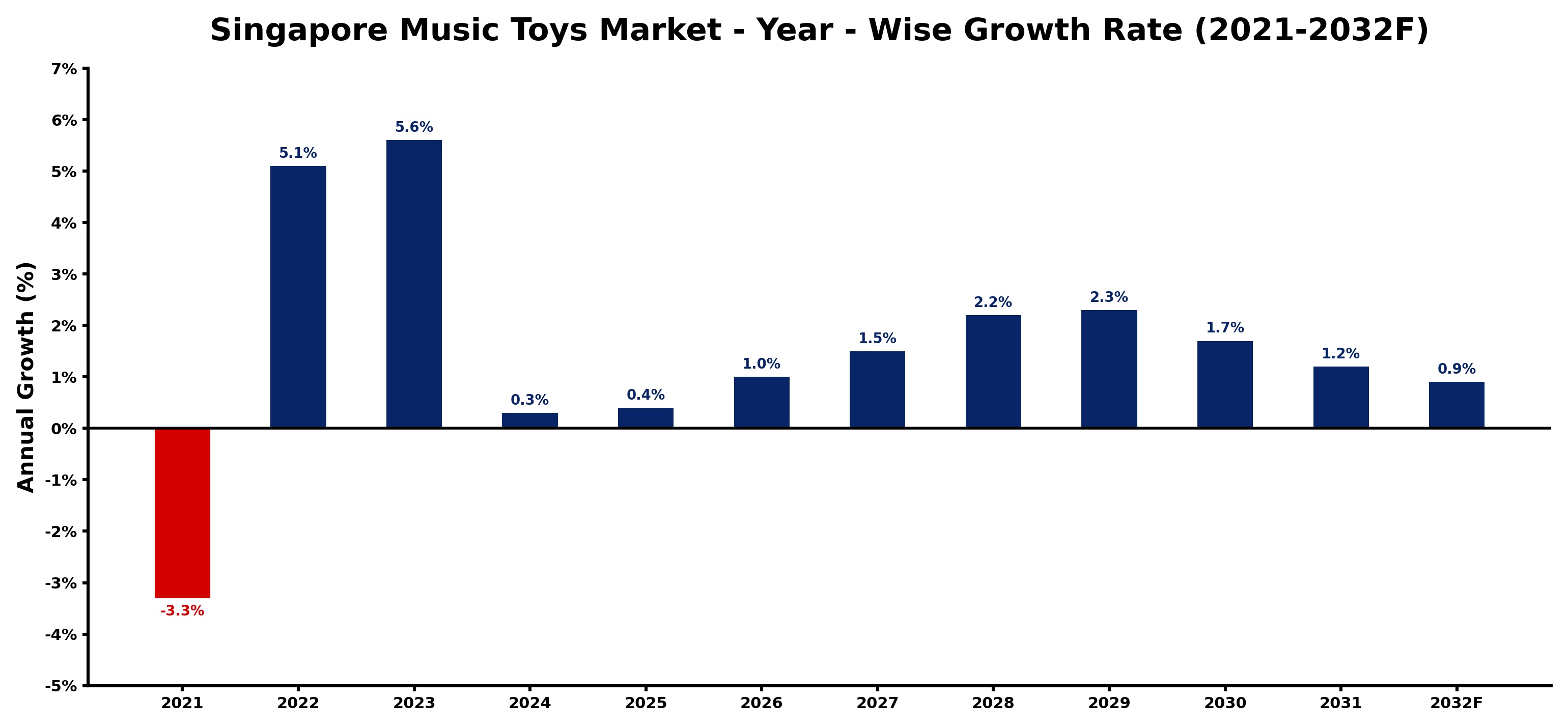
The table below presents the year‑wise growth rates along with the key drivers influencing the market
| Year | Growth Rate | Major Drivers |
| 2021 | -3.3% | Increasing industrial infrastructure investments |
| 2022 | 5.1% | Increasing adoption of advanced technologies |
| 2023 | 5.6% | Expansion of commercial construction activities |
| 2024 | 0.3% | Increasing industrial infrastructure investments |
| 2025 | 0.4% | Increasing adoption of advanced technologies |
| 2026 | 1.0% | Increasing industrial infrastructure investments |
| 2027 | 1.5% | Rapid growth in telecom and data center sectors |
| 2028 | 2.2% | Expansion of manufacturing activities |
| 2029 | 2.3% | Rising electricity demand across industries |
| 2030 | 1.7% | Rising electricity demand across industries |
| 2031 | 1.2% | Expansion of transportation and logistics networks |
| 2032 | 0.9% | Increasing industrial automation investments |
Note - Market size estimations and growth projections presented in this report are based on 6Wresearch's advanced forecasting approach, validated with industry datasets as of June 2026.
Singapore Music Toys Market Synopsis
In Singapore, music toys are not just playthings; they are essential tools for learning and development. These toys stimulate children's creativity and cognitive skills while also enhancing their sensory experiences through sound and rhythm. The local market reflects a unique blend of traditional music influences and modern educational philosophies.
Singapore's commitment to early childhood education further amplifies the demand for music toys. Parents are increasingly recognizing the value of educational play, driving them toward products that offer both entertainment and learning opportunities, thereby solidifying the market's foundation.
Singapore Music Toys Market Key Takeaways
- Strong parental investment in educational toys supports market growth.
- Innovative designs and interactive features appeal to both children and parents.
- The ongoing interest in music and arts education enhances demand for diverse musical toys.
- Digital competition poses a unique challenge for traditional music toys.
- Compliance with safety standards remains crucial for market players to build consumer trust.
Evaluation of Restraints in Singapore Music Toys Market
Despite promising growth, the Singapore music toys market faces certain restraints that could hinder its trajectory. A significant challenge is the competition from digital entertainment options, which often captivate children more effectively than traditional music toys. As digital devices become increasingly prevalent, parents may gravitate toward screen-based activities, potentially sidelining hands-on musical experiences. Additionally, manufacturers must navigate stringent safety and quality regulations, which, while essential for ensuring child safety, can also lead to increased production costs and affect pricing strategies.
Singapore Music Toys Market Trends
The current landscape of the Singapore music toys market is characterized by several exciting trends. Firstly, there is a marked shift towards eco-friendly materials, reflecting a growing consumer preference for sustainable products. Furthermore, toys that incorporate technology, such as apps that enhance musical learning or interactive features, are gaining traction. The blending of traditional instruments with digital enhancements showcases a trend toward creating engaging educational experiences that resonate with both children and their parents.
Singapore Music Toys Market Opportunities
Opportunities for growth in the Singapore music toys market are abundant. The emphasis on STEM (Science, Technology, Engineering, and Mathematics) education presents a unique avenue for product development, as parents seek toys that align with these educational initiatives. Moreover, as the local demand for culturally relevant music toys increases, manufacturers have the chance to create products that reflect Singapore's rich cultural heritage. Expanding online retail platforms also offer brands a broader reach, allowing them to tap into a more diverse consumer base.
Government Initiatives in the Singapore Music Toys Market
The Singapore government actively promotes early childhood education through various programs and initiatives. Public spending in this sector has been directed toward enhancing learning environments, which includes fostering creativity through music and play. Programs designed to support local toy manufacturers in meeting safety and quality standards also contribute positively to the market's development, helping to ensure that parents feel confident in their purchasing decisions.
Future Insights of the Singapore Music Toys Market
Looking ahead to 2026-2032, the Singapore music toys market is poised for steady growth, driven by an unwavering commitment to educational play. The integration of technology into music toys will likely continue to evolve, creating products that are not only entertaining but also provide a robust educational framework. As parental preferences shift toward sustainable and locally inspired products, companies that adapt to these trends will be well-positioned to capture market share.
Singapore Music Toys Market Latest Developments (May 2025 - June 2026)
Recent developments in the Singapore music toys market highlight a strong trend towards innovation, with manufacturers increasingly introducing interactive and smart toys that incorporate digital elements. The ongoing efforts of retailers to enhance online shopping experiences have also increased access to a wider range of music toys. Overall, the market is adapting to post-pandemic consumer behavior shifts, leading to more diversified offerings that meet evolving demand.
Singapore Music Toys Market - Key Attractiveness of the Report
- 10 Years of Market Numbers
- Historical Data Starting from 2022 to 2025
- Base Year: 2025
- Forecast Data until 2032
- Key Performance Indicators Impacting the Market
- Major Upcoming Developments and Projects
Key Highlights of the Report:
- Singapore Music Toys Market Outlook
- Market Size of Singapore Music Toys Market, 2025
- Forecast of Singapore Music Toys Market, 2032F
- Historical Data and Forecast of Singapore Music Toys Revenues & Volume for the Period 2022-2032F
- Singapore Music Toys Market Trend Evolution
- Singapore Music Toys Market Drivers and Challenges
- Singapore Music Toys Price Trends
- Singapore Music Toys Porter's Five Forces
- Singapore Music Toys Industry Life Cycle
- Historical Data and Forecast of Singapore Music Toys Market Revenues & Volume By Type for the Period 2022-2032F
- Historical Data and Forecast of Singapore Music Toys Market Revenues & Volume By Drums & Percussion for the Period 2022-2032F
- Historical Data and Forecast of Singapore Music Toys Market Revenues & Volume By Guitars & Strings for the Period 2022-2032F
- Historical Data and Forecast of Singapore Music Toys Market Revenues & Volume By Pianos & Keyboards for the Period 2022-2032F
- Historical Data and Forecast of Singapore Music Toys Market Revenues & Volume By Wind & Brass for the Period 2022-2032F
- Historical Data and Forecast of Singapore Music Toys Market Revenues & Volume By Others for the Period 2022-2032F
- Historical Data and Forecast of Singapore Music Toys Market Revenues & Volume By Age for the Period 2022-2032F
- Historical Data and Forecast of Singapore Music Toys Market Revenues & Volume By Below 1 Year for the Period 2022-2032F
- Historical Data and Forecast of Singapore Music Toys Market Revenues & Volume By 1�3 Years for the Period 2022-2032F
- Historical Data and Forecast of Singapore Music Toys Market Revenues & Volume By 3�5 Year for the Period 2022-2032F
- Historical Data and Forecast of Singapore Music Toys Market Revenues & Volume By 5�7 Years for the Period 2022-2032F
- Historical Data and Forecast of Singapore Music Toys Market Revenues & Volume By 7�9 Years for the Period 2022-2032F
- Historical Data and Forecast of Singapore Music Toys Market Revenues & Volume By Above 9 Years for the Period 2022-2032F
- Historical Data and Forecast of Singapore Music Toys Market Revenues & Volume By Distribution Channel for the Period 2022-2032F
- Historical Data and Forecast of Singapore Music Toys Market Revenues & Volume By Online Channel for the Period 2022-2032F
- Historical Data and Forecast of Singapore Music Toys Market Revenues & Volume By Offline Channel for the Period 2022-2032F
- Singapore Music Toys Import Export Trade Statistics
- Market Opportunity Assessment By Type
- Market Opportunity Assessment By Age
- Market Opportunity Assessment By Distribution Channel
- Singapore Music Toys Top Companies Market Share
- Singapore Music Toys Competitive Benchmarking By Technical and Operational Parameters
- Singapore Music Toys Company Profiles
- Singapore Music Toys Key Strategic Recommendations






































