Singapore Nail Gun Market Size, Share & Growth Rate
The Singapore Nail Gun Market was estimated at USD 1337 Million in 2025 and is projected to reach USD 2304 Million by 2032, growing at a CAGR of 8.1% from 2026 to 2032. This robust growth trajectory is primarily driven by increasing construction and woodworking activities, which are actively adopting advanced fastening solutions to enhance productivity. The demand for nail guns is further supported by innovations focusing on safety and automation, responding to evolving industry standards.
Singapore Nail Gun Market Year-wise Growth Rate and Key Drivers
This graph highlights how the Singapore Nail Gun Market has steadily grown over the years, supported by major growth factors.
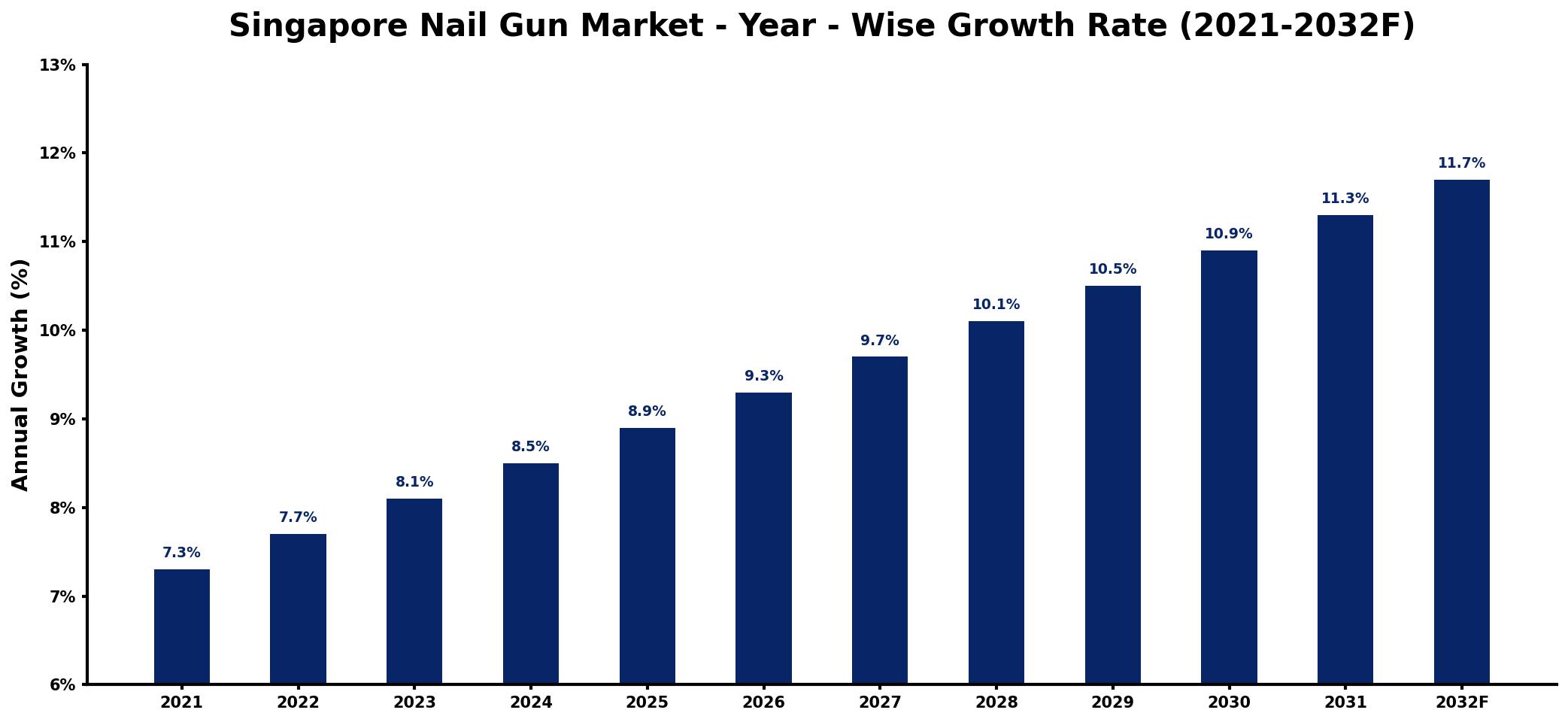
The table below presents the year‑wise growth rates along with the key drivers influencing the market
| Year | Growth Rate | Major Drivers |
| 2021 | 7.3% | Rising construction project investments |
| 2022 | 7.7% | Increased demand from contractors |
| 2023 | 8.1% | Expansion in residential building |
| 2024 | 8.5% | Growth in renovation activities |
| 2025 | 8.9% | Surge in commercial developments |
| 2026 | 9.3% | Technological advancements in tools |
| 2027 | 9.7% | Higher infrastructure spending forecast |
| 2028 | 10.1% | Growing DIY home improvement trend |
| 2029 | 10.5% | Enhanced supply chain efficiencies |
| 2030 | 10.9% | Rising popularity of prefabrication |
| 2031 | 11.3% | Increased safety regulations compliance |
| 2032 | 11.7% | rising procurement volume requirements |
Note: Market size estimations and growth projections presented in this report are based on 6Wresearch's proprietary forecasting methodology, utilizing the latest available industry data, government publications, and primary research inputs.
Singapore Nail Gun Market Synopsis
While the Singapore nail gun market has seen a temporary slowdown due to pandemic-related disruptions, a rebound is on the horizon as construction activities normalize. Enhanced safety features and improvements in tool design are shaping the future landscape, encouraging a more significant market presence.
The current market momentum reflects a keen focus on efficiency, with both pneumatic and electric tools finding their place in various applications. As demand for quick and precise fastening grows, the nail gun market is set to transform how construction and woodworking projects are executed.
Singapore Nail Gun Market Key Takeaways
- The Singapore Nail Gun Market is experiencing significant growth driven by construction and woodworking sector demands.
- Technological advancements are paving the way for more efficient and safer fastening tools.
- The resurgence of the market post-COVID-19 highlights its resilience and adaptability.
- Regulatory compliance and safety standards are crucial for market players to navigate effectively.
- The ongoing shift towards automation in construction processes is expected to sustain market expansion.
Evaluation of Restraints in Singapore Nail Gun Market
The Singapore nail gun market faces several restraints that could impede its growth trajectory. Strict safety regulations require manufacturers and users alike to ensure adherence to compliance measures, which can incur additional costs and procedural delays. Furthermore, the competition from alternative fastening methods poses a challenge, as stakeholders must continuously innovate to retain market share. Additionally, ensuring the reliability of nail guns is critical in maintaining user trust, necessitating ongoing investment in quality assurance and product development.
Singapore Nail Gun Market Trends
In recent years, the Singapore nail gun market has witnessed an increasing trend towards automation, enabling enhanced efficiency in construction and carpentry projects. The integration of smart technology is becoming more prevalent, with features such as real-time monitoring and predictive maintenance capturing the attention of industry players. Additionally, the focus on ergonomic designs and safety enhancements caters to the growing emphasis on worker welfare and productivity.
Singapore Nail Gun Market Opportunities
There are numerous growth opportunities within the Singapore nail gun market. As the construction sector embraces more sustainable practices, the demand for eco-friendly nail guns is likely to surge, presenting a niche for innovative manufacturers. Furthermore, the rise of prefabrication and modular construction methods opens new avenues for fastening solutions. Investments in training and education on the proper use of nail guns could also promote market growth by enhancing safety and operational efficiency.
Government Initiatives in the Singapore Nail Gun Market
The Singaporean government has been actively promoting construction safety and innovation through various initiatives. Support for research and development in advanced tool technologies is fostering a conducive environment for market growth. Public spending on infrastructure projects has increased, driving demand for efficient fastening tools. Moreover, government programs aimed at improving safety standards in construction are encouraging market participants to prioritize compliance and invest in more secure and reliable tools.
Future Insights of the Singapore Nail Gun Market
Looking ahead to 2026-2032, the Singapore nail gun market is anticipated to evolve significantly, propelled by ongoing technological advancements and the continual expansion of the construction sector. Automation will likely play a central role in shaping product offerings, with manufacturers increasingly integrating smart features that enhance usability and safety. As environmental considerations become more prominent, the demand for sustainable and energy-efficient tools will also influence market dynamics.
Singapore Nail Gun Market Latest Developments (2025 - 2026)
Recent industry developments indicate a renewed focus on safety and efficiency within the Singapore nail gun market. New product launches featuring enhanced safety protocols and user-friendly designs have emerged, reflecting the evolving demands of the construction and woodworking sectors. Industry stakeholders are increasingly investing in R&D to stay competitive, and collaborative initiatives aimed at improving standards in tool safety are gaining traction.
Singapore Nail Gun Market - Key Attractiveness of the Report
- 10 Years of Market Numbers
- Historical Data Starting from 2022 to 2025
- Base Year: 2025
- Forecast Data until 2032
- Key Performance Indicators Impacting the Market
- Major Upcoming Developments and Projects
Key Highlights of the Report:
- Singapore Nail Gun Market Outlook
- Market Size of Singapore Nail Gun Market, 2025
- Forecast of Singapore Nail Gun Market, 2032
- Historical Data and Forecast of Singapore Nail Gun Revenues & Volume for the Period 2022-2032F
- Singapore Nail Gun Market Trend Evolution
- Singapore Nail Gun Market Drivers and Challenges
- Singapore Nail Gun Price Trends
- Singapore Nail Gun Porter's Five Forces
- Singapore Nail Gun Industry Life Cycle
- Historical Data and Forecast of Singapore Nail Gun Market Revenues & Volume By Product Type for the Period 2022-2032F
- Historical Data and Forecast of Singapore Nail Gun Market Revenues & Volume By Pneumatic Nail Gun for the Period 2022-2032F
- Historical Data and Forecast of Singapore Nail Gun Market Revenues & Volume By Combustion Powered Nail Gun for the Period 2022-2032F
- Historical Data and Forecast of Singapore Nail Gun Market Revenues & Volume By Electric Nail Gun for the Period 2022-2032F
- Historical Data and Forecast of Singapore Nail Gun Market Revenues & Volume By others for the Period 2022-2032F
- Historical Data and Forecast of Singapore Nail Gun Market Revenues & Volume By Application for the Period 2022-2032F
- Historical Data and Forecast of Singapore Nail Gun Market Revenues & Volume By Construction Engineering for the Period 2022-2032F
- Historical Data and Forecast of Singapore Nail Gun Market Revenues & Volume By Residential Decoration for the Period 2022-2032F
- Singapore Nail Gun Import Export Trade Statistics
- Market Opportunity Assessment By Product Type
- Market Opportunity Assessment By Application
- Singapore Nail Gun Top Companies Market Share
- Singapore Nail Gun Competitive Benchmarking By Technical and Operational Parameters
- Singapore Nail Gun Company Profiles
- Singapore Nail Gun Key Strategic Recommendations






































