Singapore Narrow Woven Fabrics Market Summary
The singapore narrow woven fabrics market was estimated at USD 204 Million in 2025 and is projected to reach USD 280 Million by 2032, growing at a CAGR of 5.4% from 2026 to 2032.
Singapore Narrow Woven Fabrics Market Year-wise Growth Rate and Key Drivers
This graph highlights how the Singapore Narrow Woven Fabrics Market has steadily grown over the past five years, supported by major growth factors.
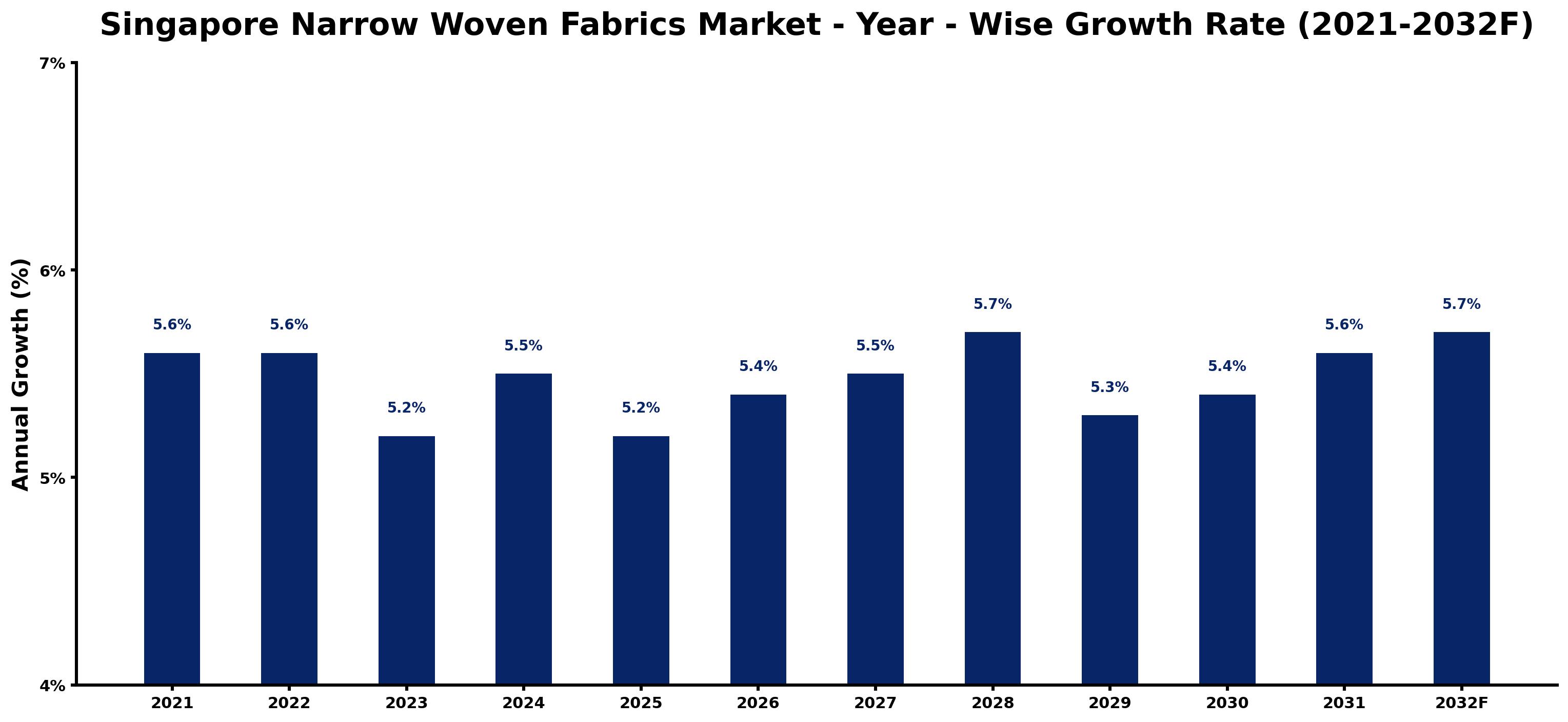
The table below presents the year wise growth rates along with the key drivers influencing the market
| Year | Growth Rate | Major Drivers |
| 2021 | 5.6% | Post-lockdown retail projects stimulated interest in innovative narrow woven fabric applications. |
| 2022 | 5.6% | Sustainable practices gained traction, influencing production methods in narrow woven fabrics market. |
| 2023 | 5.2% | Local fashion brands embraced narrow woven fabrics, enhancing their unique product offerings. |
| 2024 | 5.5% | Increased online shopping encouraged boutique textile suppliers to explore digital marketing avenues. |
| 2025 | 5.2% | The construction sector's expansion required durable, flexible materials, boosting fabric demand. |
| 2026 | 5.4% | Technological integration in manufacturing processes improved efficiency and product quality significantly. |
| 2027 | 5.5% | Collaboration between designers and manufacturers fostered creativity in narrow fabric designs. |
| 2028 | 5.7% | Growing awareness of eco-friendly textiles influenced consumer purchasing behaviors markedly. |
| 2029 | 5.3% | Export opportunities to ASEAN countries motivated local producers to scale production capacities. |
| 2030 | 5.4% | Investment in automation technologies reduced labor costs and increased operational agility. |
| 2031 | 5.6% | Emerging trends in athleisure and activewear shifted focus toward functional fabric solutions. |
| 2032 | 5.7% | Cultural events emphasizing local craftsmanship revitalized interest in Singaporean textile heritage. |
Note - Market size estimations and growth projections presented in this report are based on 6Wresearch's advanced forecasting approach, validated with industry datasets as of June 2026.
Singapore Narrow Woven Fabrics Market Synopsis
The Singapore Narrow Woven Fabrics Market is projected to reach 5.4% and witness significant growth during the forecast period (2026-2032). Narrow woven fabrics, produced by the interlacing of two or more strands of yarn, are extensively used across various sectors. These fabrics are integral to the manufacturing of ribbons, laces, trimmings, industrial fabrics, and medical textiles, including essential items such as bandages and prosthetics. The market was valued at USD 2.2 billion in 2019, with expectations of registering a compound annual growth rate (CAGR) of 4.3% through 2032, driven by multiple factors that contribute to increased demand and application.
Singapore Narrow Woven Fabrics Market Growth Drivers
The growth of the Singapore Narrow Woven Fabrics Market is primarily fueled by the rising demand for fashion apparel. As consumer preferences shift towards innovative and high-quality clothing, manufacturers are increasingly relying on narrow woven fabrics to meet these needs. Additionally, advancements in fabric production technologies have enabled the industry to produce garments that not only are more cost-effective but also possess superior quality attributes. This technological evolution is vital in sustaining growth as it allows for more efficient production processes.
Moreover, the heightened awareness surrounding personal hygiene has prompted consumers to seek high-quality medical textiles. This shift has significantly increased the demand for medical applications of narrow woven fabrics, such as bandages and surgical gowns. Furthermore, there is an ongoing trend of investment in research and development (R&D) by companies in this sector, focusing on product innovation and sustainability. These initiatives pave the way for new product launches that align with consumer expectations, driving market growth towards 2025 and beyond.
Singapore Narrow Woven Fabrics Market Challenges and Restraints
Despite the positive outlook for the Singapore Narrow Woven Fabrics Market, several challenges could hinder its growth. The market is characterized by a high degree of competition, with numerous small-scale companies vying for market share. This competitive landscape can lead to price wars and thinner profitability margins, posing a significant threat to smaller players.
The seasonal demand patterns prevalent in the apparel manufacturing sector further complicate the scenario, impacting overall sales volumes and growth trajectories. These fluctuations can create challenges in achieving consistent organic revenue growth year over year. Additionally, stringent environmental regulations imposed by government authorities add operational pressures on domestic vendors, often limiting their ability to scale efficiently.
Moreover, rising raw material costs, particularly due to volatile crude oil prices, exert additional financial strain on stakeholders throughout the supply chain. Exchange rate fluctuations can also influence export dynamics, adversely affecting the business performance of manufacturers dependent on international markets. Collectively, these challenges highlight the complexities facing the Singapore Narrow Woven Fabrics Market.
Singapore Narrow Woven Fabrics Market Government Investment and Initiatives
The government of Singapore has recognized the potential of the narrow woven fabrics sector, implementing various initiatives aimed at fostering growth and innovation within the industry. Public spending in infrastructure improvements, technology advancement, and skill development programs are designed to enhance the competitiveness of local manufacturers. These efforts include grants and funding opportunities for research and development projects that focus on sustainable production practices.
Additionally, government policies promote collaboration between academia and industry stakeholders to drive innovation. This collaborative approach is instrumental in developing new technologies and materials that can enhance the quality and functionality of narrow woven fabrics. The commitment to environmental sustainability by governmental agencies also encourages businesses to adopt greener practices, further elevating the sector's growth potential while aligning with global sustainability objectives.
Singapore Narrow Woven Fabrics Market Latest Developments (May 2025 - June 2026)
In the period from May 2025 to June 2026, the Singapore Narrow Woven Fabrics Market has observed notable developments that indicate a shift in industry trajectory. Companies have increasingly focused on sustainability, with many adopting eco-friendly materials and processes to align with international standards and consumer preferences. This shift has not only enhanced brand image but has also catered to the growing demand for environmentally responsible textiles.
Technological advancements continue to play a crucial role, with ongoing investments in automated production systems aimed at improving efficiency and reducing production costs. Additionally, the market has seen several collaborative partnerships aimed at fostering innovation in product design and functionality, particularly in the medical textiles segment. These collaborations are crucial for addressing the evolving needs of healthcare professionals and consumers alike.
Moreover, the post-pandemic recovery phase has seen a gradual rebound in consumer spending on non-essential items, including fashion apparel, which bodes well for the narrow woven fabrics market. Industry players are adapting to this shift by diversifying their product offerings and exploring new sales channels, including e-commerce platforms. This strategic pivot aims to capture a broader segment of the market and enhance overall competitiveness as the industry navigates the changing economic landscape.
Singapore Narrow Woven Fabrics Market - Key Attractiveness of the Report
- 10 Years of Market Numbers
- Historical Data Starting from 2022 to 2025
- Base Year: 2025
- Forecast Data until 2032
- Key Performance Indicators Impacting the Market
- Major Upcoming Developments and Projects
Key Highlights of the Report:
- Singapore Narrow Woven Fabrics Market Outlook
- Market Size of Singapore Narrow Woven Fabrics Market, 2025
- Forecast of Singapore Narrow Woven Fabrics Market, 2032F
- Historical Data and Forecast of Singapore Narrow Woven Fabrics Revenues & Volume for the Period 2022-2032F
- Singapore Narrow Woven Fabrics Market Trend Evolution
- Singapore Narrow Woven Fabrics Market Drivers and Challenges
- Singapore Narrow Woven Fabrics Price Trends
- Singapore Narrow Woven Fabrics Porter's Five Forces
- Singapore Narrow Woven Fabrics Industry Life Cycle
- Historical Data and Forecast of Singapore Narrow Woven Fabrics Market Revenues & Volume By Type for the Period 2022-2032F
- Historical Data and Forecast of Singapore Narrow Woven Fabrics Market Revenues & Volume By Polyester for the Period 2022-2032F
- Historical Data and Forecast of Singapore Narrow Woven Fabrics Market Revenues & Volume By Nylon for the Period 2022-2032F
- Historical Data and Forecast of Singapore Narrow Woven Fabrics Market Revenues & Volume By PP for the Period 2022-2032F
- Historical Data and Forecast of Singapore Narrow Woven Fabrics Market Revenues & Volume By Applications for the Period 2022-2032F
- Historical Data and Forecast of Singapore Narrow Woven Fabrics Market Revenues & Volume By Garments for the Period 2022-2032F
- Historical Data and Forecast of Singapore Narrow Woven Fabrics Market Revenues & Volume By Home Furnishing for the Period 2022-2032F
- Historical Data and Forecast of Singapore Narrow Woven Fabrics Market Revenues & Volume By Other for the Period 2022-2032F
- Singapore Narrow Woven Fabrics Import Export Trade Statistics
- Market Opportunity Assessment By Type
- Market Opportunity Assessment By Applications
- Singapore Narrow Woven Fabrics Top Companies Market Share
- Singapore Narrow Woven Fabrics Competitive Benchmarking By Technical and Operational Parameters
- Singapore Narrow Woven Fabrics Company Profiles
- Singapore Narrow Woven Fabrics Key Strategic Recommendations






































