Singapore Oil & Gas Pumps Market Size, Share & Growth Rate
The Singapore Oil & Gas Pumps Market was estimated at USD 749 Million in 2025 and is projected to reach USD 1095 Million by 2032, growing at a CAGR of 5.6% from 2026 to 2032. This growth is primarily driven by Singapore's strategic location as a key hub for energy activities in the region, bolstered by ongoing investments in energy infrastructure. Furthermore, the push for advanced, energy-efficient pumping systems in oil and gas operations is paving the way for sustained demand in the sector.
Singapore Oil & Gas Pumps Market Year-wise Growth Rate and Key Drivers
This graph highlights how the Singapore Oil & Gas Pumps Market has steadily grown over the years, supported by major growth factors.
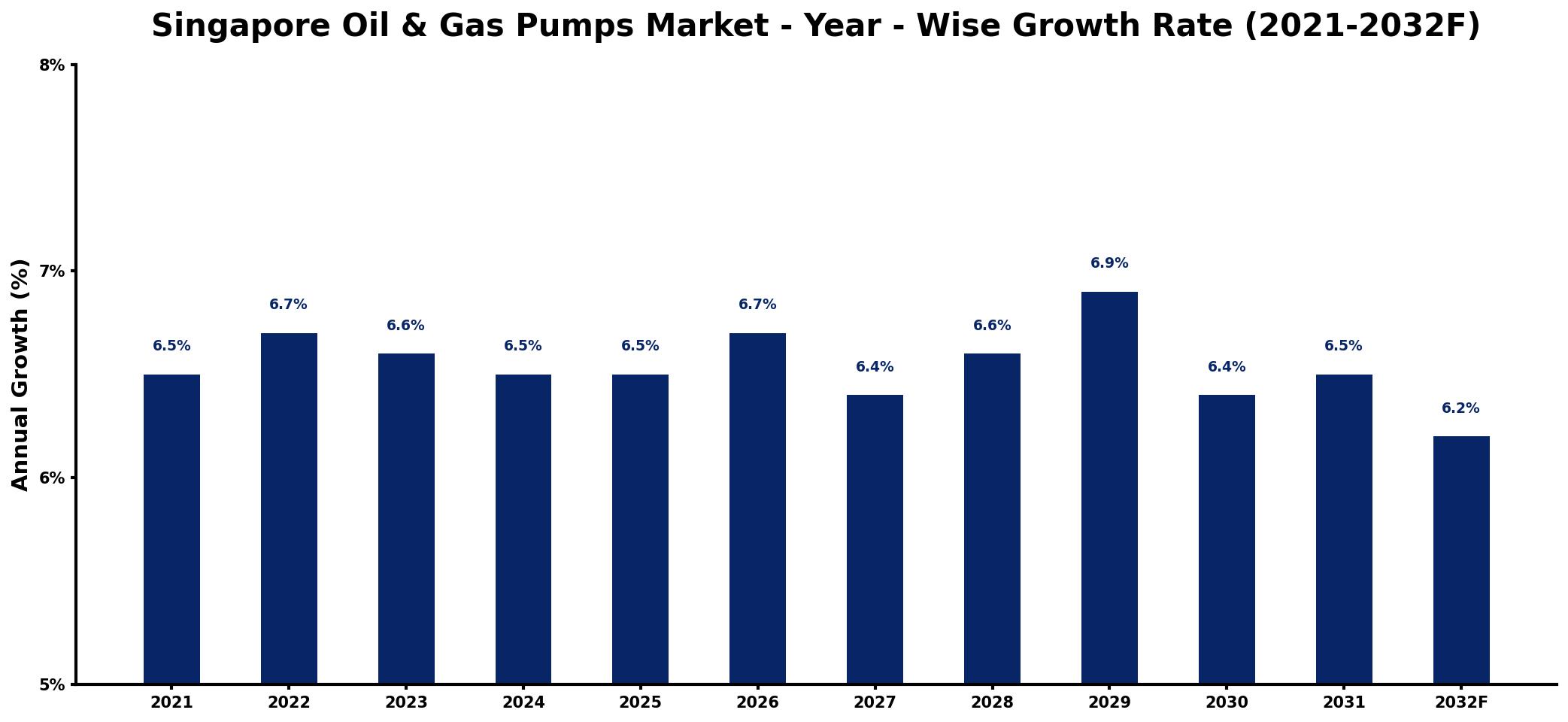
The table below presents the year‑wise growth rates along with the key drivers influencing the market
| Year | Growth Rate | Major Drivers |
| 2021 | 6.5% | Rising industrial manufacturing activities |
| 2022 | 6.7% | Increased infrastructure development projects |
| 2023 | 6.6% | Growing energy sector investments |
| 2024 | 6.5% | Expansion of logistics and transportation |
| 2025 | 6.5% | Higher demand from construction sector |
| 2026 | 6.7% | Emergence of renewable energy initiatives |
| 2027 | 6.4% | Strengthened regulatory compliance requirements |
| 2028 | 6.6% | Boost in urbanization and population |
| 2029 | 6.9% | Technological advancements in energy sector |
| 2030 | 6.4% | Growing focus on sustainability practices |
| 2031 | 6.5% | Increased foreign direct investment opportunities |
| 2032 | 6.2% | rising procurement volume requirements |
Note: Market size estimations and growth projections presented in this report are based on 6Wresearch's proprietary forecasting methodology, utilizing the latest available industry data, government publications, and primary research inputs.
Singapore Oil & Gas Pumps Market Synopsis
In recent years, the Singapore Oil & Gas Pumps Market has witnessed robust activity, driven by increasing energy demand and infrastructure investments. As the region recovers from the impacts of the pandemic, the market is anticipated to regain momentum, fueled by technological advancements and a shift towards sustainability.
Looking ahead, the market appears poised for a transformative phase, where efficiency and custom solutions will take center stage. The ongoing evolution in the oil and gas industry is set to drive innovation in pump technologies, thereby enhancing operational reliability and performance.
- The market is projected to grow significantly, with a notable CAGR of 5.6% from 2026 to 2032.
- Technological advancements in pump design and efficiency are crucial drivers of market growth.
- Investment in energy infrastructure remains a top priority for Singapore, supporting long-term demand.
- Market players are likely to focus on tailored solutions to meet the evolving needs of the industry.
- The recovery from the COVID-19 pandemic is expected to reinvigorate market dynamics and growth opportunities.
Despite the promising growth trajectory, the Singapore Oil & Gas Pumps Market faces several challenges. Fluctuations in global oil prices can create uncertainty, leading to reduced exploration and production activities. Additionally, the stringent compliance requirements around safety and quality can strain resources for market players. Moreover, the increasing competition on a global scale necessitates constant innovation, which can pose difficulties for some companies in keeping pace.
Current trends indicate a marked shift toward more energy-efficient and reliable pump technologies, driven by the industry's focus on sustainability. Additionally, there is an increasing preference for smart pumping solutions equipped with IoT capabilities, allowing for real-time monitoring and data analytics. As the industry evolves, custom-engineered pumps tailored to specific applications are becoming more prevalent, further enhancing operational efficiencies.
With the ongoing recovery of the oil and gas sector, numerous growth opportunities are emerging. Investments in renewable energy projects and a commitment to reducing carbon emissions are paving the way for innovative pumping solutions. Companies that can adapt to these trends and offer advanced, eco-friendly products stand to benefit significantly. Furthermore, the expansion of offshore activities in the region presents a considerable market opportunity for specialized pumping systems.
The Singaporean government has implemented various initiatives to promote growth in the oil and gas sector, including investments in energy infrastructure and incentives for sustainability. Public spending on infrastructure upgrades aims to enhance the efficiency and reliability of energy operations. Additionally, the government's commitment to environmental standards is encouraging the adoption of greener technologies within the market.
From 2026 to 2032, the Singapore Oil & Gas Pumps Market is expected to evolve in response to both domestic and global energy demands. As technological innovations continue to redefine the landscape, companies that invest in research and development are likely to emerge as leaders. A strong focus on efficiency, sustainability, and the customization of solutions will be crucial as the market adapts to changing consumer needs and regulatory pressures.
Recent developments in the Singapore oil and gas pumps sector indicate a shift toward integrating advanced technologies into traditional pump systems. There is a clear trend of increasing collaboration between companies and technology firms to enhance product offerings. Moreover, industry participants are actively exploring sustainable practices in pump manufacturing and operation, signaling a commitment to long-term environmental goals.
- 10 Years of Market Numbers
- Historical Data Starting from 2022 to 2025
- Base Year: 2025
- Forecast Data until 2032
- Key Performance Indicators Impacting the Market
- Major Upcoming Developments and Projects
Key Highlights of the Report:
- Singapore Oil & Gas Pumps Market Outlook
- Market Size of Singapore Oil & Gas Pumps Market, 2025
- Forecast of Singapore Oil & Gas Pumps Market, 2032
- Historical Data and Forecast of Singapore Oil & Gas Pumps Revenues & Volume for the Period 2022-2032F
- Singapore Oil & Gas Pumps Market Trend Evolution
- Singapore Oil & Gas Pumps Market Drivers and Challenges
- Singapore Oil & Gas Pumps Price Trends
- Singapore Oil & Gas Pumps Porter's Five Forces
- Singapore Oil & Gas Pumps Industry Life Cycle
- Historical Data and Forecast of Singapore Oil & Gas Pumps Market Revenues & Volume By Type for the Period 2022-2032F
- Historical Data and Forecast of Singapore Oil & Gas Pumps Market Revenues & Volume By Submersible Pumps for the Period 2022-2032F
- Historical Data and Forecast of Singapore Oil & Gas Pumps Market Revenues & Volume By Non-submersible Pumps for the Period 2022-2032F
- Historical Data and Forecast of Singapore Oil & Gas Pumps Market Revenues & Volume By Pump Type for the Period 2022-2032F
- Historical Data and Forecast of Singapore Oil & Gas Pumps Market Revenues & Volume By Centrifugal Pump for the Period 2022-2032F
- Historical Data and Forecast of Singapore Oil & Gas Pumps Market Revenues & Volume By Positive Displacement Pump for the Period 2022-2032F
- Historical Data and Forecast of Singapore Oil & Gas Pumps Market Revenues & Volume By Cryogenic Pump for the Period 2022-2032F
- Historical Data and Forecast of Singapore Oil & Gas Pumps Market Revenues & Volume By Application for the Period 2022-2032F
- Historical Data and Forecast of Singapore Oil & Gas Pumps Market Revenues & Volume By Upstream for the Period 2022-2032F
- Historical Data and Forecast of Singapore Oil & Gas Pumps Market Revenues & Volume By Midstream for the Period 2022-2032F
- Historical Data and Forecast of Singapore Oil & Gas Pumps Market Revenues & Volume By Downstream for the Period 2022-2032F
- Singapore Oil & Gas Pumps Import Export Trade Statistics
- Market Opportunity Assessment By Type
- Market Opportunity Assessment By Pump Type
- Market Opportunity Assessment By Application
- Singapore Oil & Gas Pumps Top Companies Market Share
- Singapore Oil & Gas Pumps Competitive Benchmarking By Technical and Operational Parameters
- Singapore Oil & Gas Pumps Company Profiles
- Singapore Oil & Gas Pumps Key Strategic Recommendations






































