Singapore Ophthalmic Equipment Market: Import Trend Analysis
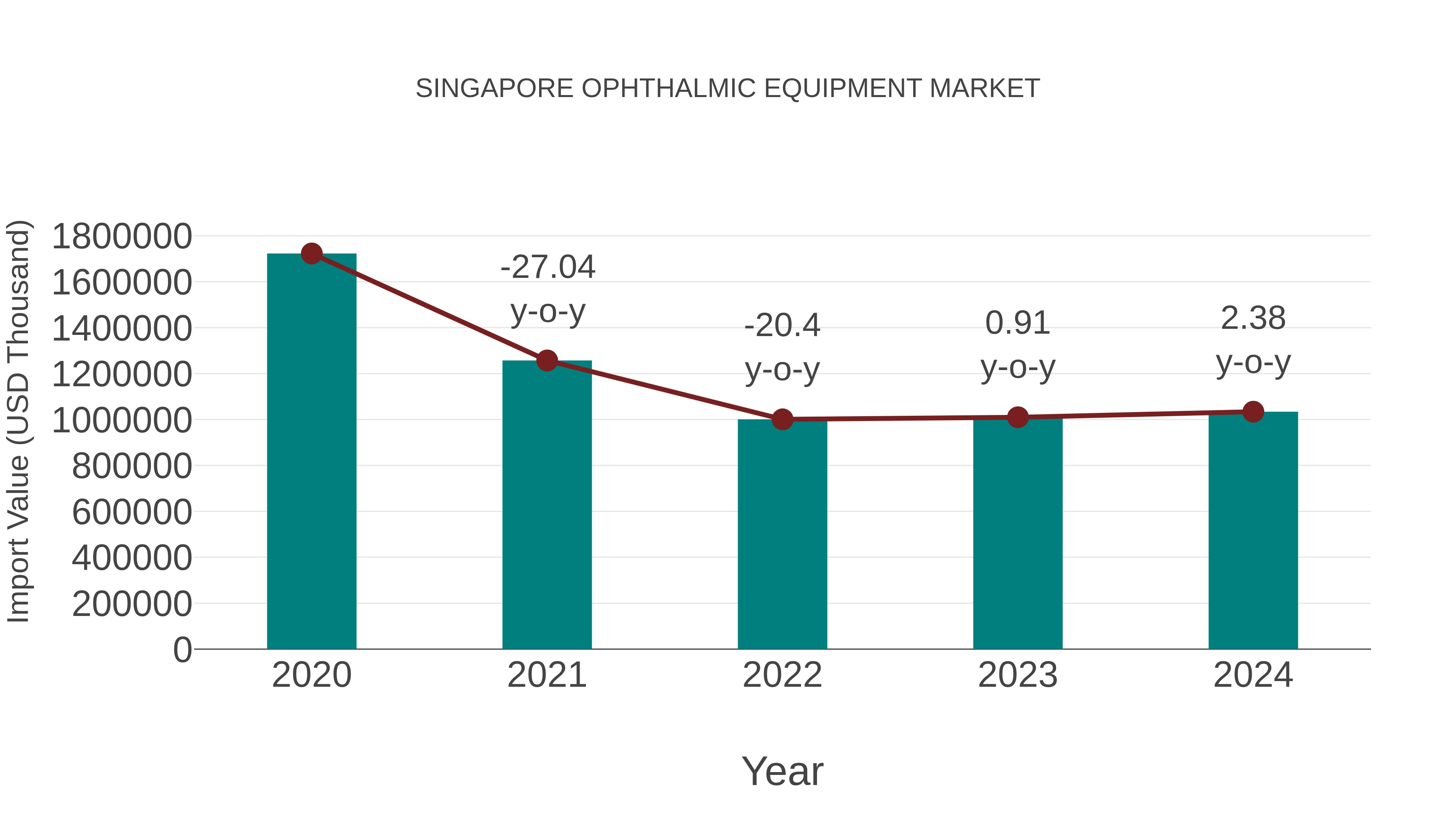
In 2024, Singapore`s ophthalmic equipment market saw a rising import trend. Imports of ophthalmic equipment increased steadily, reflecting the market`s reliance on imported products to meet domestic demand and technological advancements.
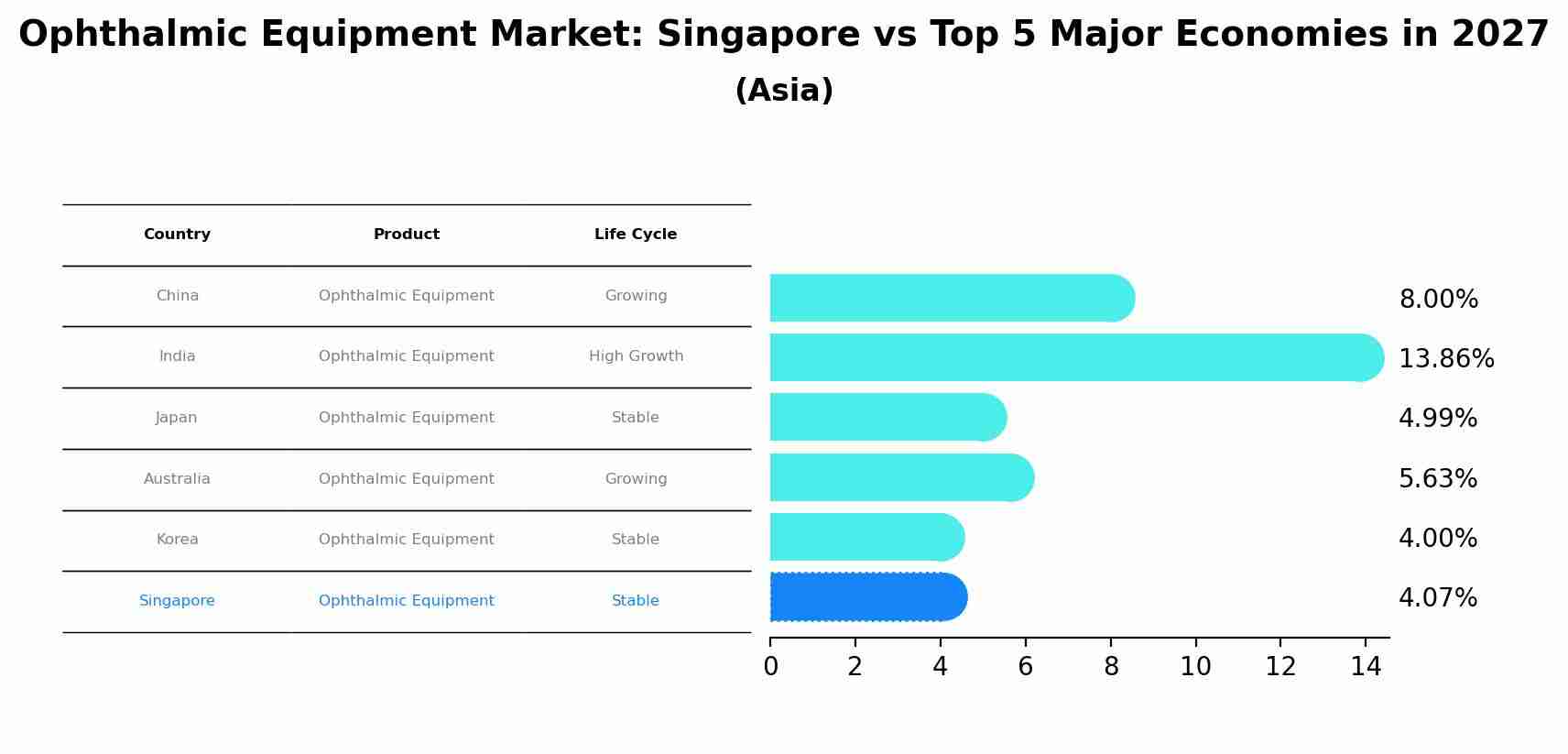
Ophthalmic Equipment Market: Singapore vs Top 5 Major Economies in 2027 (Asia)
The Ophthalmic Equipment market in Singapore is projected to grow at a stable growth rate of 4.07% by 2027, within the Asia region led by China, along with other countries like India, Japan, Australia and South Korea, collectively shaping a dynamic and evolving market environment driven by innovation and increasing adoption of emerging technologies.
Singapore Ophthalmic Equipment Market Synopsis
The Singapore Ophthalmic Equipment Market is estimated to reach USD 4.12 billion by 2026 growing at a CAGR of 6.8% during the forecast period 2020-2026. The market growth can be attributed to the increasing prevalence of vision disorders, technological advancements in ophthalmic devices and rising incidences of eye injuries among people aged more than 65 years and above in Singapore region.
Market Drivers
Increasing Prevalence Of Vision Disorders: According to the World Health Organization (WHO), around 246 million people globally were affected by moderate or severe vision impairment due to cataract in 2017, which was higher than that reported for glaucoma and age-related macular degeneration combined; this has acted as a major driving force for ophthalmic equipment demand globally. Moreover, an increase in diabetic retinopathy cases has further fueled the need for early diagnosis and treatment procedures that are largely dependent on optical imaging systems such as fundus cameras, slit lamps, ETC, thus propelling market growth over the forecast period.Technological Advancements In Ophthalmic Devices: Over recent years there have been significant advances in technology with respect to ophthalmology products such as surgical microscopes & lasers being used for treating all types of refractive errors including myopia & astigmatism; these developments have increased patient comfort during surgeries while reducing recovery time postoperatively thereby creating huge potentials for device manufacturers across developed countries like Singapore fuelling market size significantly over coming times ahead.
Market challenges
High Cost Of Ophthalmologic Procedures And Equipment Installation : Despite availability of highly sophisticated advanced technologies providing improved accuracy rate yet their high cost acts as significant challenge restraining market development considerably over the forecast period across commercially affluent regions like Asia Pacific especially Singapore hampering industry???s profitability adversely.
Key players
Leading companies actively participating across Singapore Ophthalmological Equipment Market include Essilor International S.A., Carl Zeiss AG, Johnson & Johnson Services Inc.,
Covid-19 Impact
The Covid 19 pandemic had brought global economy virtually crashing down with entire healthcare sector affected adversely due its suspension of nonessential medical services leading many hospitals having no choice but scaling down operations drastically , thus slumping sales revenues significantly making it difficult survival situation for small scale companies operating therein henceforth curtailing overall industry profit margin substantially.
Key Highlights of the Report:
- Singapore Ophthalmic Equipment Market Outlook
- Market Size of Singapore Ophthalmic Equipment Market, 2023
- Forecast of Singapore Ophthalmic Equipment Market, 2030
- Historical Data and Forecast of Singapore Ophthalmic Equipment Revenues & Volume for the Period 2020-2030
- Singapore Ophthalmic Equipment Market Trend Evolution
- Singapore Ophthalmic Equipment Market Drivers and Challenges
- Singapore Ophthalmic Equipment Price Trends
- Singapore Ophthalmic Equipment Porter's Five Forces
- Singapore Ophthalmic Equipment Industry Life Cycle
- Historical Data and Forecast of Singapore Ophthalmic Equipment Market Revenues & Volume By Product Type for the Period 2020-2030
- Historical Data and Forecast of Singapore Ophthalmic Equipment Market Revenues & Volume By Diagnostics & Monitoring Devices for the Period 2020-2030
- Historical Data and Forecast of Singapore Ophthalmic Equipment Market Revenues & Volume By Surgical Instruments for the Period 2020-2030
- Historical Data and Forecast of Singapore Ophthalmic Equipment Market Revenues & Volume By Vision Care Products for the Period 2020-2030
- Historical Data and Forecast of Singapore Ophthalmic Equipment Market Revenues & Volume By End-User for the Period 2020-2030
- Historical Data and Forecast of Singapore Ophthalmic Equipment Market Revenues & Volume By Consumers for the Period 2020-2030
- Historical Data and Forecast of Singapore Ophthalmic Equipment Market Revenues & Volume By Hospitals for the Period 2020-2030
- Historical Data and Forecast of Singapore Ophthalmic Equipment Market Revenues & Volume By Specialty Clinics and Ambulatory Surgery Centers for the Period 2020-2030
- Historical Data and Forecast of Singapore Ophthalmic Equipment Market Revenues & Volume By Other End Users for the Period 2020-2030
- Singapore Ophthalmic Equipment Import Export Trade Statistics
- Market Opportunity Assessment By Product Type
- Market Opportunity Assessment By End-User
- Singapore Ophthalmic Equipment Top Companies Market Share
- Singapore Ophthalmic Equipment Competitive Benchmarking By Technical and Operational Parameters
- Singapore Ophthalmic Equipment Company Profiles
- Singapore Ophthalmic Equipment Key Strategic Recommendations






































