Singapore Optical Measurement Market: Import Trend Analysis
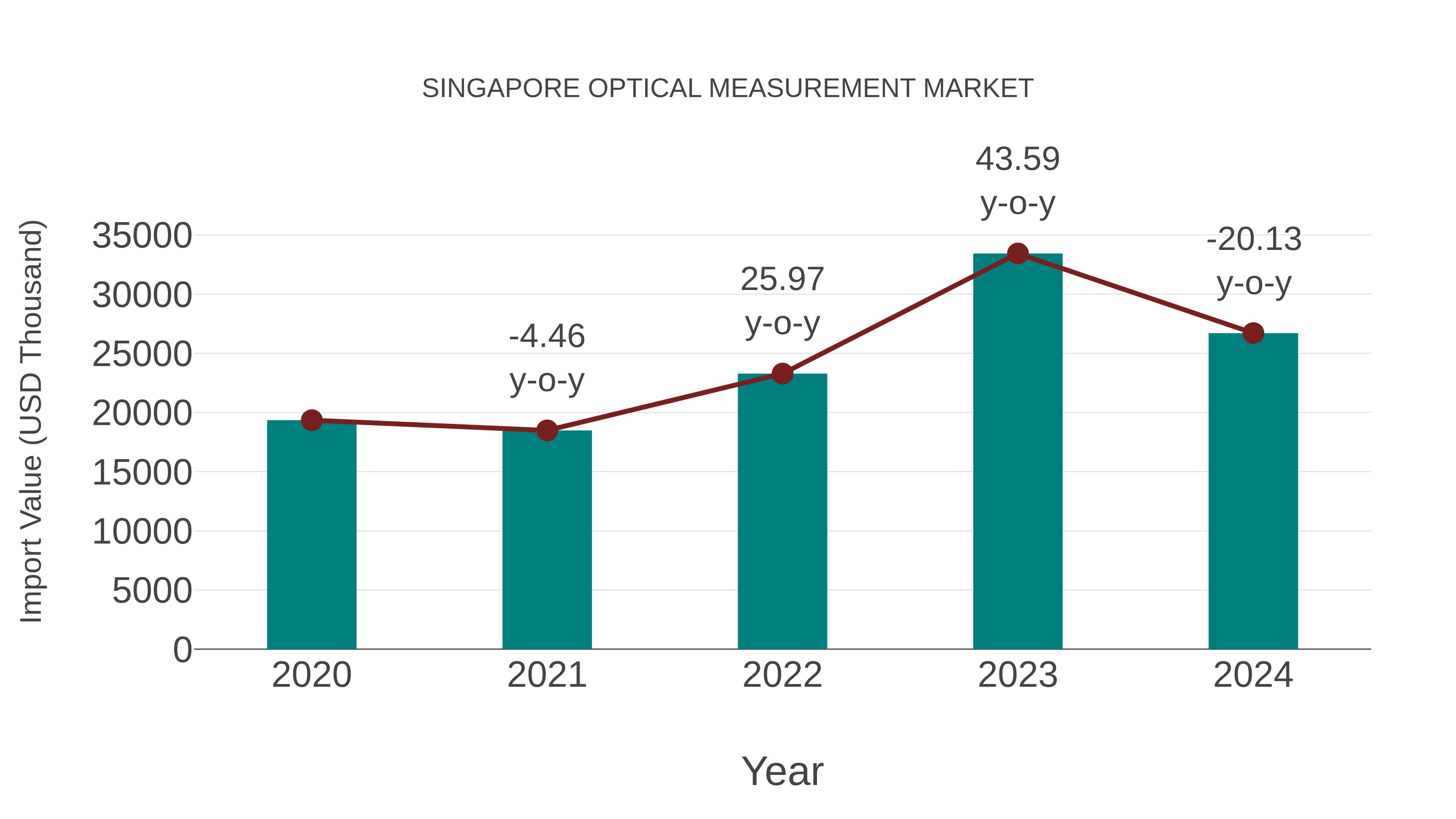
In 2024, Singapore`s optical measurement market saw a steady increase in imports. The market experienced a growing demand for advanced measurement technologies, leading to a rise in the import of optical measurement equipment and devices.
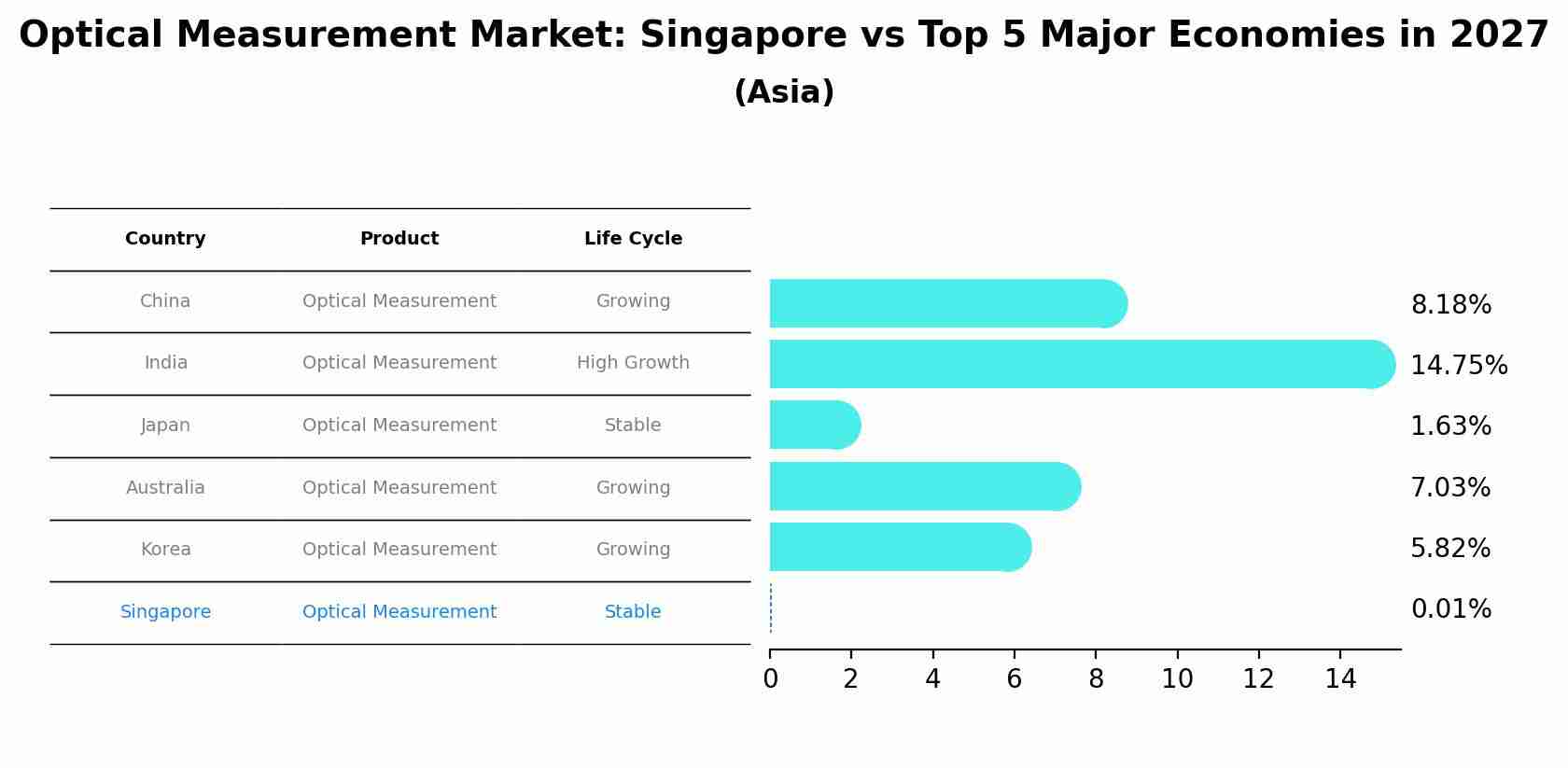
Optical Measurement Market: Singapore vs Top 5 Major Economies in 2027 (Asia)
In the Asia region, the Optical Measurement market in Singapore is projected to expand at a stable growth rate of 0.01% by 2027. The largest economy is China, followed by India, Japan, Australia and South Korea.
Singapore Optical Measurement Market Synopsis
The optical measurement market in Singapore is set to grow as industries rely on precision measurement for quality control and research purposes. Optical measurement systems offer non-contact and high-accuracy measurement solutions. The market`s expansion is driven by the need for advanced measurement techniques in manufacturing and scientific research.
Drivers of the Market
The Singapore optical measurement market experiences growth driven by factors such as the need for precision metrology in manufacturing, advancements in optical measurement technologies, and quality control requirements in various industries. Optical measurement systems provide accurate and non-contact measurement solutions for dimensions and surfaces. Growth drivers include the expansion of semiconductor and electronics manufacturing, the demand for optical 3D scanning in aerospace and automotive sectors, and the adoption of optical profilometry in research and development. As industries prioritize quality assurance and precision measurement, the optical measurement market is expected to grow, offering innovative and reliable metrology solutions.
Challenges of the Market
The Singapore optical measurement market may face challenges related to precision and calibration standards. Optical measurement instruments, such as spectrometers and interferometers, require high levels of accuracy. Manufacturers must maintain strict calibration standards and offer user-friendly features to meet the demands of research and industry applications.
COVID-19 Impact on the Market
The optical measurement market in Singapore demonstrated resilience during the COVID-19 pandemic. While there were temporary disruptions in manufacturing and calibration services, the market quickly adapted. The demand for optical measurement solutions remained consistent, especially in industries like manufacturing and metrology. Manufacturers focused on remote support and enhanced software solutions. The pandemic underscored the importance of accurate and non-contact measurement technologies.
Key Players in the Market
In the Singapore optical measurement market, major players like Faro Technologies, Inc., Hexagon AB, and Mitutoyo Corporation offer precision optical measurement instruments and 3D metrology solutions for industrial and manufacturing applications. Their accuracy, quality, and metrology expertise contribute to their market leadership.
Key Highlights of the Report:
- Singapore Optical Measurement Market Outlook
- Market Size of Singapore Optical Measurement Market, 2025
- Forecast of Singapore Optical Measurement Market, 2032
- Historical Data and Forecast of Singapore Optical Measurement Revenues & Volume for the Period 2022-2032F
- Singapore Optical Measurement Market Trend Evolution
- Singapore Optical Measurement Market Drivers and Challenges
- Singapore Optical Measurement Price Trends
- Singapore Optical Measurement Porter's Five Forces
- Singapore Optical Measurement Industry Life Cycle
- Historical Data and Forecast of Singapore Optical Measurement Market Revenues & Volume By Offering for the Period 2022-2032F
- Historical Data and Forecast of Singapore Optical Measurement Market Revenues & Volume By Hardware for the Period 2022-2032F
- Historical Data and Forecast of Singapore Optical Measurement Market Revenues & Volume By Software for the Period 2022-2032F
- Historical Data and Forecast of Singapore Optical Measurement Market Revenues & Volume By Services for the Period 2022-2032F
- Historical Data and Forecast of Singapore Optical Measurement Market Revenues & Volume By Component for the Period 2022-2032F
- Historical Data and Forecast of Singapore Optical Measurement Market Revenues & Volume By Autocollimators for the Period 2022-2032F
- Historical Data and Forecast of Singapore Optical Measurement Market Revenues & Volume By Measuring Microscopes for the Period 2022-2032F
- Historical Data and Forecast of Singapore Optical Measurement Market Revenues & Volume By Profile Projectors for the Period 2022-2032F
- Historical Data and Forecast of Singapore Optical Measurement Market Revenues & Volume By Optical Digitizers and Scanners for the Period 2022-2032F
- Historical Data and Forecast of Singapore Optical Measurement Market Revenues & Volume By Coordinate Measuring Machines for the Period 2022-2032F
- Historical Data and Forecast of Singapore Optical Measurement Market Revenues & Volume By Video Measuring Machines for the Period 2022-2032F
- Historical Data and Forecast of Singapore Optical Measurement Market Revenues & Volume By Vertical for the Period 2022-2032F
- Historical Data and Forecast of Singapore Optical Measurement Market Revenues & Volume By Automotive for the Period 2022-2032F
- Historical Data and Forecast of Singapore Optical Measurement Market Revenues & Volume By Aerospace & Defense for the Period 2022-2032F
- Historical Data and Forecast of Singapore Optical Measurement Market Revenues & Volume By Energy and Power for the Period 2022-2032F
- Historical Data and Forecast of Singapore Optical Measurement Market Revenues & Volume By Electronics Manufacturing for the Period 2022-2032F
- Historical Data and Forecast of Singapore Optical Measurement Market Revenues & Volume By Industrial for the Period 2022-2032F
- Historical Data and Forecast of Singapore Optical Measurement Market Revenues & Volume By Others for the Period 2022-2032F
- Singapore Optical Measurement Import Export Trade Statistics
- Market Opportunity Assessment By Offering
- Market Opportunity Assessment By Component
- Market Opportunity Assessment By Vertical
- Singapore Optical Measurement Top Companies Market Share
- Singapore Optical Measurement Competitive Benchmarking By Technical and Operational Parameters
- Singapore Optical Measurement Company Profiles
- Singapore Optical Measurement Key Strategic Recommendations






































