Singapore Over the Top Market Size & Growth Rate (2026-2032)
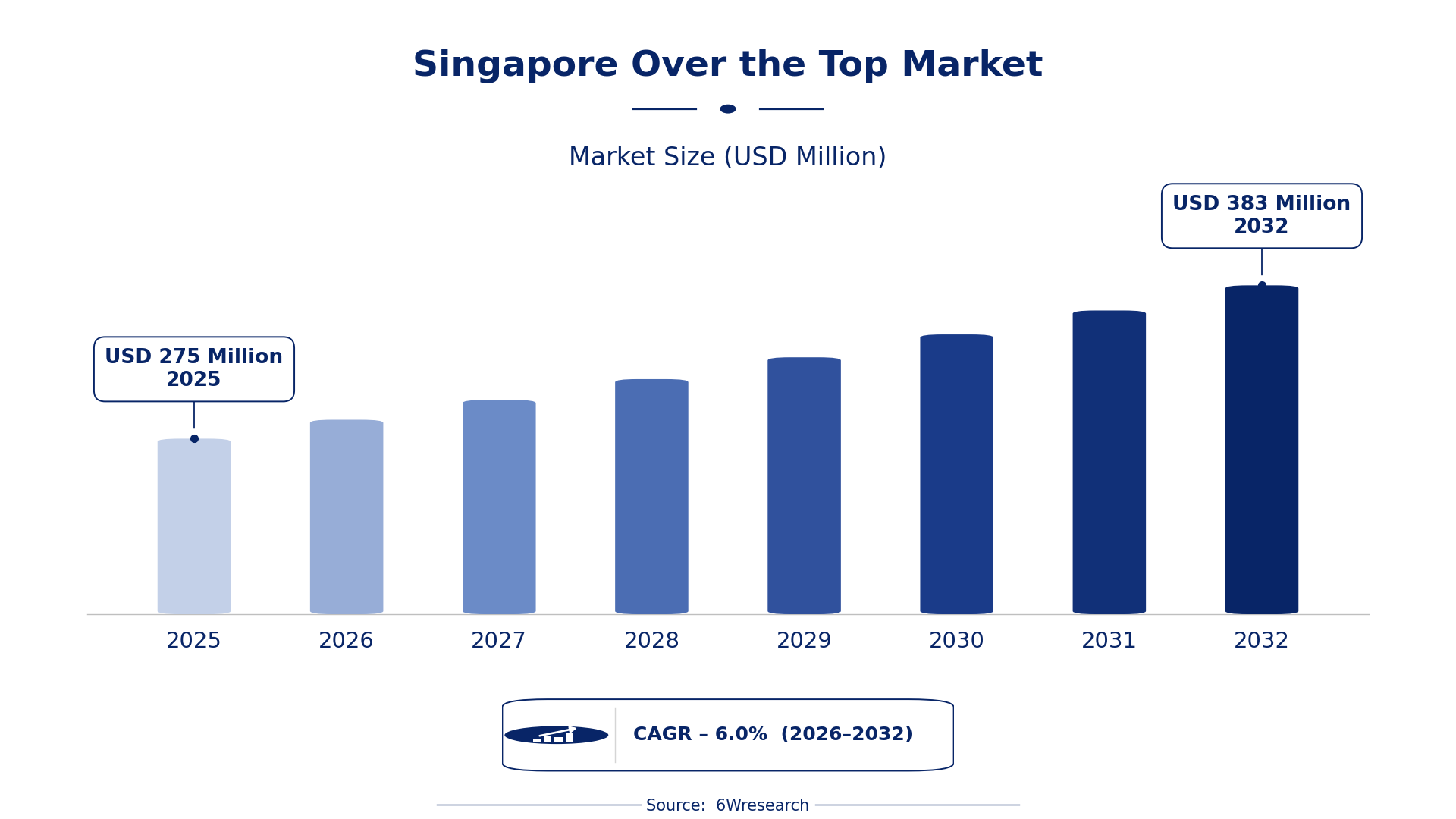
The Singapore Over the Top Market was estimated at USD 275 Million in 2025 and is projected to reach USD 383 Million by 2032, growing at a CAGR of 6.0% from 2026 to 2032.
Singapore Over the Top Market Synopsis
In recent years, the Singapore Over the Top (OTT) market has experienced an impressive surge fueled by a rapid shift in consumer behavior towards on-demand content consumption. As major global players and regional platforms gain traction, the landscape is becoming increasingly competitive.
Looking ahead, this market is set for continued growth, with local content creation and partnerships enhancing the appeal of OTT offerings. The expected integration of advanced technologies will further change how consumers engage with content, establishing a foundation for long-term market evolution.
Singapore Over the Top Market Year-wise Growth Rate and Key Drivers
This graph illustrates the annual growth rates of the Singapore Over the Top Market from 2021 to 2032, highlighting a steady upward trajectory and projected expansion over the forecast period.
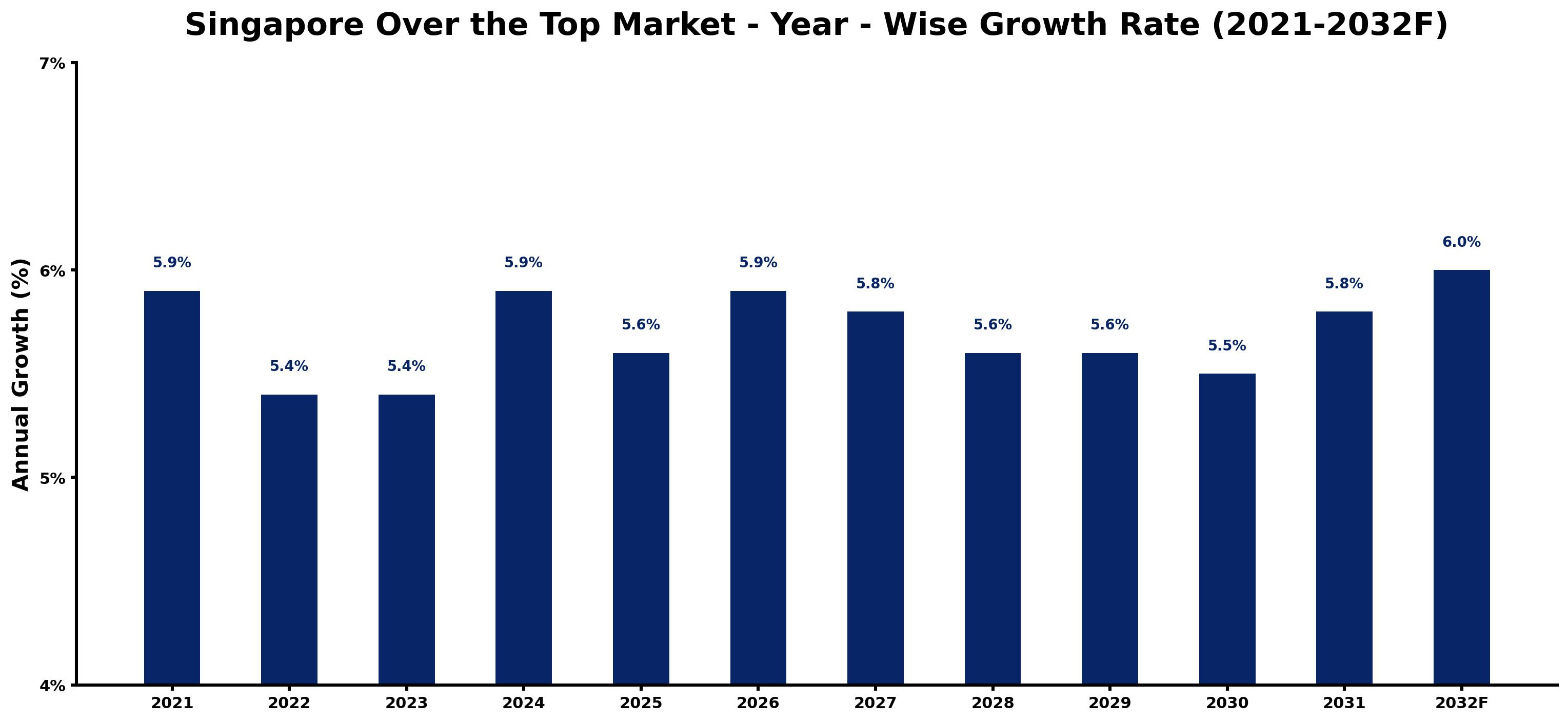
The table below presents the year‑wise growth rates along with the key drivers influencing the market
| Year | Growth Rate | Major Drivers |
| 2021 | 5.9% | Surge in demand for mobile and internet streaming services. |
| 2022 | 5.4% | Increased investments in local content production and licensing. |
| 2023 | 5.4% | Growing smartphone penetration driving OTT subscription growth. |
| 2024 | 5.9% | Government promotion of smart nation initiatives enhancing connectivity. |
| 2025 | 5.6% | Rise in digital advertising boosting OTT revenue potential. |
| 2026 | 5.9% | Partnerships with local telecoms expanding OTT service access. |
| 2027 | 5.8% | Youth demographics favoring on-demand viewing alternatives. |
| 2028 | 5.6% | Regulatory support for international content partnerships and access. |
| 2029 | 5.6% | Increased accessibility through lower broadband subscription costs. |
| 2030 | 5.5% | Adaptation of consumer habits post-pandemic favoring OTT platforms. |
| 2031 | 5.8% | Enhanced user experience via 5G network rollout benefits. |
| 2032 | 6.0% | Growing multilingual content catering to diverse local audiences. |
Note: Market size estimations and growth projections presented in this report are based on 6Wresearch's proprietary forecasting methodology, utilizing the latest available industry data, government publications, and primary research inputs.
Singapore Over the Top Market Key Takeaways
Below are some of the specific key takeaways from the market, including:
- The demand for personalized content is driving subscription growth across multiple OTT platforms.
- High-speed internet and smartphone penetration are key enablers of OTT service adoption.
- Content localization and exclusive offerings enhance user engagement and retention.
- The COVID-19 pandemic accelerated the transition from traditional media consumption to digital streaming.
- Regional players are crucial in providing culturally relevant content, carving out niche market segments.
Evaluation of Restraints in Singapore Over the Top Market
Despite its rapid growth, the Singapore OTT market contends with several restraints that could limit expansion. Chief among these are stringent content licensing regulations and intellectual property complexities. Navigating these legal frameworks requires continuous diligence from service providers.
The fierce competition among OTT platforms also necessitates a constant drive for innovation and investment in high-quality content. Without such efforts, retaining and growing subscriber bases will be increasingly challenging.
Singapore Over the Top Market Trends
A notable trend shaping the Singapore OTT market is the rise of original content production, which is becoming a key differentiator among platforms. Increasingly, players are investing heavily in local storytelling to attract viewers.
Furthermore, partnerships between OTT platforms and telecommunications companies are emerging to enhance service delivery and content accessibility. As smart TVs and mobile devices proliferate, integration across different viewing platforms will be vital to meet consumer demand.
Singapore Over the Top Market Opportunities
Opportunities for growth in the Singapore OTT market are abundant, particularly in areas such as local content creation and niche streaming services. Investment in technology that enhances user experience, such as AI-driven content recommendations, can significantly boost engagement.
Additionally, tapping into the growing demographic of younger audiences who prefer mobile viewing can lead to substantial revenue generation for service providers looking to cater to their preferences.
Government Initiatives in the Singapore Over the Top Market
The government of Singapore is actively shaping the OTT market through various initiatives aimed at enhancing digital infrastructure and encouraging content localization. Regulatory frameworks are being developed to ensure fair competition while fostering innovation within the sector.
- A regulatory framework introduced in early 2025 aimed at enhancing transparency in content licensing agreements.
- Currently ongoing initiatives focus on improving digital literacy among consumers, facilitating better access to OTT services.
- A national digital infrastructure upgrade programme is underway to enhance broadband access, expected to conclude by mid-2026.
- Planned initiatives include public-private partnerships designed to support local content creators by 2028.
Future Insights of the Singapore Over the Top Market
From 2026 to 2032, the Singapore OTT market is expected to evolve significantly, driven by technological advancements and changing consumer behaviors. The integration of AI and data analytics will optimize content recommendations and user engagement.
As competition intensifies, service providers that innovate and tailor their offerings will likely secure a larger share of the market. Partnerships with local content creators will continue to play a crucial role in attracting subscribers and maintaining loyalty.
Singapore Over the Top Market Latest Developments
In the past year, the Singapore OTT market has seen a flurry of activity marked by increased investments in original content and technological upgrades. As platforms vie for consumer attention, collaboration and competition are shaping the market's future.
- A major technology vendor announced the launch of a new AI-driven content curation tool in early 2025, aimed at enhancing user experience.
- In Q3 2025, a leading regional operator expanded its service portfolio to include a localized content channel focusing on Singaporean creators.
- An initiative that began in late 2025 aims to provide subsidies for local content production, bolstering the domestic creative industry.
- Upcoming in early 2026, a partnership is set to launch a new subscription model that combines traditional and OTT services for a seamless consumer experience.
Singapore Over the Top Market - Key Attractiveness of the Report
- 10 Years of Market Numbers
- Historical Data Starting from 2022 to 2025
- Base Year: 2025
- Forecast Data until 2032
- Key Performance Indicators Impacting the Market
- Major Upcoming Developments and Projects
Key Highlights of the Report:
- Singapore Over the Top Market Outlook
- Market Size of Singapore Over the Top Market, 2025
- Forecast of Singapore Over the Top Market, 2032
- Historical Data and Forecast of Singapore Over the Top Revenues & Volume for the Period 2022-2032F
- Singapore Over the Top Market Trend Evolution
- Singapore Over the Top Market Drivers and Challenges
- Singapore Over the Top Price Trends
- Singapore Over the Top Porter's Five Forces
- Singapore Over the Top Industry Life Cycle
- Historical Data and Forecast of Singapore Over the Top Market Revenues & Volume By Type for the Period 2022-2032F
- Historical Data and Forecast of Singapore Over the Top Market Revenues & Volume By Game Streaming for the Period 2022-2032F
- Historical Data and Forecast of Singapore Over the Top Market Revenues & Volume By Audio Streaming for the Period 2022-2032F
- Historical Data and Forecast of Singapore Over the Top Market Revenues & Volume By Video Streaming for the Period 2022-2032F
- Historical Data and Forecast of Singapore Over the Top Market Revenues & Volume By Communication for the Period 2022-2032F
- Historical Data and Forecast of Singapore Over the Top Market Revenues & Volume By Monetization Model for the Period 2022-2032F
- Historical Data and Forecast of Singapore Over the Top Market Revenues & Volume By Subscription-based for the Period 2022-2032F
- Historical Data and Forecast of Singapore Over the Top Market Revenues & Volume By Advertising-based for the Period 2022-2032F
- Historical Data and Forecast of Singapore Over the Top Market Revenues & Volume By Transaction-based for the Period 2022-2032F
- Historical Data and Forecast of Singapore Over the Top Market Revenues & Volume By Streaming Device for the Period 2022-2032F
- Historical Data and Forecast of Singapore Over the Top Market Revenues & Volume By Smartphones and Tablets for the Period 2022-2032F
- Historical Data and Forecast of Singapore Over the Top Market Revenues & Volume By Desktops and Laptops for the Period 2022-2032F
- Historical Data and Forecast of Singapore Over the Top Market Revenues & Volume By IPTV and Consoles for the Period 2022-2032F
- Historical Data and Forecast of Singapore Over the Top Market Revenues & Volume By Vertical for the Period 2022-2032F
- Historical Data and Forecast of Singapore Over the Top Market Revenues & Volume By Media and Entertainment for the Period 2022-2032F
- Historical Data and Forecast of Singapore Over the Top Market Revenues & Volume By Education and Learning for the Period 2022-2032F
- Historical Data and Forecast of Singapore Over the Top Market Revenues & Volume By Gaming for the Period 2022-2032F
- Historical Data and Forecast of Singapore Over the Top Market Revenues & Volume By Service Utilities for the Period 2022-2032F
- Singapore Over the Top Import Export Trade Statistics
- Market Opportunity Assessment By Type
- Market Opportunity Assessment By Monetization Model
- Market Opportunity Assessment By Streaming Device
- Market Opportunity Assessment By Vertical
- Singapore Over the Top Top Companies Market Share
- Singapore Over the Top Competitive Benchmarking By Technical and Operational Parameters
- Singapore Over the Top Company Profiles
- Singapore Over the Top Key Strategic Recommendations






































