Singapore Personal Computers Market Size, Share & Growth Rate
The Singapore Personal Computers Market was estimated at USD 199 Million in 2025 and is projected to reach USD 264 Million by 2032, growing at a CAGR of 4.1% from 2026 to 2032. This growth trajectory reflects a robust demand for personal computing solutions, fueled by the integration of technology across various sectors including education, business, and entertainment. The continuing trend towards remote work and digital learning, which gained momentum during the pandemic, is expected to sustain this upward momentum.
Singapore Personal Computers Market Year-wise Growth Rate and Key Drivers
This graph highlights how the Singapore Personal Computers Market has steadily grown over the years, supported by major growth factors.
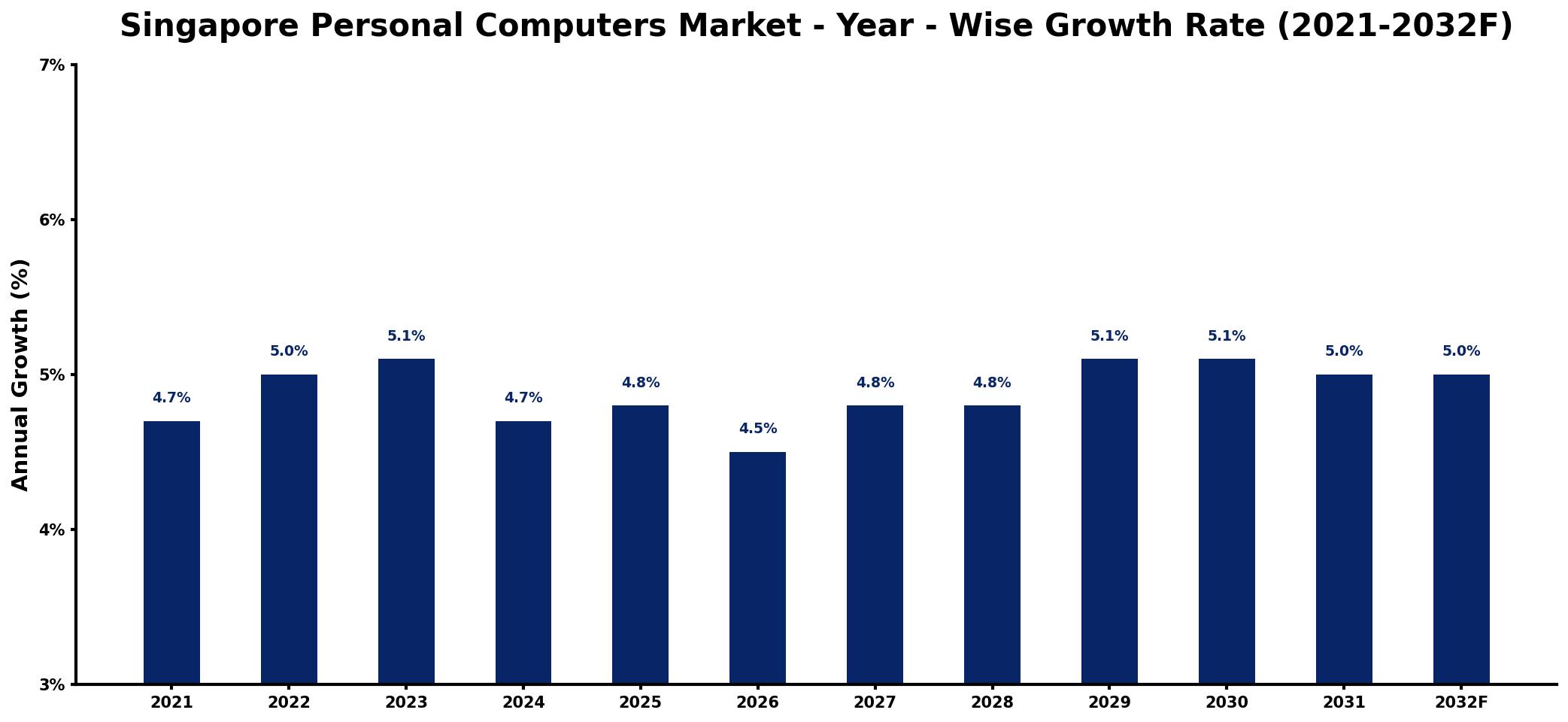
The table below presents the year‑wise growth rates along with the key drivers influencing the market
| Year | Growth Rate | Major Drivers |
| 2021 | 4.7% | Remote work adoption drives demand |
| 2022 | 5.0% | E-learning platforms increase usage |
| 2023 | 5.1% | Gaming industry expands rapidly |
| 2024 | 4.7% | Corporate investments in technology |
| 2025 | 4.8% | Cloud services require infrastructure |
| 2026 | 4.5% | Digital content creation rises significantly |
| 2027 | 4.8% | AI applications boost market growth |
| 2028 | 4.8% | 5G rollout enhances connectivity needs |
| 2029 | 5.1% | Home office setups gain popularity |
| 2030 | 5.1% | Sustainability initiatives drive upgrades |
| 2031 | 5.0% | Tech innovations attract new users |
| 2032 | 5.0% | Educational institutions modernize facilities |
Note: Market size estimations and growth projections presented in this report are based on 6Wresearch's proprietary forecasting methodology, utilizing the latest available industry data, government publications, and primary research inputs.
Singapore Personal Computers Market Synopsis
In Singapore, the market for personal computers has witnessed a noteworthy shift, with a steady demand for high-performance desktops emerging for specialized applications such as gaming and graphic design. While traditional desktops face declining sales, laptops remain an essential tool across both professional and personal environments, underpinning market resilience.
Consumer behavior has evolved, with an increasing preference for mobile and portable solutions. This trend is bolstered by innovations in hardware and software that enhance user experiences, making the upgrade to new devices more attractive. The government's push for digital literacy further supports this demand, highlighting a clear trajectory for growth.
Singapore Personal Computers Market Key Takeaways
- Increasing reliance on digital technology across sectors drives PC demand.
- The pandemic accelerated trends towards remote work and digital learning.
- High-performance desktops remain critical for niche applications.
- Consumer preferences are shifting toward portable devices and cloud solutions.
- Continuous technological innovations are prompting upgrades.
Evaluation of Restraints in Singapore Personal Computers Market
Despite its growth potential, the Singapore Personal Computers Market grapples with significant restraints, particularly the rapid pace of technological advancements that can outstrip consumer readiness. As preferences shift towards compact and portable devices, there is a risk that traditional desktops could become obsolete for many users. Furthermore, ongoing global semiconductor shortages complicate supply chain dynamics, leading to potential inventory issues and increased pricing, which may hinder growth in the near term.
Singapore Personal Computers Market Trends
The market is currently experiencing several trends that are reshaping demand and technology. The rise of hybrid work models has intensified the need for versatile devices that can seamlessly support both professional and personal tasks. Additionally, advancements in cloud computing are changing how consumers and businesses utilize PCs, encouraging more companies to opt for solutions that integrate cloud services with local hardware. The increasing emphasis on gaming and high-performance applications further fuels interest in desktops with advanced capabilities.
Singapore Personal Computers Market Opportunities
Significant growth opportunities exist within the Singapore Personal Computers Market, particularly in segments focused on high-performance applications, such as gaming and graphic design. Moreover, the ongoing digital transformation across various industries presents a favorable environment for investment in innovative computing solutions. Companies looking to enhance digital literacy and technology adoption in the corporate sector can find ample room for growth and collaboration.
Government Initiatives in the Singapore Personal Computers Market
The Singapore government has launched several initiatives aimed at promoting technology adoption and digital literacy. Programs aimed at improving access to technology for educational institutions and public-sector organizations illustrate the commitment to fostering a digitally capable workforce. These initiatives are crucial for enhancing the overall technological landscape, thereby driving demand in the personal computers market as businesses and consumers alike seek to leverage new technologies.
Future Insights of the Singapore Personal Computers Market
Looking ahead to 2026-2032, the Singapore Personal Computers Market is poised for steady growth, driven by an increasing integration of advanced technologies into daily operations. The ongoing evolution of hybrid work environments will likely continue to spur demand for laptops and mobile devices. Additionally, as businesses increasingly invest in upgrading their technology infrastructure, the market can expect sustained interest in high-performance computing solutions that support complex applications.
Singapore Personal Computers Market Latest Developments (2025 - 2026)
Recent developments in the Singapore personal computers market indicate a shift towards more sustainable practices, with manufacturers exploring environmentally friendly materials and production processes. Furthermore, the introduction of new product lines tailored to meet the evolving needs of remote workers and gamers has generated significant consumer interest. As businesses continue to adapt to changing dynamics, investment in technology upgrades remains a focal point.
Singapore Personal Computers Market - Key Attractiveness of the Report
- 10 Years of Market Numbers
- Historical Data Starting from 2022 to 2025
- Base Year: 2025
- Forecast Data until 2032
- Key Performance Indicators Impacting the Market
- Major Upcoming Developments and Projects
Key Highlights of the Report:
- Singapore Personal Computers Market Outlook
- Market Size of Singapore Personal Computers Market, 2025
- Forecast of Singapore Personal Computers Market, 2032
- Historical Data and Forecast of Singapore Personal Computers Revenues & Volume for the Period 2022-2032F
- Singapore Personal Computers Market Trend Evolution
- Singapore Personal Computers Market Drivers and Challenges
- Singapore Personal Computers Price Trends
- Singapore Personal Computers Porter's Five Forces
- Singapore Personal Computers Industry Life Cycle
- Historical Data and Forecast of Singapore Personal Computers Market Revenues & Volume By Product Type for the Period 2022-2032F
- Historical Data and Forecast of Singapore Personal Computers Market Revenues & Volume By Desktop for the Period 2022-2032F
- Historical Data and Forecast of Singapore Personal Computers Market Revenues & Volume By Notebook for the Period 2022-2032F
- Historical Data and Forecast of Singapore Personal Computers Market Revenues & Volume By Workstation for the Period 2022-2032F
- Historical Data and Forecast of Singapore Personal Computers Market Revenues & Volume By Others for the Period 2022-2032F
- Historical Data and Forecast of Singapore Personal Computers Market Revenues & Volume By Distribution Channel for the Period 2022-2032F
- Historical Data and Forecast of Singapore Personal Computers Market Revenues & Volume By Business-To-Business (B2B) for the Period 2022-2032F
- Historical Data and Forecast of Singapore Personal Computers Market Revenues & Volume By Business-To-Consumer (B2C) for the Period 2022-2032F
- Historical Data and Forecast of Singapore Personal Computers Market Revenues & Volume By Application for the Period 2022-2032F
- Historical Data and Forecast of Singapore Personal Computers Market Revenues & Volume By Consumer for the Period 2022-2032F
- Historical Data and Forecast of Singapore Personal Computers Market Revenues & Volume By Commercial for the Period 2022-2032F
- Historical Data and Forecast of Singapore Personal Computers Market Revenues & Volume By Industrial for the Period 2022-2032F
- Singapore Personal Computers Import Export Trade Statistics
- Market Opportunity Assessment By Product Type
- Market Opportunity Assessment By Distribution Channel
- Market Opportunity Assessment By Application
- Singapore Personal Computers Top Companies Market Share
- Singapore Personal Computers Competitive Benchmarking By Technical and Operational Parameters
- Singapore Personal Computers Company Profiles
- Singapore Personal Computers Key Strategic Recommendations






































