Singapore Pigments Market: Import Trend Analysis
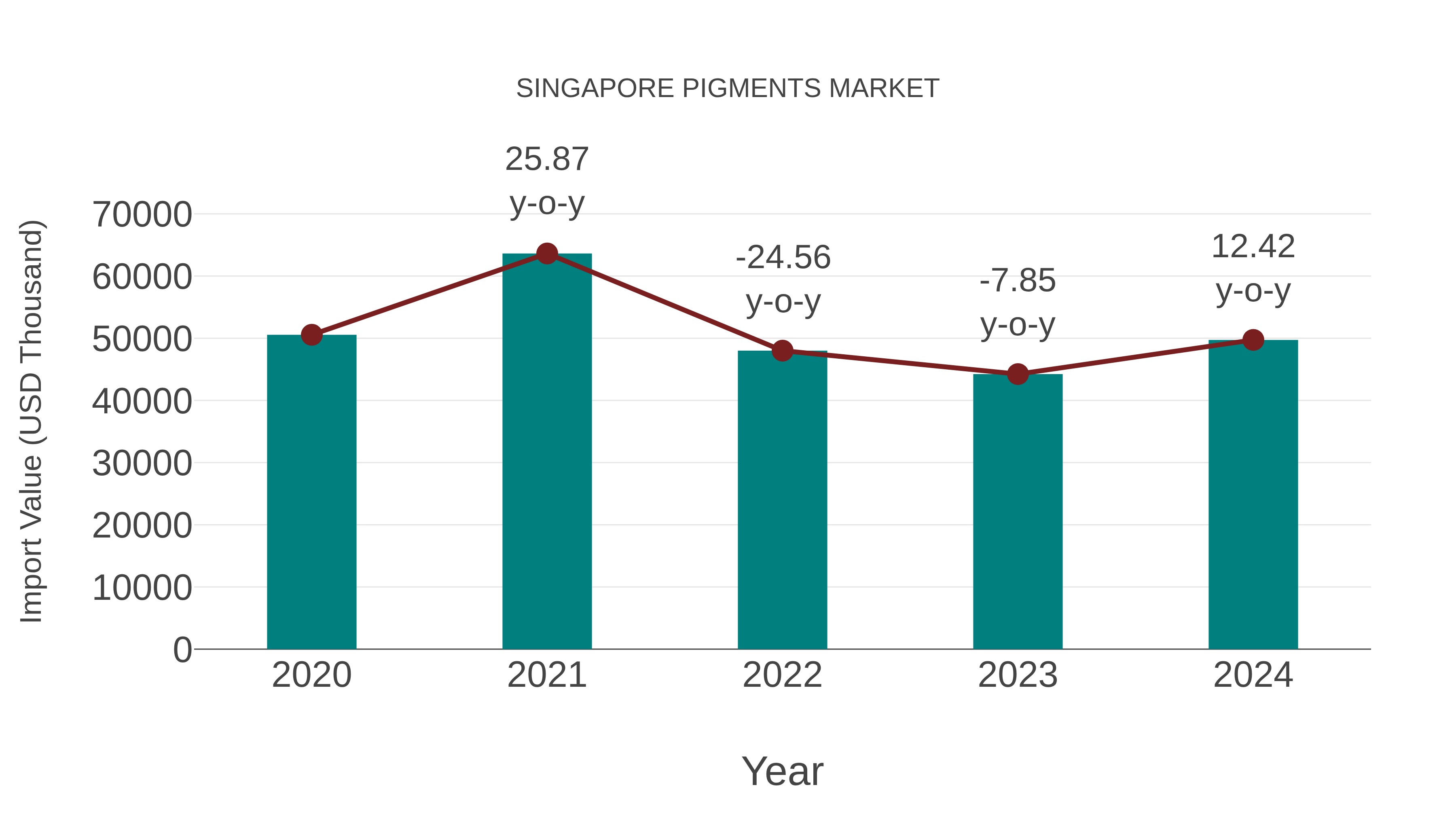
In 2024, Singapore`s pigment market witnessed a steady import trend, with a notable increase in demand for high-quality pigments. This was driven by the growing industrial sector and increasing consumer preference for innovative and sustainable products.
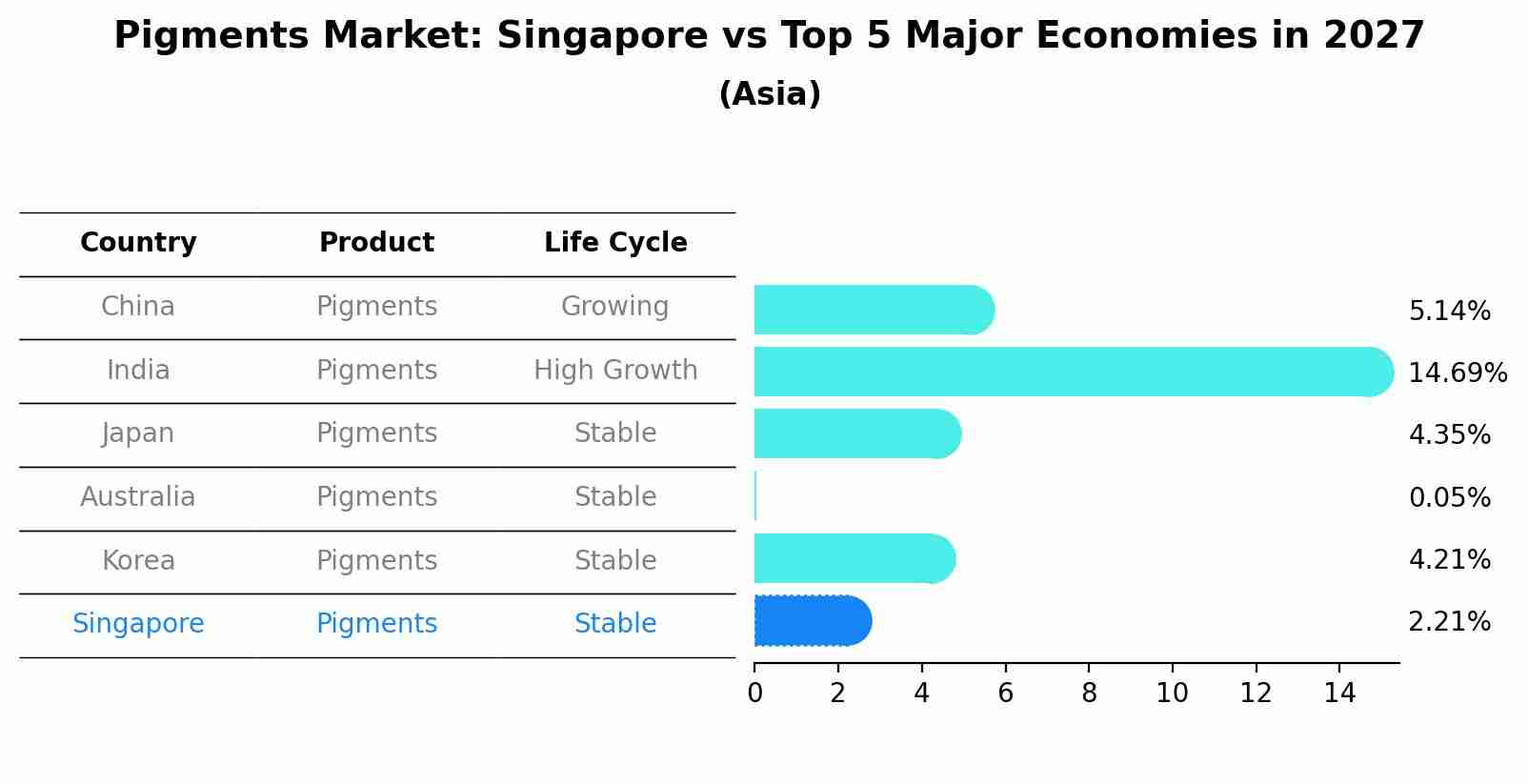
Pigments Market: Singapore vs Top 5 Major Economies in 2027 (Asia)
By 2027, Singapore's Pigments market is forecasted to achieve a stable growth rate of 2.21%, with China leading the Asia region, followed by India, Japan, Australia and South Korea.
Singapore Pigments Market Synopsis
Singapore is one of the rapidly growing countries in terms of pigments market. The country has witnessed significant growth in recent years and this can be attributed to strong government initiatives, robust distribution networks, increasing demand for paints & coatings, and other end-use industries. In addition to that, Singapore presence as a major hub for trading activities has also contributed to the development of the country???s pigments sector.
Market Drivers
The paint & coating industry in Singapore is one of the major drivers for pigments market growth. With an increase in demand from several industries such as construction and automotive due to rapid urbanization across Asia Pacific region, the demand for high performance coatings which require advanced colorants has surged over recent years. Additionally, factors such as stringent environmental regulations regarding VOC emissions from solvent based paints have propelled manufacturers towards water-based products with good hiding properties resulting further driving up pigment consumption across various applications like industrial wood finishes ETC, thereby creating positive opportunities for players operating within the Singapore pigments market landscape.
Market challenges
Despite having alluring prospects related with it; some challenges are being faced by companies operating within Singapore pigments market including intensifying competition among existing players coupled with ever changing technology trends along with rising raw material costs & import duties on a few imported materials are affecting businesses here negatively.
Key players
Few prominent players operating within the space include BASF SE, Clariant AG, Cabot Corporation, Merck KGaA, Tronox Limited, DIC Corporation amongst others
Covid-19 Impact
Due to COVID 19 pandemic outbreak globally; most economic activities were forced into lockdown while manufacturing units faced production halts thus leading to decreased purchasing power among consumers at large scale; thereby adversely impacting overall business outlook created by Covid 19 on global level which includes sectors like Pigment Manufacturing as well causing massive revenue losses throughout 2020and 1st quarter 2021in particular affected significantly by pandemic crisis world wide.
Key Highlights of the Report:
- Singapore Pigments Market Outlook
- Market Size of Singapore Pigments Market, 2023
- Forecast of Singapore Pigments Market, 2030
- Historical Data and Forecast of Singapore Pigments Revenues & Volume for the Period 2020-2030
- Singapore Pigments Market Trend Evolution
- Singapore Pigments Market Drivers and Challenges
- Singapore Pigments Price Trends
- Singapore Pigments Porter's Five Forces
- Singapore Pigments Industry Life Cycle
- Historical Data and Forecast of Singapore Pigments Market Revenues & Volume By Product for the Period 2020-2030
- Historical Data and Forecast of Singapore Pigments Market Revenues & Volume By Inorganic for the Period 2020-2030
- Historical Data and Forecast of Singapore Pigments Market Revenues & Volume By Organic for the Period 2020-2030
- Historical Data and Forecast of Singapore Pigments Market Revenues & Volume By Specialty for the Period 2020-2030
- Historical Data and Forecast of Singapore Pigments Market Revenues & Volume By Application for the Period 2020-2030
- Historical Data and Forecast of Singapore Pigments Market Revenues & Volume By Paints & coatings for the Period 2020-2030
- Historical Data and Forecast of Singapore Pigments Market Revenues & Volume By Printing inks for the Period 2020-2030
- Historical Data and Forecast of Singapore Pigments Market Revenues & Volume By Plastics for the Period 2020-2030
- Historical Data and Forecast of Singapore Pigments Market Revenues & Volume By Construction materials for the Period 2020-2030
- Historical Data and Forecast of Singapore Pigments Market Revenues & Volume By Others for the Period 2020-2030
- Singapore Pigments Import Export Trade Statistics
- Market Opportunity Assessment By Product
- Market Opportunity Assessment By Application
- Singapore Pigments Top Companies Market Share
- Singapore Pigments Competitive Benchmarking By Technical and Operational Parameters
- Singapore Pigments Company Profiles
- Singapore Pigments Key Strategic Recommendations






































