Singapore Plant-based Meat Market Size, Share & Growth Rate
The Singapore Plant-based Meat Market was estimated at USD 200 Million in 2025 and is projected to reach USD 273 Million by 2032, growing at a CAGR of 4.5% from 2026 to 2032. This growth trajectory is underpinned by an increasing consumer shift towards sustainable and healthy eating habits, aligning with global trends in dietary preferences. The local market's unique blend of cultural diversity and a rising number of health-conscious consumers further fuels the demand for innovative plant-based meat solutions.
Singapore Plant-based Meat Market Year-wise Growth Rate and Key Drivers
This graph highlights how the Singapore Plant-based Meat Market has steadily grown over the years, supported by major growth factors.
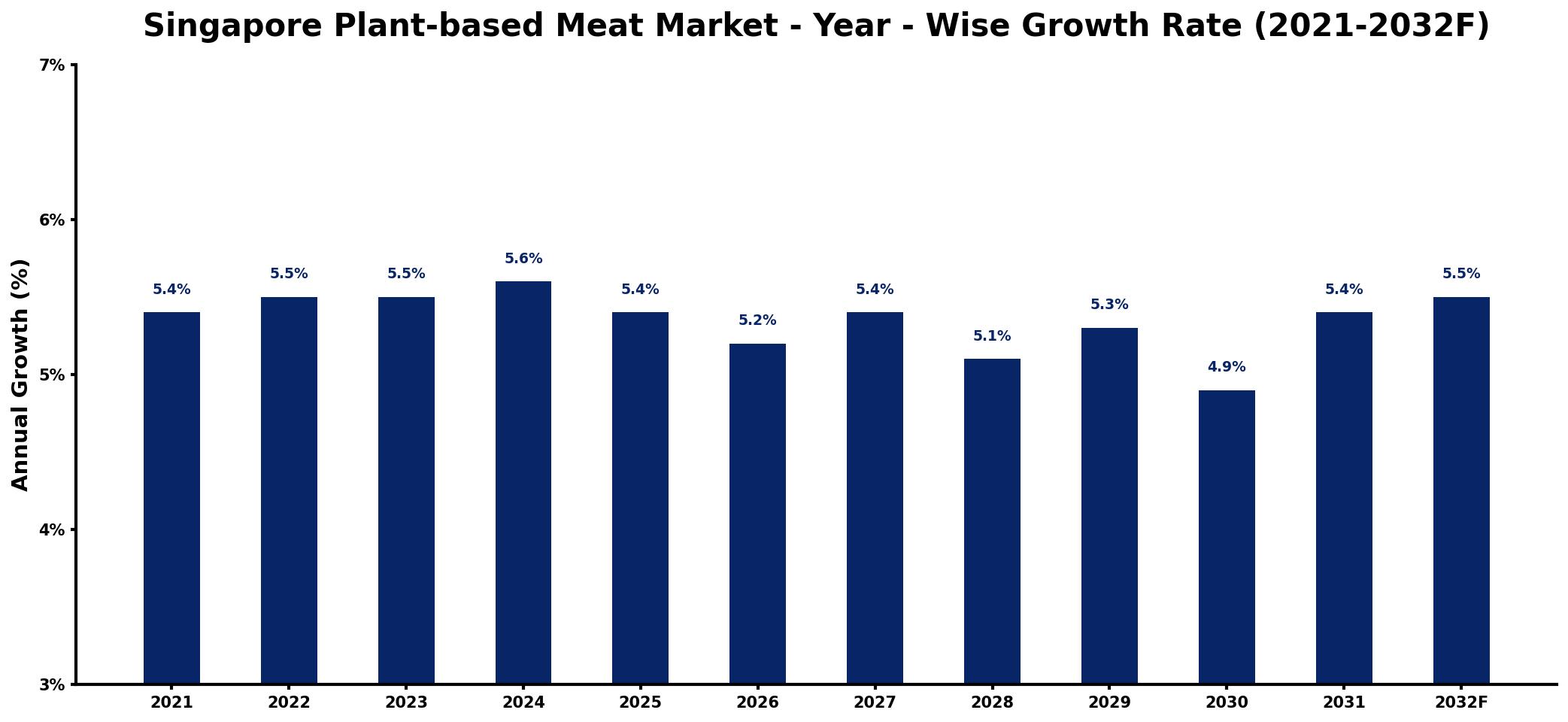
The table below presents the year‑wise growth rates along with the key drivers influencing the market
| Year | Growth Rate | Major Drivers |
| 2021 | 5.4% | Rising consumer health consciousness |
| 2022 | 5.5% | Increased availability of alternatives |
| 2023 | 5.5% | Growth in sustainable investments |
| 2024 | 5.6% | Expansion of retail distribution channels |
| 2025 | 5.4% | Higher demand for innovative cuisine |
| 2026 | 5.2% | Surge in foodservice partnerships |
| 2027 | 5.4% | Emergence of new startups |
| 2028 | 5.1% | Growing interest in ethical sourcing |
| 2029 | 5.3% | Increased awareness of nutrition benefits |
| 2030 | 4.9% | Shift towards eco-friendly practices |
| 2031 | 5.4% | Broadening culinary market applications |
| 2032 | 5.5% | Strengthened community engagement initiatives |
Note: Market size estimations and growth projections presented in this report are based on 6Wresearch's proprietary forecasting methodology, utilizing the latest available industry data, government publications, and primary research inputs.
Singapore Plant-based Meat Market Synopsis
Recent years have witnessed an uptick in consumer interest for plant-based diets, particularly in urban centers like Singapore. The convergence of health, sustainability, and ethical consumerism has positioned plant-based meats as not just a trend, but a significant segment of the food industry.
Within Singapore, the plant-based meat market is characterized by an impressive array of innovative products designed to closely mimic traditional meat in taste and texture. As such, this market is poised for considerable expansion as consumers increasingly prioritize plant-based options that are both nutritious and environmentally friendly.
Singapore Plant-based Meat Market Key Takeaways
- Consumer preferences for health-conscious and sustainable food options are driving the market's growth.
- Innovative meat analog technologies are enhancing product taste and texture, facilitating wider acceptance.
- Distribution strategies in restaurants and supermarkets are crucial for capturing diverse consumer segments.
- The COVID-19 pandemic has accelerated trends toward plant-based diets, impacting market dynamics.
- Transparency regarding ingredient sourcing and nutritional value is vital for building consumer trust.
Evaluation of Restraints in Singapore Plant-based Meat Market
Despite the promising growth trajectory, the Singapore plant-based meat market faces specific restraints. One significant challenge is the need for constant product innovation to meet evolving consumer taste preferences. As competition intensifies, brands are under pressure to refine their offerings to closely replicate the sensory attributes of traditional meats. Moreover, issues related to ingredient transparency can hinder market acceptance; consumers demand not only flavor but also assurances regarding nutritional content and sourcing practices, necessitating ongoing efforts from manufacturers to foster trust.
Singapore Plant-based Meat Market Trends
Several trends are currently shaping the Singapore plant-based meat market landscape. A notable shift is the incorporation of local flavors and culinary techniques into plant-based products, making them more appealing to Singapore's diverse consumer base. Additionally, the rise of food delivery services and online grocery shopping has expanded access to plant-based alternatives, encouraging trial and regular consumption. Moreover, partnerships between food brands and culinary experts to create signature dishes featuring plant-based meats are gaining traction, further embedding these products into the culinary mainstream.
Singapore Plant-based Meat Market Opportunities
Significant growth opportunities are emerging in the Singapore plant-based meat market as stakeholders explore untapped consumer segments. The expansion of meal kits and plant-based meat options in quick-service restaurants presents a lucrative avenue for growth. Furthermore, increased investments in local food technology innovation can lead to breakthroughs in product development, enhancing flavor profiles and health benefits. With rising environmental concerns, companies that emphasize sustainable sourcing and production methods may gain a competitive edge, further attracting conscious consumers.
Government Initiatives in the Singapore Plant-based Meat Market
The Singapore government has shown a commitment to promoting sustainability and food security, supporting initiatives that encourage the development of alternative protein sources. Policies aimed at enhancing local food production capabilities and reducing environmental impacts are increasingly relevant. Public spending on research and development in food technology not only fosters innovation but also aims to place Singapore as a leading hub for plant-based protein solutions in the region.
Future Insights of the Singapore Plant-based Meat Market
Looking ahead to 2026-2032, the Singapore plant-based meat market is expected to evolve substantially, characterized by enhanced consumer education and increased product availability. As more consumers embrace flexitarian diets, the market will likely see a diversification of offerings catering to various culinary preferences. Heightened regulatory support and incentives for sustainable practices may further empower local producers to innovate, ensuring that Singapore remains at the forefront of the plant-based food revolution.
Singapore Plant-based Meat Market Latest Developments (2025 - 2026)
The Singapore plant-based meat market has experienced notable activity over the past year, with several brands introducing new product lines that align with local tastes. Consumer feedback has become increasingly influential, guiding manufacturers in their product development strategies. Additionally, partnerships between grocery retailers and plant-based brands are being solidified to enhance distribution efficiency, ensuring consumers have greater access to these innovative meat alternatives.
Singapore Plant-based Meat Market - Key Attractiveness of the Report
- 10 Years of Market Numbers
- Historical Data Starting from 2022 to 2025
- Base Year: 2025
- Forecast Data until 2032
- Key Performance Indicators Impacting the Market
- Major Upcoming Developments and Projects
Key Highlights of the Report:
- Singapore Plant-based Meat Market Outlook
- Market Size of Singapore Plant-based Meat Market, 2025
- Forecast of Singapore Plant-based Meat Market, 2032
- Historical Data and Forecast of Singapore Plant-based Meat Revenues & Volume for the Period 2022-2032F
- Singapore Plant-based Meat Market Trend Evolution
- Singapore Plant-based Meat Market Drivers and Challenges
- Singapore Plant-based Meat Price Trends
- Singapore Plant-based Meat Porter's Five Forces
- Singapore Plant-based Meat Industry Life Cycle
- Historical Data and Forecast of Singapore Plant-based Meat Market Revenues & Volume By Source for the Period 2022-2032F
- Historical Data and Forecast of Singapore Plant-based Meat Market Revenues & Volume By Soy for the Period 2022-2032F
- Historical Data and Forecast of Singapore Plant-based Meat Market Revenues & Volume By Pea for the Period 2022-2032F
- Historical Data and Forecast of Singapore Plant-based Meat Market Revenues & Volume By Wheat for the Period 2022-2032F
- Historical Data and Forecast of Singapore Plant-based Meat Market Revenues & Volume By Others for the Period 2022-2032F
- Historical Data and Forecast of Singapore Plant-based Meat Market Revenues & Volume By Product for the Period 2022-2032F
- Historical Data and Forecast of Singapore Plant-based Meat Market Revenues & Volume By Burgers for the Period 2022-2032F
- Historical Data and Forecast of Singapore Plant-based Meat Market Revenues & Volume By Sausages for the Period 2022-2032F
- Historical Data and Forecast of Singapore Plant-based Meat Market Revenues & Volume By Patties for the Period 2022-2032F
- Historical Data and Forecast of Singapore Plant-based Meat Market Revenues & Volume By Nuggets, for the Period 2022-2032F
- Historical Data and Forecast of Singapore Plant-based Meat Market Revenues & Volume By Tenders & Cutlets for the Period 2022-2032F
- Historical Data and Forecast of Singapore Plant-based Meat Market Revenues & Volume By Grounds for the Period 2022-2032F
- Historical Data and Forecast of Singapore Plant-based Meat Market Revenues & Volume By Others for the Period 2022-2032F
- Historical Data and Forecast of Singapore Plant-based Meat Market Revenues & Volume By Type for the Period 2022-2032F
- Historical Data and Forecast of Singapore Plant-based Meat Market Revenues & Volume By Chicken for the Period 2022-2032F
- Historical Data and Forecast of Singapore Plant-based Meat Market Revenues & Volume By Pork for the Period 2022-2032F
- Historical Data and Forecast of Singapore Plant-based Meat Market Revenues & Volume By Beef for the Period 2022-2032F
- Historical Data and Forecast of Singapore Plant-based Meat Market Revenues & Volume By Fish for the Period 2022-2032F
- Historical Data and Forecast of Singapore Plant-based Meat Market Revenues & Volume By Others for the Period 2022-2032F
- Historical Data and Forecast of Singapore Plant-based Meat Market Revenues & Volume By End-user for the Period 2022-2032F
- Historical Data and Forecast of Singapore Plant-based Meat Market Revenues & Volume By Retail for the Period 2022-2032F
- Historical Data and Forecast of Singapore Plant-based Meat Market Revenues & Volume By HORECA (Hotel/Restaurant/Caf) for the Period 2022-2032F
- Historical Data and Forecast of Singapore Plant-based Meat Market Revenues & Volume By Storage for the Period 2022-2032F
- Historical Data and Forecast of Singapore Plant-based Meat Market Revenues & Volume By Refrigerated Plant-based Meat for the Period 2022-2032F
- Historical Data and Forecast of Singapore Plant-based Meat Market Revenues & Volume By Frozen Plant-based Meat for the Period 2022-2032F
- Historical Data and Forecast of Singapore Plant-based Meat Market Revenues & Volume By Shelf-stable Plant-based Meat for the Period 2022-2032F
- Singapore Plant-based Meat Import Export Trade Statistics
- Market Opportunity Assessment By Source
- Market Opportunity Assessment By Product
- Market Opportunity Assessment By Type
- Market Opportunity Assessment By End-user
- Market Opportunity Assessment By Storage
- Singapore Plant-based Meat Top Companies Market Share
- Singapore Plant-based Meat Competitive Benchmarking By Technical and Operational Parameters
- Singapore Plant-based Meat Company Profiles
- Singapore Plant-based Meat Key Strategic Recommendations






































