Singapore Planting Equipment Market Size, Share & Growth Rate
The Singapore Planting Equipment Market was estimated at USD 349 Million in 2025 and is projected to reach USD 501 Million by 2032, growing at a CAGR of 5.3% from 2026 to 2032. This upward trajectory is primarily fueled by the increasing demand for efficient agricultural practices amid a rising population and heightened food consumption. Furthermore, government support through incentives and subsidies is enhancing the adoption of advanced planting technologies among farmers, establishing a robust foundation for sustained growth in this market.
Singapore Planting Equipment Market Year-wise Growth Rate and Key Drivers
This graph highlights how the Singapore Planting Equipment Market has steadily grown over the years, supported by major growth factors.
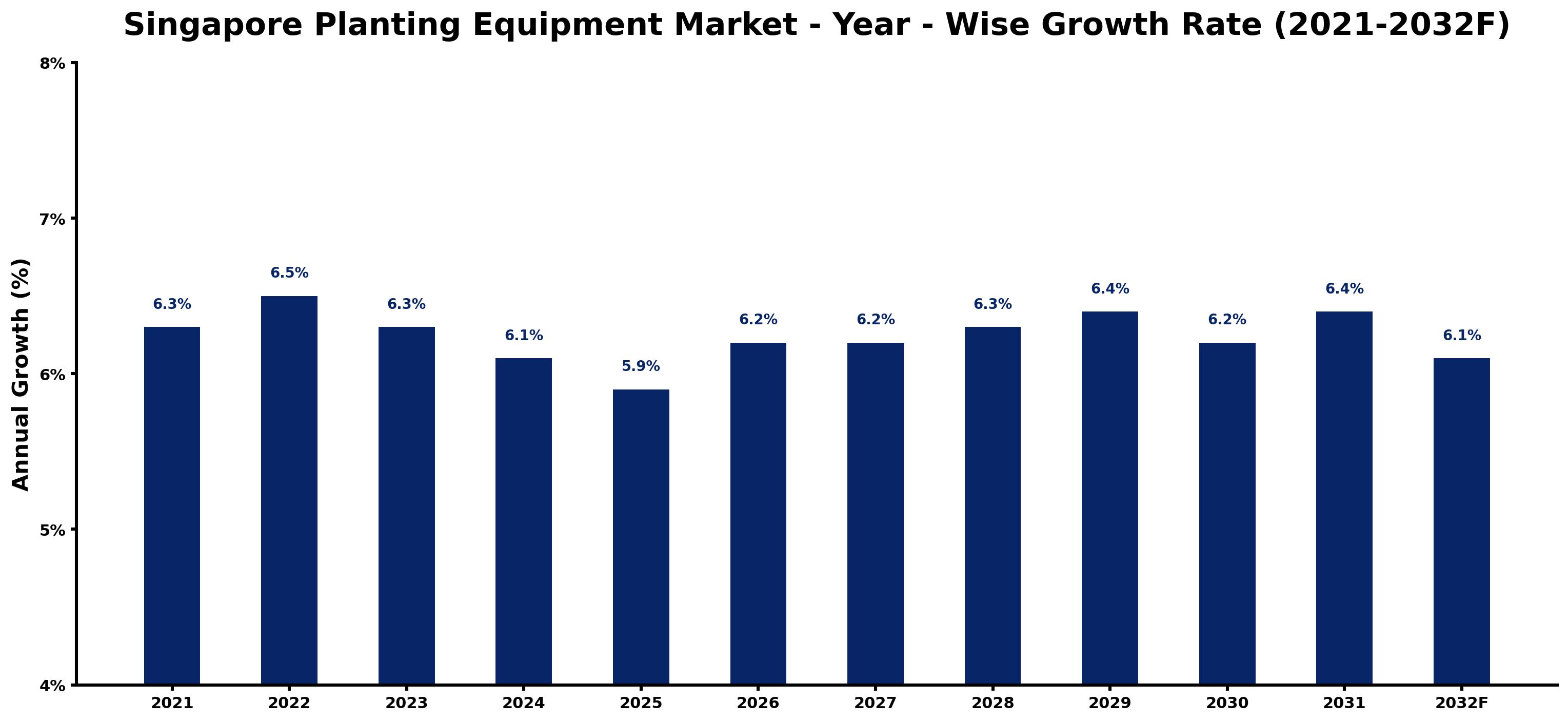
The table below presents the year‑wise growth rates along with the key drivers influencing the market
| Year | Growth Rate | Major Drivers |
| 2021 | 6.3% | Increasing adoption of advanced technologies |
| 2022 | 6.5% | Growing urbanization and commercial development |
| 2023 | 6.3% | Expansion of transportation and logistics networks |
| 2024 | 6.1% | Growing renewable energy integration projects |
| 2025 | 5.9% | Increasing industrial infrastructure investments |
| 2026 | 6.2% | Expansion of transportation and logistics networks |
| 2027 | 6.2% | Increasing industrial automation investments |
| 2028 | 6.3% | Growing urbanization and commercial development |
| 2029 | 6.4% | Growing urbanization and commercial development |
| 2030 | 6.2% | Expansion of transportation and logistics networks |
| 2031 | 6.4% | Government infrastructure modernization initiatives |
| 2032 | 6.1% | Growing urbanization and commercial development |
Note - Market size estimations and growth projections presented in this report are based on 6Wresearch’s advanced forecasting approach, validated with industry datasets as of June 2026.
Singapore Planting Equipment Market Synopsis
The most significant force currently shaping the Singapore Planting Equipment Market is the push for automation within the agricultural sector. As traditional farming practices become less viable due to labor shortages and escalating costs, the shift toward modern planting equipment has become essential for improving efficiency and yield.
Additionally, supportive government initiatives aimed at boosting agricultural productivity are playing a crucial role. Through various grants and subsidies, the Singapore government is fostering an environment that encourages farmers to transition to advanced planting equipment, thereby enhancing overall market dynamics.
Singapore Planting Equipment Market Key Takeaways
- The market is witnessing a robust CAGR of 5.3%, reflecting increasing agricultural modernization.
- Government incentives significantly influence the adoption of advanced planting machinery.
- Automation trends are driving demand for sophisticated planting equipment.
- High upfront costs and the need for skilled labor remain challenges for market growth.
- Innovation in precision farming technologies is reshaping market offerings.
Evaluation of Restraints in Singapore Planting Equipment Market
Despite the promising growth prospects, the Singapore Planting Equipment Market faces notable challenges. A primary restraint is the high cost associated with advanced technology equipment, which can deter small-scale farmers from making the necessary investments. For many, transitioning from traditional tools to more sophisticated machinery involves significant upfront costs, thus limiting accessibility to state-of-the-art planting solutions. Additionally, the scarcity of skilled labor to operate these advanced machines poses a considerable barrier. Many farmers lack the training and experience needed to utilize complex equipment effectively, further hampering market growth and technological adoption.
Singapore Planting Equipment Market Trends
Several trends are currently influencing the Singapore Planting Equipment Market. One prominent trend is the increasing adoption of precision farming techniques, which leverage technology to enhance crop yields and reduce waste. This is accompanied by an expanding interest in greenhouse cultivation, leading to a surge in demand for specialized planting equipment. Furthermore, as sustainability becomes a priority, innovations focusing on eco-friendly practices and resource efficiency are emerging, highlighting a shift in farmer priorities. The focus on automation and smart farming solutions is expected to reshape the market landscape significantly.
Singapore Planting Equipment Market Opportunities
Opportunities abound in the Singapore Planting Equipment Market for innovative companies willing to cater to the evolving needs of farmers. The growing demand for automation presents an attractive landscape for investment in advanced machinery and technology. Additionally, as urban farming and vertical agriculture gain traction, there is an increasing need for specialized planting equipment designed to optimize small-space farming. Companies that invest in research and development of cutting-edge, cost-effective solutions stand to benefit from the market's upward trajectory, carving out a significant share for themselves.
Government Initiatives in the Singapore Planting Equipment Market
The Singapore government is actively promoting agricultural development through various initiatives aimed at enhancing productivity and sustainability. These include financial incentives for farmers to purchase modern planting machinery, subsidies on agricultural products, and grants for infrastructure improvements. Such supportive policies are instrumental in encouraging farmers to adopt more efficient planting methods and technologies, ultimately leading to a more robust agricultural sector that can meet increasing food demand.
Future Insights of the Singapore Planting Equipment Market
Looking ahead to the period from 2026 to 2032, the Singapore Planting Equipment Market is poised for robust growth. Continued investments in agricultural technology, fueled by both private and public sector interests, will enhance operational efficiencies. Moreover, as Singapore's agricultural landscape evolves, emerging trends such as urban farming, sustainability, and precision agriculture are likely to further amplify demand for innovative planting solutions. As a result, stakeholders can anticipate a dynamic market that adapts to changing agricultural practices and consumer preferences.
Singapore Planting Equipment Market Latest Developments (May 2025 - June 2026)
Recent developments in the Singapore Planting Equipment Market indicate a trend towards greater innovation and technology integration. Companies are increasingly focusing on developing automated planting solutions to address labor shortages. Meanwhile, partnerships between private enterprises and governmental agencies are emerging to foster research and development in agricultural technologies. As consumer awareness around sustainability grows, businesses are also prioritizing eco-friendly practices in manufacturing and operational processes, reflecting a broader commitment to environmental stewardship.
Singapore Planting Equipment Market - Key Attractiveness of the Report
- 10 Years of Market Numbers
- Historical Data Starting from 2022 to 2025
- Base Year: 2025
- Forecast Data until 2032
- Key Performance Indicators Impacting the Market
- Major Upcoming Developments and Projects
Key Highlights of the Report:
- Singapore Planting Equipment Market Outlook
- Market Size of Singapore Planting Equipment Market, 2025
- Forecast of Singapore Planting Equipment Market, 2032F
- Historical Data and Forecast of Singapore Planting Equipment Revenues & Volume for the Period 2022-2032F
- Singapore Planting Equipment Market Trend Evolution
- Singapore Planting Equipment Market Drivers and Challenges
- Singapore Planting Equipment Price Trends
- Singapore Planting Equipment Porter's Five Forces
- Singapore Planting Equipment Industry Life Cycle
- Historical Data and Forecast of Singapore Planting Equipment Market Revenues & Volume By Type for the Period 2022-2032F
- Historical Data and Forecast of Singapore Planting Equipment Market Revenues & Volume By Air seeders for the Period 2022-2032F
- Historical Data and Forecast of Singapore Planting Equipment Market Revenues & Volume By Seed drills for the Period 2022-2032F
- Historical Data and Forecast of Singapore Planting Equipment Market Revenues & Volume By Planters for the Period 2022-2032F
- Historical Data and Forecast of Singapore Planting Equipment Market Revenues & Volume By Others for the Period 2022-2032F
- Historical Data and Forecast of Singapore Planting Equipment Market Revenues & Volume By Design for the Period 2022-2032F
- Historical Data and Forecast of Singapore Planting Equipment Market Revenues & Volume By Mechanical for the Period 2022-2032F
- Historical Data and Forecast of Singapore Planting Equipment Market Revenues & Volume By Automatic for the Period 2022-2032F
- Historical Data and Forecast of Singapore Planting Equipment Market Revenues & Volume By Crop Type for the Period 2022-2032F
- Historical Data and Forecast of Singapore Planting Equipment Market Revenues & Volume By Cereals & grains for the Period 2022-2032F
- Historical Data and Forecast of Singapore Planting Equipment Market Revenues & Volume By Oilseeds & pulses for the Period 2022-2032F
- Historical Data and Forecast of Singapore Planting Equipment Market Revenues & Volume By Fruits & vegetables for the Period 2022-2032F
- Historical Data and Forecast of Singapore Planting Equipment Market Revenues & Volume By Others for the Period 2022-2032F
- Singapore Planting Equipment Import Export Trade Statistics
- Market Opportunity Assessment By Type
- Market Opportunity Assessment By Design
- Market Opportunity Assessment By Crop Type
- Singapore Planting Equipment Top Companies Market Share
- Singapore Planting Equipment Competitive Benchmarking By Technical and Operational Parameters
- Singapore Planting Equipment Company Profiles
- Singapore Planting Equipment Key Strategic Recommendations






































