Singapore Plastic Bottles Market Size, Share & Growth Rate
The Singapore Plastic Bottles Market was estimated at USD 240 Million in 2025 and is projected to reach USD 340 Million by 2032, growing at a CAGR of 5.1% from 2026 to 2032. This upward trajectory is primarily driven by the increasing demand for bottled beverages and personal care products, coupled with the ongoing trend toward convenience in packaging solutions. Additionally, advancements in technology are fostering innovative designs and sustainable materials, further propelling market growth.
Singapore Plastic Bottles Market Year-wise Growth Rate and Key Drivers
This graph highlights how the Singapore Plastic Bottles Market has steadily grown over the years, supported by major growth factors.
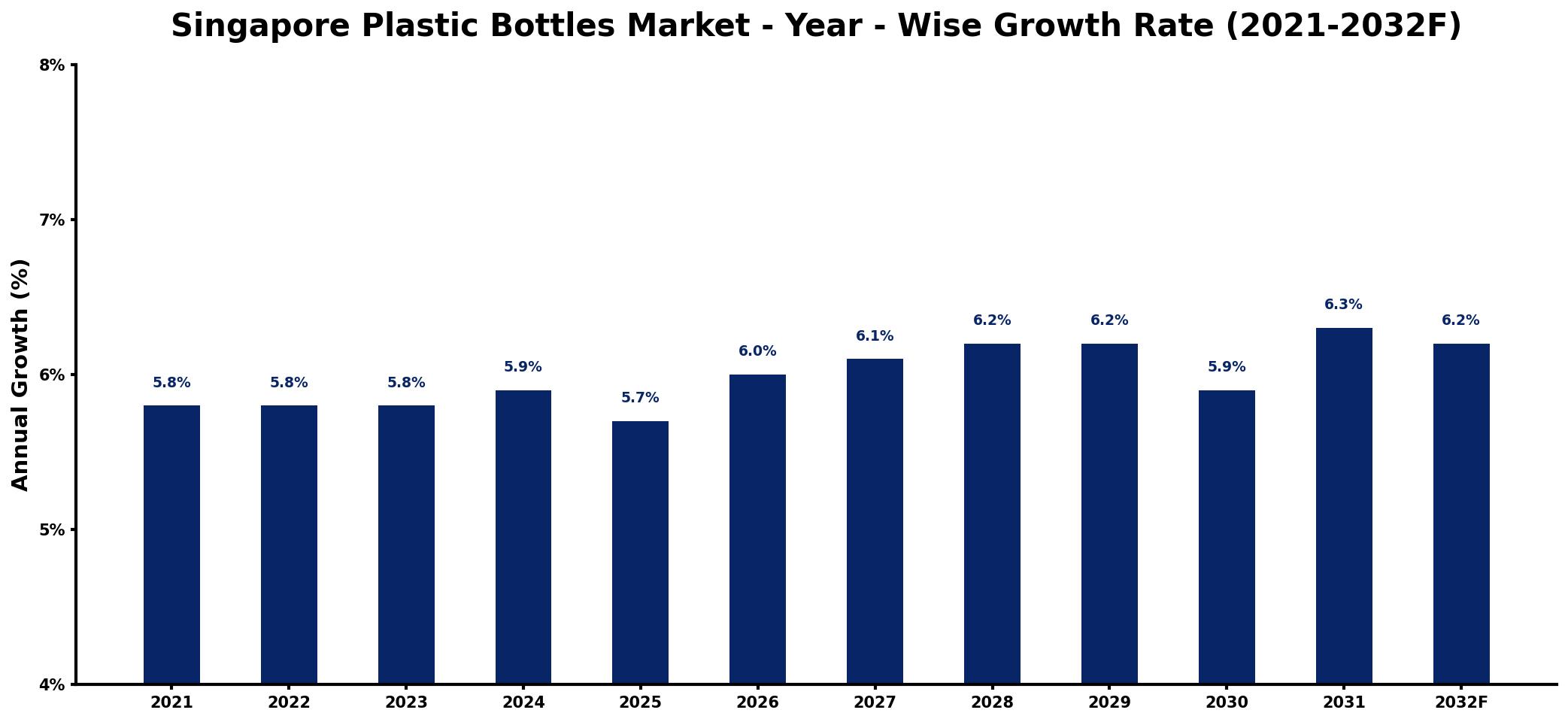
The table below presents the year‑wise growth rates along with the key drivers influencing the market
| Year | Growth Rate | Major Drivers |
| 2021 | 5.8% | Rising environmental sustainability initiatives |
| 2022 | 5.8% | Increased consumer health awareness |
| 2023 | 5.8% | Growth in e-commerce packaging |
| 2024 | 5.9% | Expansion of beverage industry demand |
| 2025 | 5.7% | Innovations in recycling technologies |
| 2026 | 6.0% | Surge in home delivery services |
| 2027 | 6.1% | Enhanced supply chain efficiencies |
| 2028 | 6.2% | Growing demand for convenience products |
| 2029 | 6.2% | Investment in sustainable materials |
| 2030 | 5.9% | Emergence of new market segments |
| 2031 | 6.3% | Government support for green initiatives |
| 2032 | 6.2% | Rising demand for personalized packaging |
Note: Market size estimations and growth projections presented in this report are based on 6Wresearch's proprietary forecasting methodology, utilizing the latest available industry data, government publications, and primary research inputs.
Singapore Plastic Bottles Market Synopsis
The plastic bottles market in Singapore has recently gained momentum due to rising consumer preferences for convenience and quality in product packaging. As sectors such as beverages, cosmetics, and pharmaceuticals expand, the demand for plastic bottles continues to grow. However, the market is also shifting towards sustainability and eco-conscious solutions, posing both opportunities and challenges.
Looking ahead, the Singapore plastic bottles market is expected to align itself with global sustainability trends while responding to local regulatory changes. This transition not only aims to satisfy consumer needs but also addresses increasing environmental concerns related to plastic waste. Such dynamics are anticipated to shape the competitive landscape significantly.
Singapore Plastic Bottles Market Key Takeaways
- The market is projected to experience robust growth driven by multiple end-use industries.
- Innovations in design and materials are pivotal for attracting environmentally conscious consumers.
- Customization and flexibility in packaging solutions are becoming essential in meeting diverse market demands.
- Regulatory measures aimed at reducing plastic waste are influencing market practices.
- The resilience of the market during the COVID-19 pandemic highlights its essential role across various sectors.
Evaluation of Restraints in Singapore Plastic Bottles Market
Despite the optimistic growth outlook, the Singapore plastic bottles market faces significant restraints, chiefly stemming from environmental regulations and consumer backlash against single-use plastics. As the country intensifies its focus on sustainability, manufacturers are pressured to adapt by integrating recyclable or biodegradable materials into their production processes. Additionally, the rising costs of eco-friendly materials can pose a barrier to rapid adoption, thereby creating a complex landscape for market players striving to innovate while meeting compliance requirements.
Singapore Plastic Bottles Market Trends
The market is witnessing several key trends, including a shift towards lightweight and space-efficient bottle designs that reduce material usage without compromising quality. Furthermore, there is a notable emphasis on developing bottles made from post-consumer recycled materials, appealing to the environmentally conscious consumer base. Digital printing technology is also becoming prevalent, allowing for greater customization and branding on packaging. As consumer awareness of sustainability continues to evolve, these trends are expected to reshape market dynamics.
Singapore Plastic Bottles Market Opportunities
Opportunities for growth within the Singapore plastic bottles market lie in the burgeoning sectors of health and wellness, where personalized and functional packaging can enhance product appeal. The rise of e-commerce also presents unique avenues for innovative packaging solutions that ensure safe transport and consumer satisfaction. Furthermore, collaborations with governmental bodies to develop sustainable practices and materials will unlock new market segments, driving investment and fostering long-term growth.
Government Initiatives in the Singapore Plastic Bottles Market
The Singapore government has been proactive in implementing policies aimed at reducing plastic waste and promoting sustainability in packaging. Initiatives such as the Singapore Green Plan 2030 highlight the commitment to enhancing environmental sustainability across various sectors, including the packaging industry. Programs designed to incentivize the adoption of eco-friendly materials and recycling practices are expected to play a pivotal role in steering the plastic bottles market towards more sustainable operational frameworks.
Future Insights of the Singapore Plastic Bottles Market
From 2026 to 2032, the Singapore plastic bottles market is anticipated to navigate a path of sustainable innovation and increased regulatory compliance. The focus will likely shift toward circular economy models, fostering an environment where materials can be reused and recycled efficiently. As consumer attitudes toward sustainability evolve, businesses that adapt to these changing dynamics will not only capture market share but will also contribute positively to the environment. Thus, anticipating future shifts in consumer preferences will be crucial for players looking to maintain their competitive edge.
Singapore Plastic Bottles Market Latest Developments (2025 - 2026)
Recent developments in the Singapore plastic bottles market indicate a strong push towards innovation and sustainability. Companies are increasingly investing in research and development to create environmentally friendly materials and designs. Additionally, partnerships between private sector players and government initiatives are being forged to enhance recycling capabilities and educate consumers on responsible disposal practices. These trends are likely to shape the market landscape in the near term, positioning participants for a future focused on sustainability.
Singapore Plastic Bottles Market - Key Attractiveness of the Report
- 10 Years of Market Numbers
- Historical Data Starting from 2022 to 2025
- Base Year: 2025
- Forecast Data until 2032
- Key Performance Indicators Impacting the Market
- Major Upcoming Developments and Projects
Key Highlights of the Report:
- Singapore Plastic Bottles Market Outlook
- Market Size of Singapore Plastic Bottles Market, 2025
- Forecast of Singapore Plastic Bottles Market, 2032
- Historical Data and Forecast of Singapore Plastic Bottles Revenues & Volume for the Period 2022-2032F
- Singapore Plastic Bottles Market Trend Evolution
- Singapore Plastic Bottles Market Drivers and Challenges
- Singapore Plastic Bottles Price Trends
- Singapore Plastic Bottles Porter's Five Forces
- Singapore Plastic Bottles Industry Life Cycle
- Historical Data and Forecast of Singapore Plastic Bottles Market Revenues & Volume By Raw Material Type for the Period 2022-2032F
- Historical Data and Forecast of Singapore Plastic Bottles Market Revenues & Volume By Polyethylene Terephthalate (PET) for the Period 2022-2032F
- Historical Data and Forecast of Singapore Plastic Bottles Market Revenues & Volume By Poly Propylene (PP) for the Period 2022-2032F
- Historical Data and Forecast of Singapore Plastic Bottles Market Revenues & Volume By Low-density Polyethylene (LDPE) for the Period 2022-2032F
- Historical Data and Forecast of Singapore Plastic Bottles Market Revenues & Volume By High-density Polyethylene (HDPE) for the Period 2022-2032F
- Historical Data and Forecast of Singapore Plastic Bottles Market Revenues & Volume By Other Raw Materials for the Period 2022-2032F
- Historical Data and Forecast of Singapore Plastic Bottles Market Revenues & Volume By End-user for the Period 2022-2032F
- Historical Data and Forecast of Singapore Plastic Bottles Market Revenues & Volume By Beverage for the Period 2022-2032F
- Historical Data and Forecast of Singapore Plastic Bottles Market Revenues & Volume By Food for the Period 2022-2032F
- Historical Data and Forecast of Singapore Plastic Bottles Market Revenues & Volume By Cosmetics for the Period 2022-2032F
- Historical Data and Forecast of Singapore Plastic Bottles Market Revenues & Volume By Pharmaceutical for the Period 2022-2032F
- Historical Data and Forecast of Singapore Plastic Bottles Market Revenues & Volume By Household Care for the Period 2022-2032F
- Historical Data and Forecast of Singapore Plastic Bottles Market Revenues & Volume By Other for the Period 2022-2032F
- Singapore Plastic Bottles Import Export Trade Statistics
- Market Opportunity Assessment By Raw Material Type
- Market Opportunity Assessment By End-user
- Singapore Plastic Bottles Top Companies Market Share
- Singapore Plastic Bottles Competitive Benchmarking By Technical and Operational Parameters
- Singapore Plastic Bottles Company Profiles
- Singapore Plastic Bottles Key Strategic Recommendations






































