Singapore Ploughing and Cultivating Machinery Market Size, Share & Growth Rate
The Singapore Ploughing and Cultivating Machinery Market was estimated at USD 925 Million in 2025 and is projected to reach USD 1325 Million by 2032, growing at a CAGR of 5.3% from 2026 to 2032. This growth trajectory is primarily fueled by the ongoing modernization of agricultural practices in Singapore, where there is a significant push for increased productivity and self-sufficiency in food production. As farmers become more aware of the advantages of precision farming techniques, the demand for advanced machinery continues to rise, supported by government initiatives promoting sustainable agriculture.
Singapore Ploughing and Cultivating Machinery Market Year-wise Growth Rate and Key Drivers
This graph highlights how the Singapore Ploughing and Cultivating Machinery Market has steadily grown over the years, supported by major growth factors.
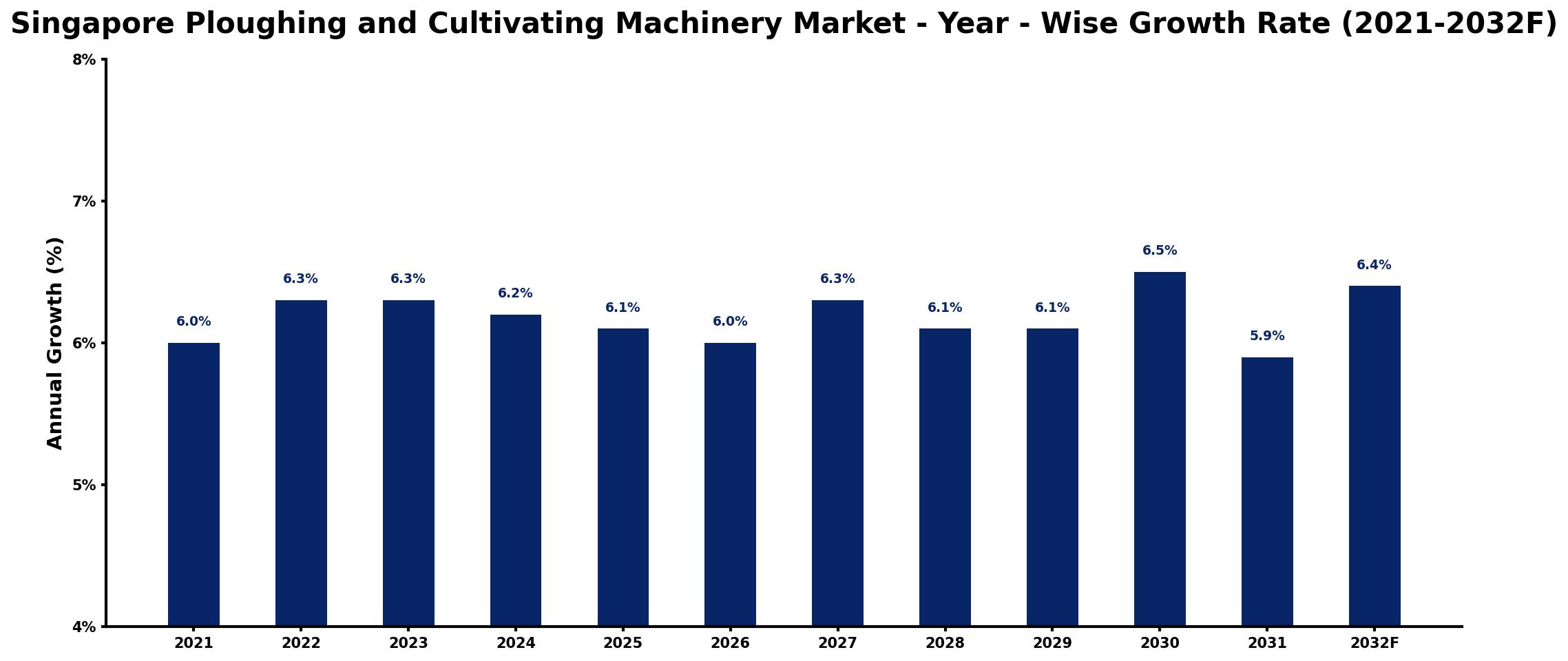
The table below presents the year‑wise growth rates along with the key drivers influencing the market
| Year | Growth Rate | Major Drivers |
| 2021 | 6.0% | Rising agricultural technology adoption |
| 2022 | 6.3% | Increased demand for automation |
| 2023 | 6.3% | Expansion of precision farming techniques |
| 2024 | 6.2% | Growing interest in sustainable practices |
| 2025 | 6.1% | Investment in rural infrastructure projects |
| 2026 | 6.0% | Enhanced focus on food security |
| 2027 | 6.3% | Surge in eco-friendly solutions |
| 2028 | 6.1% | Development of smart farming solutions |
| 2029 | 6.1% | Growing urban agriculture initiatives |
| 2030 | 6.5% | expanding healthcare application demand |
| 2031 | 5.9% | Strengthened agricultural policy frameworks |
| 2032 | 6.4% | Increased collaboration with startups |
Note: Market size estimations and growth projections presented in this report are based on 6Wresearch's proprietary forecasting methodology, utilizing the latest available industry data, government publications, and primary research inputs.
Singapore Ploughing and Cultivating Machinery Market Synopsis
Recent developments in the Singapore ploughing and cultivating machinery market indicate a revitalization after a period of modest decline during the COVID-19 pandemic. As the sector rebounds, it stands at the crossroads of innovation and tradition, as farmers increasingly adopt modern machinery for efficient land preparation.
Looking forward, the market is expected to leverage government support and innovative farming techniques to address challenges such as limited arable land. This evolving landscape suggests a promising outlook where technology integration will play a crucial role in shaping the future of agricultural practices in Singapore.
Singapore Ploughing and Cultivating Machinery Market Key Takeaways
- Continuous modernization of agricultural practices is crucial for the markets expansion.
- Government initiatives significantly bolster machinery adoption among farmers.
- Sustainable farming practices are becoming integral to new investments in equipment.
- Challenges such as limited arable land require innovative solutions and adaptation of machinery.
- Precision farming technologies are gaining traction, enhancing operational efficiency.
Evaluation of Restraints in Singapore Ploughing and Cultivating Machinery Market
The Singapore ploughing and cultivating machinery market faces significant restraints primarily due to the limited availability of arable land, which constrains agricultural expansion. Farmers often encounter difficulty in justifying investments in costly machinery, particularly within a shrinking agricultural sector. Additionally, the need to adapt existing machinery for urban farming practices complicates the landscape further. Consequently, these factors pose challenges for market growth, necessitating innovative approaches to enhance cost efficiency and accessibility.
Singapore Ploughing and Cultivating Machinery Market Trends
Several trends are shaping the Singapore ploughing and cultivating machinery market. The shift towards precision farming is at the forefront, enabling farmers to maximize yields with minimal resource wastage. Smart technology integration, including IoT devices and data analytics, enhances operational efficiency by allowing for real-time monitoring and decision-making. Furthermore, a growing emphasis on sustainability is pushing farmers to invest in eco-friendly machinery designed to minimize environmental impact while optimizing productivity.
Singapore Ploughing and Cultivating Machinery Market Opportunities
The future of the Singapore ploughing and cultivating machinery market is ripe with opportunities. Investment in advanced technologies that cater to small-scale urban farmers presents a significant growth avenue. Moreover, the increasing government support and funding for sustainable agricultural practices invite new entrants and encourage innovation. As urban agriculture gains momentum, the demand for specialized equipment tailored to smaller plots is likely to surge, creating a niche market ripe for exploration.
Government Initiatives in the Singapore Ploughing and Cultivating Machinery Market
The Singapore government plays a pivotal role in supporting the agricultural machinery sector through various initiatives aimed at boosting productivity and sustainability. Subsidies and grants are offered to farmers to adopt modern farming techniques and equipment, significantly reducing the financial burden associated with upgrading machinery. Additionally, the government promotes research and development in agricultural technology, fostering an environment conducive to innovation and efficient farming practices.
Future Insights of the Singapore Ploughing and Cultivating Machinery Market
Looking ahead to 2026-2032, the Singapore ploughing and cultivating machinery market is expected to evolve with significant technological advancements. As the agricultural landscape continues to modernize, the integration of automation and data analytics will likely become commonplace, further enhancing operational efficiency. The focus on sustainable practices will continue to shape the market, driving demand for equipment that aligns with ecological goals while supporting food security initiatives. Overall, the outlook is positive as the sector adapts to emerging trends and challenges.
Singapore Ploughing and Cultivating Machinery Market Latest Developments (2025 - 2026)
In recent months, the Singapore ploughing and cultivating machinery market has experienced notable developments focused on technological innovation and sustainability. Companies are increasingly integrating smart technologies into their machinery offerings, enhancing user experience and operational efficiency. Furthermore, there has been a concerted effort within the agricultural community to collaborate on projects aimed at increasing the adoption of eco-friendly equipment, ensuring that the sector aligns with global sustainability goals.
Singapore Ploughing and Cultivating Machinery Market - Key Attractiveness of the Report
- 10 Years of Market Numbers
- Historical Data Starting from 2022 to 2025
- Base Year: 2025
- Forecast Data until 2032
- Key Performance Indicators Impacting the Market
- Major Upcoming Developments and Projects
Key Highlights of the Report:
- Singapore Ploughing and Cultivating Machinery Market Outlook
- Market Size of Singapore Ploughing and Cultivating Machinery Market, 2025
- Forecast of Singapore Ploughing and Cultivating Machinery Market, 2032
- Historical Data and Forecast of Singapore Ploughing and Cultivating Machinery Revenues & Volume for the Period 2022-2032F
- Singapore Ploughing and Cultivating Machinery Market Trend Evolution
- Singapore Ploughing and Cultivating Machinery Market Drivers and Challenges
- Singapore Ploughing and Cultivating Machinery Price Trends
- Singapore Ploughing and Cultivating Machinery Porter's Five Forces
- Singapore Ploughing and Cultivating Machinery Industry Life Cycle
- Historical Data and Forecast of Singapore Ploughing and Cultivating Machinery Market Revenues & Volume By Type for the Period 2022-2032F
- Historical Data and Forecast of Singapore Ploughing and Cultivating Machinery Market Revenues & Volume By Ploughs for the Period 2022-2032F
- Historical Data and Forecast of Singapore Ploughing and Cultivating Machinery Market Revenues & Volume By Harrows for the Period 2022-2032F
- Historical Data and Forecast of Singapore Ploughing and Cultivating Machinery Market Revenues & Volume By Others for the Period 2022-2032F
- Historical Data and Forecast of Singapore Ploughing and Cultivating Machinery Market Revenues & Volume By Application for the Period 2022-2032F
- Historical Data and Forecast of Singapore Ploughing and Cultivating Machinery Market Revenues & Volume By Soil Loosening for the Period 2022-2032F
- Historical Data and Forecast of Singapore Ploughing and Cultivating Machinery Market Revenues & Volume By Clod Size Reduction for the Period 2022-2032F
- Historical Data and Forecast of Singapore Ploughing and Cultivating Machinery Market Revenues & Volume By Clod Sorting for the Period 2022-2032F
- Historical Data and Forecast of Singapore Ploughing and Cultivating Machinery Market Revenues & Volume By Others for the Period 2022-2032F
- Singapore Ploughing and Cultivating Machinery Import Export Trade Statistics
- Market Opportunity Assessment By Type
- Market Opportunity Assessment By Application
- Singapore Ploughing and Cultivating Machinery Top Companies Market Share
- Singapore Ploughing and Cultivating Machinery Competitive Benchmarking By Technical and Operational Parameters
- Singapore Ploughing and Cultivating Machinery Company Profiles
- Singapore Ploughing and Cultivating Machinery Key Strategic Recommendations






































