Singapore Policy Management in Telecom Market Size & Growth Rate (2026-2032)
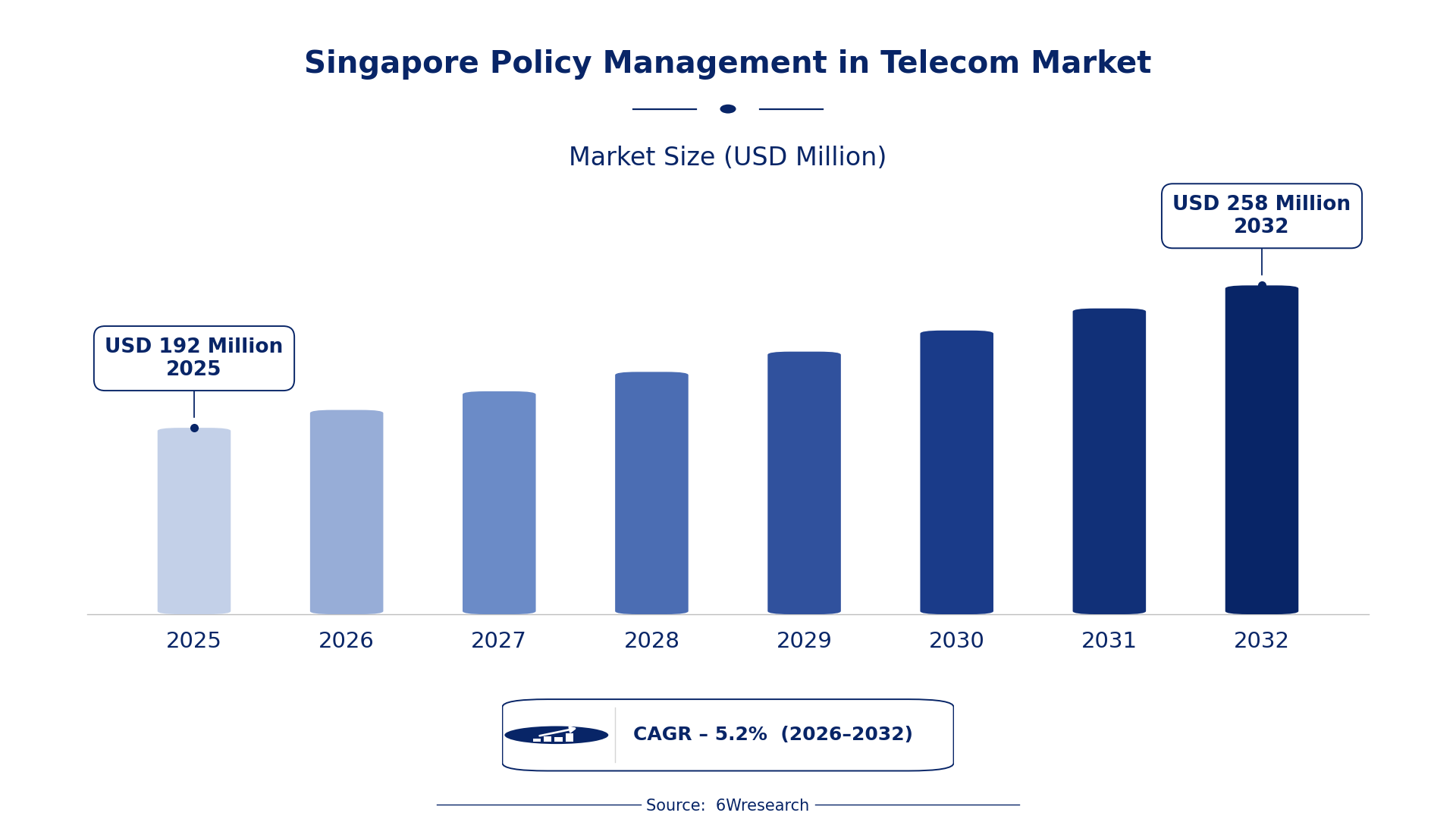
The Singapore Policy Management in Telecom Market was estimated at USD 192 Million in 2025 and is projected to reach USD 258 Million by 2032, growing at a CAGR of 5.2% from 2026 to 2032.
Singapore Policy Management in Telecom Market Synopsis
The Singapore Policy Management in Telecom Market is witnessing a transformative phase as telecom operators strive to enhance service delivery amidst increasing customer demands. The complexity of service plans is pushing operators to adopt advanced policy management solutions that ensure efficient resource allocation and quality assurance.
In this dynamic environment, telecom companies are implementing tailored policy management systems that not only streamline network operations but also offer personalized experiences to subscribers. The push for innovation, particularly following the pandemic, has spotlighted the critical role of these systems in sustaining competitive advantage and meeting regulatory requirements.
Singapore Policy Management in Telecom Market Year-wise Growth Rate and Key Drivers
This graph illustrates the annual growth rates of the Singapore Policy Management in Telecom Market from 2021 to 2032, highlighting a steady upward trajectory and projected expansion over the forecast period.
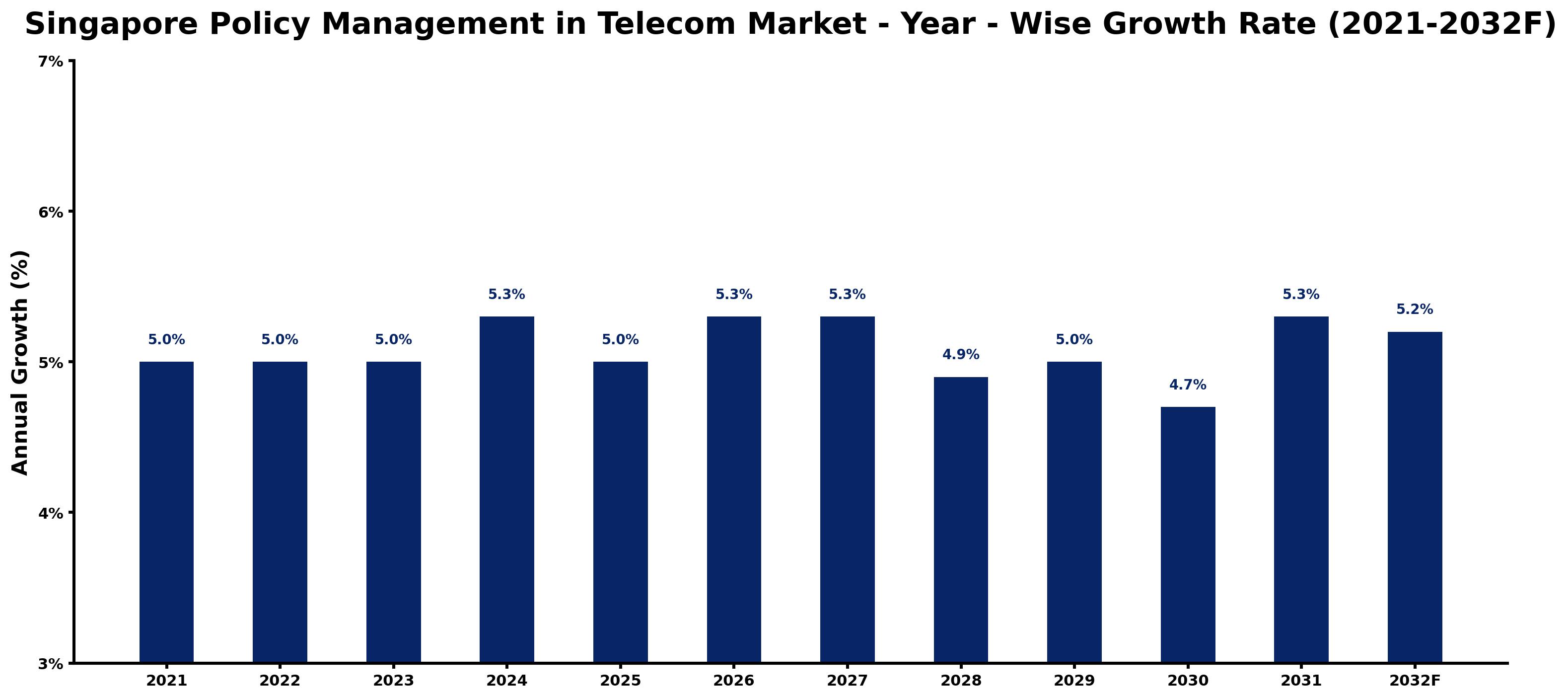
The table below presents the year‑wise growth rates along with the key drivers influencing the market
| Year | Growth Rate | Major Drivers |
| 2021 | 5.0% | Implementation of telecom regulatory framework by IMDA. |
| 2022 | 5.0% | Increased demand for mobile network resilience post-pandemic. |
| 2023 | 5.0% | 5G rollout accelerating regulatory compliance and policy updates. |
| 2024 | 5.3% | Enhanced data protection laws promoting telecom policy evolution. |
| 2025 | 5.0% | Rising interest in fintech solutions driving telecom innovation. |
| 2026 | 5.3% | Government initiatives boosting digital economy and telecom standards. |
| 2027 | 5.3% | Focus on cybersecurity frameworks impacting telecom policy adjustments. |
| 2028 | 4.9% | Consumer demand for enhanced broadband services driving policies. |
| 2029 | 5.0% | Collaboration between telcos and government on digital strategies. |
| 2030 | 4.7% | Sustainability policies pushing for greener telecom infrastructures. |
| 2031 | 5.3% | Increased foreign investment in Singapore's telecom sector. |
| 2032 | 5.2% | Growing interconnectedness of IoT devices influencing regulatory changes. |
Note: Market size estimations and growth projections presented in this report are based on 6Wresearch's proprietary forecasting methodology, utilizing the latest available industry data, government publications, and primary research inputs.
Singapore Policy Management in Telecom Market Key Takeaways
Below are some of the specific key takeaways from the market, including:
- The market is driven by the need for enhanced customer experiences and efficient resource management.
- Implementation of policy management solutions is critical for maintaining quality service standards.
- COVID-19 has accelerated the adoption of flexible policy management strategies.
- Innovations in technology are reshaping how policy management systems operate.
- Ongoing government initiatives are influencing market growth and regulatory frameworks.
Evaluation of Restraints in Singapore Policy Management in Telecom Market
Several factors are restraining the growth of the Singapore Policy Management in Telecom Market. A primary concern is the challenge of policy enforcement, where telecom operators must ensure policies are applied accurately and consistently across networks. This requirement becomes increasingly complex as service offerings diversify. Additionally, real-time decision-making is essential; operators need to respond to network demands swiftly while managing potential conflicts between competing policies. Addressing these issues is crucial for enhancing overall service quality and user satisfaction.
Singapore Policy Management in Telecom Market Trends
Key trends shaping the Singapore Policy Management in Telecom Market include the growing demand for automated policy orchestration and AI-driven analytics. Operators are increasingly investing in solutions that enable them to create adaptive policies based on real-time data and user behavior. Furthermore, the integration of 5G technology is paving the way for more complex policy management needs, particularly in terms of bandwidth allocation and service prioritization. As customers seek more personalized services, the ability to manage policies dynamically is becoming essential.
Singapore Policy Management in Telecom Market Opportunities
The market presents substantial opportunities for growth as telecom operators look to innovate their service offerings. The rise of IoT applications and smart devices is creating a demand for granular policy management, allowing for tailored services. Additionally, partnerships between telecom companies and technology firms focused on developing advanced policy management solutions can lead to new revenue streams. Companies that invest in training and upskilling their workforce on these technologies stand to gain a competitive edge in this rapidly evolving market.
Government Initiatives in the Singapore Policy Management in Telecom Market
Government policies play a crucial role in shaping the Singapore Policy Management in Telecom Market. The regulatory environment is designed to support innovation while ensuring fair practices within the industry. Authorities are keenly focused on enhancing digital infrastructure and fostering an ecosystem that encourages investment in advanced policy management technologies.
- A recently completed national digital infrastructure upgrade aimed at improving broadband access across Singapore has enhanced the capabilities of telecom operators.
- Currently ongoing is a regulatory initiative that mandates telecom operators to ensure transparency in billing and service offerings, fostering consumer trust.
- A planned public-private initiative expected to expand telecom infrastructure access by 2028 is set to enhance policy management frameworks, allowing for more agile service delivery.
- The introduction of a cybersecurity framework in 2025 aims to enhance data protection measures within telecom operations, directly influencing policy management approaches.
- Ongoing government workshops focused on emerging technologies are being conducted to help telecom companies better understand and implement effective policy management systems.
Future Insights of the Singapore Policy Management in Telecom Market
Looking ahead to 2026-2032, the Singapore Policy Management in Telecom Market is set to evolve significantly. With the continued growth of 5G and the proliferation of smart devices, the complexity of policy management will increase. Operators will need to adopt more sophisticated solutions capable of handling diverse applications and user demands. The push for greater personalization in services will drive innovation, leading to the development of advanced analytics tools that provide insights into user behavior and service effectiveness. Overall, the market is on track for steady growth, fueled by technological advancements and a supportive regulatory environment.
Singapore Policy Management in Telecom Market Latest Developments
In the past year, the Singapore Policy Management in Telecom Market has seen a surge in activity as operators and technology providers seek to refine their offerings. Enhanced emphasis on policy agility and customer-focused solutions has led to noteworthy developments across the industry.
- A major technology vendor rolled out a new policy management platform in early 2025, allowing real-time monitoring of network performance.
- An initiative that began in mid-2025 and remains underway aims to incorporate AI capabilities into existing policy management systems, improving decision-making processes.
- Currently ongoing is a collaboration between telecom operators to share best practices in policy enforcement, enhancing overall service consistency.
- A rollout expected to begin in the second half of 2026 will introduce automated policy adjustments based on user feedback and network conditions.
- A regional operator has announced a strategic partnership with a cloud service provider to enable more dynamic policy management solutions, enhancing their market competitiveness.
Singapore Policy Management in Telecom Market - Key Attractiveness of the Report
- 10 Years of Market Numbers
- Historical Data Starting from 2022 to 2025
- Base Year: 2025
- Forecast Data until 2032
- Key Performance Indicators Impacting the Market
- Major Upcoming Developments and Projects
Key Highlights of the Report:
- Singapore Policy Management in Telecom Market Outlook
- Market Size of Singapore Policy Management in Telecom Market, 2025
- Forecast of Singapore Policy Management in Telecom Market, 2032
- Historical Data and Forecast of Singapore Policy Management in Telecom Revenues & Volume for the Period 2022-2032F
- Singapore Policy Management in Telecom Market Trend Evolution
- Singapore Policy Management in Telecom Market Drivers and Challenges
- Singapore Policy Management in Telecom Price Trends
- Singapore Policy Management in Telecom Porter's Five Forces
- Singapore Policy Management in Telecom Industry Life Cycle
- Historical Data and Forecast of Singapore Policy Management in Telecom Market Revenues & Volume By Network for the Period 2022-2032F
- Historical Data and Forecast of Singapore Policy Management in Telecom Market Revenues & Volume By Fixed for the Period 2022-2032F
- Historical Data and Forecast of Singapore Policy Management in Telecom Market Revenues & Volume By Wireless for the Period 2022-2032F
- Historical Data and Forecast of Singapore Policy Management in Telecom Market Revenues & Volume By Component for the Period 2022-2032F
- Historical Data and Forecast of Singapore Policy Management in Telecom Market Revenues & Volume By Solutions for the Period 2022-2032F
- Historical Data and Forecast of Singapore Policy Management in Telecom Market Revenues & Volume By Services for the Period 2022-2032F
- Historical Data and Forecast of Singapore Policy Management in Telecom Market Revenues & Volume By Deployment for the Period 2022-2032F
- Historical Data and Forecast of Singapore Policy Management in Telecom Market Revenues & Volume By Cloud for the Period 2022-2032F
- Historical Data and Forecast of Singapore Policy Management in Telecom Market Revenues & Volume By On-Premises for the Period 2022-2032F
- Singapore Policy Management in Telecom Import Export Trade Statistics
- Market Opportunity Assessment By Network
- Market Opportunity Assessment By Component
- Market Opportunity Assessment By Deployment
- Singapore Policy Management in Telecom Top Companies Market Share
- Singapore Policy Management in Telecom Competitive Benchmarking By Technical and Operational Parameters
- Singapore Policy Management in Telecom Company Profiles
- Singapore Policy Management in Telecom Key Strategic Recommendations






































