Singapore Polymyxin B Sulfate Market Size, Share & Growth Rate
The Singapore Polymyxin B Sulfate Market was estimated at USD 255 Million in 2025 and is projected to reach USD 346 Million by 2032, growing at a CAGR of 4.5% from 2026 to 2032. This growth trajectory is primarily driven by the rising prevalence of bacterial infections and the urgent need for effective antibiotic solutions in healthcare. As antibiotic resistance continues to challenge medical practices, polymyxin B sulfate is increasingly recognized for its vital role in treating complex infections, fostering a robust demand within the pharmaceutical sector.
Singapore Polymyxin B Sulfate Market Year-wise Growth Rate and Key Drivers
This graph highlights how the Singapore Polymyxin B Sulfate Market has steadily grown over the years, supported by major growth factors.
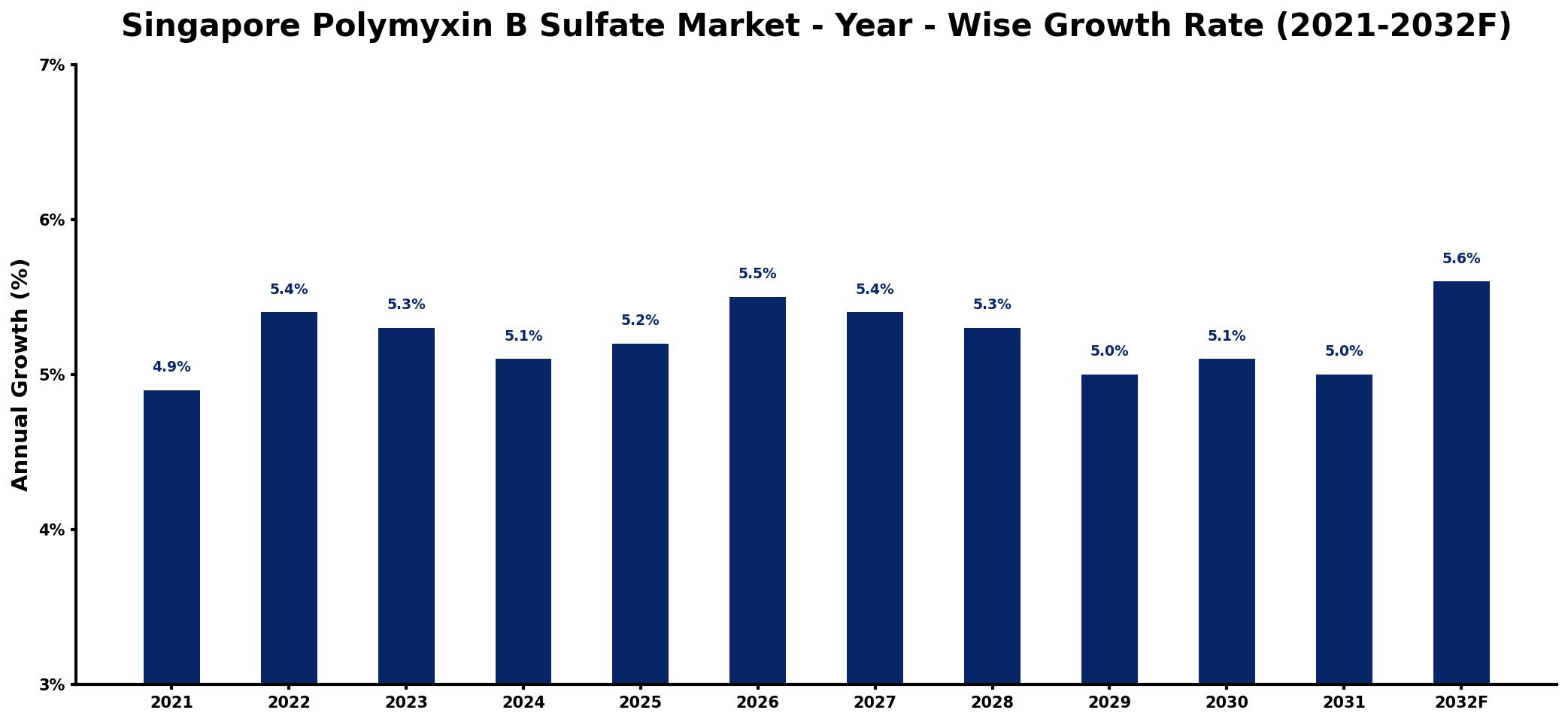
The table below presents the year‑wise growth rates along with the key drivers influencing the market
| Year | Growth Rate | Major Drivers |
| 2021 | 4.9% | Rising healthcare expenditure and investment |
| 2022 | 5.4% | Increased demand for antibiotics globally |
| 2023 | 5.3% | Growing prevalence of bacterial infections |
| 2024 | 5.1% | Expansion of pharmaceutical manufacturing facilities |
| 2025 | 5.2% | growing downstream application demand |
| 2026 | 5.5% | Advancements in drug formulation technologies |
| 2027 | 5.4% | Surge in healthcare infrastructure development |
| 2028 | 5.3% | increased capital investment inflows |
| 2029 | 5.0% | Growth in public health initiatives |
| 2030 | 5.1% | Rising awareness of antibiotic resistance |
| 2031 | 5.0% | growing emerging market penetration |
| 2032 | 5.6% | Increased collaboration among industry stakeholders |
Note: Market size estimations and growth projections presented in this report are based on 6Wresearch's proprietary forecasting methodology, utilizing the latest available industry data, government publications, and primary research inputs.
Singapore Polymyxin B Sulfate Market Synopsis
In recent years, the Singapore polymyxin B sulfate market has witnessed notable momentum, largely attributable to increased awareness regarding antibiotic treatments and their essential role in combating bacterial infections. Looking ahead, the market is expected to evolve further, driven by the growing focus on regulatory compliance and product quality, as well as heightened scrutiny surrounding antibiotic resistance.
As healthcare providers and regulatory bodies emphasize safety and efficacy, the market dynamics are set to shift, potentially impacting the strategies of pharmaceutical players in the region. The interplay between regulatory demands and clinical needs will shape the future landscape of polymyxin B sulfate in Singapore.
Singapore Polymyxin B Sulfate Market Key Takeaways
- The increasing prevalence of antibiotic-resistant infections is driving the demand for polymyxin B sulfate in Singapore.
- Regulatory compliance and product quality are becoming critical focal points for manufacturers in this market.
- Healthcare providers are adapting to evolving treatment protocols, thus enhancing the need for effective antibiotic solutions.
- COVID-19 has reinforced the importance of antibiotics, shaping market strategies going forward.
- The market's growth is underpinned by the evolving landscape of healthcare regulations and safety standards.
Evaluation of Restraints in Singapore Polymyxin B Sulfate Market
While the Singapore polymyxin B sulfate market exhibits promising growth, it faces significant constraints that could impede its progress. Chief among these is the pervasive issue of antibiotic resistance, which not only challenges current treatment paradigms but also complicates the development of new antibiotic formulations. Regulatory frameworks governing the production and distribution of antibiotics are becoming increasingly stringent, necessitating compliance from manufacturers and potentially raising costs. Moreover, the competitive landscape within the healthcare sector continues to intensify, making it essential for companies to innovate and differentiate their offerings to remain viable.
Singapore Polymyxin B Sulfate Market Trends
Current trends in the Singapore polymyxin B sulfate market are shaped by advancements in pharmaceutical research and the growing emphasis on personalized medicine. As healthcare providers seek targeted treatment options, the role of polymyxin B sulfate is expanding beyond traditional applications, prompting new formulations and delivery methods. Additionally, the integration of technology in healthcare is facilitating better tracking of antibiotic use and resistance patterns, providing valuable insights that can inform treatment protocols. The market is also witnessing a surge in collaborations between academia and industry, aimed at enhancing research and development in antibiotic therapies.
Singapore Polymyxin B Sulfate Market Opportunities
Significant opportunities abound within the Singapore polymyxin B sulfate market, particularly as healthcare systems prioritize innovative approaches to tackle antibiotic resistance. Investment in research and development can lead to the discovery of novel formulations and therapeutic applications, potentially unlocking new revenue streams for pharmaceutical companies. Furthermore, expanding collaborations with healthcare institutions can facilitate clinical trials and validate the efficacy of polymyxin B sulfate in diverse patient populations. The rising demand for antibiotics in emerging markets also presents a pathway for expansion beyond Singapore, allowing companies to diversify their reach and optimize their portfolios.
Government Initiatives in the Singapore Polymyxin B Sulfate Market
The Singaporean government has actively engaged in initiatives to bolster antibiotic stewardship and combat antibiotic resistance. Policies promoting research funding and collaboration in the pharmaceutical sector are designed to enhance the development of effective treatments. Public health campaigns that emphasize responsible antibiotic use are also integral to the broader strategy of mitigating resistance. These initiatives foster an environment conducive to innovation and ensure that both patients and healthcare providers have access to high-quality antibiotic therapies, including polymyxin B sulfate.
Future Insights of the Singapore Polymyxin B Sulfate Market
Looking ahead to 2026-2032, the Singapore polymyxin B sulfate market is poised for continued growth, driven by an ongoing commitment to addressing the challenges of infectious diseases. As healthcare providers navigate the complexities of antibiotic resistance, the focus will increasingly shift toward developing more effective and targeted therapies. Furthermore, the emphasis on regulatory compliance will prompt companies to enhance their product offerings, ultimately benefiting patient outcomes. The collaborative efforts between public health bodies, academia, and the pharmaceutical industry are expected to yield innovative solutions, positioning polymyxin B sulfate as a critical component of future antibiotic regimens.
Singapore Polymyxin B Sulfate Market Latest Developments (2025 - 2026)
In the recent period from & to June 2026, the Singapore polymyxin B sulfate market has witnessed notable shifts in industry direction, emphasizing the importance of research and development. Various stakeholders have adapted to evolving healthcare demands, ensuring consistent availability of polymyxin B sulfate in response to fluctuating market needs. Additionally, there has been an increasing focus on compliance with regulatory standards, driving improvements in product quality and manufacturing processes. Industry dialogues on antibiotic resistance have also intensified, highlighting the role of effective antibiotic stewardship in shaping future market strategies.
Singapore Polymyxin B Sulfate Market - Key Attractiveness of the Report
- 10 Years of Market Numbers
- Historical Data Starting from 2022 to 2025
- Base Year: 2025
- Forecast Data until 2032
- Key Performance Indicators Impacting the Market
- Major Upcoming Developments and Projects
Key Highlights of the Report:
- Singapore Polymyxin B Sulfate Market Outlook
- Market Size of Singapore Polymyxin B Sulfate Market, 2025
- Forecast of Singapore Polymyxin B Sulfate Market, 2032
- Historical Data and Forecast of Singapore Polymyxin B Sulfate Revenues & Volume for the Period 2022-2032F
- Singapore Polymyxin B Sulfate Market Trend Evolution
- Singapore Polymyxin B Sulfate Market Drivers and Challenges
- Singapore Polymyxin B Sulfate Price Trends
- Singapore Polymyxin B Sulfate Porter's Five Forces
- Singapore Polymyxin B Sulfate Industry Life Cycle
- Historical Data and Forecast of Singapore Polymyxin B Sulfate Market Revenues & Volume By Types for the Period 2022-2032F
- Historical Data and Forecast of Singapore Polymyxin B Sulfate Market Revenues & Volume By Tablets for the Period 2022-2032F
- Historical Data and Forecast of Singapore Polymyxin B Sulfate Market Revenues & Volume By Injections for the Period 2022-2032F
- Historical Data and Forecast of Singapore Polymyxin B Sulfate Market Revenues & Volume By Applications for the Period 2022-2032F
- Historical Data and Forecast of Singapore Polymyxin B Sulfate Market Revenues & Volume By Hospitals for the Period 2022-2032F
- Historical Data and Forecast of Singapore Polymyxin B Sulfate Market Revenues & Volume By Private Clinics for the Period 2022-2032F
- Historical Data and Forecast of Singapore Polymyxin B Sulfate Market Revenues & Volume By Others for the Period 2022-2032F
- Singapore Polymyxin B Sulfate Import Export Trade Statistics
- Market Opportunity Assessment By Types
- Market Opportunity Assessment By Applications
- Singapore Polymyxin B Sulfate Top Companies Market Share
- Singapore Polymyxin B Sulfate Competitive Benchmarking By Technical and Operational Parameters
- Singapore Polymyxin B Sulfate Company Profiles
- Singapore Polymyxin B Sulfate Key Strategic Recommendations






































