Singapore Prepaid Cards Market Size, Share & Growth Rate
The Singapore Prepaid Cards Market was estimated at USD 396 Million in 2025 and is projected to reach USD 660 Million by 2032, growing at a CAGR of 7.6% from 2026 to 2032. This upward trajectory is fueled by a notable shift toward cashless payment solutions, significantly spurred by the pandemic, which accelerated digital transaction adoption. Furthermore, the growing e-commerce landscape and the increasing integration of loyalty programs are enhancing the appeal of prepaid cards among consumers.
Singapore Prepaid Cards Market Year-wise Growth Rate and Key Drivers
This graph highlights how the Singapore Prepaid Cards Market has steadily grown over the years, supported by major growth factors.
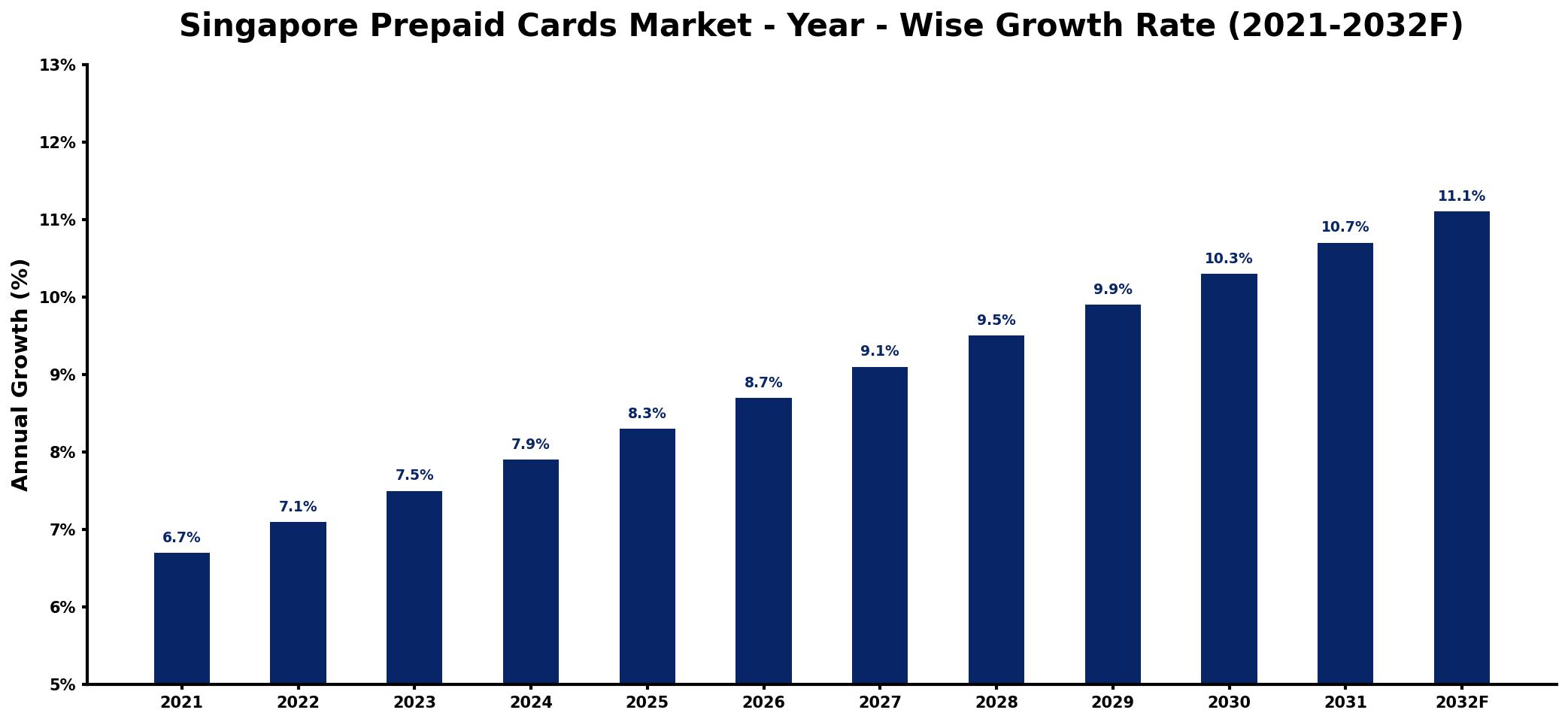
The table below presents the year‑wise growth rates along with the key drivers influencing the market
| Year | Growth Rate | Major Drivers |
| 2021 | 6.7% | Rise in digital payment adoption |
| 2022 | 7.1% | Increased consumer spending behavior |
| 2023 | 7.5% | Growth in e-commerce transactions |
| 2024 | 7.9% | Expansion of mobile wallet usage |
| 2025 | 8.3% | Boost in travel and tourism |
| 2026 | 8.7% | Surge in online subscription services |
| 2027 | 9.1% | Investment in fintech innovations |
| 2028 | 9.5% | Growth of youth spending power |
| 2029 | 9.9% | Increase in cross-border transactions |
| 2030 | 10.3% | rising export shipment volumes |
| 2031 | 10.7% | strengthening international trade flows |
| 2032 | 11.1% | expanding industrial usage applications |
Note: Market size estimations and growth projections presented in this report are based on 6Wresearch's proprietary forecasting methodology, utilizing the latest available industry data, government publications, and primary research inputs.
Singapore Prepaid Cards Market Synopsis
The proliferation of prepaid cards in Singapore marks a significant transformation in consumer payment preferences. With applications spanning various sectors—including retail, travel, and gifting—these cards offer an appealing combination of flexibility and budget control for users. As consumers increasingly favor seamless payment experiences, the prepaid card market is becoming an essential component of Singapore's financial landscape.
Innovations in fintech and strategic collaborations among payment service providers are further enriching the prepaid card ecosystem. Coupled with the rise of digital payments and loyalty initiatives, the market is well-positioned for sustained growth and innovation in the coming years. The trend is driven by consumer demand for convenience and secure payment solutions in an increasingly digital economy.
Singapore Prepaid Cards Market Key Takeaways
- The market is experiencing robust growth, driven by increased digital payment adoption.
- Prepaid cards provide significant utility across various sectors, enhancing user experience and satisfaction.
- Technological advancements are continuously reshaping the prepaid card landscape.
- Consumer education is essential for maximizing market penetration and usage.
- The competitive landscape is evolving with increasing alternatives such as mobile wallets.
Evaluation of Restraints in Singapore Prepaid Cards Market
Despite the positive market momentum, several restraints hinder the growth of the Singapore prepaid cards market. One significant challenge is regulatory compliance, particularly with anti-money laundering and know-your-customer regulations, which create complexities for businesses operating in this space. Additionally, heightened competition from emerging digital payment solutions, like mobile wallets and QR code systems, is intensifying the need for prepaid card providers to innovate continually. Furthermore, concerns surrounding security and fraud prevention are paramount, as breaches in these areas could severely impact consumer trust and adoption rates.
Singapore Prepaid Cards Market Trends
Several trends are shaping the Singapore prepaid cards market, notably the rise of value-added features such as cashback rewards and exclusive discounts. Furthermore, the integration of prepaid cards with digital wallets is fostering a more cohesive user experience, enhancing customer loyalty. Additionally, the increasing acceptance of prepaid cards across various retail and online platforms reflects a broader cultural shift towards cashless transactions. As fintech evolves, the incorporation of biometric security measures is emerging as a pivotal trend to bolster transaction safety and consumer confidence.
Singapore Prepaid Cards Market Opportunities
The Singapore prepaid cards market presents numerous growth opportunities for stakeholders. The potential for tailored prepaid solutions targeting niche markets—such as travel or employee rewards—can drive further engagement. Additionally, collaboration with fintech startups for innovative offerings can create synergies that enhance product portfolios. The ongoing digital transformation in Singapore, complemented by the government's push for cashless initiatives, positions the prepaid cards market as ripe for investment and expansion.
Government Initiatives in the Singapore Prepaid Cards Market
The Singaporean government is actively promoting digital financial solutions, including prepaid cards, as part of its broader strategy to enhance the nation's digital economy. Initiatives aimed at improving digital infrastructure and regulatory frameworks are being implemented to facilitate secure transactions and encourage consumer trust in cashless payments. Moreover, public programs aimed at financial literacy aim to educate consumers on the benefits of prepaid solutions, further supporting market development.
Future Insights of the Singapore Prepaid Cards Market
Looking ahead, the Singapore prepaid cards market is expected to witness transformative changes from 2026 to 2032. The ongoing integration of advanced technologies, including artificial intelligence and blockchain, is anticipated to enhance transaction efficiency and security. As consumers increasingly prioritize ease of use and security, prepaid card offerings will evolve, becoming more diverse and feature-rich. The market's ability to adapt to consumer preferences and technological advancements will be critical to sustaining its growth trajectory.
Singapore Prepaid Cards Market Latest Developments (2025 - 2026)
In recent months, the Singapore prepaid cards market has seen significant developments focused on enhancing user engagement and security features. Notable industry players are investing in technologies to incorporate biometric identification within prepaid card systems, aiming to mitigate fraud risks and enhance user confidence. Additionally, partnerships between fintech companies and retail platforms are creating innovative prepaid solutions that cater to evolving consumer preferences, thus promoting wider adoption.
Singapore Prepaid Cards Market - Key Attractiveness of the Report
- 10 Years of Market Numbers
- Historical Data Starting from 2022 to 2025
- Base Year: 2025
- Forecast Data until 2032
- Key Performance Indicators Impacting the Market
- Major Upcoming Developments and Projects
Key Highlights of the Report:
- Singapore Prepaid Cards Market Outlook
- Market Size of Singapore Prepaid Cards Market, 2025
- Forecast of Singapore Prepaid Cards Market, 2032
- Historical Data and Forecast of Singapore Prepaid Cards Revenues & Volume for the Period 2022-2032F
- Singapore Prepaid Cards Market Trend Evolution
- Singapore Prepaid Cards Market Drivers and Challenges
- Singapore Prepaid Cards Price Trends
- Singapore Prepaid Cards Porter's Five Forces
- Singapore Prepaid Cards Industry Life Cycle
- Historical Data and Forecast of Singapore Prepaid Cards Market Revenues & Volume By Offering for the Period 2022-2032F
- Historical Data and Forecast of Singapore Prepaid Cards Market Revenues & Volume By General Purpose Card for the Period 2022-2032F
- Historical Data and Forecast of Singapore Prepaid Cards Market Revenues & Volume By Gift Card for the Period 2022-2032F
- Historical Data and Forecast of Singapore Prepaid Cards Market Revenues & Volume By Government Benefit/Disbursement Card for the Period 2022-2032F
- Historical Data and Forecast of Singapore Prepaid Cards Market Revenues & Volume By Incentive/Payroll Card for the Period 2022-2032F
- Historical Data and Forecast of Singapore Prepaid Cards Market Revenues & Volume By Others for the Period 2022-2032F
- Historical Data and Forecast of Singapore Prepaid Cards Market Revenues & Volume By Card Type for the Period 2022-2032F
- Historical Data and Forecast of Singapore Prepaid Cards Market Revenues & Volume By Closed Loop Card for the Period 2022-2032F
- Historical Data and Forecast of Singapore Prepaid Cards Market Revenues & Volume By Open Loop Card for the Period 2022-2032F
- Historical Data and Forecast of Singapore Prepaid Cards Market Revenues & Volume By End User for the Period 2022-2032F
- Historical Data and Forecast of Singapore Prepaid Cards Market Revenues & Volume By Retail for the Period 2022-2032F
- Historical Data and Forecast of Singapore Prepaid Cards Market Revenues & Volume By Corporate for the Period 2022-2032F
- Historical Data and Forecast of Singapore Prepaid Cards Market Revenues & Volume By Government/Public Sector for the Period 2022-2032F
- Singapore Prepaid Cards Import Export Trade Statistics
- Market Opportunity Assessment By Offering
- Market Opportunity Assessment By Card Type
- Market Opportunity Assessment By End User
- Singapore Prepaid Cards Top Companies Market Share
- Singapore Prepaid Cards Competitive Benchmarking By Technical and Operational Parameters
- Singapore Prepaid Cards Company Profiles
- Singapore Prepaid Cards Key Strategic Recommendations






































