Singapore Printed Electronics Market Size, Share & Growth Rate
The Singapore Printed Electronics Market was estimated at USD 193 Million in 2025 and is projected to reach USD 261 Million by 2032, growing at a CAGR of 4.4% from 2026 to 2032. This growth trajectory is primarily driven by the rising demand for innovative electronic applications across various sectors such as healthcare, consumer electronics, and logistics. Additionally, advancements in printing technologies and materials are further enhancing the flexibility and cost-effectiveness of printed electronic components, solidifying their role in the broader electronics ecosystem.
Singapore Printed Electronics Market Year-wise Growth Rate and Key Drivers
This graph highlights how the Singapore Printed Electronics Market has steadily grown over the years, supported by major growth factors.
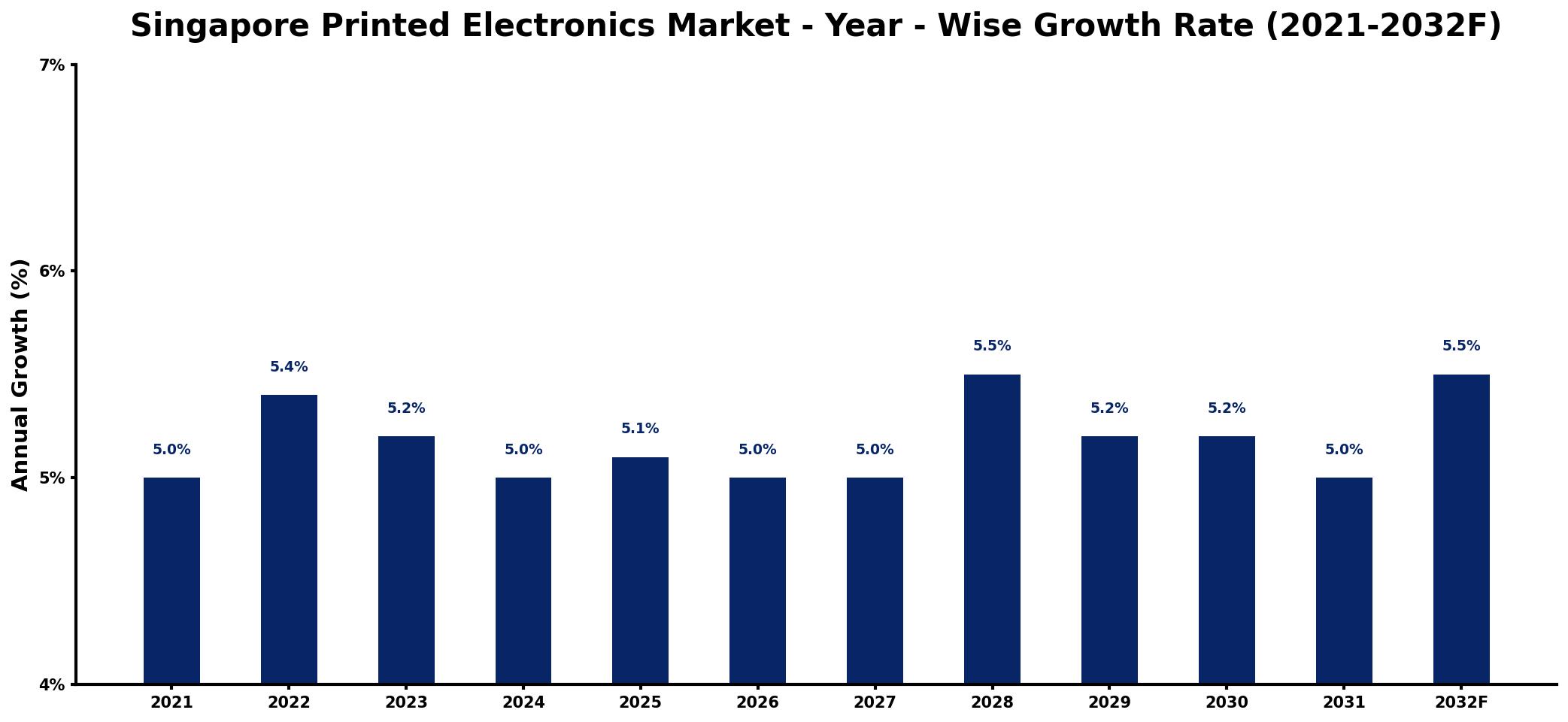
The table below presents the year‑wise growth rates along with the key drivers influencing the market
| Year | Growth Rate | Major Drivers |
| 2021 | 5.0% | Increased demand for flexible applications |
| 2022 | 5.4% | Growing interest in sustainable materials |
| 2023 | 5.2% | Expansion in wearable technology market |
| 2024 | 5.0% | Rise in smart packaging solutions |
| 2025 | 5.1% | Investment in advanced manufacturing techniques |
| 2026 | 5.0% | Surge in automotive applications innovation |
| 2027 | 5.0% | Growth in healthcare monitoring devices |
| 2028 | 5.5% | Advancements in consumer product integration |
| 2029 | 5.2% | growing downstream application demand |
| 2030 | 5.2% | Expansion of renewable energy solutions |
| 2031 | 5.0% | Rising demand for interactive displays |
| 2032 | 5.5% | stronger distribution network expansion |
Note: Market size estimations and growth projections presented in this report are based on 6Wresearch's proprietary forecasting methodology, utilizing the latest available industry data, government publications, and primary research inputs.
Singapore Printed Electronics Market Synopsis
In recent years, the Singapore printed electronics market has experienced significant momentum, transforming how electronic components are integrated into everyday products. This innovation is set against a backdrop of ongoing advancements in technology that promise to reshape the landscape of electronic manufacturing.
Looking ahead, the market is expected to evolve further, with a strong emphasis on sustainability and cost efficiency. As more industries adopt printed electronics for applications such as smart packaging and medical sensors, Singapore stands at the forefront of this technological revolution.
Singapore Printed Electronics Market Key Takeaways
- The market is poised for robust growth, fueled by increasing demand from various sectors.
- Technological innovations are enhancing the capabilities and applications of printed electronics.
- Government support plays a crucial role in promoting research and development initiatives.
- Flexibility and cost-effectiveness are key drivers behind the adoption of printed electronics.
- Collaboration between academia and industry is fostering groundbreaking advancements.
Evaluation of Restraints in Singapore Printed Electronics Market
Despite the promising growth prospects, the Singapore printed electronics market grapples with inherent challenges. Rapid advancements in traditional electronics present a significant hurdle, as conventional methods may overshadow the benefits of printed technologies. Additionally, the need for convincing industry stakeholders about the economic viability and sustainability of printed electronics remains an ongoing concern. Companies must navigate these constraints to fully capitalize on the emerging opportunities in the market.
Singapore Printed Electronics Market Trends
Current trends shaping the Singapore printed electronics market include the rise of Internet of Things (IoT) applications, which demand increasingly sophisticated electronic solutions. Wearable technology and medical devices are gaining traction, driving innovation in printed sensors and displays. Moreover, there is a growing emphasis on sustainable practices, with eco-friendly materials and processes becoming pivotal for companies aiming to differentiate themselves in a competitive landscape.
Singapore Printed Electronics Market Opportunities
The Singapore printed electronics market presents numerous growth opportunities, particularly in sectors like healthcare and logistics. As industries seek to integrate smart technologies, there is a rising demand for versatile printed components capable of meeting diverse needs. Investment in research and development, coupled with strong governmental support, creates an environment ripe for innovation, allowing businesses to leverage emerging technologies to their advantage.
Government Initiatives in the Singapore Printed Electronics Market
The Singapore government has been proactive in fostering an ecosystem conducive to the growth of the printed electronics market. Initiatives include funding for research and development projects and the establishment of innovation hubs that encourage collaboration between academic institutions and industry players. Furthermore, various incentives are designed to promote the adoption of cutting-edge technologies, ensuring that Singapore remains a competitive player on the global stage.
Future Insights of the Singapore Printed Electronics Market
Looking toward 2026-2032, the Singapore printed electronics market is expected to continue its upward trajectory. Innovations in materials and printing processes will likely lead to the development of more sophisticated electronic products. As demand for smart, connected devices increases, companies that prioritize flexibility and sustainability in their operations are positioned to thrive. Moreover, government support for technology adoption will bolster market expansion and encourage further investment in this dynamic sector.
Singapore Printed Electronics Market Latest Developments (2025 - 2026)
Recent developments in the Singapore printed electronics market indicate a surge in investments aimed at enhancing production capabilities. Companies are increasingly focusing on developing eco-friendly materials and sustainable manufacturing processes. Collaborations between research institutions and industry players are expected to yield groundbreaking advancements, paving the way for innovative applications across various sectors. These trends signify a robust commitment to not only advancing technology but also ensuring its alignment with global sustainability goals.
Singapore Printed Electronics Market - Key Attractiveness of the Report
- 10 Years of Market Numbers
- Historical Data Starting from 2022 to 2025
- Base Year: 2025
- Forecast Data until 2032
- Key Performance Indicators Impacting the Market
- Major Upcoming Developments and Projects
Key Highlights of the Report:
- Singapore Printed Electronics Market Outlook
- Market Size of Singapore Printed Electronics Market, 2025
- Forecast of Singapore Printed Electronics Market, 2032
- Historical Data and Forecast of Singapore Printed Electronics Revenues & Volume for the Period 2022-2032F
- Singapore Printed Electronics Market Trend Evolution
- Singapore Printed Electronics Market Drivers and Challenges
- Singapore Printed Electronics Price Trends
- Singapore Printed Electronics Porter's Five Forces
- Singapore Printed Electronics Industry Life Cycle
- Historical Data and Forecast of Singapore Printed Electronics Market Revenues & Volume By Material for the Period 2022-2032F
- Historical Data and Forecast of Singapore Printed Electronics Market Revenues & Volume By Ink for the Period 2022-2032F
- Historical Data and Forecast of Singapore Printed Electronics Market Revenues & Volume By Substrate for the Period 2022-2032F
- Historical Data and Forecast of Singapore Printed Electronics Market Revenues & Volume By Technology for the Period 2022-2032F
- Historical Data and Forecast of Singapore Printed Electronics Market Revenues & Volume By Screen for the Period 2022-2032F
- Historical Data and Forecast of Singapore Printed Electronics Market Revenues & Volume By Inkjet for the Period 2022-2032F
- Historical Data and Forecast of Singapore Printed Electronics Market Revenues & Volume By Flexographic for the Period 2022-2032F
- Historical Data and Forecast of Singapore Printed Electronics Market Revenues & Volume By Gravure for the Period 2022-2032F
- Historical Data and Forecast of Singapore Printed Electronics Market Revenues & Volume By Device for the Period 2022-2032F
- Historical Data and Forecast of Singapore Printed Electronics Market Revenues & Volume By Displays for the Period 2022-2032F
- Historical Data and Forecast of Singapore Printed Electronics Market Revenues & Volume By Photovoltaic for the Period 2022-2032F
- Historical Data and Forecast of Singapore Printed Electronics Market Revenues & Volume By Lighting for the Period 2022-2032F
- Historical Data and Forecast of Singapore Printed Electronics Market Revenues & Volume By RFID for the Period 2022-2032F
- Historical Data and Forecast of Singapore Printed Electronics Market Revenues & Volume By Others for the Period 2022-2032F
- Singapore Printed Electronics Import Export Trade Statistics
- Market Opportunity Assessment By Material
- Market Opportunity Assessment By Technology
- Market Opportunity Assessment By Device
- Singapore Printed Electronics Top Companies Market Share
- Singapore Printed Electronics Competitive Benchmarking By Technical and Operational Parameters
- Singapore Printed Electronics Company Profiles
- Singapore Printed Electronics Key Strategic Recommendations






































