Singapore Proactive Services Market Size & Growth Rate (2026-2032)
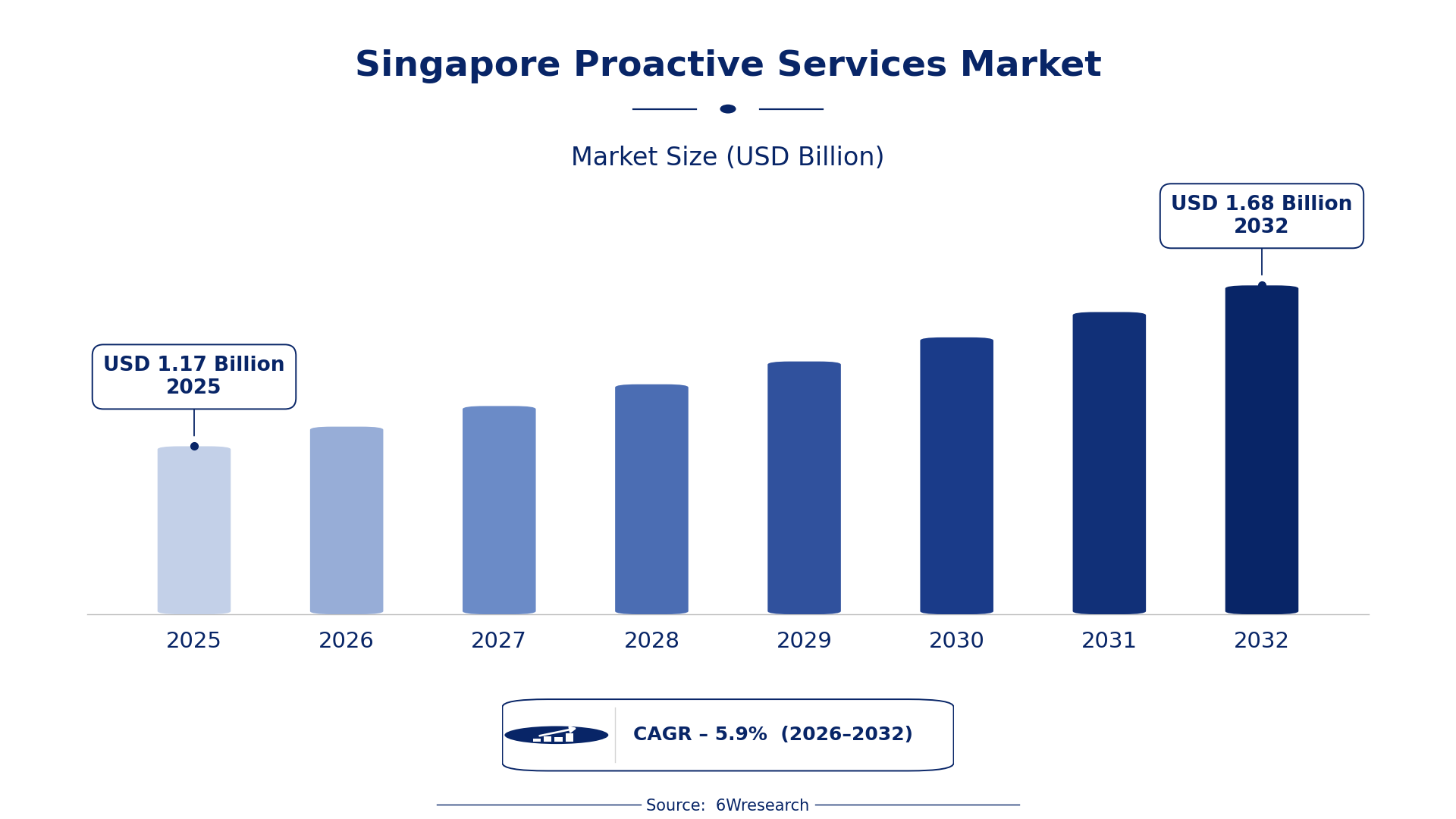
The Singapore Proactive Services Market was estimated at USD 1172 Million in 2025 and is projected to reach USD 1677 Million by 2032, growing at a CAGR of 5.9% from 2026 to 2032.
Singapore Proactive Services Market Synopsis
A major force driving the Singapore Proactive Services Market is the increasing need for organizations to anticipate and address IT challenges before they escalate. This proactive approach is essential for maintaining business continuity, especially in an environment where digital threats and operational disruptions can severely impact profitability.
As companies become more aware of the risks associated with reactive IT management, investments in proactive services are on the rise. Monitoring, predictive analytics, and early intervention strategies are now seen as critical components for sustaining operational efficiency and safeguarding IT infrastructure.
Singapore Proactive Services Market Year-wise Growth Rate and Key Drivers
This graph illustrates the annual growth rates of the Singapore Proactive Services Market from 2021 to 2032, highlighting a steady upward trajectory and projected expansion over the forecast period.
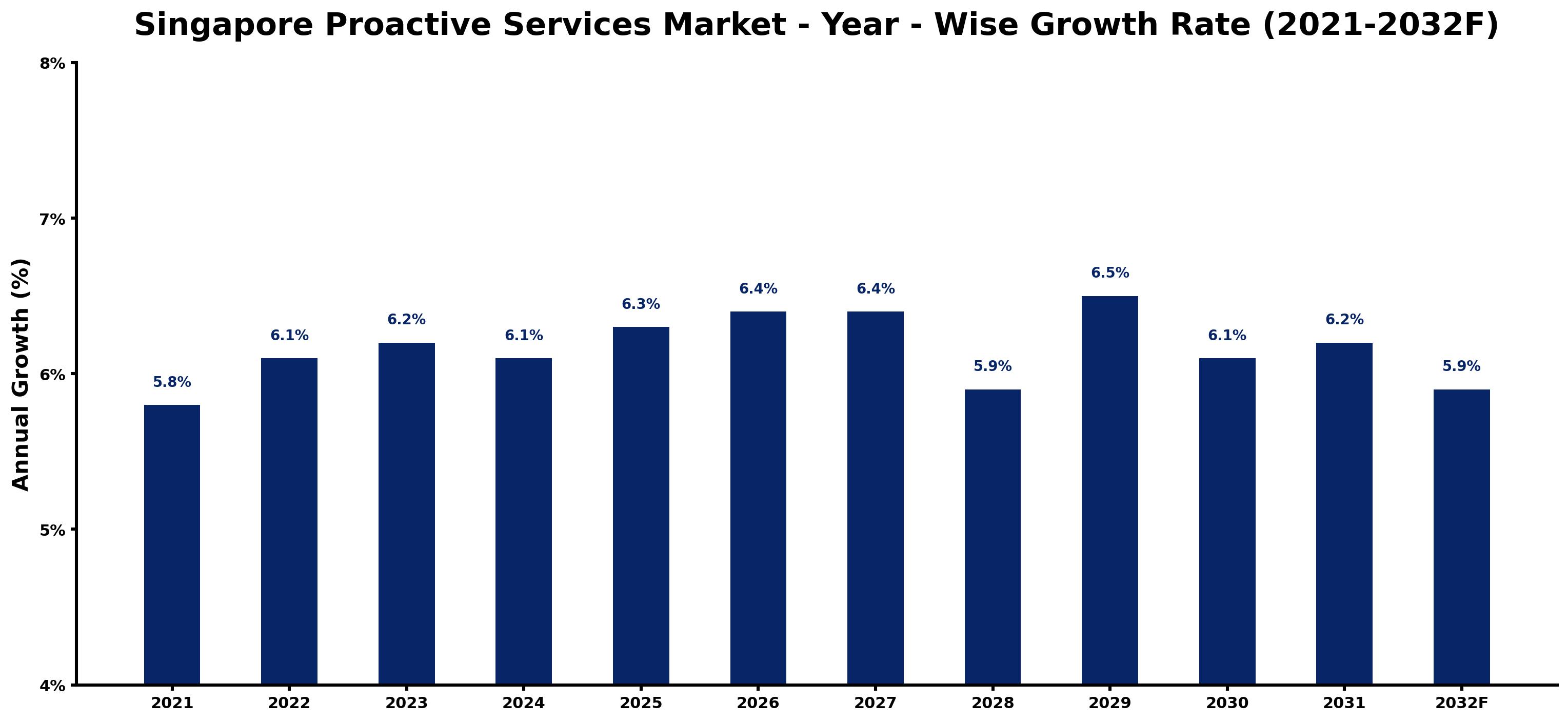
The table below presents the year‑wise growth rates along with the key drivers influencing the market
| Year | Growth Rate | Major Drivers |
| 2021 | 5.8% | Government Smart Nation initiative boosting digital services adoption |
| 2022 | 6.1% | Increased healthcare funding enhancing preventive care initiatives |
| 2023 | 6.2% | Rising elderly population demanding proactive health management |
| 2024 | 6.1% | Adoption of IoT technologies in health monitoring solutions |
| 2025 | 6.3% | New regulations incentivizing proactive service delivery models |
| 2026 | 6.4% | Partnerships between hospitals and tech firms improving services |
| 2027 | 6.4% | Growing emphasis on mental health in proactive care policies |
| 2028 | 5.9% | Local startups innovating in patient engagement technologies |
| 2029 | 6.5% | Increased investment in telemedicine platforms supporting proactive solutions |
| 2030 | 6.1% | Government grants encouraging digital health startups' growth |
| 2031 | 6.2% | Higher health insurance coverage promoting preventive health measures |
| 2032 | 5.9% | Rising consumer awareness of wellness driving service demand |
Note: Market size estimations and growth projections presented in this report are based on 6Wresearch's proprietary forecasting methodology, utilizing the latest available industry data, government publications, and primary research inputs.
Singapore Proactive Services Market Key Takeaways
Below are some of the specific key takeaways from the market, including:
- The shift from reactive to proactive IT management is reshaping service offerings.
- Investment in predictive analytics is becoming a priority for many organizations.
- Cybersecurity concerns drive demand for proactive monitoring and support services.
- The COVID-19 pandemic accelerated the adoption of proactive services across sectors.
- Ongoing technological advancements are expanding the scope of proactive service capabilities.
Evaluation of Restraints in Singapore Proactive Services Market
Despite the promising growth, the Singapore Proactive Services Market faces certain constraints. One major issue is the challenge of accurately predicting IT issues before they arise, which requires sophisticated analytics and constant monitoring. The rapid pace of technological change also demands that service providers continually update their offerings to meet evolving business needs. This can strain resources and require substantial investment in training and technology.
Singapore Proactive Services Market Trends
Several trends are influencing the Singapore Proactive Services Market. A notable trend is the increasing integration of artificial intelligence and machine learning in monitoring systems, enhancing predictive capabilities. Another trend is the growing focus on cybersecurity, with businesses prioritizing proactive threat detection and response mechanisms. Additionally, there is a noticeable shift towards cloud-based proactive services, allowing for more flexible and scalable IT management solutions.
Singapore Proactive Services Market Opportunities
The market is ripe with opportunities for growth. Organizations are looking to invest in advanced analytics and machine learning capabilities that can improve their proactive service offerings. The rising demand for cybersecurity solutions presents an avenue for service providers to innovate and expand their portfolios. on top of that, as remote work becomes more common, services that enhance remote IT support and monitoring will see increased interest.
Government Initiatives in the Singapore Proactive Services Market
Government policies are playing a crucial role in shaping the Singapore Proactive Services Market. The Singaporean government has prioritized digital transformation, establishing a supportive regulatory environment that encourages innovation in IT services. As businesses look to enhance their resilience and security, these initiatives are increasingly relevant.
- A national digital infrastructure upgrade programme launched in 2023 aims to enhance cybersecurity measures across critical sectors.
- Current initiatives are focused on providing grants to SMEs for adopting proactive IT management solutions.
- A regulatory framework introduced in 2024 mandates businesses to implement proactive cybersecurity measures, enhancing overall market compliance.
- Upcoming public-private partnerships are expected to expand access to advanced analytics tools for IT management by 2025.
Future Insights of the Singapore Proactive Services Market
Looking ahead to 2026-2032, the Singapore Proactive Services Market is expected to evolve significantly. As organizations continue to prioritize risk mitigation and operational resilience, demand for advanced proactive services will surge. Investments in AI and machine learning will likely redefine service capabilities, while the ongoing digital transformation will create a fertile ground for innovative solutions. The focus on cybersecurity will remain a central theme, shaping the strategies of businesses across all sectors.
Singapore Proactive Services Market Latest Developments
In the past year, the Singapore Proactive Services Market has seen a flurry of activity as organizations ramp up their investments in proactive IT solutions. The focus has been on enhancing capabilities to preemptively address issues that could disrupt business operations.
- A major technology vendor launched a new suite of proactive monitoring tools in early 2024, aimed at improving real-time threat detection for businesses.
- An initiative that began in mid-2024 is currently underway, focusing on integrating advanced AI capabilities into existing IT support frameworks.
- In late 2024, a collaborative project between industry leaders was announced to develop standardized metrics for measuring the effectiveness of proactive services.
- A rollout expected to begin in the second half of 2025 will introduce a new training program for IT staff focused on proactive service methodologies.
Singapore Proactive Services Market - Key Attractiveness of the Report
- 10 Years of Market Numbers
- Historical Data Starting from 2022 to 2025
- Base Year: 2025
- Forecast Data until 2032
- Key Performance Indicators Impacting the Market
- Major Upcoming Developments and Projects
Key Highlights of the Report:
- Singapore Proactive Services Market Outlook
- Market Size of Singapore Proactive Services Market, 2025
- Forecast of Singapore Proactive Services Market, 2032
- Historical Data and Forecast of Singapore Proactive Services Revenues & Volume for the Period 2022-2032F
- Singapore Proactive Services Market Trend Evolution
- Singapore Proactive Services Market Drivers and Challenges
- Singapore Proactive Services Price Trends
- Singapore Proactive Services Porter's Five Forces
- Singapore Proactive Services Industry Life Cycle
- Historical Data and Forecast of Singapore Proactive Services Market Revenues & Volume By Application for the Period 2022-2032F
- Historical Data and Forecast of Singapore Proactive Services Market Revenues & Volume By Network Management for the Period 2022-2032F
- Historical Data and Forecast of Singapore Proactive Services Market Revenues & Volume By Customer Experience Management for the Period 2022-2032F
- Historical Data and Forecast of Singapore Proactive Services Market Revenues & Volume By Data Center Management for the Period 2022-2032F
- Historical Data and Forecast of Singapore Proactive Services Market Revenues & Volume By Cloud Management for the Period 2022-2032F
- Historical Data and Forecast of Singapore Proactive Services Market Revenues & Volume By Application Management for the Period 2022-2032F
- Historical Data and Forecast of Singapore Proactive Services Market Revenues & Volume By Device / Endpoint Management for the Period 2022-2032F
- Historical Data and Forecast of Singapore Proactive Services Market Revenues & Volume By Service for the Period 2022-2032F
- Historical Data and Forecast of Singapore Proactive Services Market Revenues & Volume By Managed Services for the Period 2022-2032F
- Historical Data and Forecast of Singapore Proactive Services Market Revenues & Volume By Technical Support for the Period 2022-2032F
- Historical Data and Forecast of Singapore Proactive Services Market Revenues & Volume By Design and Consulting for the Period 2022-2032F
- Historical Data and Forecast of Singapore Proactive Services Market Revenues & Volume By Technology Type for the Period 2022-2032F
- Historical Data and Forecast of Singapore Proactive Services Market Revenues & Volume By Big Data Analytics for the Period 2022-2032F
- Historical Data and Forecast of Singapore Proactive Services Market Revenues & Volume By Business Intelligence for the Period 2022-2032F
- Historical Data and Forecast of Singapore Proactive Services Market Revenues & Volume By Machine Intelligence for the Period 2022-2032F
- Historical Data and Forecast of Singapore Proactive Services Market Revenues & Volume By Organization Size for the Period 2022-2032F
- Historical Data and Forecast of Singapore Proactive Services Market Revenues & Volume By Small and Medium-sized Enterprises (SMEs) for the Period 2022-2032F
- Historical Data and Forecast of Singapore Proactive Services Market Revenues & Volume By Large enterprises for the Period 2022-2032F
- Historical Data and Forecast of Singapore Proactive Services Market Revenues & Volume By Vertical for the Period 2022-2032F
- Historical Data and Forecast of Singapore Proactive Services Market Revenues & Volume By Banking, Financial Services, and Insurance (BFSI) for the Period 2022-2032F
- Historical Data and Forecast of Singapore Proactive Services Market Revenues & Volume By Telecommunication for the Period 2022-2032F
- Historical Data and Forecast of Singapore Proactive Services Market Revenues & Volume By Retail for the Period 2022-2032F
- Historical Data and Forecast of Singapore Proactive Services Market Revenues & Volume By Healthcare for the Period 2022-2032F
- Historical Data and Forecast of Singapore Proactive Services Market Revenues & Volume By Government and Defense for the Period 2022-2032F
- Historical Data and Forecast of Singapore Proactive Services Market Revenues & Volume By Media and Entertainment for the Period 2022-2032F
- Historical Data and Forecast of Singapore Proactive Services Market Revenues & Volume By Others for the Period 2022-2032F
- Singapore Proactive Services Import Export Trade Statistics
- Market Opportunity Assessment By Application
- Market Opportunity Assessment By Service
- Market Opportunity Assessment By Technology Type
- Market Opportunity Assessment By Organization Size
- Market Opportunity Assessment By Vertical
- Singapore Proactive Services Top Companies Market Share
- Singapore Proactive Services Competitive Benchmarking By Technical and Operational Parameters
- Singapore Proactive Services Company Profiles
- Singapore Proactive Services Key Strategic Recommendations






































