Singapore Probiotic Yeast Market Size, Share & Growth Rate
The Singapore Probiotic Yeast Market was estimated at USD 378 Million in 2025 and is projected to reach USD 543 Million by 2032, growing at a CAGR of 5.3% from 2026 to 2032. This upward trajectory is largely driven by the rising consumer awareness surrounding gut health, which has surged due to both social media influence and increasing health concerns. Furthermore, the expanding applications of probiotic yeast in dietary supplements, fermented foods, and beverages are fostering robust demand across various consumer segments.
Singapore Probiotic Yeast Market Year-wise Growth Rate and Key Drivers
This graph highlights how the Singapore Probiotic Yeast Market has steadily grown over the years, supported by major growth factors.
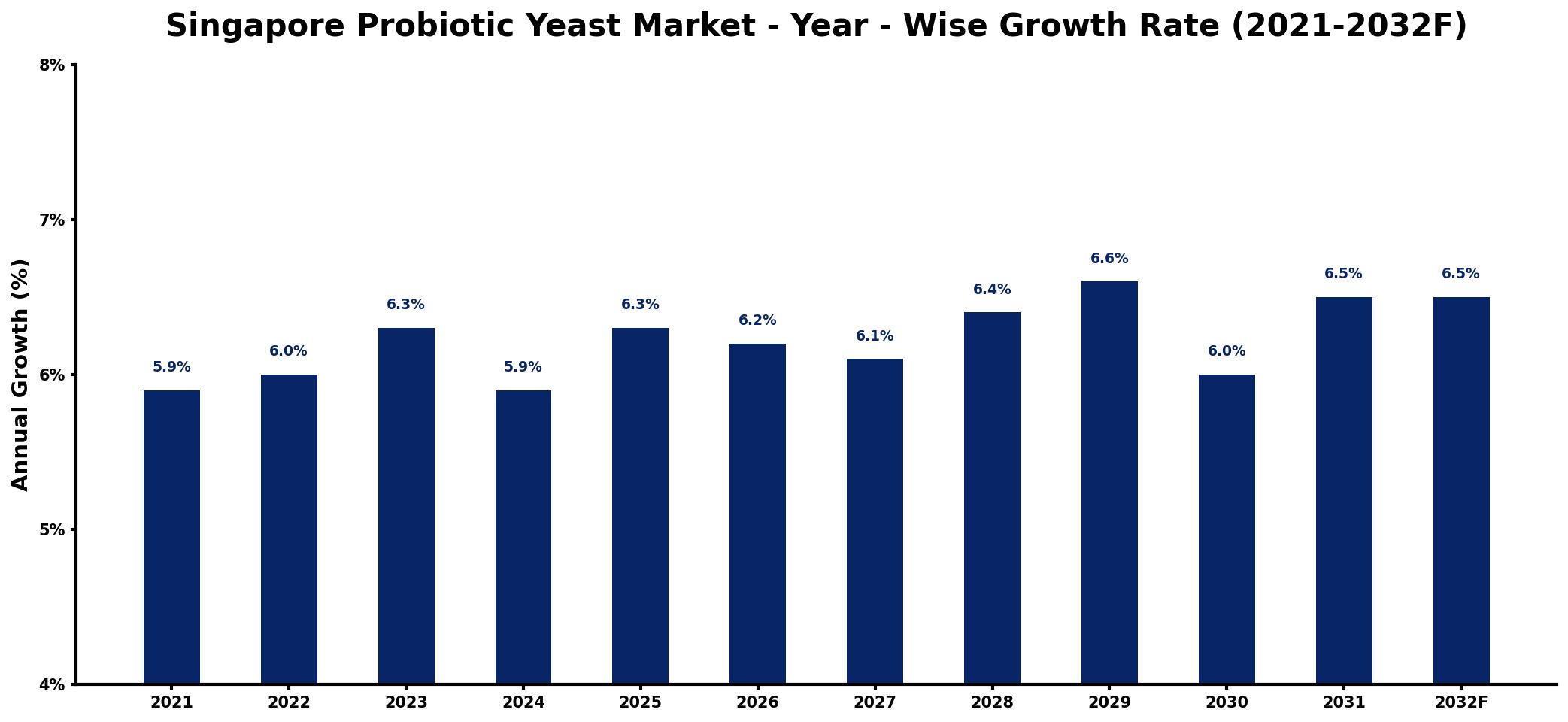
The table below presents the year‑wise growth rates along with the key drivers influencing the market
| Year | Growth Rate | Major Drivers |
| 2021 | 5.9% | Rising consumer health awareness |
| 2022 | 6.0% | Increased investment in R&D |
| 2023 | 6.3% | Growing popularity of supplements |
| 2024 | 5.9% | Expansion of health food stores |
| 2025 | 6.3% | Surge in online retail sales |
| 2026 | 6.2% | Emerging trends in gut health |
| 2027 | 6.1% | Enhanced marketing strategies adopted |
| 2028 | 6.4% | Collaborations with wellness influencers |
| 2029 | 6.6% | Diversification of product offerings |
| 2030 | 6.0% | Strengthened distribution networks established |
| 2031 | 6.5% | Growing interest in functional foods |
| 2032 | 6.5% | Rising demand for natural ingredients |
Note: Market size estimations and growth projections presented in this report are based on 6Wresearch's proprietary forecasting methodology, utilizing the latest available industry data, government publications, and primary research inputs.
Singapore Probiotic Yeast Market Synopsis
As Singaporean consumers become more health-conscious, the popularity of probiotic yeasts is rapidly gaining traction. Recognized for their potential to enhance digestive health and strengthen the immune system, these functional ingredients are now viewed as essential for holistic wellness. The trend towards natural health solutions has propelled a significant uptick in the consumption of probiotic yeast-infused products.
Innovation is at the forefront of the Singapore Probiotic Yeast Market, fueled by collaborations among researchers, health professionals, and food manufacturers. These partnerships not only drive product diversification but also enhance consumer education, helping bridge the gap between awareness and understanding of the benefits of probiotic yeasts.
Singapore Probiotic Yeast Market Key Takeaways
- Growing consumer focus on gut health is driving demand for probiotic yeast products.
- Collaborative innovations are enhancing product offerings and consumer education.
- The market is witnessing an increase in natural and organic product preferences.
- Probiotic yeasts are increasingly integrated into dietary supplements and fermented foods.
- Regulatory support is fostering a conducive environment for market expansion.
Evaluation of Restraints in Singapore Probiotic Yeast Market
While the Singapore Probiotic Yeast Market shows promising growth potential, several restraints impede its momentum. One significant limitation is the ongoing challenge of consumer education; many individuals are still unclear about the specific benefits of probiotic yeast compared to conventional yeast products. Furthermore, ensuring the stability and viability of these probiotic strains throughout the supply chain remains a critical concern, given their sensitivity to environmental factors. Addressing these issues is essential to unlock the market's full potential.
Singapore Probiotic Yeast Market Trends
Current trends in the Singapore Probiotic Yeast Market highlight a shift towards more personalized nutrition and functional foods. Consumers are increasingly interested in products tailored to their specific health needs, prompting manufacturers to innovate with specialized probiotic formulations. Additionally, the rise of e-commerce platforms is facilitating easier access to a diverse range of probiotic yeast products, further stimulating market growth.
Singapore Probiotic Yeast Market Opportunities
The market presents numerous investment opportunities, particularly in developing new probiotic yeast strains and applications. Entrepreneurs can explore niche segments such as probiotic beverages and fortified food products. Furthermore, the increasing focus on preventive healthcare solutions opens avenues for partnerships with health and wellness organizations aimed at enhancing public knowledge about gut health benefits.
Government Initiatives in the Singapore Probiotic Yeast Market
The Singaporean government is actively promoting health and wellness initiatives that support the growth of the probiotic yeast market. This includes funding research programs that explore the health benefits of probiotics and encouraging local food manufacturers to innovate in the functional foods space. Regulatory frameworks are also being developed to ensure product safety and efficacy, thereby fostering consumer trust and encouraging market participation.
Future Insights of the Singapore Probiotic Yeast Market
Looking ahead to 2026-2032, the Singapore Probiotic Yeast Market is poised for significant advancement. Increased health awareness will likely continue to drive consumer demand, while ongoing research may unlock new benefits associated with various probiotic strains. Furthermore, the expansion of e-commerce channels will enhance market accessibility, facilitating a broader consumer base and paving the way for sustained market growth.
Singapore Probiotic Yeast Market Latest Developments (2025 - 2026)
Recent developments within the Singapore Probiotic Yeast Market suggest a strong emphasis on research and product innovation. Manufacturers are increasingly investing in the development of new probiotic yeast strains that promise enhanced health benefits. Additionally, there is a noticeable shift towards sustainable production practices, aligning with global trends in environmental responsibility, which is anticipated to resonate well with increasingly eco-conscious consumers.
Singapore Probiotic Yeast Market - Key Attractiveness of the Report
- 10 Years of Market Numbers
- Historical Data Starting from 2022 to 2025
- Base Year: 2025
- Forecast Data until 2032
- Key Performance Indicators Impacting the Market
- Major Upcoming Developments and Projects
Key Highlights of the Report:
- Singapore Probiotic Yeast Market Outlook
- Market Size of Singapore Probiotic Yeast Market, 2025
- Forecast of Singapore Probiotic Yeast Market, 2032
- Historical Data and Forecast of Singapore Probiotic Yeast Revenues & Volume for the Period 2022-2032F
- Singapore Probiotic Yeast Market Trend Evolution
- Singapore Probiotic Yeast Market Drivers and Challenges
- Singapore Probiotic Yeast Price Trends
- Singapore Probiotic Yeast Porter's Five Forces
- Singapore Probiotic Yeast Industry Life Cycle
- Historical Data and Forecast of Singapore Probiotic Yeast Market Revenues & Volume By Form for the Period 2022-2032F
- Historical Data and Forecast of Singapore Probiotic Yeast Market Revenues & Volume By Powder for the Period 2022-2032F
- Historical Data and Forecast of Singapore Probiotic Yeast Market Revenues & Volume By Capsules for the Period 2022-2032F
- Historical Data and Forecast of Singapore Probiotic Yeast Market Revenues & Volume By Application for the Period 2022-2032F
- Historical Data and Forecast of Singapore Probiotic Yeast Market Revenues & Volume By Nutrition and Supplement for the Period 2022-2032F
- Historical Data and Forecast of Singapore Probiotic Yeast Market Revenues & Volume By Food and Beverages for the Period 2022-2032F
- Historical Data and Forecast of Singapore Probiotic Yeast Market Revenues & Volume By Animal feed for the Period 2022-2032F
- Historical Data and Forecast of Singapore Probiotic Yeast Market Revenues & Volume By Sales Channel for the Period 2022-2032F
- Historical Data and Forecast of Singapore Probiotic Yeast Market Revenues & Volume By Online for the Period 2022-2032F
- Historical Data and Forecast of Singapore Probiotic Yeast Market Revenues & Volume By Offline for the Period 2022-2032F
- Singapore Probiotic Yeast Import Export Trade Statistics
- Market Opportunity Assessment By Form
- Market Opportunity Assessment By Application
- Singapore Probiotic Yeast Top Companies Market Share
- Singapore Probiotic Yeast Competitive Benchmarking By Technical and Operational Parameters
- Singapore Probiotic Yeast Company Profiles
- Singapore Probiotic Yeast Key Strategic Recommendations






































