Singapore Professional Lighting Market Summary
The singapore professional lighting market was estimated at USD 496 Million in 2025 and is projected to reach USD 656 Million by 2032, growing at a CAGR of 4.9% from 2026 to 2032.
Singapore Professional Lighting Market Year-wise Growth Rate and Key Drivers
This graph highlights how the Singapore Professional Lighting Market has steadily grown over the past five years, supported by major growth factors.
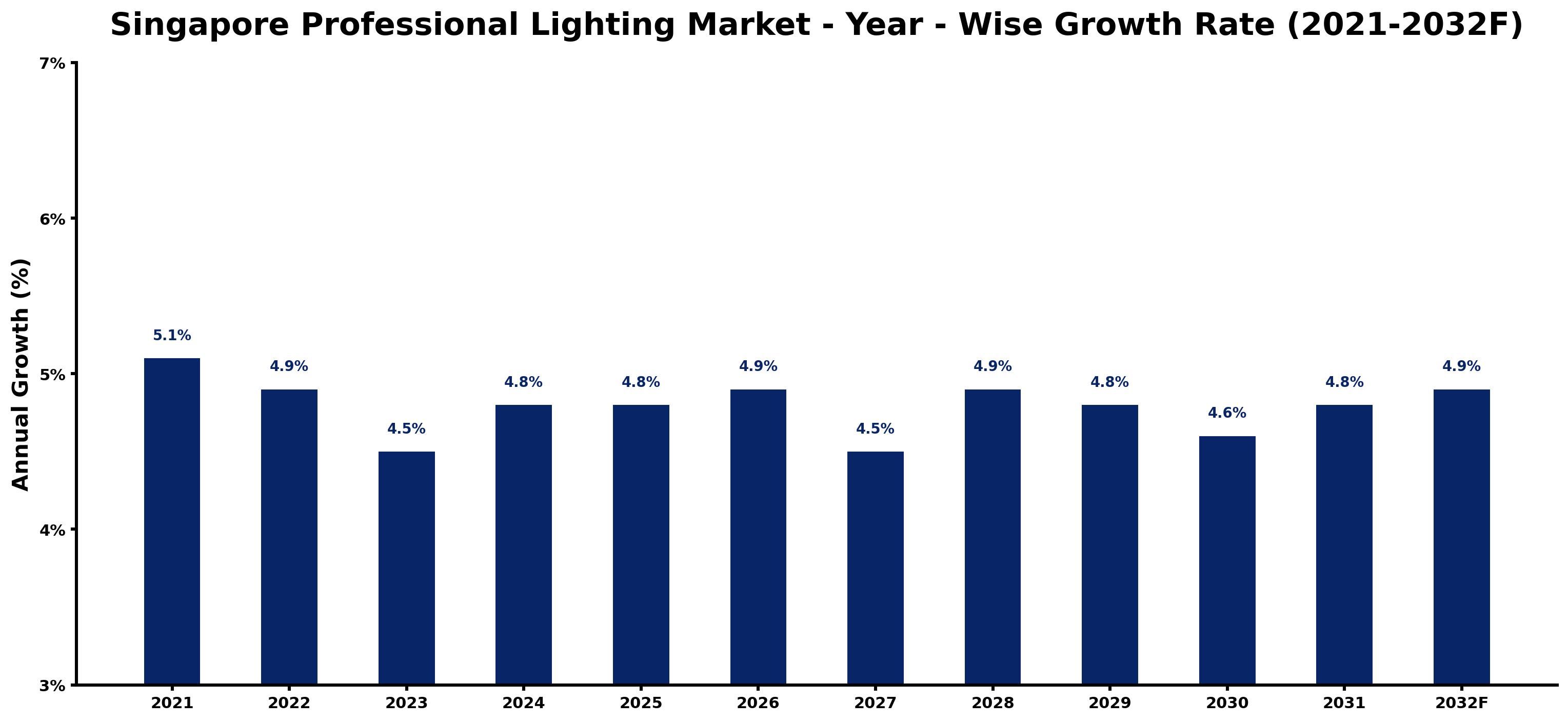
The table below presents the year wise growth rates along with the key drivers influencing the market
| Year | Growth Rate | Major Drivers |
| 2021 | 5.1% | Post-lockdown retail projects sparked significant interest in modern lighting solutions. |
| 2022 | 4.9% | Enhanced energy efficiency standards prompted upgrades in commercial lighting infrastructures. |
| 2023 | 4.5% | Smart city initiatives led to increased investment in IoT-enabled lighting systems. |
| 2024 | 4.8% | Corporate sustainability initiatives prioritized energy-saving lighting technologies dramatically. |
| 2025 | 4.8% | Emerging trends in biophilic design created demand for natural light-enhancing fixtures. |
| 2026 | 4.9% | Local manufacturing capabilities improved, reducing costs for high-quality lighting products. |
| 2027 | 4.5% | Technological innovation in LED products attracted both commercial and residential buyers. |
| 2028 | 4.9% | Demand for smart home lighting solutions increased amid rising consumer tech engagement. |
| 2029 | 4.8% | Architectural design trends incorporated advanced lighting for aesthetic and functional purposes. |
| 2030 | 4.6% | Urbanization continued to drive infrastructure projects, boosting the need for professional lighting. |
| 2031 | 4.8% | Post-pandemic recovery efforts emphasized enhanced ambient lighting in public spaces. |
| 2032 | 4.9% | Focus on health and wellness elevated preferences for circadian rhythm-friendly lighting solutions. |
Note - Market size estimations and growth projections presented in this report are based on 6Wresearch's advanced forecasting approach, validated with industry datasets as of June 2026.
Singapore Professional Lighting Market Synopsis
The Singapore Professional Lighting Market is projected to reach $810.9 million and witness significant growth during the forecast period (2026-2032). This growth is underpinned by various factors including technological innovations and a rapidly changing consumer landscape. The market encompasses a broad range of lighting solutions suitable for applications such as indoor and outdoor architectural settings, commercial establishments, stage and theatrical events, entertainment venues, video projection, and broadcast studio operations.
Singapore Professional Lighting Market Growth Drivers
The growth of the Singapore Professional Lighting Market is driven by several pivotal factors:
- The increasing adoption of connected lighting systems plays a crucial role, as residential and commercial spaces integrate smart technology to enhance convenience and reduce energy consumption.
- Energy-efficient solutions are in high demand, especially those utilizing intelligent LED fixtures that not only consume less power but also offer superior performance features.
- Public sentiment is shifting towards sustainable practices, which is further incentivized by government regulations advocating for energy-saving initiatives in lighting.
- The requirement for automated lighting systems that can be managed through DMX protocols or similar technologies is growing, particularly in professional and commercial environments.
- The evolving architectural trends in Singapore, where aesthetics meet functionality, is fueling demand for innovative lighting designs that complement modern infrastructures.
Singapore Professional Lighting Market Market Trends
As the landscape of urban development in Singapore evolves, several trends are emerging within the market:
- Connected lighting systems are being increasingly integrated into smart city initiatives, as these technologies facilitate advanced features like remote operations and data-driven insights.
- There is a noticeable shift towards sustainable design practices, which is driving demand for eco-friendly lighting solutions, particularly energy-efficient LEDs.
- Commercial establishments are investing in advanced lighting solutions that enhance consumer experience while simultaneously lowering operational costs.
- Technological advancements in lighting controls and sensor technologies are enabling more adaptive lighting systems that respond to occupancy and natural light levels.
- The rise of e-commerce is prompting retail spaces to revamp their lighting strategies to create engaging shopping experiences that attract customers.
Singapore Professional Lighting Market Challenges and Restraints
Despite the positive outlook for the Singapore Professional Lighting Market, several challenges persist:
- The high initial investment costs associated with smart lighting systems can deter potential adopters, especially in budget-sensitive sectors.
- Complexity in installation and integration of advanced systems may pose operational difficulties for some users.
- Maintenance and repair costs for sophisticated lighting setups can add to overall expenditures, pushing some businesses to avoid full automation.
- There exists a knowledge gap among general consumers regarding the benefits of modern lighting technologies, which can slow market uptake.
- The rapid pace of technological change may lead to obsolescence concerns, making businesses hesitant to invest in the latest solutions.
Singapore Professional Lighting Market Government Investment and Initiatives
The Singaporean government is actively promoting energy efficiency and sustainability in various sectors, including professional lighting. Policies aimed at reducing energy consumption through the adoption of LED technologies are being emphasized. Initiatives such as grants and incentives for businesses that implement energy-efficient lighting solutions are in place to stimulate market growth. Furthermore, the government's commitment to creating a smart nation involves substantial investments in infrastructure that integrates advanced lighting systems. Educational campaigns are also focusing on raising awareness about the benefits of energy-efficient lighting, thus fostering a supportive environment for innovations in the sector.
Singapore Professional Lighting Market Latest Developments (May 2025 - June 2026)
In the period from May 2025 to June 2026, the Singapore Professional Lighting Market has seen a notable shift towards greater incorporation of smart technologies. Several companies have introduced innovative lighting solutions that feature enhanced connectivity and sustainability attributes. The regulatory environment continues to evolve, with new policies being proposed to further incentivize energy-efficient practices across various sectors. Collaborative projects between the public and private sectors are emerging, focusing on smart city developments that integrate intelligent lighting systems into urban architecture. Moreover, an increasing number of professional lighting exhibitions and conferences are being held to showcase the latest advancements and best practices in the industry.
Singapore Professional Lighting Market - Key Attractiveness of the Report
- 10 Years of Market Numbers
- Historical Data Starting from 2022 to 2025
- Base Year: 2025
- Forecast Data until 2032
- Key Performance Indicators Impacting the Market
- Major Upcoming Developments and Projects
Key Highlights of the Report:
- Singapore Professional Lighting Market Outlook
- Market Size of Singapore Professional Lighting Market, 2025
- Forecast of Singapore Professional Lighting Market, 2032
- Historical Data and Forecast of Singapore Professional Lighting Revenues & Volume for the Period 2022-2032
- Singapore Professional Lighting Market Trend Evolution
- Singapore Professional Lighting Market Drivers and Challenges
- Singapore Professional Lighting Price Trends
- Singapore Professional Lighting Porter's Five Forces
- Singapore Professional Lighting Industry Life Cycle
- Historical Data and Forecast of Singapore Professional Lighting Market Revenues & Volume By Light Source for the Period 2022-2032
- Historical Data and Forecast of Singapore Professional Lighting Market Revenues & Volume By LEDs for the Period 2022-2032
- Historical Data and Forecast of Singapore Professional Lighting Market Revenues & Volume By Others (halogen lamps, xenon bulbs, incandescent lamps) for the Period 2022-2032
- Historical Data and Forecast of Singapore Professional Lighting Market Revenues & Volume By Applications for the Period 2022-2032
- Historical Data and Forecast of Singapore Professional Lighting Market Revenues & Volume By Entertainment for the Period 2022-2032
- Historical Data and Forecast of Singapore Professional Lighting Market Revenues & Volume By Stage lighting for the Period 2022-2032
- Historical Data and Forecast of Singapore Professional Lighting Market Revenues & Volume By Medical for the Period 2022-2032
- Historical Data and Forecast of Singapore Professional Lighting Market Revenues & Volume By UV Lamps for the Period 2022-2032
- Historical Data and Forecast of Singapore Professional Lighting Market Revenues & Volume By Others for the Period 2022-2032
- Singapore Professional Lighting Import Export Trade Statistics
- Market Opportunity Assessment By Light Source
- Market Opportunity Assessment By Applications
- Singapore Professional Lighting Top Companies Market Share
- Singapore Professional Lighting Competitive Benchmarking By Technical and Operational Parameters
- Singapore Professional Lighting Company Profiles
- Singapore Professional Lighting Key Strategic Recommendations






































