Singapore Professional Services Automation Market Size & Growth Rate (2026-2032)
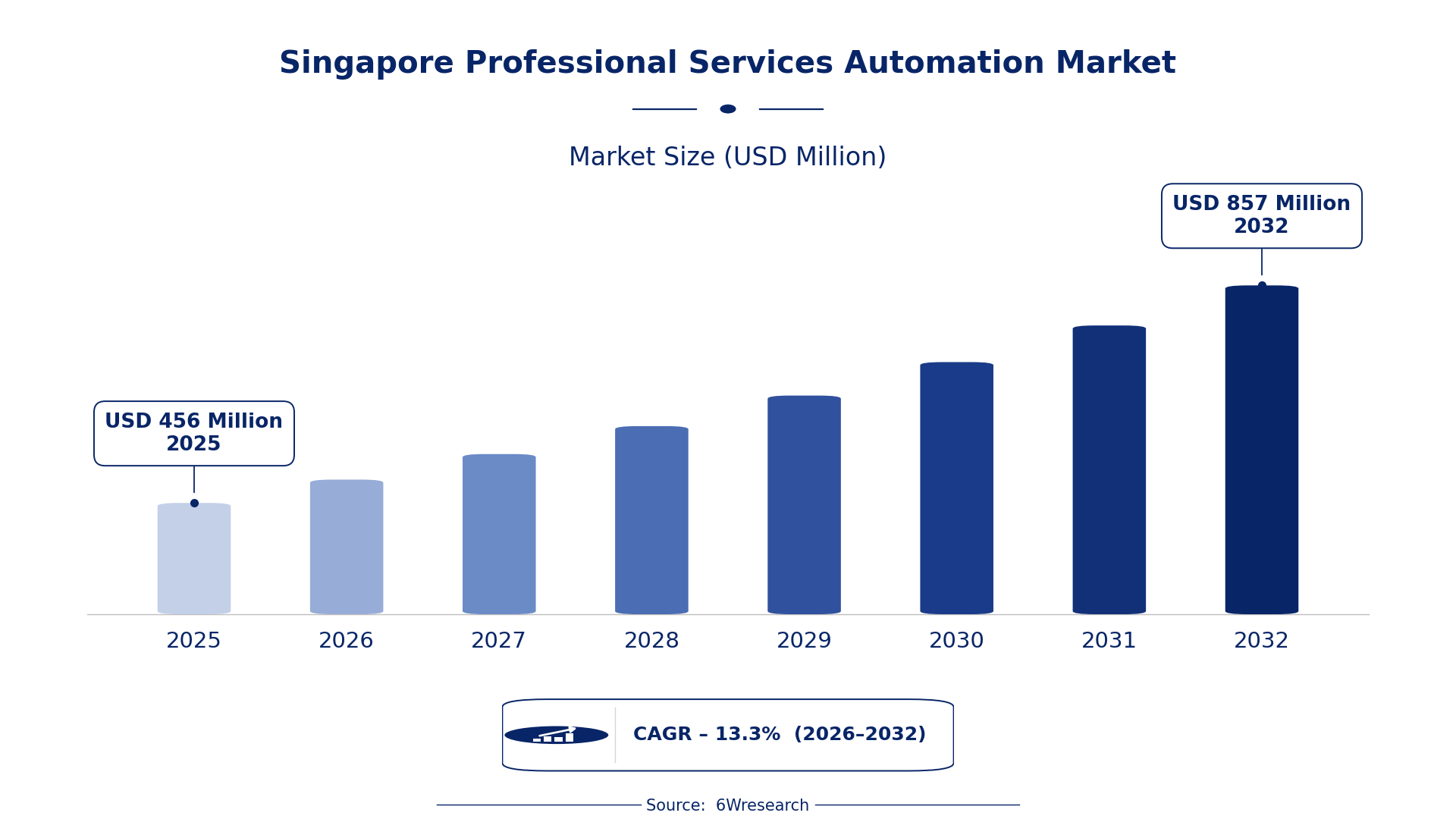
The Singapore Professional Services Automation Market was estimated at USD 456 Million in 2025 and is projected to reach USD 857 Million by 2032, growing at a CAGR of 13.3% from 2026 to 2032.
Singapore Professional Services Automation Market Synopsis
The demand for Professional Services Automation (PSA) tools in Singapore has surged, driven by service-based businesses seeking efficiency and enhanced project management capabilities. Companies recognize that effective resource allocation and real-time project tracking are critical for maintaining a competitive edge.
As the market matures, organizations are increasingly turning to integrated PSA solutions that not only streamline operations but also improve client satisfaction. The ongoing digital transformation across various sectors is further propelling the adoption of these automation tools, making them indispensable for modern business operations.
Singapore Professional Services Automation Market Year-wise Growth Rate and Key Drivers
This graph illustrates the annual growth rates of the Singapore Professional Services Automation Market from 2021 to 2032, highlighting a steady upward trajectory and projected expansion over the forecast period.
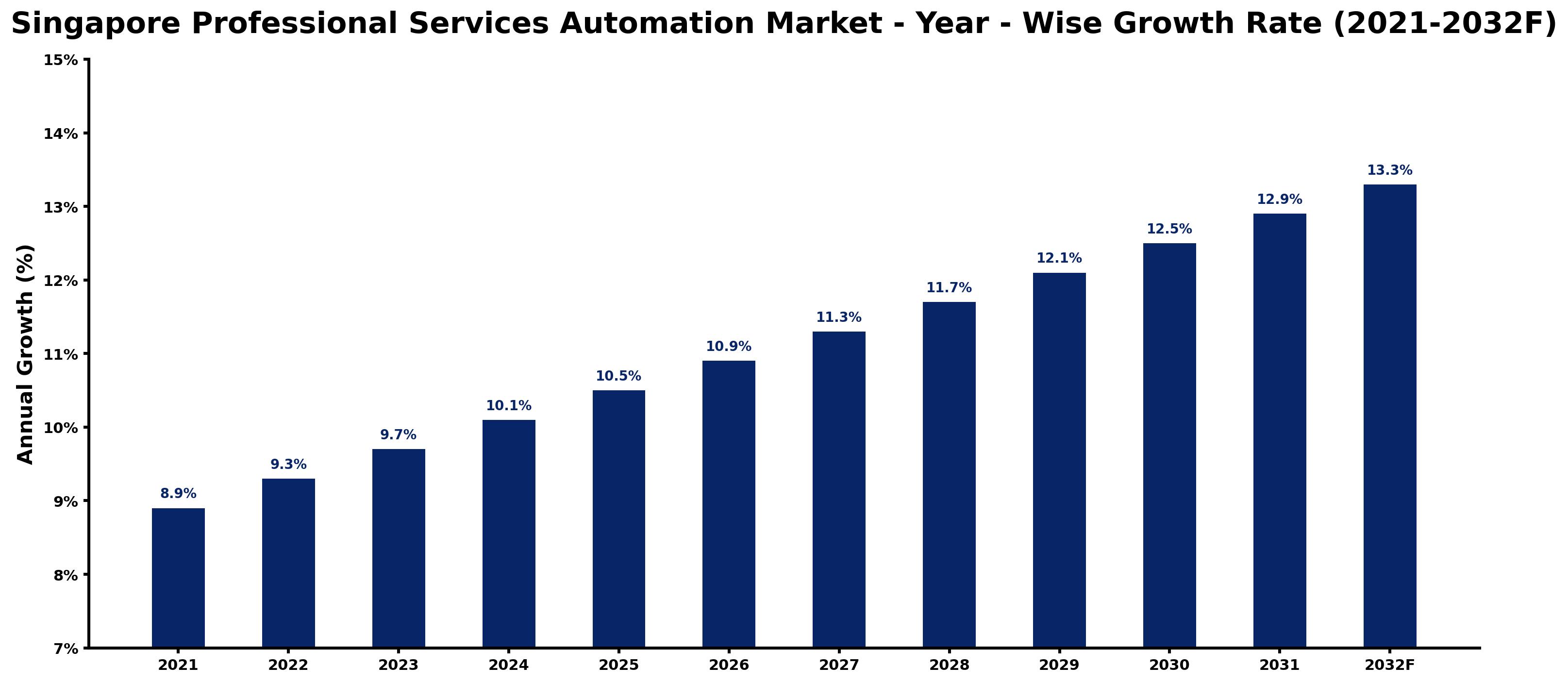
The table below presents the year‑wise growth rates along with the key drivers influencing the market
| Year | Growth Rate | Major Drivers |
| 2021 | 8.9% | Government's Smart Nation initiative fostering digital transformation. |
| 2022 | 9.3% | Surge in compliance requirements boosting automation investments. |
| 2023 | 9.7% | Growing emphasis on cybersecurity enhancing professional service efficiency. |
| 2024 | 10.1% | Investment in digital infrastructure by local enterprises. |
| 2025 | 10.5% | Rising labor costs prompting automation in professional services. |
| 2026 | 10.9% | Increase in startups leveraging automated solutions for efficiency. |
| 2027 | 11.3% | Strong demand for data analytics in consulting services. |
| 2028 | 11.7% | Elevated focus on sustainability driving automation innovations. |
| 2029 | 12.1% | Local tax incentives for businesses adopting automation technologies. |
| 2030 | 12.5% | Government policies supporting digital skills training for professionals. |
| 2031 | 12.9% | Booming gig economy necessitating automation for flexibility. |
| 2032 | 13.3% | Strategic partnerships between tech firms and professional service providers. |
Note: Market size estimations and growth projections presented in this report are based on 6Wresearch's proprietary forecasting methodology, utilizing the latest available industry data, government publications, and primary research inputs.
Singapore Professional Services Automation Market Key Takeaways
Below are some of the specific key takeaways from the market, including:
- The market is set to expand significantly, reflecting a growing need for optimized project delivery and resource management.
- Integration of advanced technologies such as AI and machine learning is increasingly influencing PSA solution development.
- Service-based industries are prioritizing automation to enhance productivity and reduce operational costs.
- Real-time visibility into project performance is becoming a standard requirement among organizations.
- The competitive nature of the market necessitates continuous innovation in PSA tools and services.
Evaluation of Restraints in Singapore Professional Services Automation Market
Despite its growth trajectory, the Singapore Professional Services Automation market faces notable challenges. Organizations often struggle with balancing resource allocation against project timelines while meeting client expectations. Additionally, ensuring data security and confidentiality remains a pressing concern. These factors complicate the optimization of project management processes, making it essential for firms to adopt solutions that address these limitations effectively.
Singapore Professional Services Automation Market Trends
A notable trend shaping the Singapore PSA market is the increasing integration of cloud-based solutions. This shift allows companies to enhance collaboration and improve accessibility for remote teams. on top of that, there's a growing emphasis on data analytics within PSA tools, enabling organizations to leverage insights for better decision-making.
Additionally, the demand for mobile-friendly PSA applications is on the rise, reflecting the need for flexibility and on-the-go management capabilities. As businesses adapt to hybrid work environments, these tools are becoming critical for sustaining operational efficiency.
Singapore Professional Services Automation Market Opportunities
Opportunities abound for investment and growth in the Singapore PSA market, particularly in sectors like IT services and consulting. The increasing adoption of automation tools among small to medium-sized enterprises (SMEs) presents a significant market segment ready for exploration. on top of that, the potential for integrating emerging technologies, such as blockchain for secure transactions, opens new avenues for innovation.
Government Initiatives in the Singapore Professional Services Automation Market
The Singapore government actively fosters an environment conducive to the growth of the Professional Services Automation market. Public policy initiatives aim to enhance digital infrastructure and support innovation across service-based sectors. This proactive stance is crucial for maintaining Singapore's competitive edge in the global market.
- A national digital infrastructure upgrade programme launched in 2023 aims to enhance connectivity and support the integration of advanced technologies in businesses.
- Currently ongoing is a public-private partnership focusing on workforce training for digital skills, ensuring that professionals are equipped to utilize PSA tools effectively.
- A regulatory framework introduced in 2025 will mandate transparency in billing processes, enhancing trust between service providers and clients.
- Planned for 2026 is a government initiative to incentivize SMEs to adopt PSA solutions through grants and subsidies.
Future Insights of the Singapore Professional Services Automation Market
Looking ahead to 2026-2032, the Singapore Professional Services Automation market is set to evolve in response to changing business needs and technological advancements. As organizations prioritize efficiency and customer satisfaction, the demand for sophisticated PSA solutions will continue to rise. The integration of artificial intelligence and automation will redefine project management, driving further growth in this sector.
Singapore Professional Services Automation Market Latest Developments
Recent industry activity in the Singapore Professional Services Automation market reflects a trend toward innovation and strategic partnerships. Companies are investing in enhancing their PSA offerings to meet the growing demands of service-based businesses.
- A leading technology vendor launched an upgraded PSA platform in early 2025, focusing on enhanced user experience and integration capabilities.
- An initiative that began in late 2024 aims to develop industry-specific PSA solutions, currently underway and expected to complete by mid-2025.
- A collaborative project between local universities and PSA software developers is currently in the research phase, set to explore new functionalities for automation tools.
- A major upgrade of existing PSA solutions is anticipated in Q4 2025, which will introduce advanced analytics features for better project insights.
Singapore Professional Services Automation Market - Key Attractiveness of the Report
- 10 Years of Market Numbers
- Historical Data Starting from 2022 to 2025
- Base Year: 2025
- Forecast Data until 2032
- Key Performance Indicators Impacting the Market
- Major Upcoming Developments and Projects
Key Highlights of the Report:
- Singapore Professional Services Automation Market Outlook
- Market Size of Singapore Professional Services Automation Market, 2025
- Forecast of Singapore Professional Services Automation Market, 2032
- Historical Data and Forecast of Singapore Professional Services Automation Revenues & Volume for the Period 2022-2032F
- Singapore Professional Services Automation Market Trend Evolution
- Singapore Professional Services Automation Market Drivers and Challenges
- Singapore Professional Services Automation Price Trends
- Singapore Professional Services Automation Porter's Five Forces
- Singapore Professional Services Automation Industry Life Cycle
- Historical Data and Forecast of Singapore Professional Services Automation Market Revenues & Volume By Component for the Period 2022-2032F
- Historical Data and Forecast of Singapore Professional Services Automation Market Revenues & Volume By Solutions for the Period 2022-2032F
- Historical Data and Forecast of Singapore Professional Services Automation Market Revenues & Volume By Services for the Period 2022-2032F
- Historical Data and Forecast of Singapore Professional Services Automation Market Revenues & Volume By Deployment Type for the Period 2022-2032F
- Historical Data and Forecast of Singapore Professional Services Automation Market Revenues & Volume By On-Premises for the Period 2022-2032F
- Historical Data and Forecast of Singapore Professional Services Automation Market Revenues & Volume By Cloud for the Period 2022-2032F
- Historical Data and Forecast of Singapore Professional Services Automation Market Revenues & Volume By Organization Size for the Period 2022-2032F
- Historical Data and Forecast of Singapore Professional Services Automation Market Revenues & Volume By Small and Medium-sized Enterprises (SMEs) for the Period 2022-2032F
- Historical Data and Forecast of Singapore Professional Services Automation Market Revenues & Volume By Large enterprises for the Period 2022-2032F
- Historical Data and Forecast of Singapore Professional Services Automation Market Revenues & Volume By Vertical for the Period 2022-2032F
- Historical Data and Forecast of Singapore Professional Services Automation Market Revenues & Volume By Information Technology (IT) for the Period 2022-2032F
- Historical Data and Forecast of Singapore Professional Services Automation Market Revenues & Volume By Telecom for the Period 2022-2032F
- Historical Data and Forecast of Singapore Professional Services Automation Market Revenues & Volume By Architecture, Engineering and Construction for the Period 2022-2032F
- Historical Data and Forecast of Singapore Professional Services Automation Market Revenues & Volume By BSFI for the Period 2022-2032F
- Historical Data and Forecast of Singapore Professional Services Automation Market Revenues & Volume By Legal Services for the Period 2022-2032F
- Historical Data and Forecast of Singapore Professional Services Automation Market Revenues & Volume By Media and Entertainment for the Period 2022-2032F
- Historical Data and Forecast of Singapore Professional Services Automation Market Revenues & Volume By Healthcare and Life sciences for the Period 2022-2032F
- Historical Data and Forecast of Singapore Professional Services Automation Market Revenues & Volume By Government for the Period 2022-2032F
- Singapore Professional Services Automation Import Export Trade Statistics
- Market Opportunity Assessment By Component
- Market Opportunity Assessment By Deployment Type
- Market Opportunity Assessment By Organization Size
- Market Opportunity Assessment By Vertical
- Singapore Professional Services Automation Top Companies Market Share
- Singapore Professional Services Automation Competitive Benchmarking By Technical and Operational Parameters
- Singapore Professional Services Automation Company Profiles
- Singapore Professional Services Automation Key Strategic Recommendations






































