Singapore Public Cloud Market Size & Growth Rate (2026-2032)
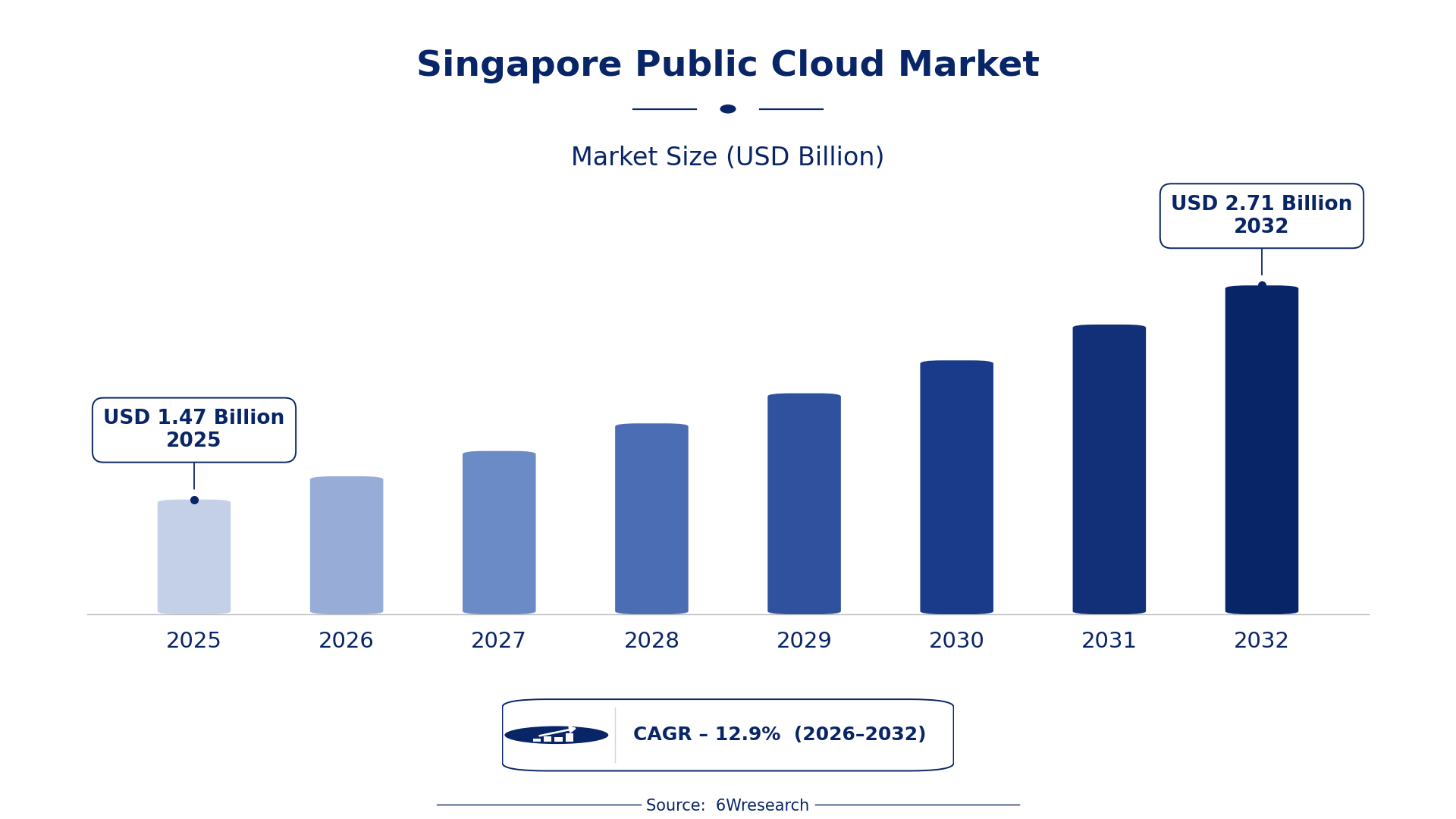
The Singapore Public Cloud Market was estimated at USD 1473 Million in 2025 and is projected to reach USD 2710 Million by 2032, growing at a CAGR of 12.9% from 2026 to 2032.
Singapore Public Cloud Market Synopsis
A notable shift towards cloud-native solutions has catalyzed the Singapore Public Cloud Market. Enterprises across finance, healthcare, and e-commerce are increasingly relying on public cloud services for enhanced agility and operational efficiency, driving demand for scalable computing resources.
As organizations embrace digital transformation, the public cloud landscape in Singapore has become increasingly competitive. This trend is supported by the country's strategic investments in digital infrastructure, which bolster the capabilities and offerings of cloud service providers operating within its borders.
Singapore Public Cloud Market Year-wise Growth Rate and Key Drivers
This graph illustrates the annual growth rates of the Singapore Public Cloud Market from 2021 to 2032, highlighting a steady upward trajectory and projected expansion over the forecast period.
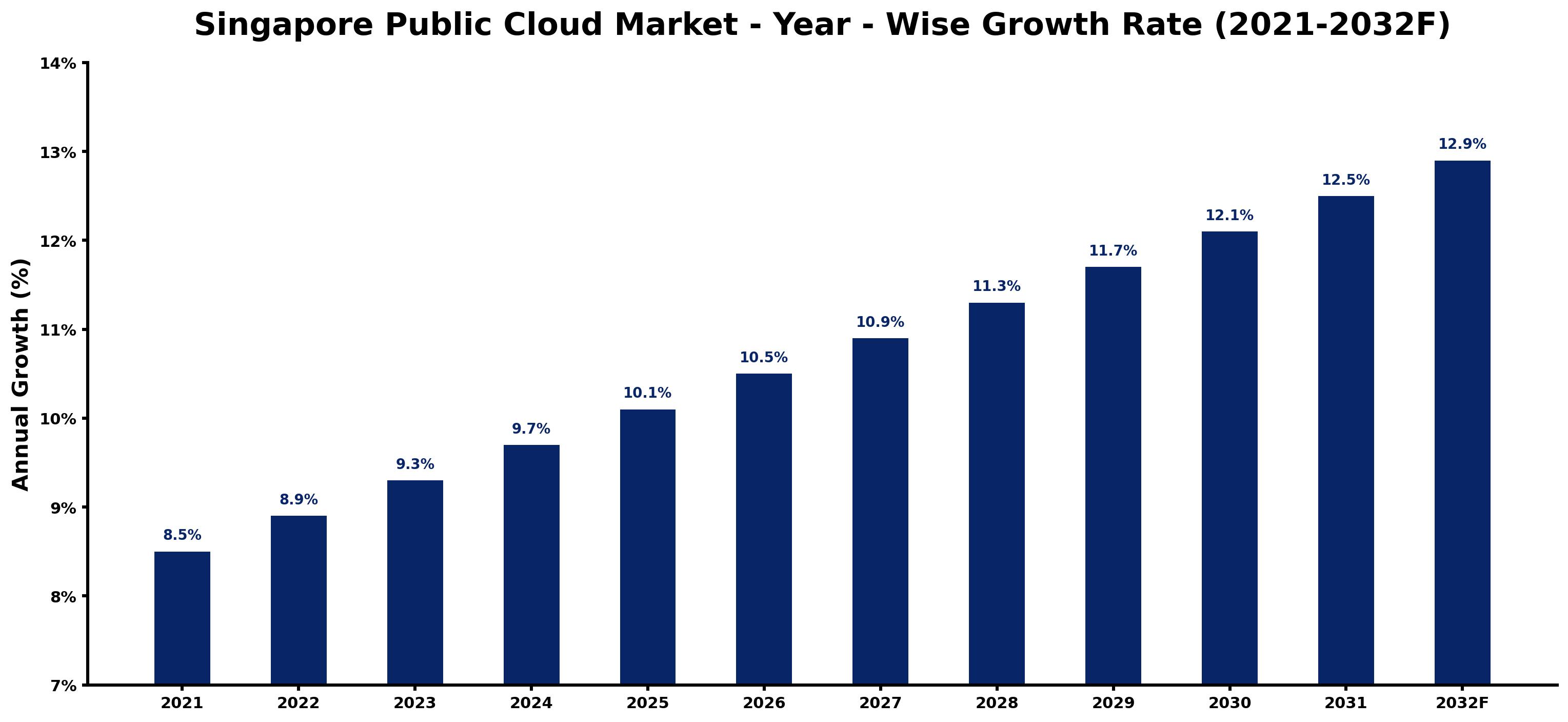
The table below presents the year‑wise growth rates along with the key drivers influencing the market
| Year | Growth Rate | Major Drivers |
| 2021 | 8.5% | Government's Smart Nation initiative promoting digital transformation. |
| 2022 | 8.9% | Increased adoption of e-commerce driving cloud services. |
| 2023 | 9.3% | Growing cybersecurity regulations enhancing cloud infrastructure demand. |
| 2024 | 9.7% | Surge in fintech startups requiring scalable cloud solutions. |
| 2025 | 10.1% | Telecommunications advancements improving cloud connectivity options. |
| 2026 | 10.5% | Local education sector investing heavily in online platforms. |
| 2027 | 10.9% | Healthcare digitalization efforts boosting cloud service utilization. |
| 2028 | 11.3% | Rise in remote work increasing cloud application adoption. |
| 2029 | 11.7% | Digital payment trends necessitating enhanced cloud security measures. |
| 2030 | 12.1% | Government policies supporting green technology in cloud services. |
| 2031 | 12.5% | Urbanization driving demand for smart city cloud applications. |
| 2032 | 12.9% | Increased regulatory compliance requirements for cloud data storage. |
Note: Market size estimations and growth projections presented in this report are based on 6Wresearch's proprietary forecasting methodology, utilizing the latest available industry data, government publications, and primary research inputs.
Singapore Public Cloud Market Key Takeaways
Below are some of the specific key takeaways from the market, including:
- The market is experiencing rapid growth driven by the need for scalable and cost-effective cloud solutions.
- Data sovereignty and regulatory compliance pose challenges for organizations utilizing public cloud services.
- The COVID-19 pandemic accelerated cloud adoption, solidifying its role in business continuity plans.
- Investment in cloud-native technologies is expected to shape future demand and service offerings.
- Government policies are actively supporting digital infrastructure development and cloud service accessibility.
Evaluation of Restraints in Singapore Public Cloud Market
The Singapore Public Cloud Market faces certain restraints, primarily centered around regulatory compliance and data sovereignty. Organizations must navigate local laws regarding data residency, which can limit their choice of cloud providers and complicate cross-border data flows. on top of that, concerns over data security remain paramount, as businesses increasingly scrutinize potential vulnerabilities associated with cloud storage. The complexities of managing cloud costs also persist, requiring continuous oversight to avoid unexpected expenses. Lastly, vendor lock-in presents a significant barrier, as transitioning data and applications between cloud services can be fraught with challenges and costs.
Singapore Public Cloud Market Trends
The public cloud market is witnessing several key trends. Cloud-native development methodologies are gaining traction as organizations prioritize agility and speed in application deployment. There is also a growing focus on hybrid cloud environments, allowing businesses to balance on-premises infrastructure with public cloud services for enhanced flexibility. on top of that, advancements in AI and machine learning are being integrated into cloud offerings, enabling companies to harness data insights more effectively. Lastly, sustainability initiatives are shaping cloud strategies, as companies increasingly seek eco-friendly solutions and energy-efficient data centers.
Singapore Public Cloud Market Opportunities
Opportunities abound in the Singapore Public Cloud Market, particularly in sectors experiencing rapid digital transformation. The finance and healthcare industries stand out, as they increasingly adopt cloud solutions to streamline operations and enhance service delivery. Startups and small to medium-sized enterprises (SMEs) also represent a burgeoning market segment, eager to leverage public cloud capabilities without the overhead of traditional IT infrastructure. Additionally, the rise of remote work has opened avenues for cloud service providers to offer tailored solutions that address the unique needs of a distributed workforce.
Government Initiatives in the Singapore Public Cloud Market
Government initiatives are actively shaping the Singapore Public Cloud Market, reflecting a commitment to enhancing digital infrastructure and fostering innovation. The regulatory environment emphasizes data protection and compliance, influencing how organizations approach cloud adoption. This proactive stance is critical for building trust and ensuring that businesses can confidently migrate their operations to the cloud.
- A national digital infrastructure upgrade programme aimed at enhancing broadband connectivity was recently completed, facilitating better access to cloud services.
- Currently ongoing is a government initiative that promotes the adoption of cloud technologies among SMEs, offering grants and resources to support their migration journeys.
- A planned public-private partnership initiative is set to be launched by 2028, focusing on expanding the accessibility of cloud services across underserved regions.
- The introduction of a regulatory framework mandating transparency in cloud service billing is expected to be implemented by mid-2026.
- A digital skills development programme is underway to equip the workforce with the necessary skills for cloud technology implementation, enhancing overall market readiness.
Future Insights of the Singapore Public Cloud Market
Looking ahead to 2026-2032, the Singapore Public Cloud Market is set to continue its upward trajectory, fueled by ongoing digital transformation initiatives across industries. Increased investment in AI and machine learning will drive innovation in cloud services, while the demand for flexible cloud solutions will encourage further adoption of hybrid models. As organizations navigate an evolving regulatory landscape, cloud service providers will need to prioritize compliance and security to maintain market trust. The convergence of these factors positions Singapore as a leading hub for cloud technology in the Asia-Pacific region.
Singapore Public Cloud Market Latest Developments
Recent developments in the Singapore Public Cloud Market indicate a dynamic environment, marked by innovation and strategic partnerships. Cloud service providers are actively enhancing their offerings to meet the diverse needs of businesses across various sectors. As demand for cloud solutions continues to rise, these developments signal a commitment to improving service delivery and expanding capabilities.
- A major technology vendor launched a new suite of AI-driven cloud services in Q1 2025, aimed at helping businesses harness data analytics more effectively.
- An initiative that began in early 2025 focuses on improving security protocols for public cloud services, with several updates already implemented.
- A strategic partnership between two cloud providers was announced in mid-2025, aimed at enhancing data integration services for clients in the finance sector.
- A rollout expected to begin in late 2025 will introduce new cloud solutions tailored for healthcare providers, addressing compliance and data management needs.
- Ongoing upgrades to existing cloud infrastructures are set to enhance performance and reliability, with completion anticipated by late 2026.
Singapore Public Cloud Market - Key Attractiveness of the Report
- 10 Years of Market Numbers
- Historical Data Starting from 2022 to 2025
- Base Year: 2025
- Forecast Data until 2032
- Key Performance Indicators Impacting the Market
- Major Upcoming Developments and Projects
Key Highlights of the Report:
- Singapore Public Cloud Market Outlook
- Market Size of Singapore Public Cloud Market, 2025
- Forecast of Singapore Public Cloud Market, 2032
- Historical Data and Forecast of Singapore Public Cloud Revenues & Volume for the Period 2022-2032F
- Singapore Public Cloud Market Trend Evolution
- Singapore Public Cloud Market Drivers and Challenges
- Singapore Public Cloud Price Trends
- Singapore Public Cloud Porter's Five Forces
- Singapore Public Cloud Industry Life Cycle
- Historical Data and Forecast of Singapore Public Cloud Market Revenues & Volume By Service Model for the Period 2022-2032F
- Historical Data and Forecast of Singapore Public Cloud Market Revenues & Volume By Infrastructure as a Service for the Period 2022-2032F
- Historical Data and Forecast of Singapore Public Cloud Market Revenues & Volume By Platform as a Service for the Period 2022-2032F
- Historical Data and Forecast of Singapore Public Cloud Market Revenues & Volume By Software as a Service for the Period 2022-2032F
- Historical Data and Forecast of Singapore Public Cloud Market Revenues & Volume By Organization Size Large enterprises for the Period 2022-2032F
- Historical Data and Forecast of Singapore Public Cloud Market Revenues & Volume By Small for the Period 2022-2032F
- Historical Data and Forecast of Singapore Public Cloud Market Revenues & Volume By Medium Enterprises SMEs for the Period 2022-2032F
- Historical Data and Forecast of Singapore Public Cloud Market Revenues & Volume By Verticals for the Period 2022-2032F
- Historical Data and Forecast of Singapore Public Cloud Market Revenues & Volume By BFSI for the Period 2022-2032F
- Historical Data and Forecast of Singapore Public Cloud Market Revenues & Volume By Telecommunication for the Period 2022-2032F
- Historical Data and Forecast of Singapore Public Cloud Market Revenues & Volume By IT & ITeS for the Period 2022-2032F
- Historical Data and Forecast of Singapore Public Cloud Market Revenues & Volume By Government & Public Sector for the Period 2022-2032F
- Historical Data and Forecast of Singapore Public Cloud Market Revenues & Volume By Retail & Consumer Goods for the Period 2022-2032F
- Historical Data and Forecast of Singapore Public Cloud Market Revenues & Volume By Manufacturing for the Period 2022-2032F
- Historical Data and Forecast of Singapore Public Cloud Market Revenues & Volume By Energy & Utility for the Period 2022-2032F
- Historical Data and Forecast of Singapore Public Cloud Market Revenues & Volume By Media & Entertainment for the Period 2022-2032F
- Singapore Public Cloud Import Export Trade Statistics
- Market Opportunity Assessment By Service Model
- Market Opportunity Assessment By Organization Size Large enterprises
- Market Opportunity Assessment By Verticals
- Singapore Public Cloud Top Companies Market Share
- Singapore Public Cloud Competitive Benchmarking By Technical and Operational Parameters
- Singapore Public Cloud Company Profiles
- Singapore Public Cloud Key Strategic Recommendations






































