Singapore Pyrotechnics Market Size, Share & Growth Rate
The Singapore Pyrotechnics Market was estimated at USD 287 Million in 2025 and is projected to reach USD 397 Million by 2032, growing at a CAGR of 4.7% from 2026 to 2032. This growth trajectory is being propelled by a vibrant culture of festivals and national celebrations, where pyrotechnics play a pivotal role in enhancing the overall festive experience. Additionally, Singapore's increasing tourism and entertainment sectors are driving the demand for innovative and memorable pyrotechnic displays that appeal to both local residents and visitors alike.
Singapore Pyrotechnics Market Year-wise Growth Rate and Key Drivers
This graph highlights how the Singapore Pyrotechnics Market has steadily grown over the years, supported by major growth factors.
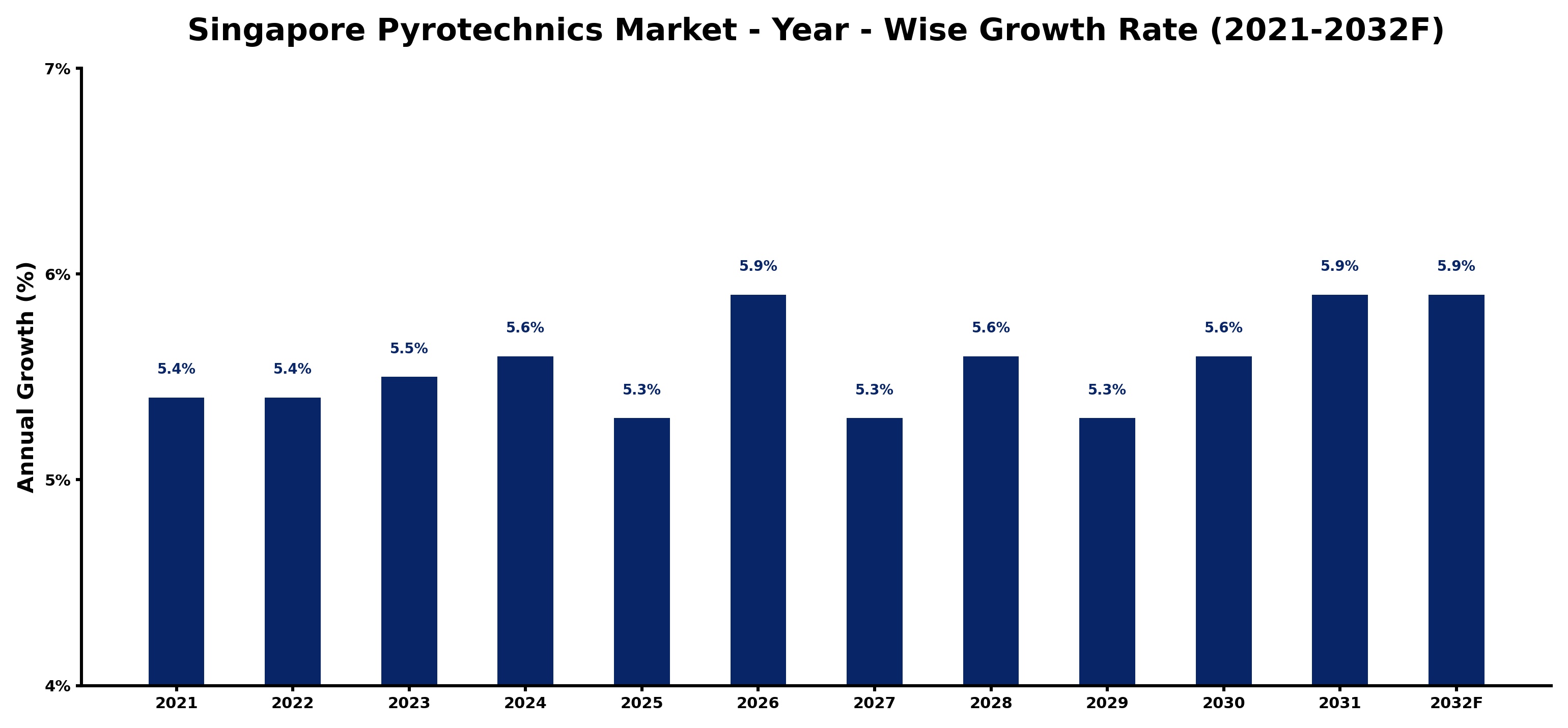
The table below presents the year‑wise growth rates along with the key drivers influencing the market
| Year | Growth Rate | Major Drivers |
| 2021 | 5.4% | Expansion of manufacturing activities |
| 2022 | 5.4% | Increasing smart city development projects |
| 2023 | 5.5% | Growing renewable energy integration projects |
| 2024 | 5.6% | Expansion of commercial construction activities |
| 2025 | 5.3% | Expansion of commercial construction activities |
| 2026 | 5.9% | Growing renewable energy integration projects |
| 2027 | 5.3% | Increasing industrial infrastructure investments |
| 2028 | 5.6% | Increasing industrial infrastructure investments |
| 2029 | 5.3% | Expansion of commercial construction activities |
| 2030 | 5.6% | Increasing adoption of advanced technologies |
| 2031 | 5.9% | Government infrastructure modernization initiatives |
| 2032 | 5.9% | Expansion of transportation and logistics networks |
Note - Market size estimations and growth projections presented in this report are based on 6Wresearch’s advanced forecasting approach, validated with industry datasets as of June 2026.
Singapore Pyrotechnics Market Synopsis
In Singapore, pyrotechnics have transcended their traditional role, becoming a fundamental part of the nation's celebrations and events. Whether it's the explosive fireworks on National Day or the colorful displays for Chinese New Year, these visual spectacles are deeply ingrained in Singaporean culture.
The market remains buoyant, despite challenges such as stringent safety regulations and environmental concerns. Major events and festivities throughout the year continuously showcase the growing demand for high-quality pyrotechnic experiences, which in turn fuels market expansion.
Singapore Pyrotechnics Market Key Takeaways
- The market benefits from a rich tapestry of cultural and national celebrations that integrate pyrotechnics as a central feature.
- Growth is expected to align closely with Singapore's booming tourism industry, enhancing visitor experiences through stunning pyrotechnic displays.
- Safety and regulatory compliance remain paramount, influencing market dynamics and operational practices.
- Environmental considerations are reshaping how pyrotechnics are produced and displayed, leading to innovations in eco-friendly alternatives.
- Ongoing investment in event infrastructure suggests a positive long-term outlook for the pyrotechnics market in Singapore.
Evaluation of Restraints in Singapore Pyrotechnics Market
The Singapore pyrotechnics market faces several constraints that could limit its potential growth. Chief among these is the necessity for strict safety compliance, as any incidents could lead to public reluctance regarding pyrotechnic displays. Regulatory frameworks governing the use of pyrotechnics are becoming increasingly stringent, which, while ensuring safety, can also result in operational challenges for companies. Additionally, rising environmental concerns about noise and air pollution have prompted a push towards more sustainable pyrotechnic solutions, which may require significant investment and innovation from market players.
Singapore Pyrotechnics Market Trends
Emerging trends within the Singapore pyrotechnics market are increasingly leaning towards eco-conscious solutions. Innovations in biodegradable materials and environmentally friendly pyrotechnics are gaining traction as public awareness about sustainability rises. Moreover, technology integration, such as digital displays and synchronized music, is enhancing the spectacle of pyrotechnic shows, providing audiences with a multi-sensory experience. This convergence of technology and creativity is likely to redefine the traditional pyrotechnics landscape in Singapore.
Singapore Pyrotechnics Market Opportunities
With the revival of large-scale events post-pandemic, opportunities for growth in the Singapore pyrotechnics market are abundant. The increasing frequency of cultural festivals and international events provides fertile ground for pyrotechnic companies to innovate and expand their offerings. Moreover, collaborations with event organizers to create bespoke pyrotechnic displays can enhance brand visibility and attract new clientele. Additionally, the potential for exploring virtual and augmented reality experiences in conjunction with pyrotechnic shows can unlock new avenues for audience engagement and revenue generation.
Government Initiatives in the Singapore Pyrotechnics Market
The Singapore government actively promotes cultural celebrations and events, which inherently supports the pyrotechnics market. Public spending on infrastructure for large-scale events, alongside initiatives aimed at fostering tourism, plays a significant role in the market's sustainability. Furthermore, safety regulations set by governmental bodies ensure that all pyrotechnic displays adhere to national safety standards, thereby protecting the public and contributing to the industry's credibility.
Future Insights of the Singapore Pyrotechnics Market
Looking ahead to 2026-2032, the Singapore pyrotechnics market is poised for steady growth. As public interest in spectacular visual entertainment continues to rise, the demand for innovative pyrotechnic solutions is expected to surge. Companies that prioritize safety, sustainability, and technology integration will likely capture a larger market share. Furthermore, the continual evolution of cultural and national events will ensure that pyrotechnics remain a crucial element of Singapore's vibrant celebration landscape.
Singapore Pyrotechnics Market Latest Developments (May 2025 - June 2026)
Recent trends indicate a growing emphasis on the integration of technology within pyrotechnic displays in Singapore. Event organizers are increasingly collaborating with pyrotechnic experts to create synchronized shows that blend fireworks with audio-visual elements, enhancing the overall audience experience. Moreover, initiatives are emerging that focus on developing more environmentally friendly pyrotechnic materials, responding to growing public demand for sustainability in entertainment.
Singapore Pyrotechnics Market - Key Attractiveness of the Report
- 10 Years of Market Numbers
- Historical Data Starting from 2022 to 2025
- Base Year: 2025
- Forecast Data until 2032
- Key Performance Indicators Impacting the Market
- Major Upcoming Developments and Projects
Key Highlights of the Report:
- Singapore Pyrotechnics Market Outlook
- Market Size of Singapore Pyrotechnics Market, 2025
- Forecast of Singapore Pyrotechnics Market, 2032F
- Historical Data and Forecast of Singapore Pyrotechnics Revenues & Volume for the Period 2022-2032F
- Singapore Pyrotechnics Market Trend Evolution
- Singapore Pyrotechnics Market Drivers and Challenges
- Singapore Pyrotechnics Price Trends
- Singapore Pyrotechnics Porter's Five Forces
- Singapore Pyrotechnics Industry Life Cycle
- Historical Data and Forecast of Singapore Pyrotechnics Market Revenues & Volume By Product for the Period 2022-2032F
- Historical Data and Forecast of Singapore Pyrotechnics Market Revenues & Volume By Signaling for the Period 2022-2032F
- Historical Data and Forecast of Singapore Pyrotechnics Market Revenues & Volume By Screening and Illumination for the Period 2022-2032F
- Historical Data and Forecast of Singapore Pyrotechnics Market Revenues & Volume By Law Enforcement & Crowd Control for the Period 2022-2032F
- Historical Data and Forecast of Singapore Pyrotechnics Market Revenues & Volume By Type for the Period 2022-2032F
- Historical Data and Forecast of Singapore Pyrotechnics Market Revenues & Volume By Proximate Pyrotechnics for the Period 2022-2032F
- Historical Data and Forecast of Singapore Pyrotechnics Market Revenues & Volume By Consumer Pyrotechnics for the Period 2022-2032F
- Historical Data and Forecast of Singapore Pyrotechnics Market Revenues & Volume By Display Pyrotechnics for the Period 2022-2032F
- Historical Data and Forecast of Singapore Pyrotechnics Market Revenues & Volume By Others for the Period 2022-2032F
- Historical Data and Forecast of Singapore Pyrotechnics Market Revenues & Volume By Applications for the Period 2022-2032F
- Historical Data and Forecast of Singapore Pyrotechnics Market Revenues & Volume By Signal Cartridges for the Period 2022-2032F
- Historical Data and Forecast of Singapore Pyrotechnics Market Revenues & Volume By Hand-Fired Rocket for the Period 2022-2032F
- Historical Data and Forecast of Singapore Pyrotechnics Market Revenues & Volume By Grenades for the Period 2022-2032F
- Historical Data and Forecast of Singapore Pyrotechnics Market Revenues & Volume By Trip-Flare for the Period 2022-2032F
- Historical Data and Forecast of Singapore Pyrotechnics Market Revenues & Volume By Solar Flare for the Period 2022-2032F
- Historical Data and Forecast of Singapore Pyrotechnics Market Revenues & Volume By CS Smoke Pellets for the Period 2022-2032F
- Historical Data and Forecast of Singapore Pyrotechnics Market Revenues & Volume By Others for the Period 2022-2032F
- Singapore Pyrotechnics Import Export Trade Statistics
- Market Opportunity Assessment By Product
- Market Opportunity Assessment By Type
- Market Opportunity Assessment By Applications
- Singapore Pyrotechnics Top Companies Market Share
- Singapore Pyrotechnics Competitive Benchmarking By Technical and Operational Parameters
- Singapore Pyrotechnics Company Profiles
- Singapore Pyrotechnics Key Strategic Recommendations






































