Singapore Radio Broadcast Receivers Market Size, Share & Growth Rate
The Singapore Radio Broadcast Receivers Market was estimated at USD 992 Million in 2025 and is projected to reach USD 1417 Million by 2032, growing at a CAGR of 5.2% from 2026 to 2032. This growth trajectory is primarily attributed to the persistent demand for radio as a trusted source of entertainment and information, especially in urban settings. Additionally, the integration of advanced digital features and connectivity options in radio receivers is capturing the interest of tech-savvy consumers, thereby enhancing market dynamics.
Singapore Radio Broadcast Receivers Market Year-wise Growth Rate and Key Drivers
This graph highlights how the Singapore Radio Broadcast Receivers Market has steadily grown over the years, supported by major growth factors.
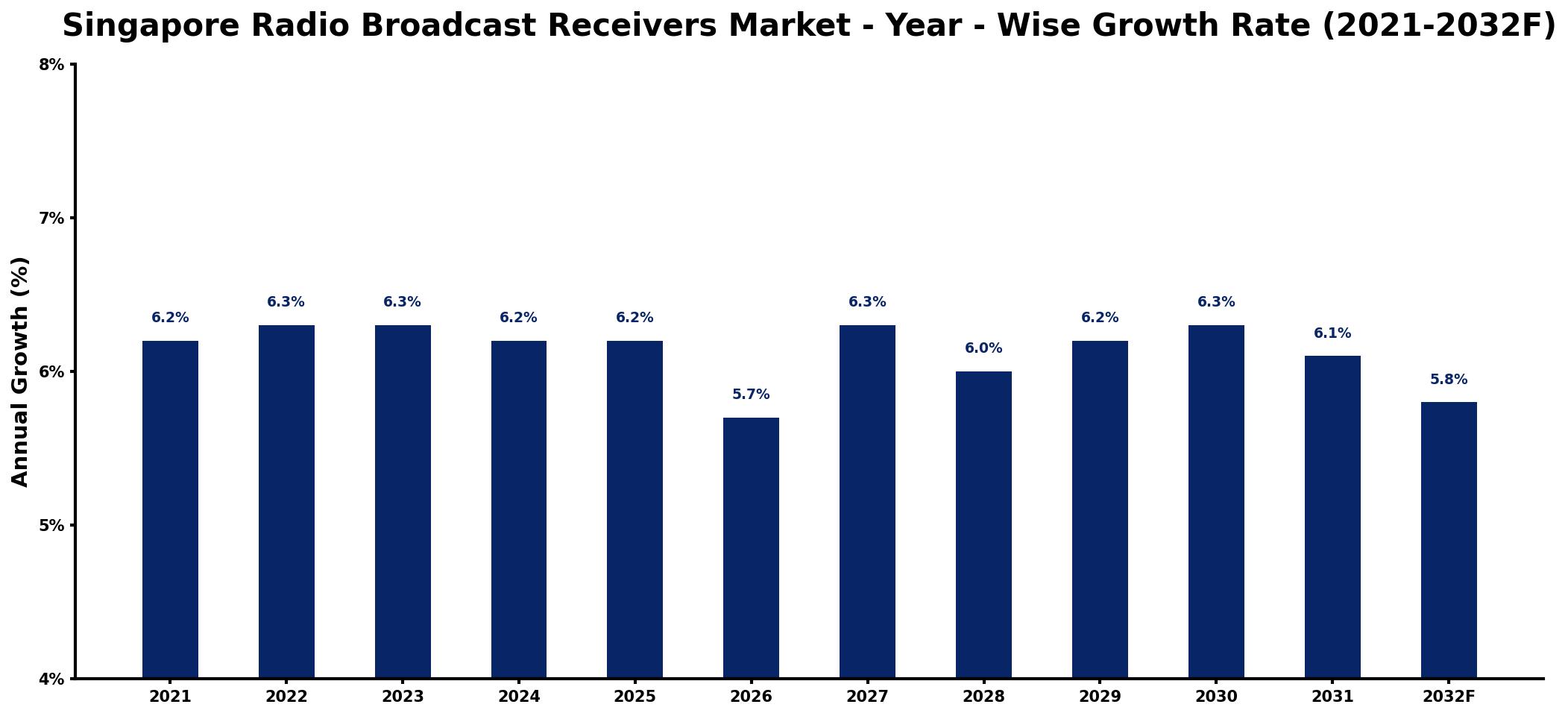
The table below presents the year‑wise growth rates along with the key drivers influencing the market
| Year | Growth Rate | Major Drivers |
| 2021 | 6.2% | Increased digital audio consumption |
| 2022 | 6.3% | Growing demand for portable devices |
| 2023 | 6.3% | Rise in smart home integration |
| 2024 | 6.2% | Expansion of streaming services |
| 2025 | 6.2% | Higher consumer disposable income |
| 2026 | 5.7% | Shift towards premium audio experiences |
| 2027 | 6.3% | Surge in automotive audio systems |
| 2028 | 6.0% | Growth in outdoor entertainment trends |
| 2029 | 6.2% | Increase in youth media consumption |
| 2030 | 6.3% | Enhanced connectivity technologies adoption |
| 2031 | 6.1% | Rising interest in nostalgic formats |
| 2032 | 5.8% | Development of innovative sound solutions |
Note: Market size estimations and growth projections presented in this report are based on 6Wresearch's proprietary forecasting methodology, utilizing the latest available industry data, government publications, and primary research inputs.
Singapore Radio Broadcast Receivers Market Synopsis
In Singapore, radio remains a vital source of communication, providing updates and emergency alerts, particularly in times of crisis. The availability of diverse programming, encompassing FM, AM, and digital formats, caters to a broad audience, maintaining radio's relevance in a fast-evolving media landscape.
The market's resilience can also be attributed to the growing preference for hybrid listening experiences that combine traditional radio with internet streaming. This evolution supports a diverse range of consumer choices and keeps radio receivers modernized, appealing to both nostalgic users and new generations.
Singapore Radio Broadcast Receivers Market Key Takeaways
- The market demonstrates a robust growth outlook driven by the continued demand for traditional radio combined with new digital features.
- Hybrid radio receivers that incorporate streaming and digital tuning are gaining significant traction among consumers.
- Despite digital competition, radio's status as a dependable communication tool remains intact, particularly during emergencies.
- Economic fluctuations and changes in consumer behavior are influencing spending patterns in the radio broadcast receivers sector.
- Government support for digital infrastructure is vital for market evolution and technological advancements.
Evaluation of Restraints in Singapore Radio Broadcast Receivers Market
While the Singapore Radio Broadcast Receivers Market exhibits promising growth, it faces significant constraints stemming from the digitalization of media consumption. Many consumers are increasingly drawn to on-demand streaming platforms, which threatens traditional radio's advertising revenues. The shift in listener demographics, particularly among younger audiences, poses a challenge to retaining existing listener numbers. Furthermore, maintaining technological relevance necessitates consistent investments in updates and infrastructure, which can strain smaller players in the market. Finally, regulatory challenges, including content censorship, further inhibit the diversity and richness of radio programming, potentially stifling market expansion.
Singapore Radio Broadcast Receivers Market Trends
The Singapore Radio Broadcast Receivers Market is witnessing several emerging trends, including an increased focus on smart radio technologies that allow seamless integration with smartphones and smart home devices. The demand for customized listening experiences is driving manufacturers to incorporate user-friendly interfaces and advanced tuning features. Moreover, the growing interest in local content, including niche programming and podcasts, is stimulating the market, encouraging a revival of community-focused radio initiatives. As the competition intensifies, companies are emphasizing eco-friendly designs and sustainability in their product offerings to appeal to environmentally conscious consumers.
Singapore Radio Broadcast Receivers Market Opportunities
The market presents numerous growth opportunities, particularly in the realm of internet radio and streaming integrations. As consumers increasingly seek flexibility in media consumption, producers and retailers can capitalize on hybrid receiver models that incorporate both traditional broadcasting and internet-based services. Additionally, there is potential for investment in smart speaker technology, which could serve as a platform for radio broadcasting alongside other audio content. The trend toward sustainable products also offers an avenue for differentiation, as consumers are becoming more discerning about the environmental impact of their purchases. Thus, strategic partnerships with tech innovators can drive product development forward.
Government Initiatives in the Singapore Radio Broadcast Receivers Market
The Singapore government continues to champion initiatives aimed at enhancing the digital landscape, which indirectly supports the radio broadcast receivers market. Policies promoting the adoption of digital radio and funding for technological upgrades in broadcasting infrastructure are essential components of this strategy. Additionally, public broadcasting campaigns that emphasize the importance of radio in emergency communication and community engagement underscore the role of government in fostering a robust broadcasting environment. These initiatives aim to ensure that radio remains a key player in the multifaceted media ecosystem.
Future Insights of the Singapore Radio Broadcast Receivers Market
Looking ahead to the period from 2026 to 2032, the Singapore Radio Broadcast Receivers Market is positioned for transformative growth. As consumer preferences continue to evolve, there will be a palpable shift towards hybrid models that seamlessly blend traditional and digital functionalities. Technological advancements, particularly in artificial intelligence and personalized content delivery, will enhance the listener experience, ensuring that radio remains relevant. Moreover, as sustainability becomes a focal point for consumers, market players that adapt their product lines to incorporate eco-friendly technologies will likely find favor among discerning buyers. Overall, the interplay between innovation and consumer behavior will shape the future landscape of the market.
Singapore Radio Broadcast Receivers Market Latest Developments (2025 - 2026)
Recent developments within the Singapore Radio Broadcast Receivers Market indicate a growing convergence of technology and traditional broadcasting. Companies are actively exploring partnerships with tech firms to enhance receiver capabilities, particularly in integrating voice recognition and AI features. Furthermore, there has been a noticeable push toward promoting local talent and content in broadcasting, bolstered by government initiatives aimed at increasing community engagement. Market participants are focusing on consumer education regarding the benefits of digital radio, thereby fostering a more informed listening populace.
Singapore Radio Broadcast Receivers Market - Key Attractiveness of the Report
- 10 Years of Market Numbers
- Historical Data Starting from 2022 to 2025
- Base Year: 2025
- Forecast Data until 2032
- Key Performance Indicators Impacting the Market
- Major Upcoming Developments and Projects
Key Highlights of the Report:
- Singapore Radio Broadcast Receivers Market Outlook
- Market Size of Singapore Radio Broadcast Receivers Market, 2025
- Forecast of Singapore Radio Broadcast Receivers Market, 2032
- Historical Data and Forecast of Singapore Radio Broadcast Receivers Revenues & Volume for the Period 2022-2032F
- Singapore Radio Broadcast Receivers Market Trend Evolution
- Singapore Radio Broadcast Receivers Market Drivers and Challenges
- Singapore Radio Broadcast Receivers Price Trends
- Singapore Radio Broadcast Receivers Porter's Five Forces
- Singapore Radio Broadcast Receivers Industry Life Cycle
- Historical Data and Forecast of Singapore Radio Broadcast Receivers Market Revenues & Volume By Equipment for the Period 2022-2032F
- Historical Data and Forecast of Singapore Radio Broadcast Receivers Market Revenues & Volume By Modulators for the Period 2022-2032F
- Historical Data and Forecast of Singapore Radio Broadcast Receivers Market Revenues & Volume By Transmitters And Receivers for the Period 2022-2032F
- Historical Data and Forecast of Singapore Radio Broadcast Receivers Market Revenues & Volume By Encoders for the Period 2022-2032F
- Historical Data and Forecast of Singapore Radio Broadcast Receivers Market Revenues & Volume By Switches for the Period 2022-2032F
- Historical Data and Forecast of Singapore Radio Broadcast Receivers Market Revenues & Volume By Filters for the Period 2022-2032F
- Historical Data and Forecast of Singapore Radio Broadcast Receivers Market Revenues & Volume By Amplifiers for the Period 2022-2032F
- Historical Data and Forecast of Singapore Radio Broadcast Receivers Market Revenues & Volume By Frequency for the Period 2022-2032F
- Historical Data and Forecast of Singapore Radio Broadcast Receivers Market Revenues & Volume By Low Frequency for the Period 2022-2032F
- Historical Data and Forecast of Singapore Radio Broadcast Receivers Market Revenues & Volume By Medium Frequency for the Period 2022-2032F
- Historical Data and Forecast of Singapore Radio Broadcast Receivers Market Revenues & Volume By High Frequency for the Period 2022-2032F
- Singapore Radio Broadcast Receivers Import Export Trade Statistics
- Market Opportunity Assessment By Equipment
- Market Opportunity Assessment By Frequency
- Singapore Radio Broadcast Receivers Top Companies Market Share
- Singapore Radio Broadcast Receivers Competitive Benchmarking By Technical and Operational Parameters
- Singapore Radio Broadcast Receivers Company Profiles
- Singapore Radio Broadcast Receivers Key Strategic Recommendations






































