Singapore Radio Cassette Players Market Size, Share & Growth Rate
The Singapore Radio Cassette Players Market was estimated at USD 224 Million in 2025 and is projected to reach USD 299 Million by 2032, growing at a CAGR of 4.2% from 2026 to 2032. This projected growth underscores the intriguing yet niche demand driven by a segment of the population that yearns for vintage audio experiences. Although mainstream audio consumption continues to favor digital formats, a dedicated audience for retro devices persists, sustaining a unique market environment in Singapore.
Singapore Radio Cassette Players Market Year-wise Growth Rate and Key Drivers
This graph highlights how the Singapore Radio Cassette Players Market has steadily grown over the years, supported by major growth factors.
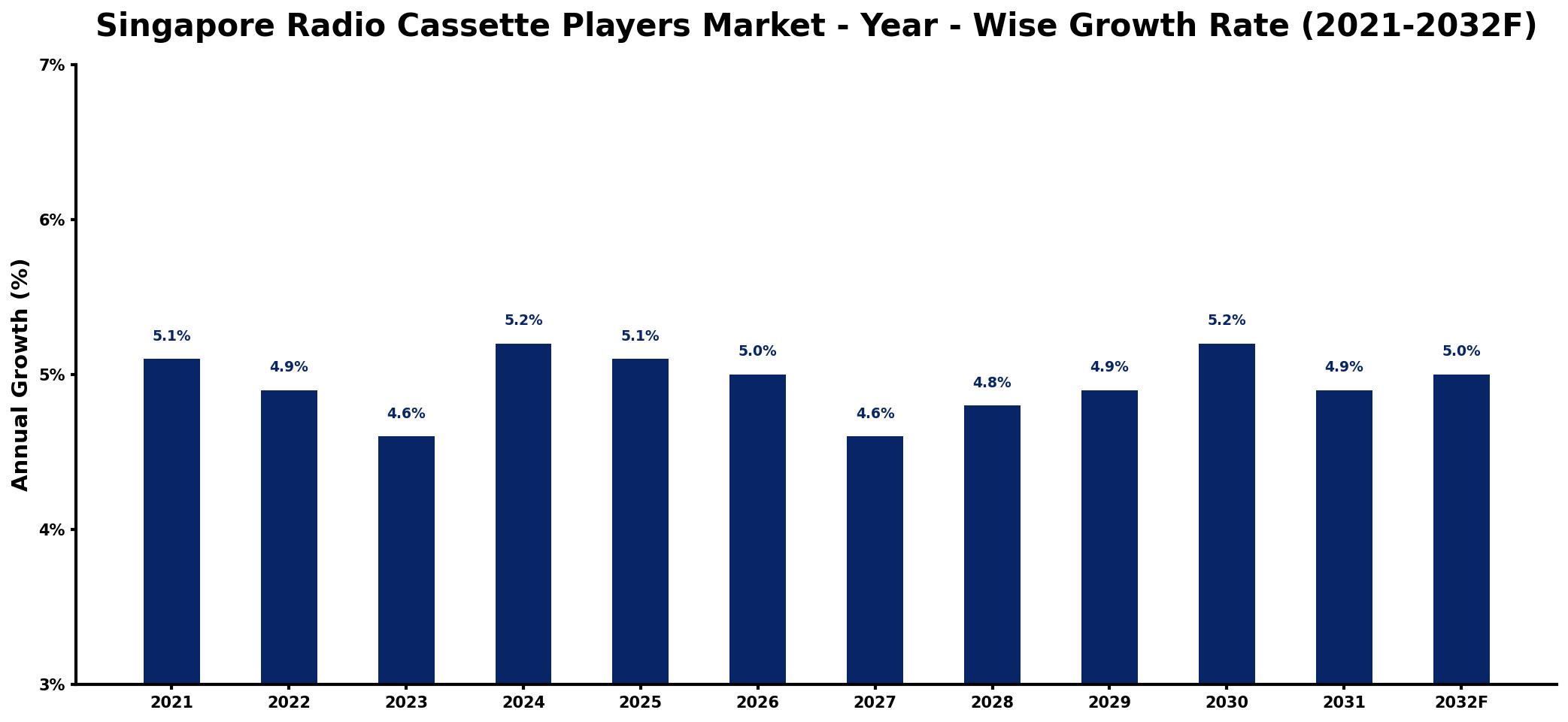
The table below presents the year‑wise growth rates along with the key drivers influencing the market
| Year | Growth Rate | Major Drivers |
| 2021 | 5.1% | Rising consumer interest in nostalgia |
| 2022 | 4.9% | Increased investment in retro technology |
| 2023 | 4.6% | Growing popularity of vintage aesthetics |
| 2024 | 5.2% | Expansion of audio streaming services |
| 2025 | 5.1% | Surge in collectible electronics market |
| 2026 | 5.0% | Emergence of DIY audio projects |
| 2027 | 4.6% | Heightened focus on sustainable products |
| 2028 | 4.8% | Boost in home entertainment systems |
| 2029 | 4.9% | Increased collaboration with artists |
| 2030 | 5.2% | Growth in local manufacturing initiatives |
| 2031 | 4.9% | Enhanced marketing strategies implemented |
| 2032 | 5.0% | Rise in experiential audio events |
Note: Market size estimations and growth projections presented in this report are based on 6Wresearch's proprietary forecasting methodology, utilizing the latest available industry data, government publications, and primary research inputs.
Singapore Radio Cassette Players Market Synopsis
Despite the overwhelming shift towards digital audio formats, Singapore's radio cassette players market enjoys a small but dedicated base of consumers seeking nostalgic and retro experiences. This demand is spurred by collectors and vintage enthusiasts who appreciate the aesthetic and tactile nature of cassette players, reflecting a unique blend of old-school charm and contemporary use.
Moreover, while the mainstream audio industry has largely moved on, certain retailers and brands have begun to integrate modern functionalities into these classic devices. This strategic move aims to attract younger consumers who might be intrigued by retro trends, thus positioning the market to remain viable despite technological advancements.
Singapore Radio Cassette Players Market Key Takeaways
- The market thrives on nostalgia, appealing to collectors and enthusiasts of vintage audio.
- Demand is primarily driven by a specific demographic that appreciates the unique experience of cassette playback.
- While overall growth may be modest, the market exhibits resilience through targeted marketing and product innovation.
- Consumer preferences are gradually shifting, with some integrating modern features into traditional cassette players.
- Market players must continuously adapt to maintain relevance in a rapidly digitizing audio landscape.
Evaluation of Restraints in Singapore Radio Cassette Players Market
The Singapore radio cassette players market faces several critical limitations that hinder its growth potential. The primary restraint is the accelerated obsolescence of cassette technology, which has been largely supplanted by advanced digital audio solutions and smartphones. As production of cassette players dwindles, sourcing spare parts for repairs becomes increasingly challenging, limiting the lifespan of existing products. This scenario requires manufacturers to pivot their strategies, focusing on the nostalgia factor while facing the inevitable reality of declining mainstream interest in cassette technology.
Singapore Radio Cassette Players Market Trends
Current trends in the Singapore radio cassette players market illustrate a fascination with vintage audio technologies. Retro-themed products are gaining traction, often showcased in boutique shops and online platforms, tapping into the nostalgic sentiments of older generations while attracting a younger demographic intrigued by retro aesthetics. Additionally, social media influencers and vintage culture movements are promoting cassette players as unique lifestyle choices, encouraging more consumers to explore these nostalgic devices. As a result, the interplay between modern technology and retro appeal is defining the market landscape.
Singapore Radio Cassette Players Market Opportunities
Opportunities within the Singapore radio cassette players market largely revolve around the innovation of hybrid devices that fuse classic cassette technology with modern digital functionalities. Companies can explore collaborations with contemporary artists and musicians to create limited-edition cassette releases, tapping into a market of audio enthusiasts eager for exclusive content. Furthermore, engaging in experiential marketing, such as hosting vintage-themed events or pop-up shops, can significantly enhance brand visibility and attract a wider audience intrigued by the retro audio experience.
Government Initiatives in the Singapore Radio Cassette Players Market
While direct government initiatives specifically targeting the radio cassette players market are minimal, the broader support for cultural preservation and the promotion of local businesses can indirectly benefit this niche market. Programs aimed at enhancing local arts and heritage may encourage the sale and promotion of vintage audio products. Furthermore, public spending focused on technology and innovation may also create avenues for retro products to find a modern audience, fostering interest in the audio landscape as a whole.
Future Insights of the Singapore Radio Cassette Players Market
Looking forward to the period between 2026 and 2032, the Singapore radio cassette players market is poised to navigate a path defined by niche demand and innovative marketing. As the world continues to embrace digital formats, those seeking vintage audio experiences will drive a sustained, albeit modest, growth trajectory. Brands that successfully blend nostalgia with modern technology stand to benefit significantly, tapping into a market that, while small, is passionate and engaged. It is likely that the narrative of retro will continue to evolve, ensuring the relevance of cassette players in Singapore's diverse audio culture.
Singapore Radio Cassette Players Market Latest Developments (2025 - 2026)
Recently, the radio cassette players market has seen a surge in the release of limited-edition products that cater to the retro trend, with some manufacturers introducing models that incorporate Bluetooth connectivity alongside traditional cassette playback. This innovative blend is appealing to a younger audience, who appreciate both nostalgic design and modern convenience. Additionally, a rise in vintage audio fairs and community events has provided platforms for retailers to showcase their offerings and engage directly with consumers, thus fostering a sense of community around cassette technology.
Singapore Radio Cassette Players Market - Key Attractiveness of the Report
- 10 Years of Market Numbers
- Historical Data Starting from 2022 to 2025
- Base Year: 2025
- Forecast Data until 2032
- Key Performance Indicators Impacting the Market
- Major Upcoming Developments and Projects
Key Highlights of the Report:
- Singapore Radio Cassette Players Market Outlook
- Market Size of Singapore Radio Cassette Players Market, 2025
- Forecast of Singapore Radio Cassette Players Market, 2032
- Historical Data and Forecast of Singapore Radio Cassette Players Revenues & Volume for the Period 2022-2032F
- Singapore Radio Cassette Players Market Trend Evolution
- Singapore Radio Cassette Players Market Drivers and Challenges
- Singapore Radio Cassette Players Price Trends
- Singapore Radio Cassette Players Porter's Five Forces
- Singapore Radio Cassette Players Industry Life Cycle
- Historical Data and Forecast of Singapore Radio Cassette Players Market Revenues & Volume By Products for the Period 2022-2032F
- Historical Data and Forecast of Singapore Radio Cassette Players Market Revenues & Volume By Magnetic Radio-cassette Player for the Period 2022-2032F
- Historical Data and Forecast of Singapore Radio Cassette Players Market Revenues & Volume By Cable Radio-cassette Player for the Period 2022-2032F
- Historical Data and Forecast of Singapore Radio Cassette Players Market Revenues & Volume By Applications for the Period 2022-2032F
- Historical Data and Forecast of Singapore Radio Cassette Players Market Revenues & Volume By Car Radio-cassette Player for the Period 2022-2032F
- Historical Data and Forecast of Singapore Radio Cassette Players Market Revenues & Volume By The Old Radio-cassette Player for the Period 2022-2032F
- Historical Data and Forecast of Singapore Radio Cassette Players Market Revenues & Volume By Portable Radio-cassette Player for the Period 2022-2032F
- Historical Data and Forecast of Singapore Radio Cassette Players Market Revenues & Volume By Electric Car Radio-cassette Player for the Period 2022-2032F
- Historical Data and Forecast of Singapore Radio Cassette Players Market Revenues & Volume By Walking Car Radio-cassette Player for the Period 2022-2032F
- Singapore Radio Cassette Players Import Export Trade Statistics
- Market Opportunity Assessment By Products
- Market Opportunity Assessment By Applications
- Singapore Radio Cassette Players Top Companies Market Share
- Singapore Radio Cassette Players Competitive Benchmarking By Technical and Operational Parameters
- Singapore Radio Cassette Players Company Profiles
- Singapore Radio Cassette Players Key Strategic Recommendations






































