Singapore Radio Remote Control Equipment Market Size, Share & Growth Rate
The Singapore Radio Remote Control Equipment Market was estimated at USD 453 Million in 2025 and is projected to reach USD 615 Million by 2032, growing at a CAGR of 4.5% from 2026 to 2032. This growth is primarily driven by the increasing adoption of automation across various sectors, including construction and logistics. The demand for sophisticated remote control systems is further intensified by the ongoing efforts to enhance safety and efficiency in machinery operations, ensuring a robust trajectory for market expansion.
Singapore Radio Remote Control Equipment Market Year-wise Growth Rate and Key Drivers
This graph highlights how the Singapore Radio Remote Control Equipment Market has steadily grown over the years, supported by major growth factors.
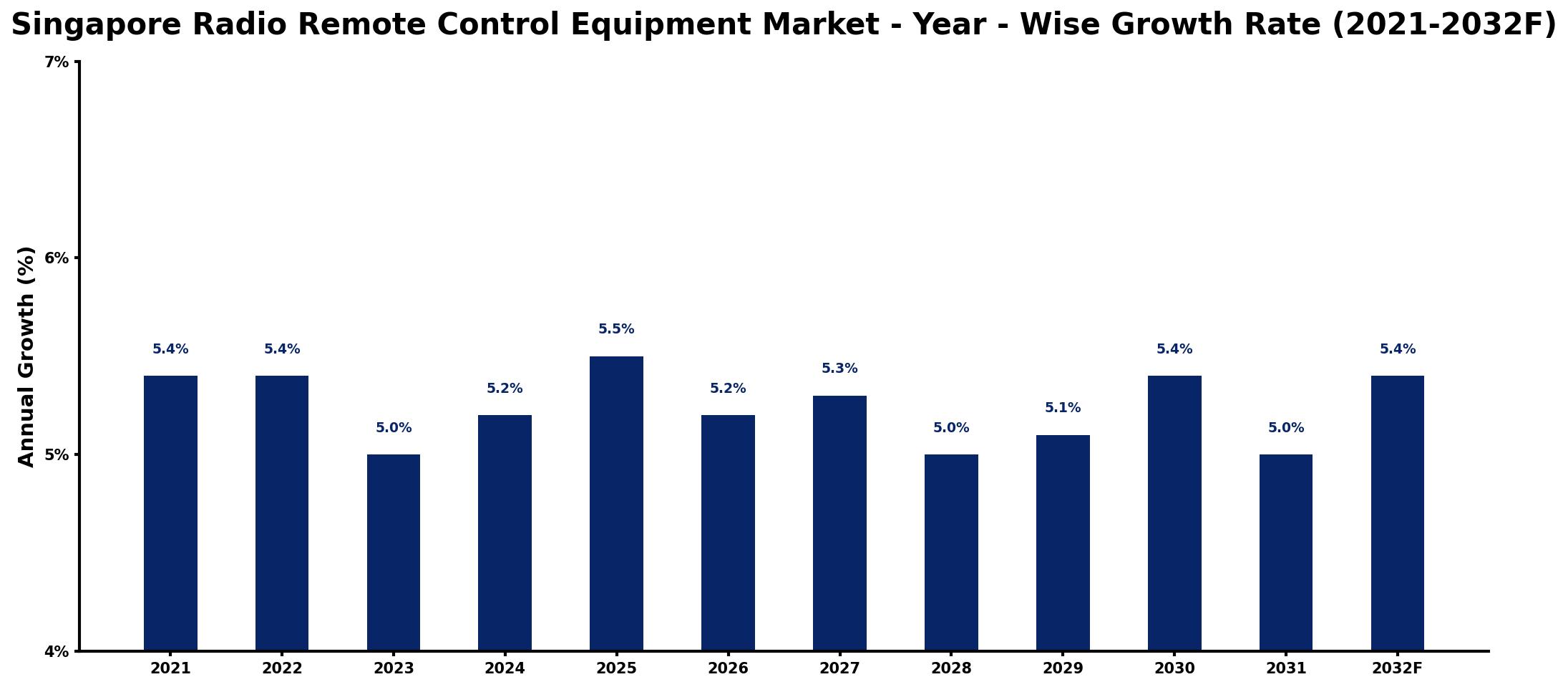
The table below presents the year‑wise growth rates along with the key drivers influencing the market
| Year | Growth Rate | Major Drivers |
| 2021 | 5.4% | Increased demand for automation solutions |
| 2022 | 5.4% | Rising investments in smart technologies |
| 2023 | 5.0% | Growth in home entertainment systems |
| 2024 | 5.2% | Expansion of industrial automation sectors |
| 2025 | 5.5% | Surge in consumer electronics adoption |
| 2026 | 5.2% | Development of advanced connectivity standards |
| 2027 | 5.3% | Increased focus on energy efficiency |
| 2028 | 5.0% | expanding industrial usage applications |
| 2029 | 5.1% | stronger distribution network expansion |
| 2030 | 5.4% | growing commercial sector adoption |
| 2031 | 5.0% | Increased deployment of smart devices |
| 2032 | 5.4% | rising end-use demand growth |
Note: Market size estimations and growth projections presented in this report are based on 6Wresearch's proprietary forecasting methodology, utilizing the latest available industry data, government publications, and primary research inputs.
Singapore Radio Remote Control Equipment Market Synopsis
In Singapore, the application of radio remote control equipment is becoming increasingly vital, particularly in industries where heavy machinery is prevalent. This technology not only streamlines operations but also significantly reduces the risk associated with manual control of hazardous equipment. As automation takes center stage, the need for reliable and advanced control systems is more pronounced than ever.
The market's dynamics are shaped by the growing emphasis on workplace safety and the integration of smart technologies. Features such as wireless connectivity and user-friendly interfaces are enhancing the functionality of these systems, catering to a broad range of operational needs. Consequently, businesses are prioritizing investments in these innovative solutions to optimize their processes.
Singapore Radio Remote Control Equipment Market Key Takeaways
- The market is characterized by increasing automation trends across diverse industries, driving demand for radio remote control systems.
- Enhanced safety protocols in operating heavy machinery are a primary motivation for the adoption of these technologies.
- Wireless connectivity and advanced features are leading to innovations in remote control systems.
- Key players in the market are focusing on R&D to mitigate security and interference challenges.
- Increased adoption of remote control technologies was noted in logistics during the COVID-19 pandemic, impacting market trends positively.
Evaluation of Restraints in Singapore Radio Remote Control Equipment Market
Despite the promising growth, the Singapore Radio Remote Control Equipment Market faces several significant challenges. Security concerns surrounding wireless communication can impede the confidence of potential users, particularly in high-stakes industries such as manufacturing and construction. Additionally, interference issues can compromise the reliability of remote control systems, which is critical for their intended applications. The market's specialized nature means that new entrants encounter barriers to entry, necessitating substantial investment in technology and innovation to compete effectively. This level of competition drives the need for continual advancement in product offerings, which may strain resources for some companies.
Singapore Radio Remote Control Equipment Market Trends
Several key trends are shaping the future of the Singapore Radio Remote Control Equipment Market. The integration of IoT capabilities into remote control systems is paving the way for smarter, more efficient operations. Additionally, the trend towards automation in construction and logistics is prompting businesses to invest in equipment that enhances operational efficiency. Moreover, there is a noticeable shift towards user-centric designs that prioritize ease of use and adaptability, making these systems accessible to a wider range of operators.
Singapore Radio Remote Control Equipment Market Opportunities
The market presents numerous growth opportunities, particularly in sectors that are still transitioning to automation. Industries such as agriculture and waste management are ripe for investment in radio remote control technologies. Furthermore, the ongoing push for smart city initiatives in Singapore can lead to increased demand for advanced remote control systems to manage urban logistics more effectively. Companies that can innovate and provide solutions tailored to these emerging needs stand to benefit significantly in the coming years.
Government Initiatives in the Singapore Radio Remote Control Equipment Market
The Singapore government has launched several initiatives aimed at promoting technological advancement across various industries. These include funding programs for research and development, public spending on smart infrastructure, and incentives for companies adopting automation technologies. Such policies create a conducive environment for the growth of the radio remote control equipment market, encouraging businesses to enhance operational efficiencies through technological investment.
Future Insights of the Singapore Radio Remote Control Equipment Market
Looking ahead to 2026-2032, the Singapore Radio Remote Control Equipment Market is poised for robust growth. The acceleration of automation across industries will continue to drive demand for advanced control systems, particularly as companies seek to enhance safety and efficiency. Furthermore, the ongoing development of smart technologies is expected to revolutionize how these systems are utilized, creating new applications and expanding market reach. This forward momentum, coupled with supportive government policies, positions the market for sustained expansion.
Singapore Radio Remote Control Equipment Market Latest Developments (2025 - 2026)
Recent developments in the Singapore Radio Remote Control Equipment Market indicate a strong trend towards technological innovation. Companies are increasingly focusing on enhancing wireless communication capabilities to address security concerns. Moreover, there has been a noticeable rise in partnerships and collaborations aimed at integrating IoT features into existing systems. These initiatives reflect the sector's commitment to adapting to evolving market demands and improving the overall user experience.
Singapore Radio Remote Control Equipment Market - Key Attractiveness of the Report
- 10 Years of Market Numbers
- Historical Data Starting from 2022 to 2025
- Base Year: 2025
- Forecast Data until 2032
- Key Performance Indicators Impacting the Market
- Major Upcoming Developments and Projects
Key Highlights of the Report:
- Singapore Radio Remote Control Equipment Market Outlook
- Market Size of Singapore Radio Remote Control Equipment Market, 2025
- Forecast of Singapore Radio Remote Control Equipment Market, 2032
- Historical Data and Forecast of Singapore Radio Remote Control Equipment Revenues & Volume for the Period 2022-2032F
- Singapore Radio Remote Control Equipment Market Trend Evolution
- Singapore Radio Remote Control Equipment Market Drivers and Challenges
- Singapore Radio Remote Control Equipment Price Trends
- Singapore Radio Remote Control Equipment Porter's Five Forces
- Singapore Radio Remote Control Equipment Industry Life Cycle
- Historical Data and Forecast of Singapore Radio Remote Control Equipment Market Revenues & Volume By Type for the Period 2022-2032F
- Historical Data and Forecast of Singapore Radio Remote Control Equipment Market Revenues & Volume By Pushbutton for the Period 2022-2032F
- Historical Data and Forecast of Singapore Radio Remote Control Equipment Market Revenues & Volume By Joystick for the Period 2022-2032F
- Historical Data and Forecast of Singapore Radio Remote Control Equipment Market Revenues & Volume By Application for the Period 2022-2032F
- Historical Data and Forecast of Singapore Radio Remote Control Equipment Market Revenues & Volume By Industry & Logistics for the Period 2022-2032F
- Historical Data and Forecast of Singapore Radio Remote Control Equipment Market Revenues & Volume By Construction Crane for the Period 2022-2032F
- Historical Data and Forecast of Singapore Radio Remote Control Equipment Market Revenues & Volume By Mobile Hydraulics for the Period 2022-2032F
- Historical Data and Forecast of Singapore Radio Remote Control Equipment Market Revenues & Volume By Forestry for the Period 2022-2032F
- Historical Data and Forecast of Singapore Radio Remote Control Equipment Market Revenues & Volume By Mining for the Period 2022-2032F
- Historical Data and Forecast of Singapore Radio Remote Control Equipment Market Revenues & Volume By Others for the Period 2022-2032F
- Singapore Radio Remote Control Equipment Import Export Trade Statistics
- Market Opportunity Assessment By Type
- Market Opportunity Assessment By Application
- Singapore Radio Remote Control Equipment Top Companies Market Share
- Singapore Radio Remote Control Equipment Competitive Benchmarking By Technical and Operational Parameters
- Singapore Radio Remote Control Equipment Company Profiles
- Singapore Radio Remote Control Equipment Key Strategic Recommendations






































