Singapore Radioactive Waste Management Market Size, Share & Growth Rate
The Singapore Radioactive Waste Management Market was estimated at USD 383 Million in 2025 and is projected to reach USD 526 Million by 2032, growing at a CAGR of 4.6% from 2026 to 2032. This growth trajectory is primarily driven by an increasing recognition of the need for stringent regulatory compliance and the adoption of advanced waste containment technologies. As Singapore continues to develop its nuclear research capabilities, the demand for effective radioactive waste management solutions is expected to rise, further solidifying the countrys position as a regional player in this critical sector.
Singapore Radioactive Waste Management Market Year-wise Growth Rate and Key Drivers
This graph highlights how the Singapore Radioactive Waste Management Market has steadily grown over the years, supported by major growth factors.
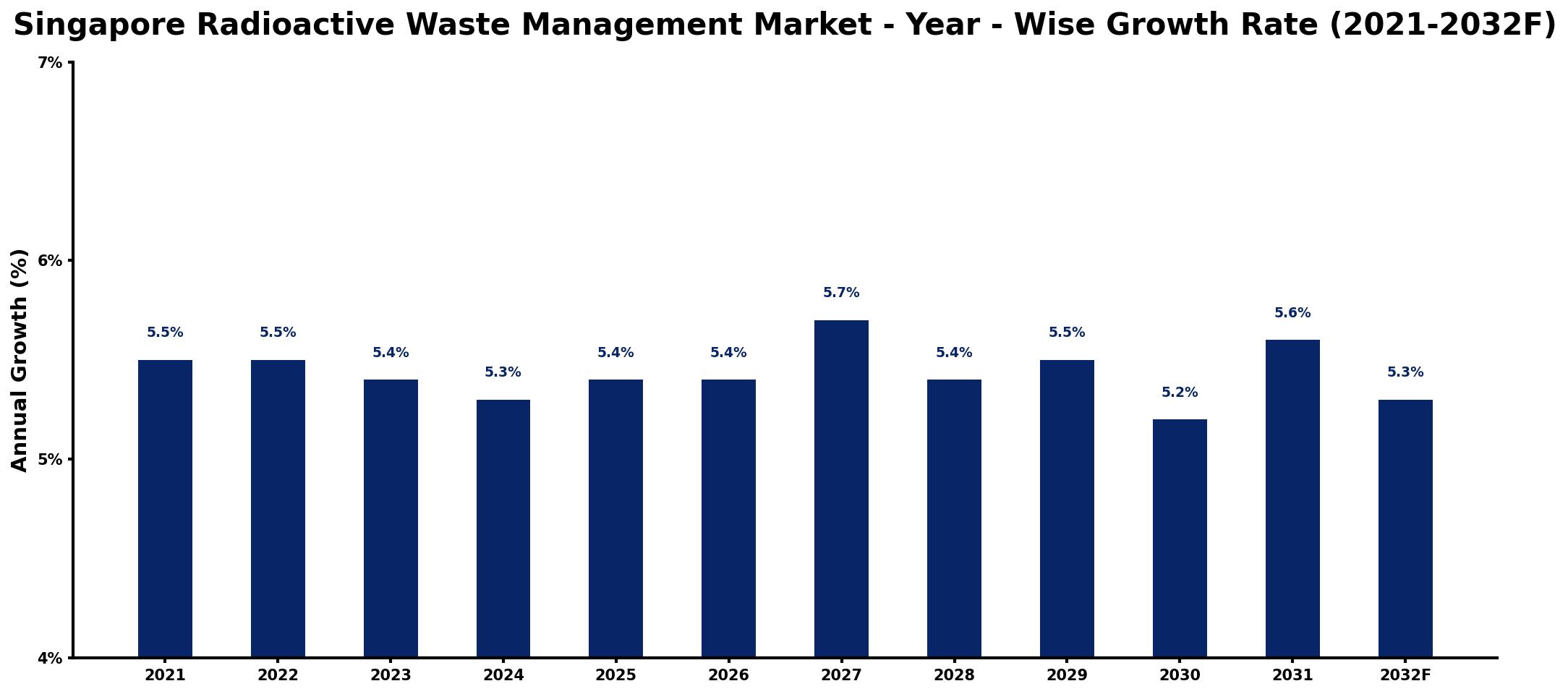
The table below presents the year‑wise growth rates along with the key drivers influencing the market
| Year | Growth Rate | Major Drivers |
| 2021 | 5.5% | Increased regulatory compliance requirements |
| 2022 | 5.5% | Growing industrial sector investments |
| 2023 | 5.4% | Rising public safety concerns |
| 2024 | 5.3% | Expansion of energy production facilities |
| 2025 | 5.4% | Enhanced technology adoption trends |
| 2026 | 5.4% | Increased environmental sustainability focus |
| 2027 | 5.7% | Growing international collaboration efforts |
| 2028 | 5.4% | Rising demand for disposal solutions |
| 2029 | 5.5% | enhanced product quality standards |
| 2030 | 5.2% | Shifts in global policy frameworks |
| 2031 | 5.6% | Emergence of innovative treatment methods |
| 2032 | 5.3% | rising procurement volume requirements |
Note: Market size estimations and growth projections presented in this report are based on 6Wresearch's proprietary forecasting methodology, utilizing the latest available industry data, government publications, and primary research inputs.
Singapore Radioactive Waste Management Market Synopsis
The strongest force shaping the Singapore radioactive waste management market is the stringent regulatory framework that governs the disposal and management of radioactive materials. Regulatory compliance is essential not only for safeguarding public health but also for ensuring environmental protection, thus driving demand for reliable waste management solutions.
In addition, Singapore's growing expertise in nuclear technology and waste management practices positions it favorably within the market. As the nation expands its research capabilities, the associated increase in radioactive waste generation underscores the necessity for effective management strategies tailored to local needs.
Singapore Radioactive Waste Management Market Key Takeaways
- The market is projected to grow steadily, reflecting a commitment to safety and environmental standards.
- Technological advancements in waste containment are pivotal for compliance and market expansion.
- Regulatory frameworks are continuously evolving, emphasizing the need for adaptable management solutions.
- Public health and safety remain central to market dynamics, influencing operational practices and investment.
- International collaboration could enhance Singapore's capabilities in radioactive waste management.
Evaluation of Restraints in Singapore Radioactive Waste Management Market
The Singapore radioactive waste management market faces significant restraints that could impede its growth. The foremost challenge is the limited infrastructure dedicated to the safe disposal of radioactive materials, which stems from the absence of nuclear power plants within the country. This constraint necessitates a reliance on multinational players and their expertise, which may not always align with local regulatory requirements or operational standards. Furthermore, public perception of radioactive waste management practices remains a barrier, with community concerns regarding safety and environmental impacts potentially influencing policy decisions and investment flows.
Singapore Radioactive Waste Management Market Trends
Current trends in the Singapore radioactive waste management market point towards an increasing integration of smart technologies and data analytics. Companies are investing in advanced monitoring systems and real-time data processing to enhance the safety and efficiency of waste management operations. Additionally, there is a rising emphasis on sustainability and eco-friendly practices, leading to innovative disposal methods that minimize environmental footprints. These trends are indicative of a market that is evolving in response to both regulatory pressures and technological advancements.
Singapore Radioactive Waste Management Market Opportunities
There are numerous growth opportunities within the Singapore radioactive waste management market, particularly in developing enhanced waste treatment technologies. As Singapore strengthens its nuclear research capabilities, there is an increasing demand for specialized waste management services tailored to emerging nuclear activities. Partnerships with global players could facilitate knowledge transfer and technology adoption, opening new avenues for market expansion. Furthermore, government initiatives aimed at enhancing regulatory compliance and promoting safety standards present additional opportunities for investment and innovation in waste management solutions.
Government Initiatives in the Singapore Radioactive Waste Management Market
The Singapore government has implemented various policies aimed at enhancing radioactive waste management practices. Emphasizing regulatory compliance, the government invests in public education and outreach initiatives to raise awareness about the importance of safe radioactive waste disposal. Moreover, government agencies are actively collaborating with industry stakeholders to develop comprehensive strategies that encompass technology advancements and sustainable waste management practices. Such initiatives aim to ensure that Singapore meets both international safety standards and local environmental commitments.
Future Insights of the Singapore Radioactive Waste Management Market
Looking ahead to 2026-2032, the Singapore radioactive waste management market is expected to experience significant advancements driven by technological innovations and a stronger regulatory landscape. As the nation continues to enhance its nuclear research initiatives, the demand for safe and efficient waste management solutions will only intensify. In this evolving environment, companies will need to adopt agile strategies that not only comply with regulatory requirements but also address public health concerns and environmental sustainability.
Singapore Radioactive Waste Management Market Latest Developments (2025 - 2026)
Recent developments in the Singapore radioactive waste management market reflect an ongoing adaptation to changing circumstances. Companies are enhancing their waste management technologies and safety protocols to align with evolving regulatory frameworks. The push for sustainability is driving innovation, with an emphasis on reducing the environmental impacts of waste disposal. Additionally, international collaborations are gaining traction as firms seek to leverage global expertise and best practices in radioactive waste management.
Singapore Radioactive Waste Management Market - Key Attractiveness of the Report
- 10 Years of Market Numbers
- Historical Data Starting from 2022 to 2025
- Base Year: 2025
- Forecast Data until 2032
- Key Performance Indicators Impacting the Market
- Major Upcoming Developments and Projects
Key Highlights of the Report:
- Singapore Radioactive Waste Management Market Outlook
- Market Size of Singapore Radioactive Waste Management Market, 2025
- Forecast of Singapore Radioactive Waste Management Market, 2032
- Historical Data and Forecast of Singapore Radioactive Waste Management Revenues & Volume for the Period 2022-2032F
- Singapore Radioactive Waste Management Market Trend Evolution
- Singapore Radioactive Waste Management Market Drivers and Challenges
- Singapore Radioactive Waste Management Price Trends
- Singapore Radioactive Waste Management Porter's Five Forces
- Singapore Radioactive Waste Management Industry Life Cycle
- Historical Data and Forecast of Singapore Radioactive Waste Management Market Revenues & Volume By Type for the Period 2022-2032F
- Historical Data and Forecast of Singapore Radioactive Waste Management Market Revenues & Volume By Exempt Waste and Very Low-Level Waste(VLLW) for the Period 2022-2032F
- Historical Data and Forecast of Singapore Radioactive Waste Management Market Revenues & Volume By Low-Level Waste(LLW) for the Period 2022-2032F
- Historical Data and Forecast of Singapore Radioactive Waste Management Market Revenues & Volume By Intermediate-Level Waste(ILW) for the Period 2022-2032F
- Historical Data and Forecast of Singapore Radioactive Waste Management Market Revenues & Volume By High-Level Waste(HLW) for the Period 2022-2032F
- Historical Data and Forecast of Singapore Radioactive Waste Management Market Revenues & Volume By Application for the Period 2022-2032F
- Historical Data and Forecast of Singapore Radioactive Waste Management Market Revenues & Volume By Industrial for the Period 2022-2032F
- Historical Data and Forecast of Singapore Radioactive Waste Management Market Revenues & Volume By Utility for the Period 2022-2032F
- Singapore Radioactive Waste Management Import Export Trade Statistics
- Market Opportunity Assessment By Type
- Market Opportunity Assessment By Application
- Singapore Radioactive Waste Management Top Companies Market Share
- Singapore Radioactive Waste Management Competitive Benchmarking By Technical and Operational Parameters
- Singapore Radioactive Waste Management Company Profiles
- Singapore Radioactive Waste Management Key Strategic Recommendations






































