Singapore Remote Control Products Hobby Market Size, Share & Growth Rate
The Singapore Remote Control Products Hobby Market was estimated at USD 291 Million in 2025 and is projected to reach USD 412 Million by 2032, growing at a CAGR of 5.1% from 2026 to 2032. This growth is primarily driven by an increasing fascination with technology among hobbyists, who are continually searching for advanced and innovative remote-controlled devices. Moreover, the surge of online communities that connect enthusiasts is playing a crucial role in expanding interest and participation in remote control hobbies throughout Singapore.
Singapore Remote Control Products Hobby Market Year-wise Growth Rate and Key Drivers
This graph highlights how the Singapore Remote Control Products Hobby Market has steadily grown over the years, supported by major growth factors.
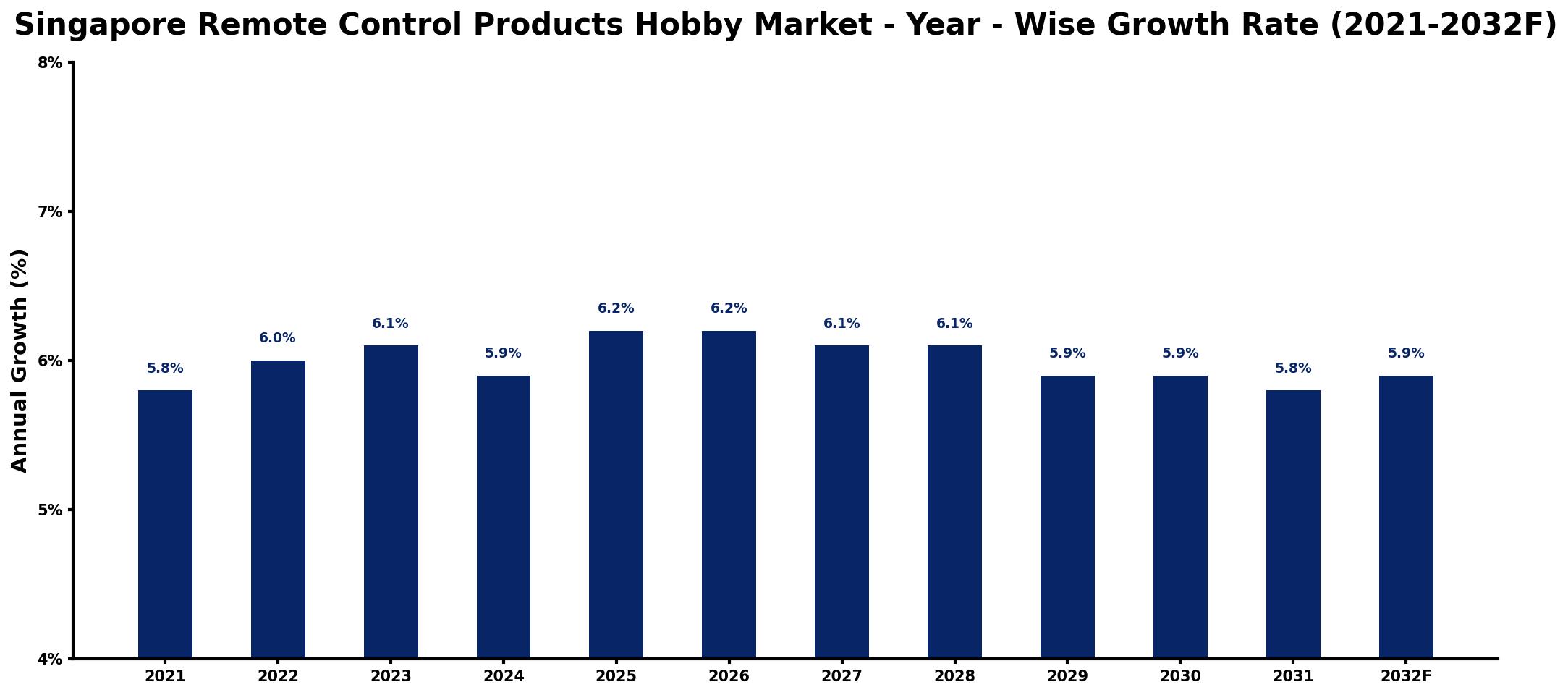
The table below presents the year‑wise growth rates along with the key drivers influencing the market
| Year | Growth Rate | Major Drivers |
| 2021 | 5.8% | Increased interest in outdoor activities |
| 2022 | 6.0% | Rise in technological advancements |
| 2023 | 6.1% | Growth in online communities |
| 2024 | 5.9% | Expansion of retail distribution channels |
| 2025 | 6.2% | Increased disposable income levels |
| 2026 | 6.2% | Surge in youth engagement initiatives |
| 2027 | 6.1% | expanding industrial usage applications |
| 2028 | 6.1% | rising infrastructure development spending |
| 2029 | 5.9% | Increased social media influence |
| 2030 | 5.9% | improved processing technologies adoption |
| 2031 | 5.8% | Innovations in recreational technologies |
| 2032 | 5.9% | improved raw material availability |
Note: Market size estimations and growth projections presented in this report are based on 6Wresearch's proprietary forecasting methodology, utilizing the latest available industry data, government publications, and primary research inputs.
Singapore Remote Control Products Hobby Market Synopsis
The demand for high-performance remote control products, particularly drones and model vehicles, has seen a notable uptick in Singapore. As consumers increasingly prioritize quality and performance, the market has witnessed an influx of innovative designs and functionalities that appeal to both seasoned hobbyists and newcomers alike.
In Singapore, the integration of social media and online forums has revitalized interest in remote control products. These platforms enable hobbyists to share knowledge, showcase their creations, and foster a collaborative environment, making the remote control hobby scene more vibrant than ever.
Singapore Remote Control Products Hobby Market Key Takeaways
- The market is driven by technological advancements and increased consumer interest in innovative remote control products.
- Community engagement through online platforms is enhancing the popularity of remote control hobbies in Singapore.
- Competition from alternative forms of entertainment poses challenges, particularly for traditional remote control activities.
- COVID-19 initially disrupted supply chains but ultimately increased demand as people sought home-based hobbies.
- Major brands are actively innovating to meet evolving consumer preferences and maintain market relevance.
Evaluation of Restraints in Singapore Remote Control Products Hobby Market
Despite its growth, the Singapore Remote Control Products Hobby Market faces significant restraints. The allure of digital entertainment options, such as video games and mobile applications, has diverted attention from traditional remote control hobbies. This shift is particularly evident among younger demographics, making it crucial for the industry to appeal to this audience. Additionally, logistical challenges like import restrictions on certain high-tech devices pose hurdles, limiting the availability of sought-after products. Such challenges require strategic adjustments from market players to maintain competitive relevance.
Singapore Remote Control Products Hobby Market Trends
Several trends are shaping the Singapore Remote Control Products Hobby Market, notably the rise of drone racing and aerial photography as competitive pastimes. These activities demand high-performance equipment, creating niche segments within the broader market. Furthermore, the trend towards sustainability is influencing consumer preferences, with an increased interest in eco-friendly materials for remote control products. The blending of virtual reality experiences with remote control products is also gaining traction, reflecting a broader trend towards immersive recreational activities.
Singapore Remote Control Products Hobby Market Opportunities
There are significant opportunities for growth within the Singapore Remote Control Products Hobby Market, especially as technological innovations continue to evolve. Businesses can tap into the burgeoning interest in educational and STEM-focused remote control kits, appealing to parents seeking engaging activities for their children. Additionally, developing partnerships with local events and competitions can drive community engagement and market presence, leveraging the enthusiasm of hobbyists to create more immersive experiences. The emerging trend of integrating augmented reality with remote control devices presents further potential for innovation and investment.
Government Initiatives in the Singapore Remote Control Products Hobby Market
The Singaporean government has shown a keen interest in promoting innovation and technology, fostering an environment conducive to the growth of the remote control products hobby market. Public spending on technology-driven initiatives, alongside support for local manufacturing and the arts, provides a beneficial backdrop for hobby-related enterprises. Moreover, regulations surrounding the use of drones are being refined to ensure safety while facilitating recreational use, which can encourage more hobbyists to engage with these products.
Future Insights of the Singapore Remote Control Products Hobby Market
Looking ahead, the Singapore Remote Control Products Hobby Market is poised for continued expansion between 2026 and 2032. As technological advancements yield more sophisticated and user-friendly products, greater accessibility will likely draw in a broader audience. The key to sustained growth will hinge on adapting to shifting consumer preferences while leveraging community engagement and educational opportunities. Innovations that merge traditional hobbies with cutting-edge technology are expected to be a significant driver of future market dynamics.
Singapore Remote Control Products Hobby Market Latest Developments (2025 - 2026)
The market has recently seen a surge in new product launches, with several companies introducing cutting-edge drones equipped with advanced imaging capabilities. There has also been a notable rise in organized events and competitions that bring together enthusiasts, fostering a sense of community and stimulating interest. Moreover, online platforms have continued to flourish, serving as critical venues for knowledge exchange and product showcases. These developments indicate a vibrant and evolving market landscape.
Singapore Remote Control Products Hobby Market - Key Attractiveness of the Report
- 10 Years of Market Numbers
- Historical Data Starting from 2022 to 2025
- Base Year: 2025
- Forecast Data until 2032
- Key Performance Indicators Impacting the Market
- Major Upcoming Developments and Projects
Key Highlights of the Report:
- Singapore Remote Control Products Hobby Market Outlook
- Market Size of Singapore Remote Control Products Hobby Market, 2025
- Forecast of Singapore Remote Control Products Hobby Market, 2032
- Historical Data and Forecast of Singapore Remote Control Products Hobby Revenues & Volume for the Period 2022-2032F
- Singapore Remote Control Products Hobby Market Trend Evolution
- Singapore Remote Control Products Hobby Market Drivers and Challenges
- Singapore Remote Control Products Hobby Price Trends
- Singapore Remote Control Products Hobby Porter's Five Forces
- Singapore Remote Control Products Hobby Industry Life Cycle
- Historical Data and Forecast of Singapore Remote Control Products Hobby Market Revenues & Volume By Product Type for the Period 2022-2032F
- Historical Data and Forecast of Singapore Remote Control Products Hobby Market Revenues & Volume By Drones for the Period 2022-2032F
- Historical Data and Forecast of Singapore Remote Control Products Hobby Market Revenues & Volume By Airplanes for the Period 2022-2032F
- Historical Data and Forecast of Singapore Remote Control Products Hobby Market Revenues & Volume By Cars for the Period 2022-2032F
- Historical Data and Forecast of Singapore Remote Control Products Hobby Market Revenues & Volume By Trains for the Period 2022-2032F
- Historical Data and Forecast of Singapore Remote Control Products Hobby Market Revenues & Volume By Others for the Period 2022-2032F
- Historical Data and Forecast of Singapore Remote Control Products Hobby Market Revenues & Volume By Age Group Type for the Period 2022-2032F
- Historical Data and Forecast of Singapore Remote Control Products Hobby Market Revenues & Volume By Below 18 Years for the Period 2022-2032F
- Historical Data and Forecast of Singapore Remote Control Products Hobby Market Revenues & Volume By 18-35 Years for the Period 2022-2032F
- Historical Data and Forecast of Singapore Remote Control Products Hobby Market Revenues & Volume By 36-60 Years for the Period 2022-2032F
- Historical Data and Forecast of Singapore Remote Control Products Hobby Market Revenues & Volume By More Than 60 Years for the Period 2022-2032F
- Historical Data and Forecast of Singapore Remote Control Products Hobby Market Revenues & Volume By Distribution Channel Type for the Period 2022-2032F
- Historical Data and Forecast of Singapore Remote Control Products Hobby Market Revenues & Volume By Offline for the Period 2022-2032F
- Historical Data and Forecast of Singapore Remote Control Products Hobby Market Revenues & Volume By Online for the Period 2022-2032F
- Historical Data and Forecast of Singapore Remote Control Products Hobby Market Revenues & Volume By End Users for the Period 2022-2032F
- Historical Data and Forecast of Singapore Remote Control Products Hobby Market Revenues & Volume By Entertainment for the Period 2022-2032F
- Historical Data and Forecast of Singapore Remote Control Products Hobby Market Revenues & Volume By Professional Competition for the Period 2022-2032F
- Historical Data and Forecast of Singapore Remote Control Products Hobby Market Revenues & Volume By Others for the Period 2022-2032F
- Singapore Remote Control Products Hobby Import Export Trade Statistics
- Market Opportunity Assessment By Product Type
- Market Opportunity Assessment By Age Group Type
- Market Opportunity Assessment By Distribution Channel Type
- Market Opportunity Assessment By End Users
- Singapore Remote Control Products Hobby Top Companies Market Share
- Singapore Remote Control Products Hobby Competitive Benchmarking By Technical and Operational Parameters
- Singapore Remote Control Products Hobby Company Profiles
- Singapore Remote Control Products Hobby Key Strategic Recommendations






































